Home Blog Page 921

Mexican racquetball champ wins another world title

0
Racquetball champion Paola Longoria.
Racquetball champion Paola Longoria. Conade

Paola Longoria of Mexico has done it again. The 33-year-old native of San Luis Potosí won her fifth world racquetball title this week, solidifying her ranking as the No. 1 female player on the planet.

Longoria came out on top in the World Racquetball Championships, which in past years have been held in an array of countries, including South Korea, Colombia and Ireland, but this year happened to be in her hometown of San Luis Potosí.

In the women’s singles title match, she posted a tidy 12-10, 11-6, 11-7 win over Gabriela Martínez of Guatemala, the world’s No. 2 player.

Longoria, who has been a top-echelon player since winning her first Pan American Championship in 2006, has now won International Racquetball Federation world singles titles in 2012, 2014, 2016, 2021 and 2022. No one has more singles titles than her; two Americans are next in line with three apiece.

Paola Longoria celebrates her fifth International Racquetball Federation world title in her home state of San Luis Potosí this week.
Paola Longoria celebrates her fifth International Racquetball Federation world title in her home state of San Luis Potosí this week. IRF

And that’s not all. She and Samantha Salas also won the women’s doubles world title, beating the Argentinian duo of Valeria Centellas and Natalia Mendez in a thrilling final. The match went a full five sets, with Longoria and Salas prevailing 11-6, 15-17, 11-9, 9-11, 12-10.

Longoria and Salas, a 35-year-old native of León, Guanajuato, entered the tournament as the No. 1 women’s doubles team in the world and have now won five straight IRF world doubles titles.

The tournament was held at the Loma Sports Center in San Luis Potosí, and much of the action was streamed live online. Archived versions of this year’s women’s singles final and women’s doubles final are available on the IRF’s YouTube channel, and the announcing is in English.

Longoria entered this week’s tournament fresh off a gold medal in mid-July at the 2022 World Games, a competition for sports that are not included in the Olympics. In that final in Birmingham, Alabama, as well as in the final this week, her victim was Martínez — two satisfying results since it was the Guatemalan who, in 2018, ended Longoria’s run of three straight world titles.

Fourteen years ago, Longoria became the first Mexican woman to reach No. 1 in the world professional rankings. According to Wikipedia, she uses a “semi-western grip,” a style that not only is “rarely used in racquetball,” but she is “the only active professional player to employ it.”

According to the newspaper El Universal, Longoria, Salas and other Mexican players who competed this week did not receive any financial support from the Mexican Racquetball Federation or Conade (the National Commission for Physical Culture and Sport). A few weeks ago, some Mexican players took up a collection to help defray their costs.

“It is sad to see that racquetball is not supported,” Longoria said. “It is a sport that has given great satisfaction to Mexico.” She acknowledged that it’s not an Olympic sport, but added that it’s a sport at which Mexico is quite good. “We are the sport that won all the medals in the Pan American Games,” she said.

For their part, Conade pinned the lack of funding on some erroneous expense reports submitted by the players and the 2021 dissolution of Mexico’s High Performance Sports Fund (Fodepar).

Longoria also criticized the management of Ana Gabriela Guevara, general director of Conade and a former world-class runner in the 400 and 800 meters. “As an athlete I admire her, but she lived the reality, so it surprises me that she does not understand” what we are going through.

“I am an athlete who does not like gossip or drama … but it is time to raise my voice,” Longoria concluded.

With reports from Reforma and El Universal
New plan for Coahuila miners’ rescue could take at least 11 months

0
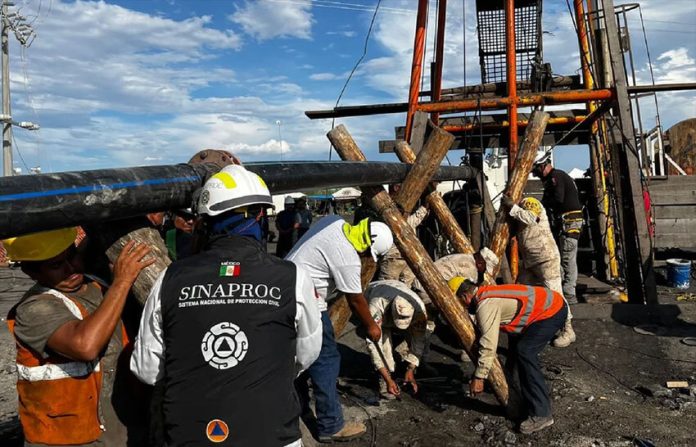
Rescue workers outside El Pinabete mine, propping up a water pipe with logs, while a government Sinaproc official looks on.
Rescues initially hoped to reach the trapped miners after pumping water out of the flooded mine, but water continues to enter the mine faster than it is being pumped out. Twitter @CNPC_MX

The families of 10 miners who have been trapped in a Coahuila coal mine since August 3 have rejected a rescue plan that could take 11 months or even longer to execute.

Relatives said Thursday that Civil Protection chief Laura Velázquez informed them that the best option is to build a slanted tunnel into the El Pinabete mine, located in the municipality of Sabinas.

The project, which involves the excavation of an open pit where the tunnel would begin, is slated to take between six and 11 months to complete.

“We don’t want the [open] pit option, we want them to look at other options,” Juani Tijerina, sister of one of the trapped miners, told the newspaper El Universal.

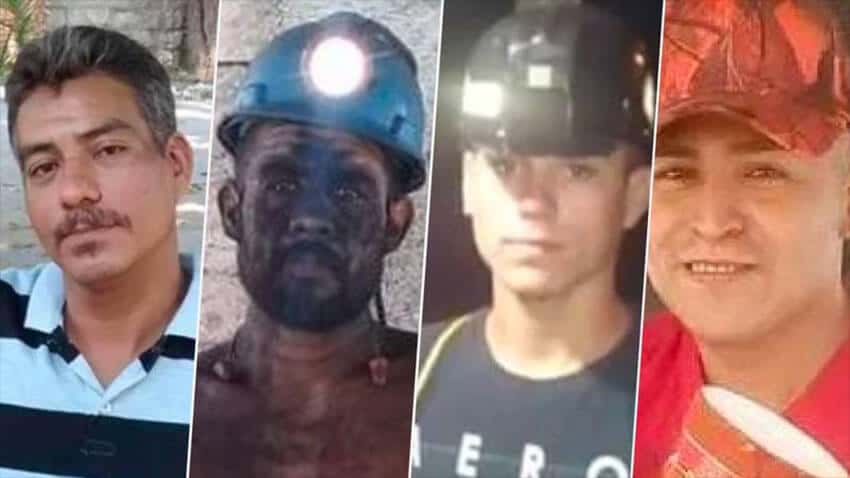
Mario Alberto Cabriales Uresti, José Rogelio Moreno Leija, José Rogelio Moreno Morales and Hugo Tijerina Amaya (from left to right) are four of the miners who were trapped in the August 3 accident.
Mario Alberto Cabriales Uresti, José Rogelio Moreno Leija, José Rogelio Moreno Morales and Hugo Tijerina Amaya (from left to right) are four of the miners who were trapped in the August 3 accident. Social media/courtesy

She said that the trapped miners’ families informed the authorities that they don’t support the proposed rescue plan because they want their loved ones to be returned to them without delay. However, Tijerina said they were told that there is no other option to rescue the miners, or – as is more likely – recover their bodies.

Sergio Martínez Valdez, brother of a trapped miner, also told El Universal that the families rejected the proposed rescue plan. He called for foreign mining experts to travel to the mine to offer their opinion.

The federal government asked a United States company and a German firm for advice about how to go about rescuing the miners, but they concluded that Mexican authorities’ approach – which to date has mainly involved pumping water out of the flooded mine – was “the right one,” according to President López Obrador.

Velázquez on Wednesday announced that the authorities involved in the rescue mission were considering the construction of a slanted tunnel into the galerías, or passages, of the mine, which is flooded due to inflows of water from abandoned adjacent mines.

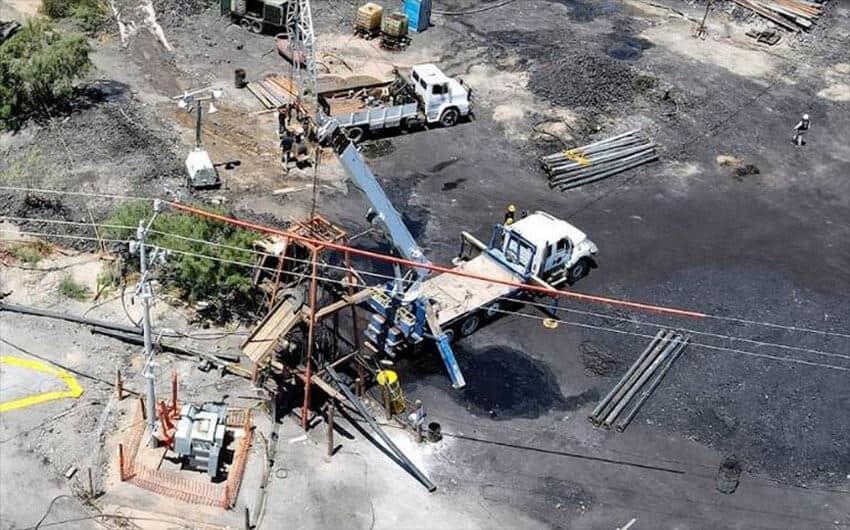
An aerial view of the entrance to El Pinabete mine.
An aerial view of the entrance to El Pinabete mine. Arturo Salazar

However, the Civil Protection chief said the authorities didn’t want to begin a new rescue strategy without the consent of the families.

For his part, the director of the Center for Research in Applied Geosciences at the Autonomous University of Coahuila said the excavation of an open pit and construction of a sloping tunnel to rescue the miners is a complex project, but a viable one.

Luis Fernando Camacho Ortegón said that a range of studies would be required prior to the commencement of the project, including topographical and electrical tomography ones.

“Pits in that area could be susceptible to problems … because you’d have to break the aquifer, and the aquifer could flood the pit,” he said.

Camacho said the project could take longer than 11 months due to its complexity, the amount of work and the prior planning required, which could take three or four months.

Idalia Morales, another family member, also expressed opposition to the plan to get the miners out of the mine via a tunnel exiting into the open pit. “We don’t know how they are now, let alone [how they’ll be] in six to 11 months,” she said.

Martínez criticized the authorities for achieving nothing in the three weeks since the miners became trapped, while Tijerina noted that family members have already been offered compensation. However, the families won’t accept any money until the miners have been returned to them, she said.

Relatives have also criticized the authorities for removing portable toilets and other amenities from the mine site, where they have camped out since the miners became trapped. Despite that, “we’re not going to leave,” Morales declared.

“We’re going to stay here. What we want is justice and we’re not going to leave them [trapped in the mine],” she said.

With reports from El Universal 

Ocean turns from turquoise to black at celebrated Balandra beach

0
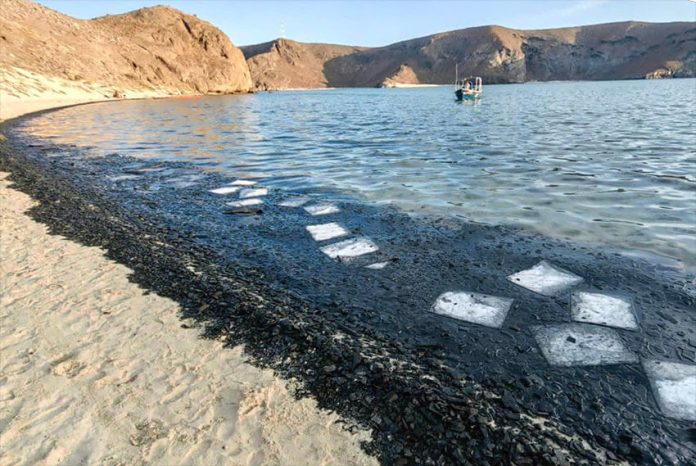
Balandra beach covered in soot, with oil floating on the water.
The accident spilled fuel and spread soot and debris from the boat around Balandra bay. Facebook / Subsecretaría de Protección Civil BCS

A cleanup brigade of officials and more than 50 volunteers have cleared 10 tonnes of waste — including oil, diesel fuel, ash and soot — from a beach that has been described as the most beautiful in Mexico after a yacht sank nearby last Sunday.

The garbage removed from Balandra beach, located near La Paz, Baja California Sur, also included wreckage of the yacht Fortius, which caught fire and sank. On Monday, the National Commission for Natural Protected Areas (Conamp) declared an “environmental contingency” and closed the beach.

Twelve people were rescued from the 24-meter-long yacht Sunday evening, with no injuries reported. The boat went down within the Balandra Natural Protected Area, which is off-limits to motorized vessels.

On Thursday, officials reported that diesel fuel was still leaking from the boat. How much fuel might have been spilled has not been revealed but a spokesman for the navy described the quantity as “considerable.”

State Civil Protection officials shared the news of the accident early Sunday morning on Facebook.

Activists and some politicians have called for fines to be meted out to the owners of the boat but Governor Víctor Castro Cosío took a more conciliatory stance.

“This is the kind of thing that can’t be anticipated, it was a fire on a boat. I think the whole community understands that it was an accident. This could happen with a car in the city and a gas spill. The owners, poor people, experienced losses as well,” Castro said.

An environmentalist with the international organization Oceana was among those urging fines.

“Admonitory fines should be imposed on the owners to cover the cost of repairing the damage and to deter this kind of situation in the future,” said Miguel Rivas.

Reports from Expansión Política and BBC

Artist revives a lost craft from Aguascalientes’ past

0
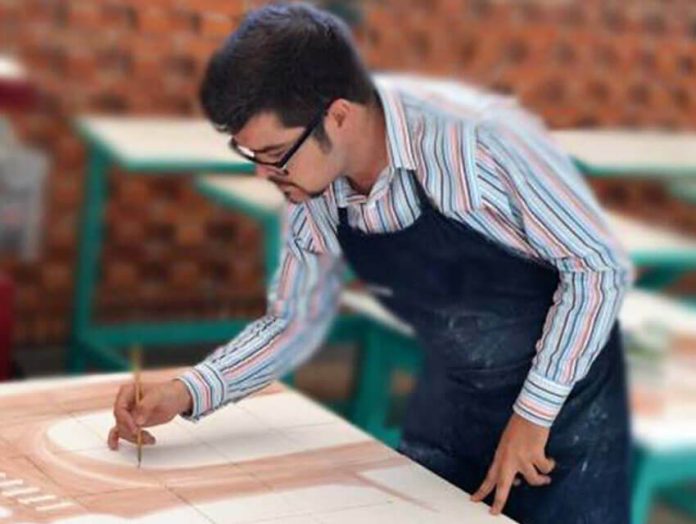
Iván Pugga designing tiles for a restoration project.
Iván Pugga at work designing tiles for a restoration project. Photos courtesy of Iván Pugga

I had the fortune of meeting Iván Pugga González on a trip to Aguascalientes in 2018. At the time, my focus was finishing up loose ends on my book, Mexican Cartonería, but his work was highly recommended, and I decided to check it out. What I saw was the beginning of a revival of ceramic production in the state.

Aguascalientes straddles north and central Mexico geographically and culturally. It is not known for pottery, but it does have an important history here.

The Spanish brought glazed ceramic techniques and designs here as they did to Mesoamerica to the south. There are definite similarities between the traditional work of Aguascalientes and the better-known majolica traditions to the south and east, but it is somewhat simpler, with fewer of the later influences seen in areas such as Puebla and Guanajuato.

Like these, Aguascalientes majolica favors color combinations such as blue, cherry red, orange, brown, black, yellow and green, but the background color tends to be more yellowish because of local minerals.

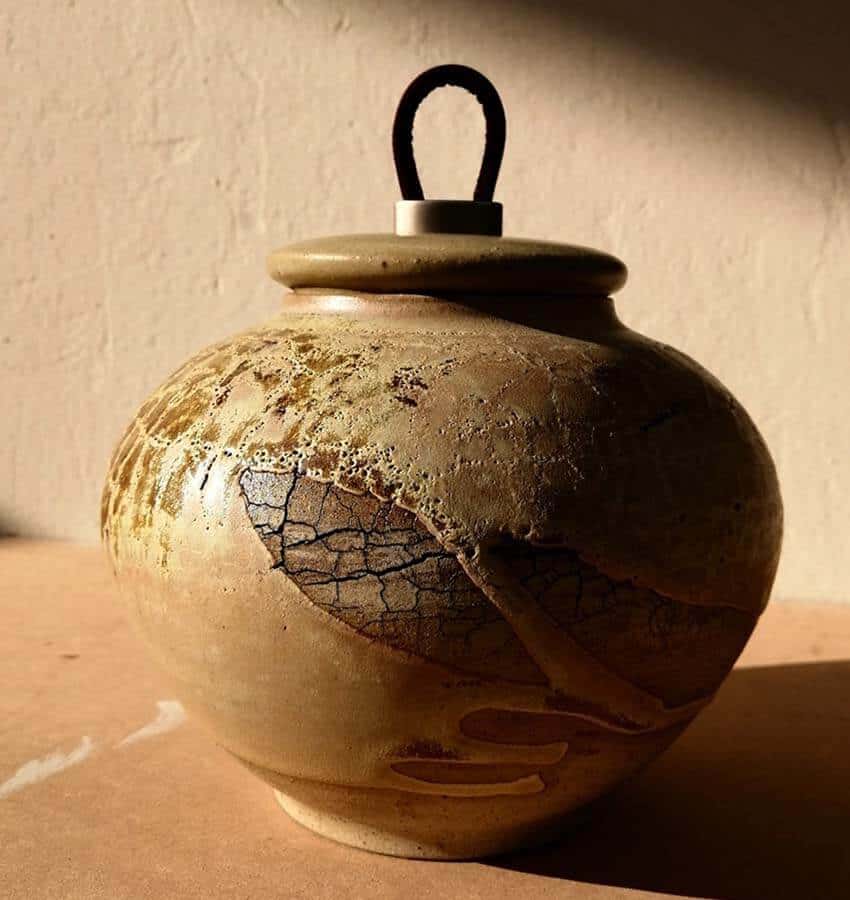
Jar by Mexican artisan Ivan Pugga
This jar is based on Pugga’s childhood experiences with nature, but it almost has a Japanese feel.

Aguascalientes ceramics reached its peak in the early 19th century, both in terms of quantity and quality of production. Tiles on older buildings in the state capital bear witness to the industry, and the state was a major producer of utilitarian dishes in Mexico.

With Mexico’s industrial revolution, ceramics production managed to keep up to some extent. Large workshops such as Casa Terán and San Carlos became semi-industrialized by the 20th century, but eventually, Aguascalientes pottery went into decline. By the 1970s, the last of the workshops had closed, seemingly for good.

It would be 50 years before Pugga would take up the challenge of researching and reviving the craft. He is an artist by training, and he currently teaches art at the Cultural Institute of Aguascalientes.

After learning basic ceramic work in 2010, the state’s tiles and dishes inspired him to research and experiment. He scoured libraries for texts as far as Mexico City and Guadalajara and sought out the few still-living craftsmen from the old industry. In his workshop, he worked out with his hands what the books and his trained eye told him.

Traditional plate from Aguascalientes by Ivan Pugga
An example of a traditional plate design from Aguascalientes revived by Pugga.

He has managed to recreate authentic processes, using authentic materials in molding, glazing, decoration and firing, with one exception. The glazes are modern both because of economics and to make the wares lead-free.

When I first saw Pugga and his work, his progress had been sufficient to create traditional wares, plus some new designs based on motifs from Aguascalientes culture. There were even some purely artistic pieces. Sales had already begun through word of mouth, mostly to foreign tourists through the state’s Casa de Artesanias and to restaurants, hotels and galleries.

Five years later, I saw Pugga and his work again at an event sponsored by the Culture Ministry. His work was good before, but the strides he had made were impressive.

His traditional designs have become more refined, and there is now some play in them. Some of his more innovative wares have natural curves and an almost Japanese look to them. Perhaps some of the most impressive work are the tiny tiles, with even tinier painted details that grace the necklaces, earrings and more of his jewelry collection.

Earrings by Mexican artisan Ivan Pugga
Earrings based on traditional tile designs from Pugga’s unique jewelry collection.

All his pieces/sets are unique, signed and numbered by the artist.

He was in Mexico City because of the quality of this work and the fact that he has become the ceramicist of Aguascalientes. He is the only true producer still, working along with some help from family.

His training as an artist influences his craft, and now his craft influences his art. He believes that the two are strongly interconnected as both require the full dedication of the creator. As satisfying as the craft element of his work is, his favorite works are still artistic.

These can be artistic variations on utilitarian items, such as pots, decorative items or sculptures. They often reflect his experiences with nature.

The traditional craft work remains an important part of his business as appreciation for what was lost continues to grow.

In 2019, the city of Aguascalientes commissioned him to create majolica plaques for a program called Finca Patrimonio, which highlights historic buildings and places to commemorate the 10th anniversary of Royal Inland Road (aka Silver Route) as a UNESCO World Heritage Site.

These plaques can be found in the city at locations such as the Municipal Palace, the Hotel París and the La Saturnina restaurant.

By the end of the 2010s, Pugga and his work began receiving local and state media coverage. He has received recognition from local, state and federal cultural institutions, receiving awards and grants for restoration projects. His is a story of what can be possible with time and determination.

Leigh Thelmadatter arrived in Mexico 18 years ago and fell in love with the land and the culture in particular its handcrafts and art. She is the author of Mexican Cartonería: Paper, Paste and Fiesta (Schiffer 2019). Her culture column appears regularly on Mexico News Daily.

Coffee, aguardiente producers are focus of Veracruz tourism plan

0
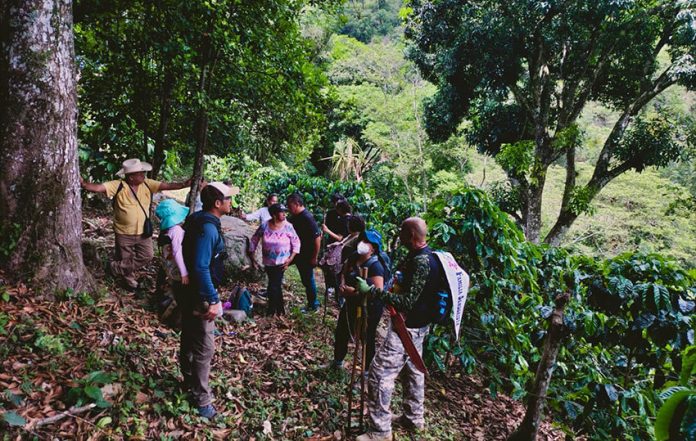
Hikers take a break in a coffee field in Cosautlán as they follow one of the proposed routes, which is currently a narrow, overgrown footpath.
Hikers take a break in a Cosautlán coffee field as they follow one of the proposed routes, which is currently a narrow, overgrown footpath. Cultura y Turismo Cosautlán 2022-2025

Miguel Galán, the municipal tourism director in Cosautlán de Carvajal, Veracruz, said this week that his office is focused on two of the area’s industries to bring tourist to the municipality — coffee and aguardiente, a category of strong, artisanal liquors.

A little over an hour from Xalapa, the Cosautlán de Carvajal municipality is located in a mountainous area of the state near its border with Puebla. Historically, the region has produced coffee and aguardiente, with several producers gaining national recognition in recent years and expanding their businesses beyond small-scale production.  The municipality’s current tourism plan, according to Galán, includes creating hiking routes that incorporate visits to local producers of both products that will hopefully attract new tourists from Veracruz and beyond.

According to Galán, the tourism office is working with the agriculture development office to help local distilleries that make different types of the liquor, usually with a base of cane sugar alcohol, have their production evaluated and receive official recognition as masters of their trade from the state Tourism Ministry.

“We have 11 to 15 [producers] that have joined, and from there we are inviting more because there are some that make the product but don’t have their own brand … what I want to do with the directors and my coworkers is  … that more keep joining the group of aguardiente producers,” Galán said.

There are also 40 regional coffee producers, from simple set-ups where farmers are drying coffee on the outdoor patios of their houses, to award-winning coffee producers that are creating new local brands. According to Galán, there is already a coffee route where local guides take visitors to visit producers and the tourism office is looking to expanded and formalize that trail.

The tourism office is planning for these routes to be established by the end of 2023 and connect 33 communities within the municipality.

With reports from Diario de Xalapa

As another journalist is killed, attacks on media continue to rise: report

0
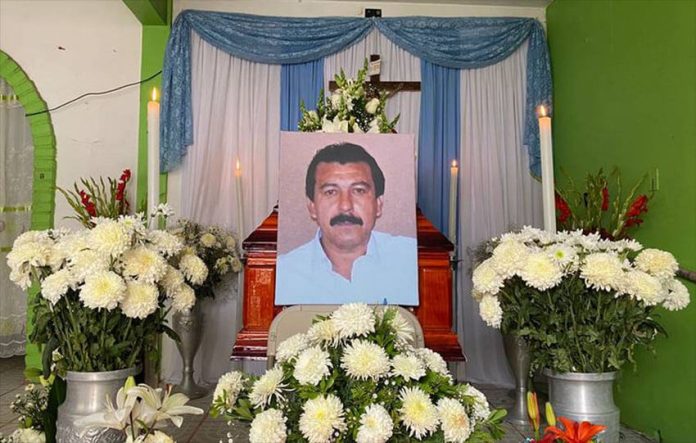
Flowers and a photograph of Guerrero journalist Fredid Román, at his wake in Acapulco.
Flowers and a photograph of Guerrero journalist Fredid Román, at his wake in Acapulco. (File photo)

A journalist was killed in Guerrero on Monday, becoming the 15th media worker to be murdered this year.

Fredid Román, a columnist and former newspaper director who had an online news program called “The Reality of Guerrero,” was shot dead in Chilpancingo, the state capital. His murder came seven weeks after his son, Vladimir Román, was gunned down in the same city.

According to a report by the news magazine Proceso, one lead under consideration by the Guerrero Attorney General’s Office (FGE) is that Fredid Román’s murder is related to a conflict between two criminal groups – Los Tlacos and Los Ardillos – over the production and sale of chicken in Chilpancingo.

The July 1 murder of Vladimir Román, who was a chicken distributor, came just weeks after eight people with connections to the poultry industry were killed in the state capital.

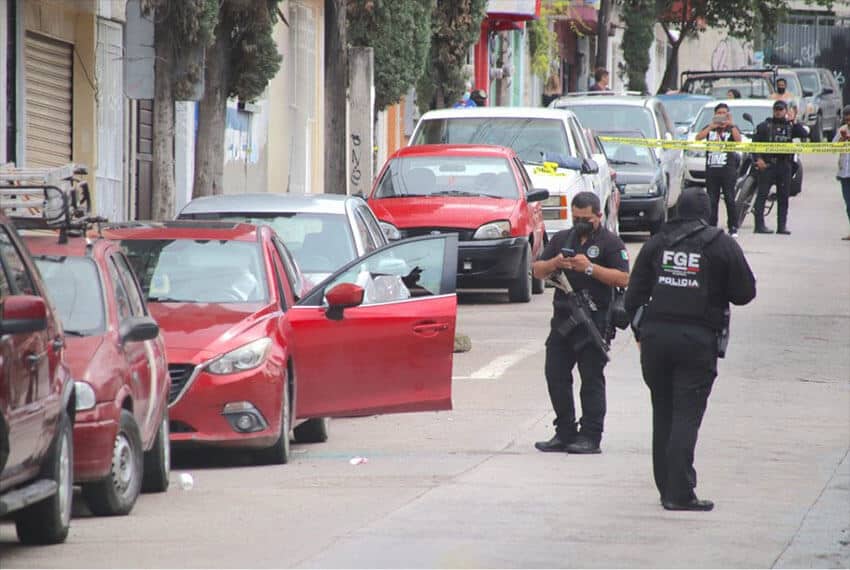
Police stand guard at the site of Fredid Román's murder in Chilpancingo.
Police stand guard at the site of Fredid Román’s murder in Chilpancingo.

Proceso said it had access to official reports that indicated that it’s possible that the murders of both Fredid Román and his son were ordered by Jose David Barrientos Salazar, the leader of a citizens’ security force believed to be the armed wing of Los Ardillos.

Ramón Celaya Gamboa, a senior official with the FGE, said Tuesday that authorities were committed to holding those responsible for the latest murder to account. “The commitment of the Attorney General’s Office is to ensure that this crime doesn’t go unpunished,” he said.

“… The criminals that operate in the El Ocotito valley [in the municipality of Chilpancingo] should know that we have you perfectly identified. We know that there are criminal groups and that there are different interests.  … We’re facing up to them and you won’t intimidate us,” Celaya said.

The prosecutor also said that “all possible theories have to be worked on” to determine the motive for the journalist’s murder. “We still have to rule out that it wasn’t related to his work,” Celaya said.

Román’s murder came just days after press freedom advocacy organization Article 19 published a new report on violence against the press in Mexico.

The report, titled Impunity and Denial in the face of Extreme Violence against the Press Persists, said that there were 331 verbal, online and physical attacks against journalists and the media in the first six months of 2022. Article 19 highlighted that the figure is 51.8% higher than in the first half of 2016, when former president Enrique Peña Nieto was in his fourth year in office, as President López Obrador is now.

The report noted that the five most common kinds of aggression were intimidation and harassment, with 101 cases; threats, with 66 cases; illegitimate use of public power, with 45 cases; physical attacks, with 29 cases; and the blocking or alteration of content, with 28 cases.

Just under one-third of the attacks – 105 of 331 – occurred online. Twelve journalists were murdered in Mexico between January and June, Article 19 said, adding that there was evidence that nine of those were killed due to their journalistic work.

The report said that various levels of government have justified against the press by calling the media in question "conservative, sold or adversarial."
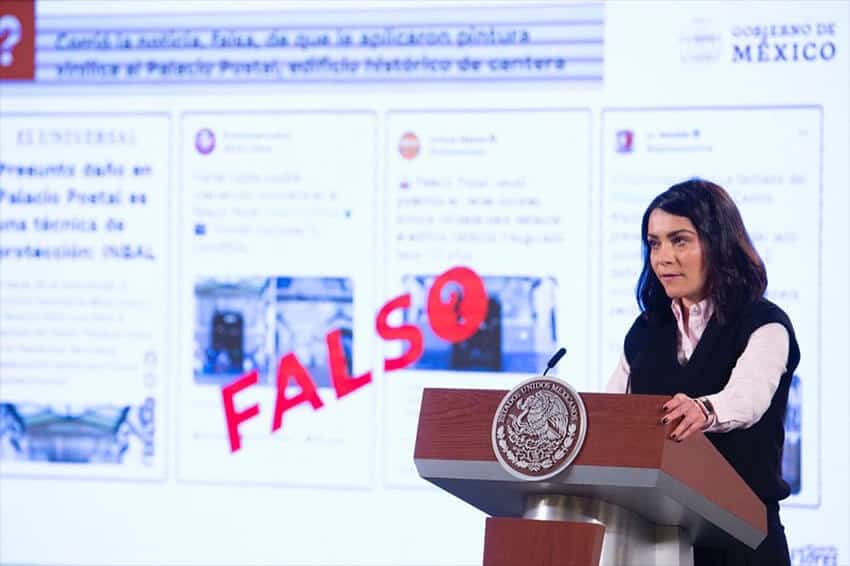
The report said that various levels of government have justified against the press by calling the media in question “conservative, sold or adversarial.” Pictured: presidential spokesperson Elizabeth García Vilchis. Presidencia de la República

The organization said that in the first half of the year it “documented the persistence of stigmatizing discourses against journalists and the media, which seek to turn the messenger into the message, detracting from the investigations or original reports of the press.”

It said that López Obrador is responsible for a “cascade effect,” which has caused authorities at all levels of government to “deny their responsibilities and even justify violence against the press by classifying it as conservative, sold or adversarial, among other [descriptors].”

The report identified “the Mexican state” as the foremost perpetrator of aggression against journalists and the media, with 61 attacks committed by state governments, 44 by municipal governments and 23 by the federal government. Among the other attackers are private citizens, criminal groups, political parties, police and the armed forces.

Article 19 said that Mexico City recorded the highest number of attacks in the first half of the year with 49. Yucatán and Michoacán ranked equal second with 30, followed by Tamaulipas with 21 and Chiapas with 20.

“The fact that the press was attacked every 14 hours in the first half of 2022 shows that violence against journalists and the media has not been curbed. On the contrary, the increase in lethal violence speaks of a worsening of the conditions of vulnerability under which the press exercises its work,” Article 19 said.

With reports from Proceso and AP

Acclaimed children’s book has an unlikely star: Mexico’s axolotl

0
My Life at the Bottom by Linda Bondestam
Bondestam's book is intended for readers three years old and up. Restless Books

The Mexican salamander the axolotl is the unlikely star of an award-winning children’s book written in Helsinki.

In My Life at the Bottom: The Story of a Lonesome Axolotl, by celebrated Scandinavian author and illustrator Linda Bondestam, an axolotl enjoys an idyllic life growing up on the bottom of a lake. He learns about the wider world from a waterproof smartphone and by making friends with tiger salamander classmates at school. Yet, trouble arises when the already polluted lake gets warmer and cloudier due to climate change.

The book has received acclaim in Europe, where it won the Nordic Council Children and Young People’s Literature Prize. Recently translated into English, its first U.S. printing in May sold out quickly.

Bondestam’s books for children have won extensive recognition, including seven nominations for the Astrid Lindgren Memorial Award.

Author Linda Bondestam
Author Linda Bondestam’s My Life at the Bottom: The Story of a Lonesome Axolotl became available in May. Niklas Sandstrom

The children’s book author had never heard about the mysterious endangered amphibian before attending a book fair in Bologna, Italy, a few years ago. But when she saw a photo of an axolotl, she was entranced by its unique appearance.

“It looked like a mix of an alien and a human being, something very innocent,” she marveled in a Zoom interview. “It’s a very, very special animal. I just knew I had to write something about it.”

My Life at the Bottom is intended for readers three years old and up.

“I think it’s a good book to read in a group or with mom or dad or a big sister,” Bondestam said. “You can discuss things. Of course, you can [look at] the pictures by yourself. But I think it’s really a story to enjoy together.”

The book includes drawings of the axolotl and his tiger salamander classmates made by Bondestam’s youngest daughter.

“I really love how children draw,” she said. “Their lines are so free and imaginative. They don’t have the same [quality] as you get older. You become more stressed about your drawing. A lot of artists try to draw more like children.”

The International Union for Conservation of Nature (IUCN) includes the axolotl on its Red List of Threatened Species under the Critically Endangered category. It estimates that only 50 to 1,000 mature adults are left in the wild, scattered across three lakes in Mexico City – Xochimilco, Chalco and Chapultepec.

The IUCN cites multiple dangers to axolotls, from pollution to invasive species.

My Life at the Bottom by Linda Bondestam
Bondestam was inspired to write the book after learning of the animal’s endangered status. Restless Books

Of the situation in Xochimilco, Bondestam said, “I think it’s getting warmer. Maybe that’s why they can’t live there anymore. I heard they put big fish in the lake that eat the small axolotls. It has become a disaster for the axolotls in many ways.”

To the author, the axolotl seemed like a perfect way to help young readers learn about climate change, thanks to its ability to regenerate lost limbs.

“It has this wonderful power – it can renew itself, just like nature can,” she said. “I wanted to make a book to get people interested in nature, but I also wanted to show how badly nature is doing.”

To make the issue of climate change more global to young readers, and to avoid singling out Mexico, Bondestam opted for a setting that is less Mexico-centric and more universal.

“I hope Mexicans don’t think I in any way mean to say that Mexico City is the most polluted [city in the world] or anything like that,” she said. “It could be set in any big city, I think. It’s a problem that is very global. Lots of animals are disappearing.”

Bondestam became especially disheartened after the gloomy 2018 report by the Intergovernmental Panel on Climate Change.

“I still hope we can make it,” she said. “Of course, it’s really stressful to read these reports with everything that’s happening [today] – the war in Ukraine and so many other disasters. It will take a lot of time and a lot of money. It’s really sad. We can do much more for the climate, but, I think, of course, there is hope. There are a lot of clever people working on this issue.”

Regarding the book, Bondestam added, “I didn’t want to be moralizing; I wanted it to be funny at the same time, and also optimistic.”

My Life at the Bottom by Linda Bondestam
The book includes drawings of the axolotl and tiger salamanders in the classroom by Bondestam’s youngest daughter. Restless Books

She achieves this through her protagonist, whimsically spotlighting a central feature of the species — its gills.

“Other, more common salamanders might look like the axolotl when really young, but their gills will fall off, they’ll grow lungs, they’ll start living on the earth like lizards,” Bondestam said. “But the axolotl never changes. It continues to be young all its life in a way. It was quite sweet to have this childish character in a peaceful and happy state.”

She called axolotls “a bit like the Peter Pans of nature.”

In the narrative, things start changing for the worse when the tiger salamanders mature and move out of the lake. The axolotl, initially one of 987 born to the same mother — “I think I read somewhere that they can have up to 1,000 babies,” Bondestam said — finds itself suddenly lonesome.

Meanwhile, the climate situation is about to get much more dramatic.

“When I started making the book, I didn’t know how to end it,” Bondestam said. “I didn’t want to make a really devastating book. It really had to be hopeful as well. But it was hard.”

For any future children’s book writers or artists out there, the author has a counterintuitive recommendation.

“As a child, I spent a lot of time on an island with my family,” Bondestam said. “There was not too much to do. I had to be very creative. Sometimes it’s very good for a child to be bored once in a while. It makes you creative.”

Rich Tenorio is a frequent contributor to Mexico News Daily.

Lawmaker under fire after labeling criminals ‘beasts’ undeserving of human rights

0
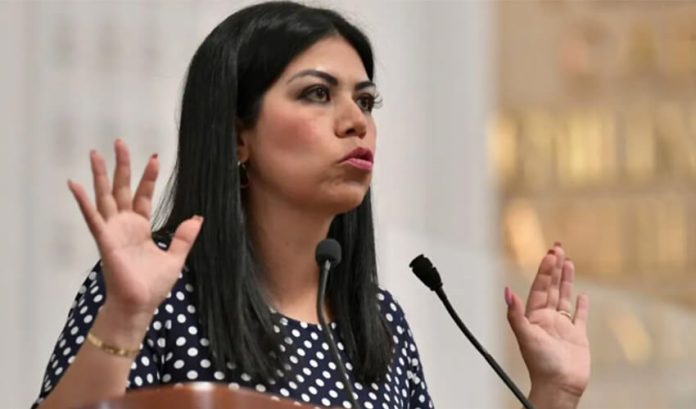
Mexico City Congress Deputy America Rangel
Deputy in the Mexico City Congress América Rangel set off controversy with a tweet on her account on Saturday.

A Mexico City lawmaker has been criticized by President López Obrador and counseled by her congressional colleagues after asserting that criminals are “beasts” underserving of human rights.

National Action Party (PAN) Deputy América Rangel came under fire after she tweeted Saturday that “human rights are precisely for humans” and “criminals are beasts that don’t deserve any consideration.”

López Obrador on Monday described her opinion as “conservative thinking” before declaring that “fortunately Mexico is different” and “the people have become aware.”

Rangel responded to his remarks in another tweet, saying that “as was to be expected,” the president “got very angry about me calling his partners and protégés, the poor little criminals, beasts.”

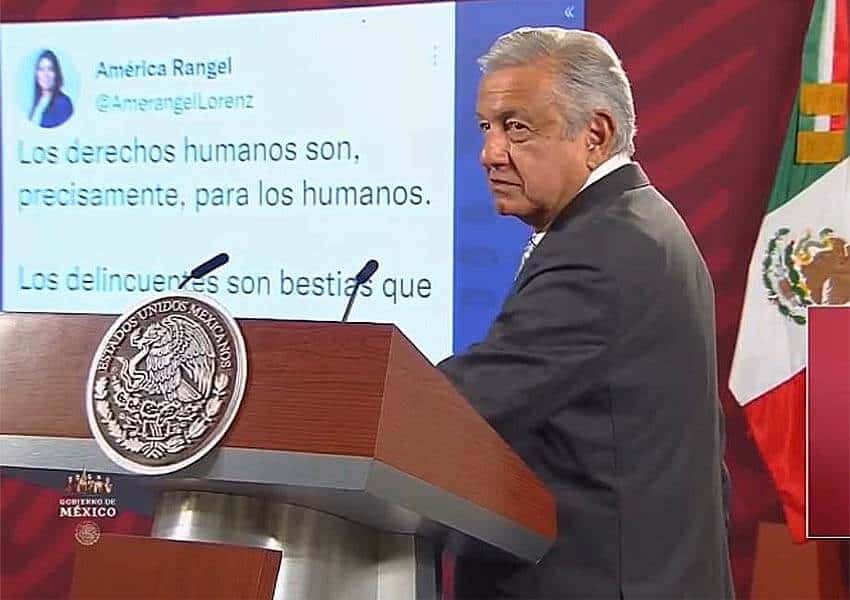
AMLO discussing Mexico lawmaker America Rangel
AMLO addressed Rangel’s tweet during his Monday press conference, saying her opinion was out of line with how Mexico thinks now.

“… I repeat it: murderers, rapists and kidnappers are beasts that don’t deserve a hug but do deserve all the force of the state. Coward,” she added above a photo of López Obrador.

“They expose themselves on their own, allowing who they really work for to be seen,” she wrote.

Her message alluded to the government’s controversial “hugs, not bullets” security strategy, which favors addressing the root causes of violence with social programs over simply combating criminal organizations with force.

Rangel’s original tweet also irked lawmakers with the ruling Morena party in the Mexico City Congress. Deputy Miriam Valeria Cruz Flores presented a document in Congress that called on the PAN lawmaker to not engage in hate speech against anyone, including accused and convicted criminals.

“The Mexico City Congress urges the Deputy América Alejandra Rangel Lorenzana to comply with the constitutional mandate … that obliges her to promote, respect, protect and guarantee human rights in accordance with the principles of universality, interdependence, indivisibility and progressiveness,” the document said.

Rangel responded to the advice by tweeting that Morena deputies “have never raised their voices to defend a victim or condemn a crime,” but they defend the “poor little criminals I called ‘beasts.’”

Rangel responded to the president’s criticism by calling him a coward.


Among the other critics of Rangel’s “beasts” claim was Saskia Niño de Rivera, president of Reinserta,  a civil society organization that helps ex-prisoners reintegrate into society.

“If this is the opposition, we’re screwed,” she wrote on Twitter above an image of the lawmaker’s tweet. “… Unquestionably, the politician doesn’t understand the reality of our people.”

With reports from Aristegui Noticias and El Universal 

3 police, judge arrested after woman’s death in Oaxaca jail

0
Flor Abigail Hay Urrutia died in police custody in Salinas Cruz, Oaxaca
Flor Abigail Hay Urrutia, 30, was last seen alive in police custody by the father of her two children. Her family believes authorities murdered her. Social media

A municipal police chief, two officers and a judge have been arrested in connection with the death of a 30-year-old woman who died in police cells in Salina Cruz, Oaxaca, last Friday.

Oaxaca Attorney General Arturo Peimbert Calvo told the newspaper Reforma that the officials were arrested in Salina Cruz after a judge issued arrest warrants for the murder of Flor Abigail Hay Urrutia.

Hay, a mother of two, was detained by municipal police last Friday after allegedly attacking her partner in a vehicle in which they were traveling. The newspaper El Financiero reported that it appeared that she was arrested at the request of her partner.

Municipal police told Hay’s family that she used her underwear to hang herself in a cell at a police station in Salina Cruz. Her family was given a suicide note she allegedly wrote, but they said the handwriting wasn’t hers.

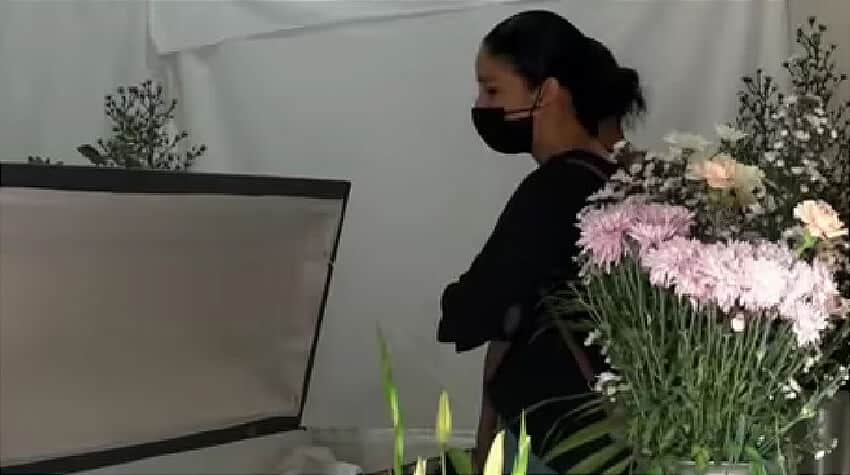
funeral of Flor Abigail Hay Urrutia in Oaxaca
Hay’s family waited to bury her because they had requested an additional autopsy in hopes of finding more evidence about the cause of death. Screen capture

The family also said that the name Hay used on social media, rather than the name she used with them, appeared on the note.

Federal Deputy Security Minister Ricardo Mejía said Thursday that a third autopsy made the same conclusion as the first two — that Hay died from asphyxiation as a result of hanging. He said her death was being investigated as a femicide.

Margarita Hay Urrutia, Flor Abigail’s sister, said that the three municipal police and the judge – all of whom were dismissed before their arrest – were detained as a result of the pressure exerted on authorities by her family. José Luis Hay has openly accused the police of murdering his daughter.

“I just want justice because the Salina Cruz police beat my daughter to death and then hung her, but she was already dead,” he wrote on social media. “They wanted to make me believe that she hung herself with her panties, but I didn’t believe it,” he said.

“… My daughter’s body had a deep wound on the neck, … we assume that the wound wasn’t made by her underwear. …. The police murdered her.”

José Hay also said it was unclear why his daughter was arrested, asking “Why did they take her? and “What were the charges?”

In video footage showing the woman’s arrest, she can be heard repeatedly saying, “I’m the mother of your child” to her partner, the father of her youngest.

José Hay said that his daughter’s partner accompanied her to the police station but left to buy her a torta, or sandwich. He returned to the police station but didn’t see Flor Abigail again, the woman’s father said.

Hay was buried in the Salina Cruz municipal cemetery on Wednesday after the third autopsy was completed. During the funeral procession, family and friends called for justice for Abigail, according to an Aristegui Noticias report.

“I’m very sad, it’s the only thing I can say,” José Hay said as his daughter was laid to rest.

With reports from Reforma, El Financiero and Aristegui Noticias

Competing factions of Familia Michoacana cartel clash leaving 8 dead

0
Michoacan Security Minister Jose Alfredo Reyes in Tuzantla
Michoacán Security Minister José Alfredo Reyes Ortega, visited Tuzantla and said that a National Guard barracks would be established nearby to bolster security.

An armed confrontation between competing cells of the same criminal organization left eight people dead in Michoacán on Wednesday.

Two groups identified as factions of the Familia Michoacana cartel clashed in the municipality of Tuzantla, located 170 kilometers southeast of Morelia near the Michoacán border with México state and Guerrero.

The eight presumed criminals were killed in the town’s main square. Three minors were among the dead, according to preliminary information cited by the Reforma newspaper.

The confrontation occurred after one faction entered the turf of a rival faction based in Tuzantla to carry out an attack, according to Deputy Security Minister Ricardo Mejía Berdeja, who addressed President Lopez Obrador’s daily press conference Wednesday morning. Five men and one woman have been arrested in connection with the incident, in which the attackers arrived in cars, pickup trucks and motorcycles, he said.

organized crime shootout in Tuzantla, Michoacan
The criminals arrived in pickup trucks, cars and motorcycles and unleashed heavy fire in Tuzantla’s main square. Screen capture

The Tuzantla-based cell returned fire but was overwhelmed by the heavily armed invaders, El Universal said.

The dispute between the two competing groups, who are led by criminals Mejía only identified only as “El Pez” (The Fish) and “El Chaparro” (Shorty), appears to be related to the murder a few weeks ago of another individual whom Mejia only identified as “Lalo Mantecas.”

Four abandoned pickup trucks, one of which had been torched, were seized after the shootout, the newspaper El Universal reported. According to Mejia, drugs and weapons were also confiscated.

Security forces including the army and National Guard responded to the violence. Michoacán Security Minister José Alfredo Reyes Ortega also traveled to Tuzantla, where he told reporters that security would be bolstered in the area.

He said that a National Guard barracks would be established in Melchor Ocampo, a Tuzantla community 20 kilometers southwest of the municipal seat. Reyes said that México state-based criminal groups enter Michoacán in that part of the state and that the presence of the National Guard would stop that.

Michoacán was the second most violent state in the first seven months of the year, with 1,587 homicides, the federal government reported last week.

In addition to the Familia Michoacana, the Jalisco New Generation Cartel and the Cárteles Unidos – a criminal group led by Los Viagras – operate in Michoacán, one of six Mexican states classed as “Level 4: Do Not Travel” by the United States Department of State.

With reports from El Universal and Reforma