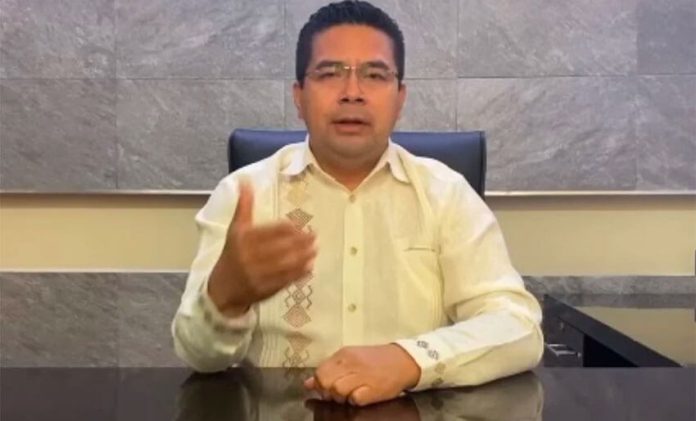
Mayor Maza made the comments in advance of a cultural festival.
The mayor of a municipality in Chiapas has apologized after stating that feminism and homosexuality are not normal.
In a press conference held Monday in advance of a music and cultural festival in Ocozocoautla de Espinosa this week, Mayor Javier Maza Cruz commented on feminism and homosexuality by saying, “All those things, they can be seen as normal, but they are not.”
Local media picked up on the comments and broadcast the portion of his speech in which he also recommended that young people should engage in reading, painting and creating with their hands so “they will be more involved in artistic activities than in trivial things — things that are not going to fill the spirit.”
“Read so that homosexuality or feminism are removed,” he was quoted as saying. “Moral values are being lost with feminism and factors of sexuality.”
Hours later, through his social networks, Maza apologized and assured that his administration will always be inclusive of the LGBTTTIQ+ community (lesbian, gay, bisexual, transgender, transvestite, transsexual, intersex and queer). By that time, video of the press conference had been removed from official channels.
Ocozocoautla, known more informally as Coita, is a town and municipality of 97,000 about 15 miles west of the Chiapas capital city of Tuxla-Gutiérrez.
The Festival Emergente (Emerging Festival) is set for June 9 and 10 in a large park near the zoo. It includes musical acts of many different styles (including ska, hip-hop, rap and surf music), break-dancing, stargazing led by an astronomical club, vendors and creative workshops. In that light, Maza lauded festival organizers for an event that focuses on young audiences interested in urban culture and emerging expressions.
He also said that many young people are engaged in nonproductive activities, and that for society to improve, there is a need to instill in them arts, culture and education. “We are very concerned about these generations that are coming now,” he said, adding that society’s “moral values are being lost” because of the media and misinformation.
“The truth is that we have a post-pandemic generation that was already [addicted] to smartphones,” he said. “Through culture, arts and education we will be able to have a better society.”
In regard to the mayor’s comments about homosexuality and feminism, which came during the month in which gay pride is celebrated, groups such as the feminist collective 50+1 Chiapas issued condemnations on their social networks.
“[We] express our outrage and strongly condemn the statements … [that] feminists and people of sexual diversity are not normal,” 50+1 Chiapas posted in a four-paragraph statement on its Facebook page. “We all have the right to be treated with the same dignity, which is why intolerance, discrimination and gender-based violence are reprehensible. We demand a public apology!”
Maza did just that. “My most sincere apologies to the entire LGBT community and feminist groups for my comment issued today,” he said in a 52-second video message posted to his Facebook account. “To clarify, both this public servant and the government that I represent are respectful of all citizens without any distinction.”
In an additional Facebook post the next day, he said in a video that Ocozocoautla would implement a program addressing gender and gender diversity “in order for us to be a fully inclusive government.” In a written statement accompanying that video, he said Coita “would be one of the first municipalities to have a director in charge of defending plurality and the issues of the LGBTTTIQ+ community … It’s important that they know that our intentions are the best in terms of respecting human rights.”
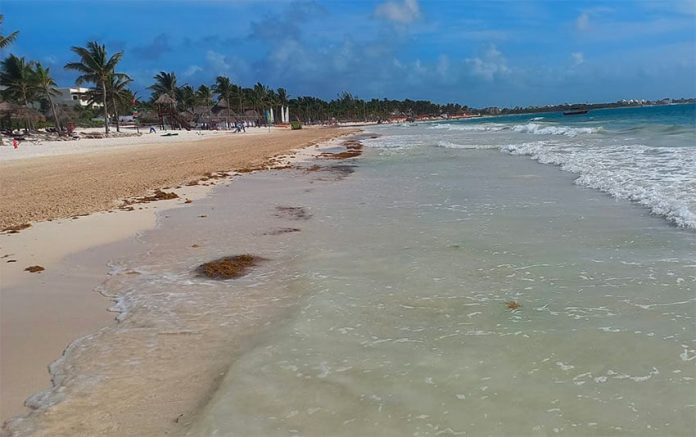
Some of the sargassum collected from the Caribbean Sea and Quintana Roo beaches is ending up in clandestine dump sites, a practice that poses environmental risks.
The number of such places has increased due to the lack of official landfill sites, the newspaper Milenio reported.
The director of the Puerto Morelos branch of Zofemat, the federal office of maritime land zones, condemned the dumping of sargassum in unauthorized locations. “They can’t just dump it on any property … or beside the highway,” Gerardo Rosas said, referring to people who offer sargassum disposal services to authorities and beachfront businesses such as hotels and restaurants.
He added that Zofemat has also detected the disposal of the seaweed in mangrove areas. “That causes a direct impact on the ecosystem, on the wetlands,” Rosas said.
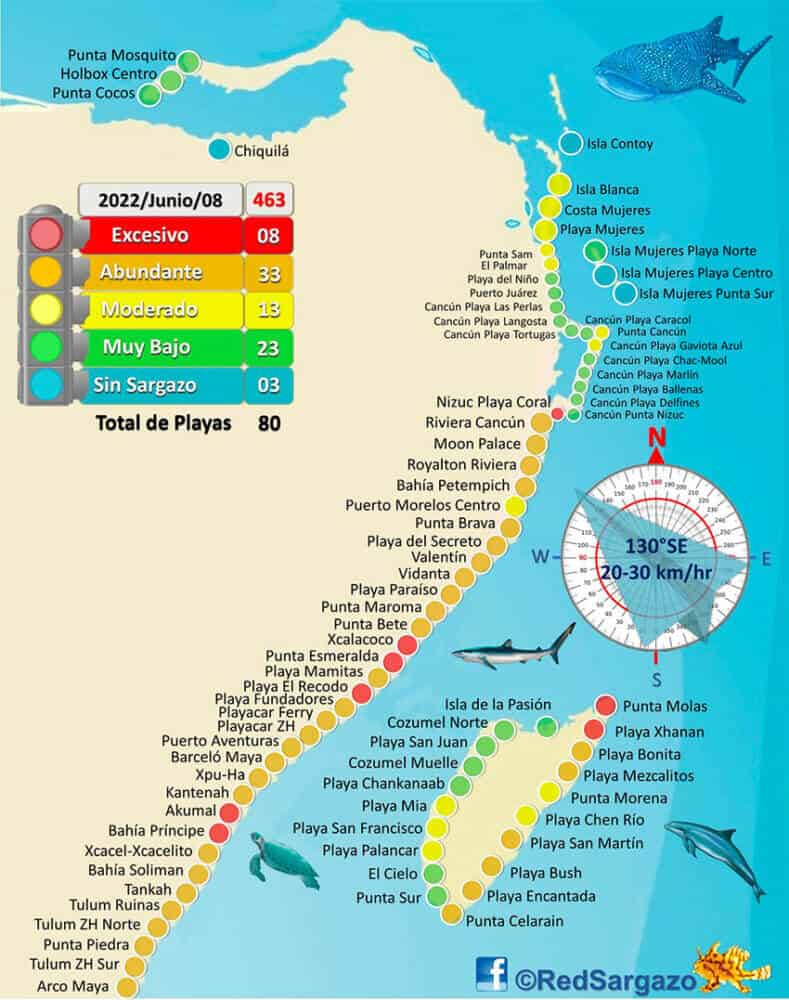
The latest sargassum map, published by the sargassum monitoring network.
Using specially-designed sargassum-gathering vessels, the navy collects the seaweed from the Caribbean sea off the coast of Quintana Roo and deposits it at the end of each day in containers on docks, Milenio reported. Municipal authorities are then tasked with disposing of the seaweed on land. But they sometimes subcontract the job to people offering disposal services and they dump the sargassum in areas where it shouldn’t be discarded. Such sites don’t have geomembranes – synthetic liners – that prevent toxic liquids called leachates from seeping into the soil.
“Studies tell us that [sargassum] produces leachates [when it decomposes] and it has a high arsenic content,” said navy sargassum strategy coordinator Alejandro López Zenteno. “So how [sargassum] is managed at the time of disposal on land is very important to avoid damage to the water table.”
Managing the seaweed this sargassum season has been a challenge as huge amounts have washed up on Quintana Roo’s coastline. As a result, authorized landfill sites have been overwhelmed by the weed.
The Quintana Roo sargassum monitoring network’s latest map shows eight Quintana Roo beaches with excessive amounts of sargassum, 33 with abundant amounts and 13 with moderate coverage of the smelly brown seaweed. That’s a significant improvement compared to late May when 50 beaches were plagued by excessive amounts.
Two of the beaches that currently have excessive amounts and six of those with abundant quantities are located on the east coast of Cozumel, an island off the coast of Playa del Carmen. Local Zofemat director Marco Antonio Loeza Pacheco acknowledged that the quantity of sargassum that has reached Cozumel this year has exceeded expectations. Over three tonnes of the weed have been removed from beaches in recent days, he said Monday.
A truck was recently seen dumping sargassum on a Cozumel street, confirming that the improper disposal of the weed is not a problem limited to the Quintana Roo mainland. Loeza urged hotels and beach clubs to consult with authorities so that the sargassum they collect can be disposed of in a place where it won’t pose a risk to the environment.
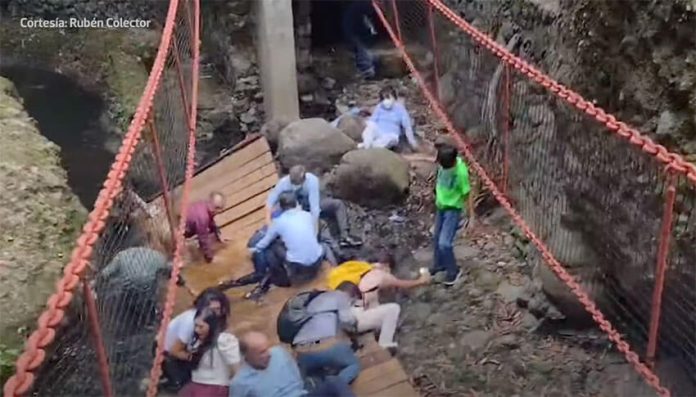
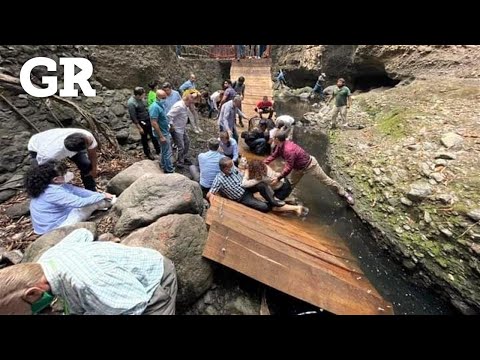
The official reopening of a popular riverside walk in Cuernavaca, Morelos, took a scary turn Tuesday when a short suspension bridge collapsed while two dozen people were crossing it — including the mayor and his wife.
Fortunately, the hanging bridge did not span a huge ravine, and the fall to the stream and rocks below was approximately two meters. But at least 14 people were injured, according to sources.
The situation unfolded in a tourist area in Parque Barranca de Amanalco, one of the most visited parks in Cuernavaca, the state capital. The city is a popular weekend getaway destination about 90 minutes south of Mexico City by car.
Mayor José Luis Urióstegui Salgado suffered minor injuries and was “out of danger,” according to a spokesperson, but his wife, Luz María Zagal Guzmán, was taken to a local hospital, as were four members of the municipal council, a government employee and a reporter for a local newspaper who was on one of her first assignments. Treated at the scene without serious injuries were at least six others, including a councilor, the secretary of the council and four government employees.
The suspension bridge connects two paved pathways on the Paseo Ribereño, a tourist walk in the park that had been closed for about four years. Initial reports said the bridge, made of wooden boards and metal chains, had been renovated as part of a larger rehabilitation project in the park, which is located in the Amanalco canyon.
However, the state government later announced that the suspension bridge had not been included in the project to improve the riverside walk. A non-suspension footbridge on the walk, underneath the Porfirio Díaz vehicular bridge, was replaced due to damage from the 2017 Puebla earthquake and deterioration from natural causes.
The park was being reopened as part of a larger program that was reactivating popular tourist sites throughout Cuernavaca, such as the El Castillito photographic museum and Porfirio Díaz Park. The normally user-friendly Paseo Ribereño allows people to walk through nature in the midst of extensive vegetation and experience unique climate conditions.
Enrique Clemente, the coordinator of Civil Protection of Morelos, said, “The walk is complicated because there are many stairs [and] a very steep slope,” which made it difficult to get some of the injured people out of the park. He said that two people suffered serious injuries, and that most of those who fell landed on sand and stones.
Caen Edil de Cuernavaca y acompañantes de puente colgante
Morelos Governor Cuauhtémoc Blanco, 49, a former soccer star considered to be one of Mexico’s greatest players of all time, issued a statement immediately after the accident, saying, “I am very sorry for the accident that the mayor of Cuernavaca José Luis Uriostegui, his wife, work team and media correspondents suffered a few moments ago during the inauguration of Paseo Ribereño. I sincerely hope that there are no serious injuries.”
A report from Uno TV said that “a young man was seen jumping on the suspension bridge” at the outset of the incident, which video confirms.
Mayor Urióstegui said as much in a TV interview after the incident, noting that the bridge collapsed due to “recklessness of whoever started to jump” while adding that all the people on the bridge at the same time made for more weight than the structure was built to support.
The newspaper Milenio identified the person who jumped as a municipal assistant in Amatitlán, a neighborhood in Cuernavaca.
Milenio also spoke with civil engineers who went to the scene to evaluate the collapse of the bridge. “They assured that regardless of the state of the bridge, or whether or not it was maintained, the structure did not have the capacity to support so many people on it at the same time. They ruled out that just the jumping of a person on the bridge was enough to make it collapse; it was, rather, the combined weight of more than 20 people,” Milenio quoted them as saying.
Valeria Díaz Beltrán, a reporter who had been on staff at the newspaper El Sol de Cuernavaca for only a week, reported from her hospital what she experienced during the collapse: “I was approximately half a meter from the mayor … and I just don’t know who, I don’t know the name of the person who said, when we were already in the middle of the bridge, ‘You have to go one by one.’ And that was the last thing I heard. After that, I only remember lying on the ground. I got up immediately because, out of shock and nerves and fright, there were people in front of me who were very hurt.”
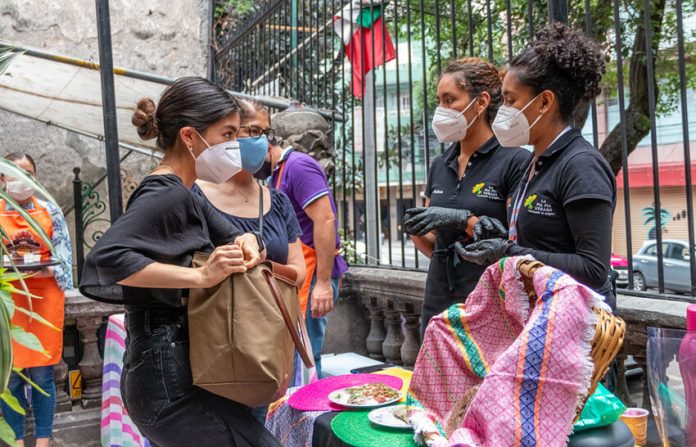
Shoppers and vendors wearing face masks at a market in Mexico City in August 2020. deposit photos
The fifth wave of coronavirus infections began in Mexico in early May, according to experts who spoke with the newspaper El Universal, but the government waited until after the June 5 elections to say anything, said one.
Arturo Erdély, a National Autonomous University (UNAM) mathematician who has tracked Mexico’s COVID data throughout the pandemic, said it was clear that the fifth wave started at the beginning of last month. “Since the middle of May I’ve been saying that there were already very clear signs about the fifth COVID-19 wave but the government didn’t want to talk about it, perhaps for electoral reasons,” he said.
“Curiously,” Erdély added, the day after elections were held the government acknowledged that case numbers had increased and announced the return of daily COVID data reports.
Official data published Monday showed that active coronavirus case numbers had increased over 50% in the space of a week and almost 140% in the past two weeks. The Health Ministry reported 8,026 new cases Tuesday, a 377% increase compared to the average number of infections reported daily between May 29 and June 4.
Erdély said that the fifth wave is likely to peak this month and warned against not taking the COVID threat seriously. “We always have to be concerned about a virus that has shown a great capacity for mutation and adaptation. We have to be careful with the messages … that Deputy Health Minister Hugo López-Gatell gave in the sense that omicron isn’t so virulent,” he said.
“… Getting sick with COVID isn’t good even if [the illness] is mild, because it leaves consequences that deteriorate the quality of life,” Erdély said.
The mathematician predicted that far fewer people will die from COVID during the fifth wave because the disease has already claimed the lives of many those who were most vulnerable to getting seriously ill, such as the elderly and people with chronic health problems.
“We’re talking about 726,000 Mexicans who were the most susceptible to dying,” he said, referring to an excess death figure over the past two years rather than the official COVID-19 death toll, which is currently just over 325,000.
‘Getting sick with COVID isn’t good even if the illness is mild:’ Arturo Erdély.
The number of COVID-19 deaths since early May is indeed low when compared with fatalities during Mexico’s first four waves. There were 708 deaths between May 3 – about the time the fifth wave started, according to experts – and June 7 for a daily average of just under 20. During the worst month for COVID-19 fatalities – January 2021, when the vast majority of the population was not yet vaccinated – Mexico recorded a daily average of 1,055 deaths.
While the daily death toll won’t return to such a high level, the number of new infections reported on a daily basis could approach the figures seen in the first three waves, if not those recorded in the fourth omicron-fueled wave, during which monthly case numbers peaked at almost 1 million in January 2022.
Infectious disease specialist Alejandro Macías said the BA.4 and BA.5 sub-variants of the omicron strain – which haven’t yet been detected in Mexico – will cause a lot of infections in the fifth wave. “What can we expect? As a lot of people already have immunity because they were already infected or got vaccinated or both, an increase in cases can be expected in Mexico but not a catastrophic situation,” he said.
The former health official – Mexico’s influenza czar during the 2009 swine flu pandemic – also predicted an increase in hospitalizations but asserted that fatality numbers won’t be as high as in previous waves.
Macías said that federal authorities have a responsibility to make it clear to citizens that the pandemic is not over. “The use of face masks indoors has to be promoted, people who haven’t completed their vaccination scheme should do so, enclosed spaces need to be ventilated and those who can work at home should continue to do so,” he said.
“Things like that are necessary to avoid the … [fifth wave] being very intense.”
Héctor Hernández Bringas, an UNAM academic with a doctorate in population studies, described the number of new cases reported in the seven-day period to June 6 – 18,539 – as a “significant quantity.”
“Infections, deaths and hospitalizations decreased in March and April, leading to some assertions that we were …[at the] end of the pandemic, a mistaken message that resulted in a greater relaxation of prevention measures on the part of the public,” he said.
Hernández blamed municipal, state and federal authorities for poor pandemic messaging. “They tell us to forget about face masks. In fact there were orders in that sense,” he said, referring to the termination of mask mandates in some states. “In a nutshell, there have been messages that have caused people to be careless,” the academic added.
“We all want life to return to normal, for children to go to school and for people to return to their workplaces, and this is already occurring. But that might also be part of the reason why we’re seeing a new wave. We have to be more cautious in resuming the activities we considered normal before the pandemic,” Hernández said.
Laurie Ann Ximénez-Fyvie, director of the Molecular Genetics Laboratory at UNAM and author of a book about the government’s “criminal management” of the pandemic, said that it’s difficult to make predictions about the fifth wave because the risk posed by omicron sub-variants is not yet fully understood.
She warned that infants up to the age of two and the elderly, especially those with chronic diseases, are most vulnerable to dying if they become infected. “But the main risk of death from COVID-19 comes from not being vaccinated,” Ximénez-Fyvie added.
About 70% of Mexicans are vaccinated but the government hasn’t offered shots to children under 12.
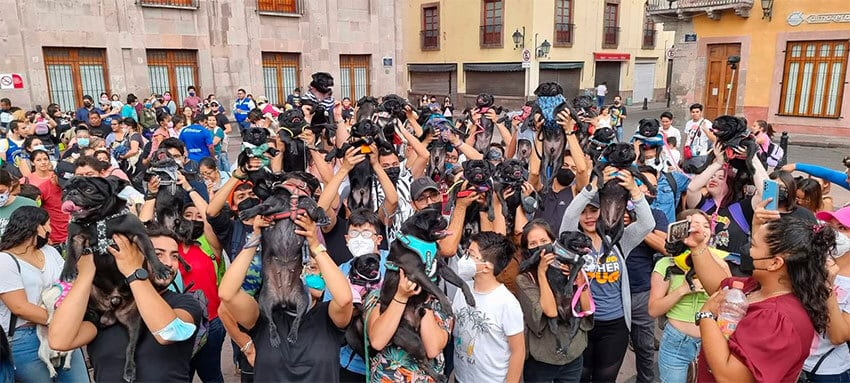
A pug owner holds up her dog for everyone to admire.
Hundreds of pug owners and their furry friends flocked to Querétaro city Sunday for the fifth annual encuentro pugmaniaco, or pugmania meeting.
The dog lovers gathered in the central square known as the Plaza de Armas in the late afternoon to proudly show off their pugs and meet with other owners of the distinctive breed, which originally came from China.
Juan Reyes, founder of the pugfest, told the newspaper El Universal that the purpose of the event is to give families an opportunity to spend time together and to make people aware that “we promote adoptions and sterilizations.”
Some 300 pugs and their owners attended this year’s event, with some dogs and people traveling from other states. One first-time participant was Violeta, a two-year-old female pug dressed as a diablita, or little devil. Many other pugs attended the event in costumes, with a Baby Yoda pug and a Batman pug among the pampered pooches panting, peeing and parading in the public plaza.
Pug owners show off their pets in Querétaro.
“I really like the breed,” said Youseth Trejo, a resident of San Juan del Río and owner of Violeta. “There’s an incorrect concept about the breed, that they’re unhealthy and things like that, but the truth is they’re not. … [Pugs are] very noble and even have almost human-like behaviors. Once I scolded [Violeta] and she vomited from anger at being scolded.”
Alejandro Montes traveled from Tequisquiapan with his black pug Tiberio for the event. “I found out on Facebook that it was the fifth meeting and we decided to bring Tiberio … so that he can mix with [other] dogs of his breed,” he told El Universal.
“I’m looking forward to meeting more people,” said Pablo Rodríguez, a pug owner who moved to Querétaro from Durango just before the beginning of the coronavirus pandemic. “[I’d like] my dog to spend time with … [other pugs]; this is perfect to make more friendships and socialize better,” he said. “… It’s a very relaxed and healthy environment.”
Pug lovers will get another chance to dress up their pets and show them off in public later this year when a Halloween-inspired event called pugween is held in the Bajío region state.
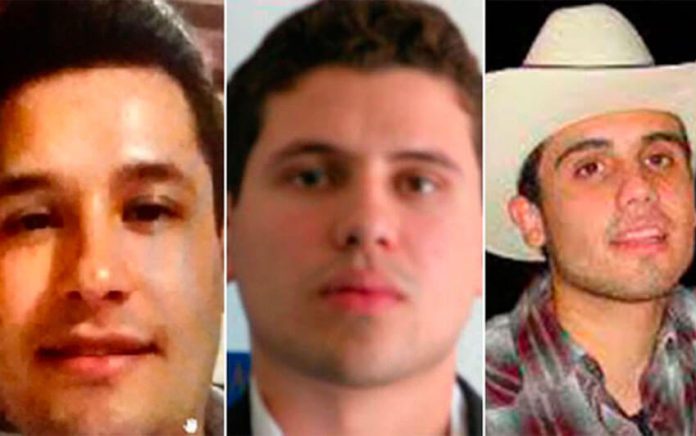
Los Chapitos, sons of jailed drug lord El Chapo, alleged to have made a pact with the president's party.
Members of the ruling Morena party entered into an “electoral narco-pact” with the Sinaloa Cartel last year, according to well known investigative journalist Anabel Hernández.
Writing for the German state-owned news outlet Deutsche Welle, Hernández said she had information that Morena members made a pact with Iván Archivaldo Guzmán Salazar, one of the sons of convicted drug lord and former Sinaloa Cartel leader Joaquín “El Chapo” Guzmán Loera.
The pact was reportedly made in the lead-up to the municipal and state elections in Sinaloa in June of last year. Governor Rubén Rocha Moya won the governorship for Morena, easily beating PAN-PRI-PRD candidate Mario Zamora, and Morena triumphed in the majority of Sinaloa’s 18 municipalities.
Hernández, who has written extensively about Mexican criminal organizations and their links to governments, political parties and politicians including presidents, said “direct sources that know the events first hand” asserted that Morena made a deal with Iván Guzmán, who – along with his brothers, “Los Chapitos,” and uncles – controls a faction of the Sinaloa Cartel, one of Mexico’s most powerful criminal organizations.
She wrote that “people who have been part of the close team” of President López Obrador corroborated the existence of a narco-pact. According to those people, the president is neither unaware of nor disapproves of the agreement, Hernández wrote.
Hernández said the purpose of the pact was for El Chapo’s sons and brothers to give their “blessing” to Morena along with that of Ismael Zambada García – “El Mayo” – the “maximum leader” of the Sinaloa Cartel. The deal ensured that Los Chapitos and their uncles would help Rocha win the governor’s office and support the election of Morena candidates to other positions, she wrote.
“In order for El Chapo’s family to operate in the election, key meetings were held with morenistas,” Hernández wrote referring to Morena party operatives including former interior minister Ricardo Peralta.
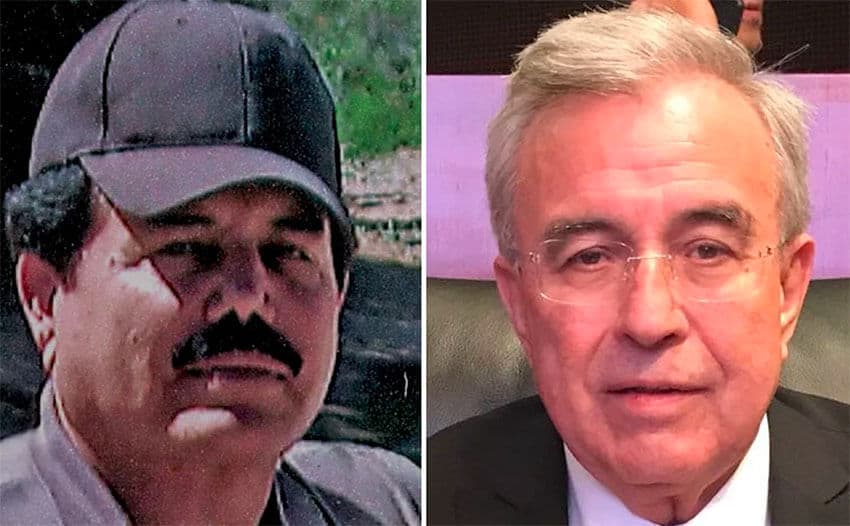
El Mayo Zambada and Governor Rocha: did the Sinaloa Cartel gives its blessing to his election?
She said at least two meetings with Iván Guzmán took place in Culiacán and at least one with “El Guano” and “El Mudo” – brothers of El Chapo – were held in the community of La Tuna in the municipality of Badiraguato at the home of Consuelo Loera, Joaquín Guzmán’s mother, “who AMLO personally greeted in Badiraguato, Sinaloa, in 2020, during the the worst moments of the COVID-19 pandemic.”
At one Culiacán meeting, El Chapito, as Iván Guzmán is known, “with a pistol on his waistband and protected by a large group of armed people,” gave instructions for videos in support of Rubén Rocha to be filmed and disseminated on social media, Hernández wrote.
Members of famous music groups known for singing narcocorridos, or narco-ballads, and “with influence among the population” appeared in the videos, the journalist wrote. “’The Rocha Moya musicians’ were part of the propaganda plan. In that meeting, Iván Guzmán’s people had already received promotional Rocha Moya campaign t-shirts.”
“… In April 2021, Rocha Moya himself filmed a video … thanking the musicians for the support of his campaign.”
Hernández said that other Morena candidates, such as current Badiraguato Mayor José Paz López Elenes, also used narcocorridos in their campaign advertising.
She wrote that El Chapito – one of four brothers for whom the United States has announced rewards of up to US $5 million each for information leading to their arrest – also “ordered narco-electoral actions,” explaining that “he coordinated violent operations in Badiraguato against the PRI mayoral candidate … in order to favor … López Elenes.”
“… Iván also mobilized people to promote the vote and hand out gifts to the electorate, and with intimidation counteracted … similar operations that other opposing candidates were carrying out,” Hernández added.
In Consuelo Loera’s home, Aureliano and Miguel Angel Guzmán Loera – El Guano and El Mudo – met with López Elenes and other Morena “electoral operators,” the journalist said, adding that the same house hosted one of the then-mayoral candidate’s campaign events. “… At the time of the pact with El Chapo’s family, the delegate sent to Sinaloa by Morena for the electoral process was the then [federal] senator Américo Villarreal,” Hernández wrote.
The president greets Consuelo Loera, grandmother of Los Chapitos, in Sinaloa in 2020.
Villarreal, who won the election for governor of Tamaulipas for Morena last Sunday, had knowledge of the pact with the Sinaloa Cartel and agreed with it, she wrote, adding that he is a personal friend of Governor Rocha. Hernández said that Los Chapitos and their uncles agreed to provide electoral support for Morena candidates in Sinaloa in exchange for the ruling party – which will soon govern 20 of Mexico’s 32 federal entities – agreeing not to go after them, including via arrest warrants issued for extradition purposes.
Ovidio Guzmán López, one of Los Chapitos, was released shortly after his 2019 arrest in Culiacán triggered a wave of cartel attacks that terrorized residents of the northern city. López Obrador said he personally ordered the release, asserting that more than 200 innocent people would have been killed had he not taken the decision. He said last month that his government looks after criminals by avoiding armed confrontations with them.
Hernández wrote that people with knowledge of the “electoral narco-pact” told her that the “successful model” used in Sinaloa at last year’s elections was also used in at least three states where citizens elected new governors last Sunday. “Direct sources” told the journalist that the Sinaloa Cartel supported the Morena party in Durango, Tamaulipas and Quintana Roo. Morena candidates won in Tamaulipas and Quintana Roo, but the PAN-PRI-PRD contender triumphed in Durango.
Hernández noted that Quintana Roo is a “key point” for the trafficking of drugs from South America and that the Sinaloa Cartel had criminal control of the state for many years before other cartels, including the Jalisco New Generation Cartel, caused a fracturing of that hegemony.
“Recovering it would be an advantage in the international drug trafficking business,” she wrote. Former Benito Juárez (Cancún) mayor Mara Lezama won the governorship of the Caribbean coast state.
Tamaulipas, Hernández wrote, is a state where the Sinaloa Cartel has never had a stronghold. “For 20 years it has fought to displace the Gulf Cartel and then its armed wing, Los Zetas, in a bloody war. But, despite military and police help from the governments of Vicente Fox and Felipe Calderón, it hasn’t achieved it because local governments have historically supported the Gulf Cartel,” she wrote.
If the Sinaloa Cartel were to gain control of Tamaulipas via its apparent pact with incoming governor Américo Villarreal, it would – for the first time in its criminal history – control the four most important northern border states for the trafficking of drugs to the United States, Hernández wrote, noting that it already holds sway in Baja California, Sonora and Chihuahua.
The journalist, who has previously exposed links between narcos and the three most recent former presidents, contended that AMLO and Morena are also in cahoots with other criminal organizations, including those involved in extortion and fuel theft – a crime the federal government has significantly combatted.
In exchange for “not combatting criminal organizations such as the Sinaloa Cartel,” Hernández wrote, the president and Morena demand “financial and operational help to increase their political hegemony in the country,” a claim similar to that made by Muñoz Ledo, a Morena lawmaker until last year. “At least that’s what the model that operated in Sinaloa shows,” she wrote.
Hernández charged that the establishment of pacts between parties in power and organized crime is a “cyclical” problem in Mexico that appears “sexenio after sexenio,” or from one six-year government to the next. Meanwhile, “tens of thousands of people will continue disappearing in Mexico [and] tens of thousands will continue being murdered, extorted, kidnapped, exploited and trafficked,” she wrote.
“Those who make agreements with organized crime to obtain power, handing over citizens like cattle to the slaughter, cannot be called a political party or government, not before or now,” Hernández added.
Her claims about Morena were rejected by the party’s general secretary, Senator Citlalli Hernández, who claimed that Hernández was guilty of writing “gossip without rigor.” The senator also claimed that the journalist has built a career and “certain credibility” only to lend that credibility to the “highest bidder.”
“The role of Anabel Hernández is really sad and disappointing,” she said.
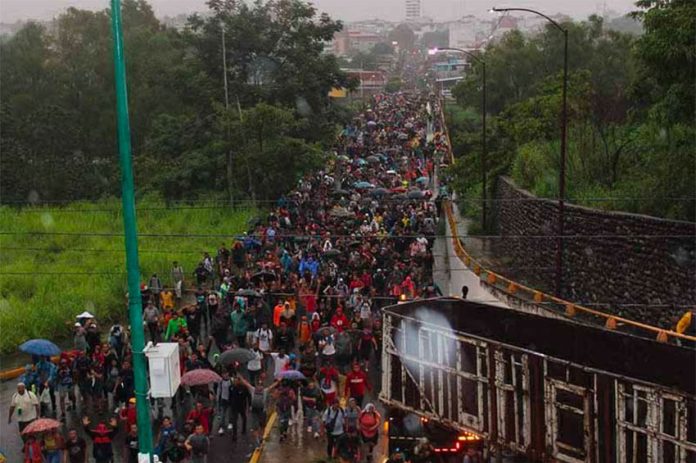
Thousands of migrants left Tapachula, Chiapas, on foot Monday morning, beginning a long journey to the northern border with the United States, where they hope to claim asylum or cross into that country between official ports of entry.
Reports about the size of the migrant caravan varied, with estimates as low as 4,000 and as high as 15,000. Caravan organizer Luis García Villagrán put the figure at 11,000.
The National Immigration Institute (INM) hasn’t commented publicly on the caravan, which is mainly made up of Venezuelans, Cubans and Central Americans and includes pregnant women, children and people with disabilities.
Tired of waiting for months in Tapachula to regularize their migratory status, the migrants departed from the southern city shortly after 6:00 a.m. Monday and walked approximately 15 kilometers in the rain to the town of Álvaro Obregón, where they spent the night. They planned to walk some 30 kilometers on Tuesday to the town of Huixtla.
The migrants passed an INM checkpoint outside Tapachula but fears they would be detained proved unfounded. INM agents and members of the National Guard have broken up previous caravans by confronting them with force and detaining migrants.
Arbitrary detentions, excessive use of force and sexual violence are among the abuses committed against migrants by the armed forces and the National Guard, according to a recent report by six non-governmental organizations.
García Villagrán, director of the Centro de Dignificación Humana (Human Dignity Center), an NGO, said the first goal of the latest migrant caravan is to get to Tuxtla Gutiérrez and demand that the INM issue them with documents that allow them to continue their journey to the northern border legally. He said INM officials told the migrants their claims would be processed in the Chiapas capital.
García Villagrán and other migrant advocates said the departure of the caravan was timed to coincide with the Summit of the Americas, a regional meeting currently taking place in Los Angeles.
“Today we say to the leaders of the United States and each of the countries meeting at the Summit of the Americas [that] migrant families are not a bargaining chip for ideological and political interests,” García Villagrán said before the caravan left Chiapas.
“… Today we’re going to walk in the name of God … so that it’s seen that we’re free people with dignity who have the right to migrate. Migrating is not a crime,” he said.
The Associated Press reported that many migrants carried children in their arms and on their backs, and used sheets of plastic and blankets to protect themselves from constant rain.
Ruben Medina told AP that he and 12 family members left Venezuela because of the poor conditions in the country under the rule of President Nicolás Maduro, who along with the presidents of Cuba and Nicaragua didn’t receive an invitation to the Summit of the Americas, leading President López Obrador to decide not to attend the meeting.
“[We have] been waiting [in Tapachula] about two months for the visa and still nothing, so better to start walking in this march,” he said.
Nicaraguan migrant Joselyn Ponce said she was given an appointment with the Mexican refugee commission COMAR in August but couldn’t afford to wait in Tapachula, where there are few if any work opportunities for undocumented migrants.
“We had to walk around hiding from immigration, there were raids, because if they catch us they will lock us up,” she said, referring to the time she spent in the southern city, located about 40 kilometers north of the border with Guatemala, where thousands of migrants enter Mexico every day.
The Bajo la Bota (Under the Boot) report by the Foundation for Justice and the Democratic Rule of Law and five other groups asserted that “Mexico has opted for the implementation of a migration policy without a human rights focus, making use of the National Guard and other military forces as an apparatus of migration control even when this goes against migration regulations and international human rights law.”
It said that the use of the National Guard to combat the flow of migrants through Mexico is “one of the main institutional legacies” of the pressure imposed on Mexico by the administration of former United States president Donald Trump, who described at least one migrant caravan as an “invasion.”
Mexico deployed troops to its southern and northern borders in 2019 after Trump threatened to impose blanket tariffs on Mexican exports to the U.S. if the Mexican government didn’t do more to stem migration. Mexico has continued to detain migrants in large numbers since United States President Joe Biden took office in early 2021, but many have nevertheless made it to the northern border, with illegal attempts to cross the border currently at their highest level in decades.
Regional migration is scheduled to be the main topic of discussion at Summit of the Americas meetings on Friday. Noting that Foreign Affairs Minister Marcelo Ebrard would be in attendance, U.S. State Department spokesman Ned Price said Monday that López Obrador’s absence would not hinder further efforts to cooperate on migration and other issues.
As thousands of migrants head north while simultaneously bringing renewed attention to the crime, poverty, political repression and other factors that forced them to leave their countries of origin, other would-be U.S. asylum seekers remain in Tapachula.
A group of migrants held at the Siglo XXI detention center climbed onto the facility’s roof Monday in an attempt to escape. However, police and the National Guard surrounded the center and prevented an exodus.
Approximately 70 detained migrants have been on a hunger strike in recent days to pressure authorities to allow them to leave.
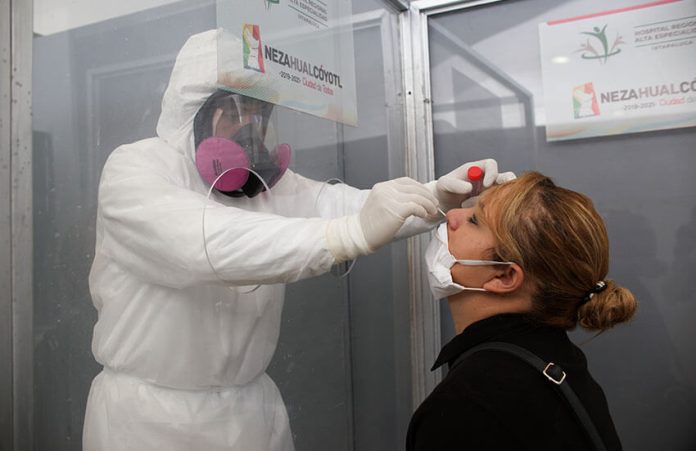
A health worker performs a COVID-19 test in Nezahualcóyotl, state of México. shutterstock
Active coronavirus case numbers have increased over 50% in the space of a week and almost 140% in the past two weeks, official data shows.
There are 23,891 estimated active cases across Mexico, the federal Health Ministry reported Monday, an increase of 8,206 or 52% compared to a week earlier. Estimated active cases have increased 137% since May 23 when the tally was 10,073.
The Health Ministry said in a statement Monday that an average of 1,684 new infections was reported between May 29 and June 4, a 60% increase compared to the previous week. Confirmed COVID cases spiked in 20 states, the ministry said.
“An increase was recorded in Aguascalientes, Baja California, Campeche, Mexico City, Hidalgo, Jalisco, Nuevo León, Sinaloa and Yucatán followed by Baja California Sur, Colima, Durango, México state, Guanajuato, Nayarit, Oaxaca, Puebla, Querétaro, Quintana Roo and Veracruz,” it said.
On a per capita basis, Baja California Sur has the highest number of active cases with about 130 per 100,000 people. Mexico City – which leads the country for total active cases with over 7,400 – ranks second with about 80 followed by Sinaloa with just over 60 active infections per 100,000 residents.
Due to the national increase in numbers, the ministry said it would return to reporting COVID data on a daily basis. It has only provided weekly updates since late April.
The ministry said the increase has not resulted in a higher number of COVID-19 fatalities and hospitalizations.
Mexico’s official COVID-19 death toll was 325,000 on Monday, an increase of 146 compared to a week earlier. That means an average of just under 21 fatalities per day was reported in the seven-day period.
Only 3% of general care beds set aside for coronavirus patients are currently in use, while 1% of those with ventilators are occupied, the Health Ministry said.
It also reported that almost 209 million vaccine doses have been administered to 88.2 million people – about 70% of Mexico’s total population – since December 2020, when the first shots were given. More than 53 million booster shots have been given to adults.
The ministry said that 91% of adults are vaccinated but the rate is only 53% among adolescents aged 12 to 17. Children younger than 12 haven’t been offered shots.
Mexico ranks 76th in the world for population-wide COVID-19 vaccination coverage, according to The New York Times vaccinations tracker. It ranks 15th in the Americas behind Chile, Cuba, Peru, Nicaragua, Canada, Costa Rica, Ecuador, Brazil, Uruguay, Colombia, Panama, United States, Venezuela and El Salvador.
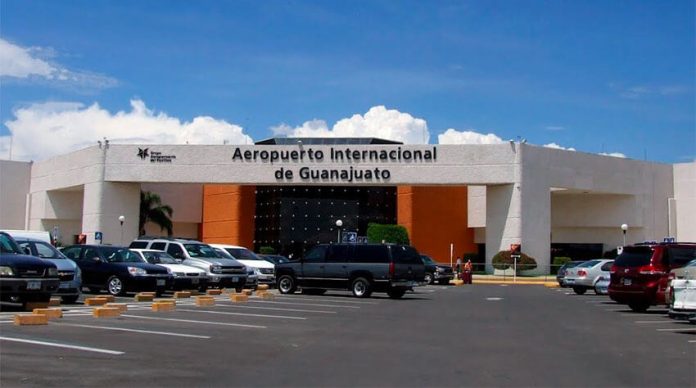
Flights to the Bajío airport will allow travelers to bypass Mexico City.
Mexico’s second largest airline has announced new flights connecting two expat friendly cities, both renowned for their beauty and cultural offerings — San Miguel de Allende, Guanajuato, and Mérida, Yucatán.
The new Volaris route from Mérida to Bajío Airport in Silao, the nearest airport to San Miguel de Allende at 90 minutes from the city, offers expats in Yucatán access to a cooler summer climate to unwind in a region famed for its wine production and art scene. It also gives expats in San Miguel de Allende an easy journey to the Maya region with some of the county’s best beaches, inspiring ruins and natural sights.
One key advantage of the new route is that travelers can avoid having to connect through Mexico City. “As of the moment, you can only get there [San Miguel de Allende] via CDMX,” San Miguel de Allende resident Lucinda Young told Yucatán Magazine.
From Mexico City, Young added, there are flights to Bajío airport or to Querétaro airport, where travelers can take a shuttle to San Miguel de Allende.
Young thinks the easy-going lifestyle in San Miguel de Allende will attract Mérida residents. “For the energetic, motivated and fit it’s a great walking city, with a plethora of European-style cafes and wine bars for refreshment stops … But unlike Mérida it’s also very easy to pick up a taxi anywhere and there’s a fixed in-city fare of 60 pesos,” she said.
Young added that the change of scenery and altitude could be a welcome change for people in Yucatán, as well as the food. “I think the combination of desert plateaus, rivers, and dramatic ravines might be pretty attractive to Yucatán folks who live at sea level with little change in topography … The city sits at the heart of one of Mexico’s most intensive agricultural regions and is also just a three-hour drive to the Pacific coast, so the quality of ingredients is stellar,” she said.
Volaris says the new route will begin operating before the end of the year. The frequency of flights and the fares have not yet been announced.
Meanwhile, Mérida airport registered an all-time record number of passengers for a single month in March, receiving 233,504 travelers.
Traffic is likely to increase. Several domestic airlines, including Viva Aerobus and Magnicharters, have announced they will be increasing their daily flights to Mexico City. There will also be new direct flights to Puerto Vallarta, Jalisco, and Toluca, México state.
There is plenty of room for growth at Yucatán’s main airport: authorities say the existing facilities are still only operating at about 25% capacity.
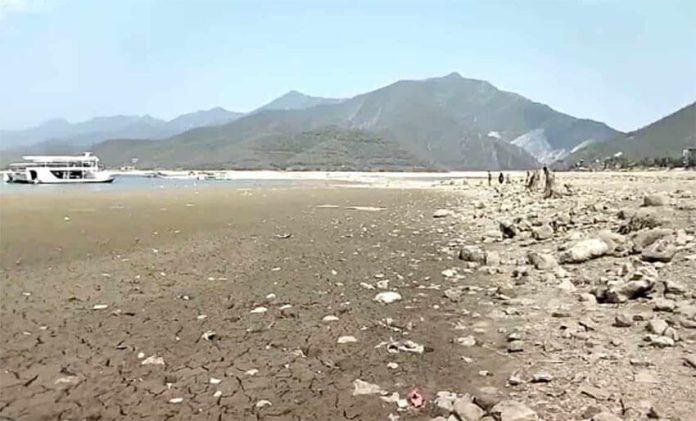
La Boca dam, one of Monterrey's water sources, seen here in March 2022. So far this year, dam water levels are lower than they were at the same time last year. File photo
Monterrey has a new surefire plan to deal with water shortages: to only make water available for six hours a day.
The taps of 5.3 million citizens living in Monterrey’s Metropolitan Zone and in neighboring municipalities have only been of use from 4-10 a.m. since Saturday, after the director of Servicios de Agua y Drenaje de Monterrey, the company that manages water in Nuevo León, announced the strategy.
Juan Ignacio Barragán Villarreal said the new water schedule would replace the “Water for Everyone” program, which had seen water cuts for one day a week rotating around different areas of the city since March 22.
The battle for water in Nuevo León has been long-running: the state declared a state of emergency on February 3 due to a lack of rain, which has caused a shortage of water in the Cerro Prieto and La Boca dams.
El Plan Agua Para Todos tendrá una modificación: a partir de mañana, todos los días en todas las zonas, habrá agua de 4 a 10 de la mañana. Seguiremos trabajando para hacerle frente a la sequía y salir pronto de esta, a ti te toca cuidar el agua y no almacenar de más. pic.twitter.com/94ttI5buUa
The Nuevo León water services company shared the modified restrictions on Twitter Friday.
Barragán made the announcement after meeting with Governor Samuel García and mayors from the affected areas. He said the plan, which was “drastic but necessary,” would “give certainty” to citizens and would be in place until at least August.
Barragán previously announced that water pressure would be reduced at properties that are consuming more than 70 cubic meters of water per month, after reporting that 30% of people were using more water than before restrictions were introduced.
Barragán said that the worst offenders were people living in wealthy residential areas and pointed blame at companies in office buildings and owners of houses in suburban areas where green areas and fruit trees were watered. He also admitted that 61 neighborhoods had gone without water for two to five days at some point since measures were introduced.
Protests by people in the city about the water situation have recently become widespread and have involved demonstrators blocking traffic, the newspaper El Universal reported.
Water supply is a big challenge for authorities in Nuevo León, where droughts can be severe. More than 90% of the state was reported to have abnormal dryness, moderate drought or severe drought in the National Water Commission’s (Conagua) latest drought monitoring report, published on June 3.