Dogs chasing pelicans and Múlege’s elephant seal were topics of interest on social media this week in Baja California Sur.
In the port town of Pichilingue, four dogs were captured on video hunting pelicans on Thursday. Evident from the video is that the pelican was already injured, as it didn’t fly away from its attackers even as they got close and started to circle it in the water.
Whether the dogs were hot in the 30-degree heat, hungry or just bored, they did seem to understand that the pelican was defenseless and that this moment in the video was their best chance to capture it.
The one-and-half minute video shows the four dogs swimming out from the shore toward the pelican as it tries without success to swim away. The dogs finally corral the bird until the four canine hunters surround and attack it.
— Carlos Alfredo Godinez León (@CarlosA94203364) July 28, 2022
The video ends there and so does the story.
Also back in the news was the elephant seal that has been spotted several times in the last few months along the coast of the Gulf of California on the eastern side of the Baja California peninsula. This time it was a siting of the more than two-meter animal swimming near the river entrance at Múlege that connects to the gulf waters.
The animal seems to have little fear of humans and has been seen sunning itself on the beach next to groups of families and making other appearances to tourists along the coast. It’s believed that the possible effects of climate change, a search for food, or a mishap along its migration route has caused the female to be so far from the U.S. and Canadian shores where northern elephant seals are usually found. It has become a bit of a local celebrity, popping up on El Coyote and other local beaches to the shock and awe of beachgoers.
This latest video, uploaded by the same Twitter user as the pelican-hunting dogs, shows this massive creature content as can be while floating up the Múlege river. While wildlife is a common site in the bio-rich Baja Peninsula, up close and personal encounters are always a particular thrill, especially for first-time visitors to this popular tourist destination.
The Fuerza Territorial Poblana's leader Eloy Merino Mendoza died in a clash with the Familia Michoacana cartel on July 20. But his group says it isn't deterred. FTP/Facebook
A Puebla self-defense force’s decade-long fight against narcos intensified last week with an armed confrontation that left six of the self-proclaimed good guys dead.
But with authorities failing to protect residents of the state’s Mixteca region, members of the Fuerza Territorial Poblana (FTP) have not been deterred by the deaths of their comrades, In fact, they are as determined as ever to do what they can to protect themselves and their families – despite the risks they face.
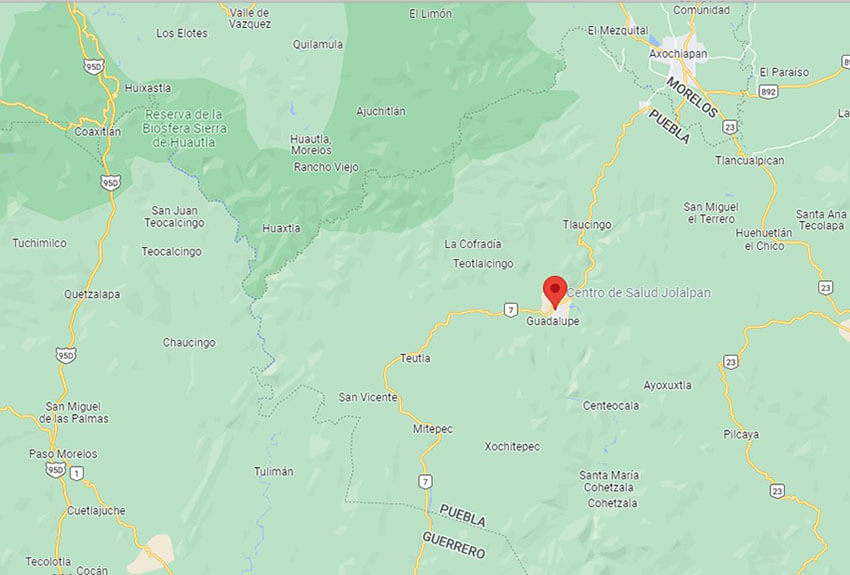
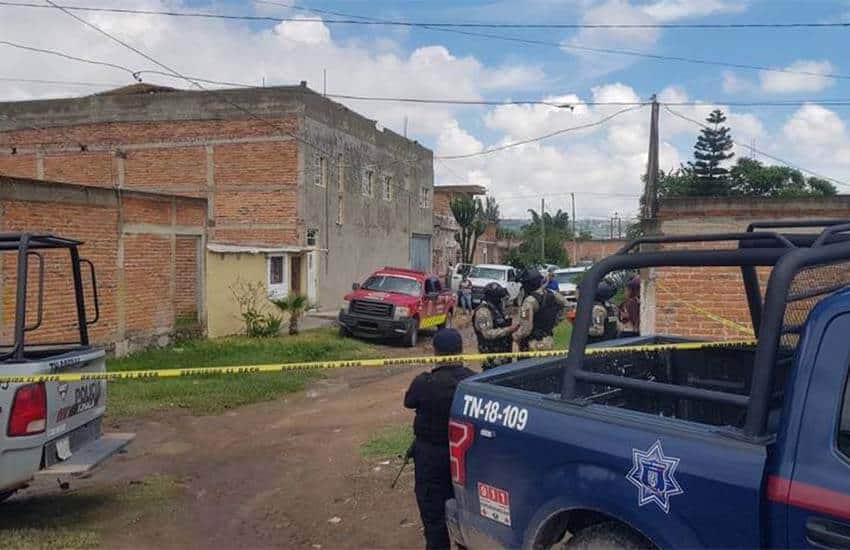
The clash with presumed members of the Familia Michoacana crime group occurred July 20 in Jolalpan, a Mixteca region municipality that borders both Guerrero and Morelos. Among the six dead was FTP leader Eloy Merino Mendoza. Sixteen other people were wounded, one report said.
According to a Milenio newspaper report, the FTP formed 10 years ago when Los Rojos was the dominant criminal gang in the Mixteca region of Puebla, which borders Oaxaca, Guerrero and Morelos and is part of a drug trafficking route. The FTP was successful in weakening Los Rojos, but the Familia Michoacana subsequently moved in and started making threats against residents.
The deadly clash between the self-defense group and cartel members happened in the municipality of Jolalpan, Puebla, which is near Puebla’s border with Guerrero and Morelos. Google Maps
Since then, the self-defense force has been focused on keeping the Familia Michoacana at bay. In 10 years, its membership has grown to almost 2,500 autodefensas, including elderly men and women.
“The group formed to defend ourselves because we were fed up with so many threats and deaths,” Arturo, a 75-year-old campesino-cum-vigilante, told Milenio.
“… What do we have to do? Find the way to defend our own lives and families because nobody wants to die [at the hands of a crime group],” he said.
“When will the government do its job?” questioned another FTP member. “That’s why we pay taxes. … If the government did its job, we wouldn’t have to go around with weapons, we wouldn’t use them anymore,” he said, repeating a refrain uttered countless times by self-defense force members in states such as Michoacán and Chiapas.
The vigilante, who asked not to be identified by name, told Milenio that he and other FTP members didn’t want to be “police” but had no choice.
An elderly female autodefensa also said she felt obliged to take up arms. “At this age, we have no option but to pick up a weapon and defend ourselves,” she said. “To be sincere, I’m scared, taking up arms frightens me … but we all have families.”
Milenio reported that the FTP has taken control of security in 27 Mixteca region municipalities, most of which don’t have certified municipal police. In Jolalpan, where last week’s clash occurred, there have been no certified officers for 10 years, according to a local councilor.
“The truth is there haven’t been any certified police since 2012,” said Bernabé Cortez. “I don’t know [why] because we’re [a] new [municipal government],” he said.
Puebla Governor Miguel Barbosa, seen here five days after the Jolalpan clash at a ceremony to destroy decommissioned military arms to prevent them falling into criminal hands, calls self-defense groups’ efforts ‘unacceptable.’ Miguel Barbosa/Twitter
The state government, which is responsible for certifying police, has condemned the FTP’s efforts to keep the peace, even accusing it of being involved in crime. But it hasn’t guaranteed the Mixteca region’s security itself, vigilantes say.
Yet another FTP member who spoke with Milenio rejected accusations that the self-defense force is in fact a cartel.
“They’ve been accused of being criminals but there’s no proof of that. Not one authority can prove that we’re a cartel or collude with a cartel. No, we’re merely campesinos, sugar cane workers, farmers, stockbreeders, doctors, engineers, there are all kinds of people here [but] there are no narcos, at least as far as we know,” he said.
To keep criminals out of FTP ranks, new members are asked to prove that they don’t have a criminal record and present identification and even personal references, Milenio said. Vigilantes said they would only lay down their arms if a military or state police base was built in the Mixteca region, where Milenio’s reporter saw no federal or state forces during a recent trip.
The group has its own social media presence and a logo. But members say they wouldn’t exist if the government provided security against criminal groups. FTP/Facebook
President López Obrador announced in May that new National Guard barracks would be built in the region, but it was unclear when they would be completed.
Puebla Governor Miguel Barbosa, who has described the operation of unofficial self-defense forces as “unacceptable,” said after last week’s confrontation that a “very specific strategy” involving all three levels of government was needed to return peace to the region.
A United States government commission said earlier this year that the federal government’s non-confrontational security strategy – the so-called “hugs, not bullets” approach – was insufficient to combat synthetic drug trafficking.
The runway closure will affect flights that take off and land between 11 p.m. and 5:30 a.m. until December.
Just days after fixing a pothole that appeared on one of its runways, the Mexico City International Airport (AICM) has announced a major repair project for the other that will affect overnight flights until December.
Then came another surprise: after the airport tweeted on Tuesday that its other runway (not the one with the pothole) would be closed for routine maintenance between 11 p.m. and 5:50 a.m. from July 26–31, it announced two days later that the runway was undergoing a major repair project that would keep it shut during those overnight hours until December so that a range of improvements can be carried out.
Estimated to cost some 700 million pesos (US $34.4 million), the project includes the laying of new asphalt, the widening of the runway, the replacement of lighting fixtures that have been in use for over 20 years, the painting of new lines, the relocation of drainage systems and even weeding to “inhibit the presence of fauna that could affect operations.”
The US $34.4 million project includes, among other improvements, laying new asphalt, widening the runway, and painting new lines. AICM
“The rehabilitation of the 05L/23R runway allows the correction of its deterioration due to weather conditions and the load it receives from airplanes that operate at AICM,” the statement said, adding that the project will allow operational safety to be maintained.
“So that the work can be carried out, the runway will be closed between the hours of 23:00 and 05:50, during which landing and takeoff demand is lower,” AICM said.
The airport said that preparations for an “executive project” to repair the 05R-23L runway – the one where the pothole appeared – will begin at the end of the year. It highlighted that each runway is subject to a safety inspection once a week.
“This is carried out in daylight in order to visually check the physical conditions of the runways [and] identify necessary repairs,” AICM said.
Carlos Torres, an aviation sector analyst, said it was concerning that AICM didn’t plan and announce the major runway project in advance and thus give airlines the opportunity to alter their schedules.
“There will be more flight delays and cancellations in the summer vacation season [as a result of the project],” he told the newspaper Reforma.
Fernando Gómez, another analyst, also said that the project will affect flights, despite the work being carried out late at night and early in the morning.
“The landing and take-off of planes will be limited,” he said. “In this case, flights in the early hours of the morning will be affected, they’ll have to be rescheduled,” Gómez said, adding that the runway repair project will have an impact on both passenger and freight aircraft.
In addition to the runway work, the federal government intends to carry out repairs to attend to structural damage in both AICM terminal buildings. Earlier this week, the Ministry of Infrastructure, Communications and Transport announced an investment of 46.5 million pesos (US $2.3 million) to carry out a range of projects to strengthen the foundations and superstructures of terminals 1 and 2.
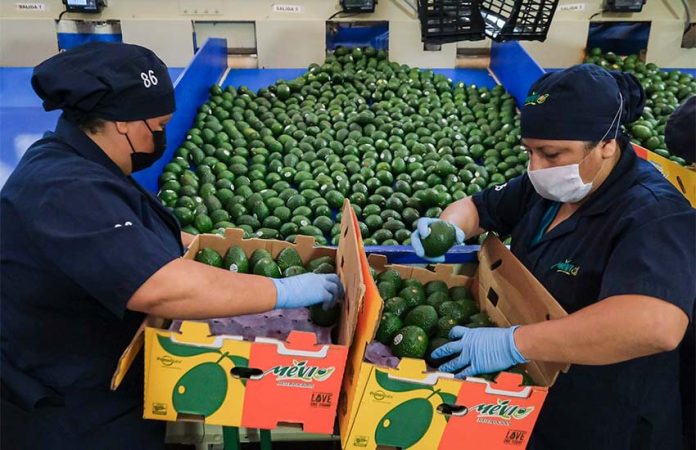
Avocado processing at a plant in Jalisco. Photos: @EnriqueAlfaroR/Twitter
Jalisco has begun exporting avocados to the United States, becoming Mexico’s second supplier of the fruit to the lucrative market.
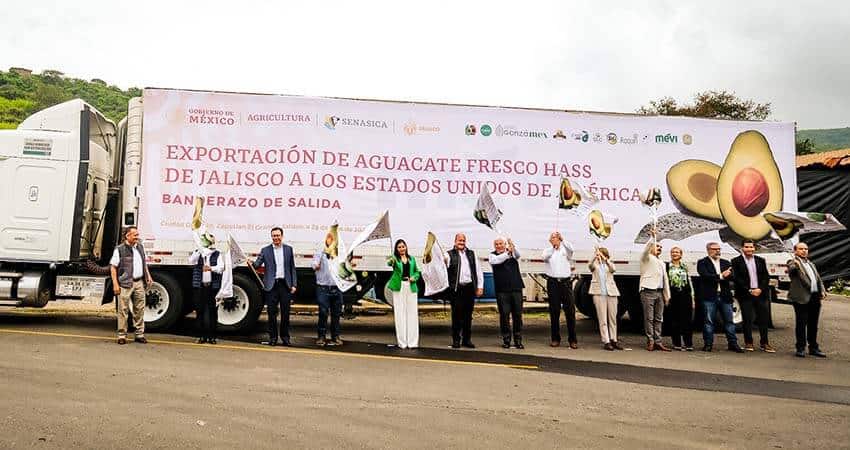
A shipment of 201 tonnes of Jalisco-grown Hass avocados departed the municipality of Zapotlán el Grande in 11 trucks on Thursday. Governor Enrique Alfaro said on Twitter that it was a “historic day for Jalisco, its economy and its countryside,” noting that the United States’ certification of avocados grown in the state came after a decade of work.
For the past 25 years, Michoacán has been the only state authorized to ship avocados to the U.S., where demand for the fruit has increased significantly over the past 20 years. However, the Animal and Plant Health Inspection Service, part of the United States Department of Agriculture, certified Jalisco-grown avocados as being free of diseases and pests earlier this year.
Federal Agriculture Minister Víctor Villalobos Arámbula said Thursday that the commencement of exports was the result of “the commitment, dedication and passion” of avocado producers at 608 orchards and 10 packaging plants in Jalisco that were certified by authorities in both the U.S. and Mexico.
Governor Enrique Alfaro, sixth from left, and other officials gathered Thursday to send off Jalisco’s first shipment of avocados to the United States.
He told attendees at an export inauguration ceremony that it was a privilege for the federal government to work with the Jalisco avocado industry during the certification process. The opening up of the United States as an export market will generate “well-being” for small and medium-sized avocado producers in Jalisco as well as their families and communities, Villalobos said.
In collaboration with federal authorities, several other states – including México state, Puebla, Colima and Morelos – are also aiming to get U.S. certification.
In Jalisco, Villalobos noted, the avocado industry directly employs more than 12,000 people. Before winning U.S. certification, Jalisco-grown avocados were already exported to some 25 countries including Canada, Japan and Spain. The state’s 2021 exports totaled 113,000 tonnes.
Javier Medina Villanueva, president of the Jalisco Avocado Export Association, said the supply of avocados from the state will help bring prices down in the United States, where a single fruit can cost more than US $2.
“When we were talking about very high prices a month ago, it was because the [U.S] market wasn’t getting enough supply,” he said. “So we believe that the entry of Jalisco will close that supply shortage. … I think prices will stabilize.”
Mexico – the world’s largest avocado exporter – is already the dominant foreign supplier of avocados to the U.S. market, but volumes will increase now that Jalisco can send its fruit north. Mexico’s export capacity will increase even further if more states are authorized by the U.S.
Villalobos noted that national production of avocados has tripled over the past 25 years, increasing to 2.4 million tonnes in 2021 from 790,000 tonnes in 1996. He said that exports to a total of 51 countries are worth US $3.1 billion annually, with almost 80% of that revenue coming from the United States.
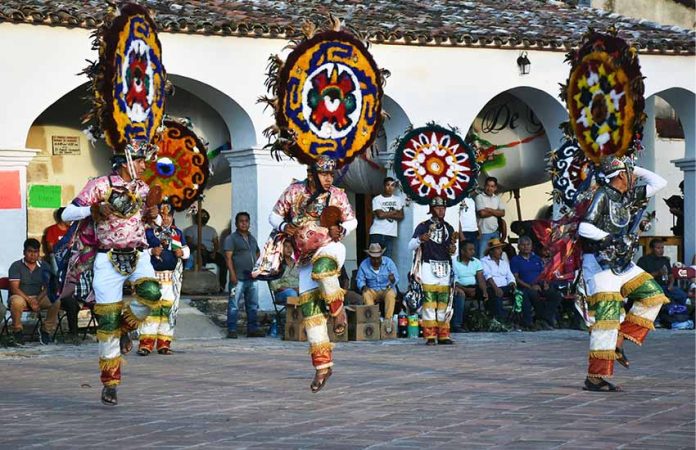
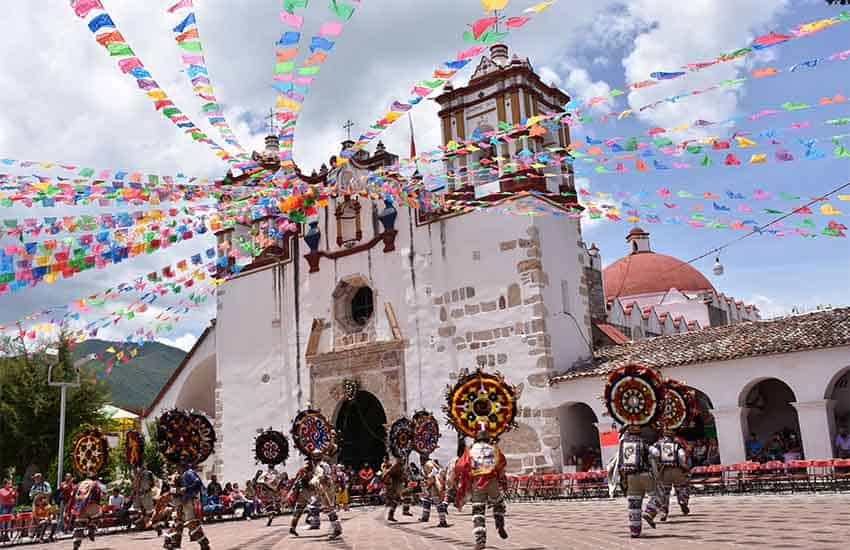
These young men give up much of their lives for three years to learn intricate traditional dances they perform during a six-day annual event in Teotitlán de Valle, Oaxaca. Photos by Joseph Sorrentino
For six days in early July, the atrium of the Iglesia Preciosa Sangre de Cristo in Teotitlán del Valle, Oaxaca is filled with 17 young men dressed in traditional Zapotecan clothing, complete with huge, beautifully crafted headdresses. They, along with two girls, then dance for as long as eight hours, fulfilling a promise to God.
This ceremony is known here as the Preciosa Sangre de Cristo (Precious Blood of Christ).
“We participate to ask for health, for well-being and for work,” said David Santiago Sosa.
The full promise they make—the promesa — is a three-year commitment to participate several ceremonies during the year.
The dance is a retelling of the Conquest story. Emanuel Ruíz Ruíz portrays Moctezuma.
“We also decorate the church and participate in other activities,” said Emanuel Ruíz Ruíz. “It is all done with faith.”
It’s an enormous commitment.
For the young men, it means learning many intricate dances. “It takes eight months to a year to learn the dances because they are very complicated,” said Sosa.
Rehearsals took up seven hours a day, four days a week. “We repeat and repeat until we perfect everything,” Ruíz said.
Seven-year-old Silvia Melisa Zaños portrays La Malinche, Hernan Cortes’ indigenous translator, in pre-conquest indigenous clothing.
“For the first year of the promesa, one cannot work or do anything else,” said José Hernandez Ruíz. Although they can resume studies and work the last two years, Sosa decided to take a break from schooling. “I want to commit 100% to the promesa,” he said.
Silvia Melisa Zaños, seven years old, and Youshita Yamilet, eight, both portrayed La Malinche, the indigenous woman who aided conquistador Hernán Cortés. Zaños dressed in indigenous clothing while Yamilet was in more modern clothing, which portrayed La Malinche after her conversion to Catholicism when she was renamed Doña Marina.
These girls, despite their young age, also made a three-year promesa.
The ceremony is divided into three days. The first day, a Monday, is called the candela, or the candle.
The headdresses, called penachos, weigh 2 kilograms.
“It is a recorrido,” said Ruíz, who portrayed Moctezuma during the event. A recorrido is a walk through a pueblo. This one took about four hours. “It is to tell the pueblo that the fiesta is beginning.”
An orchestra of 32 musicians led the recorrido. Behind them was Marbella Irene Lázaro, carrying a large basket of roses on her head. “I represent all of the single women in the pueblo,” she said.
Then came the 17 young men and the two Malinches. They first stopped at the church atrium, which quickly filled with a couple of hundred young women carrying religious banners. All of the participants then left to continue the recorrido.
The second day is the Baile en la Víspera (Dance of the Evening).
Youshita Yamilet plays the part of La Malinche after the conquest, in more modern dress. She and Zaños also make a 3-year committment to participate in the annual event.
Surprisingly, the music accompanying the dances is classical, mostly waltzes that start slow and then quicken. The young men twirl, jump and kick while balancing penachos, which weigh two kilograms on their heads.
The dance lasted a little over five hours.
The third and final day, for the fiesta of the Precious Blood of Christ, they perform the Danza de la Pluma (Feather Dance).
“On this day, we dance eight hours,” explained Ruíz. “I feel tired, but I have to continue. I can only continue because of my faith. That is what moves me.”
A dancer at the end of the second day.
Thursday is a day of rest and then the ceremony is repeated in full beginning on Friday.
When asked what they would do on Thursday, Hernández answered simply, “Sleep.”
The large stones embedded into the walls of the historic church behind the dancers were taken from the pre-Hispanic pyramid on which the church was built.
A prayer before the dancing starts on Day 3.
Marbella Irene Lázaro carries a basket of roses to represent all the single women in the pueblo.
As part of the procession, women exit the Iglesia Preciosa Sangre de Cristo church and parade religious images with handmade frames around the town.
The girl suffered second-degree burns to 13% of her body.
The National Human Rights Commission is investigating accusations of torture of an 11-year-old Jalisco girl who her mother says was tasered by employees at a mental health facility after being doused with alcohol in a bid to control an anxiety attack.
The incident resulted in second-degree burns to 13% of the girl’s body, according to the newspaper Informador.
The girl, who suffered burns on her thorax, left hand and arm and abdomen, remains hospitalized and has received plastic surgery for her injuries and was due to receive another operation Thursday to determine if she will need skin grafts, Informador said.
The attack, which occurred on Friday at the House of Life, Way to Health facility in Tonalá, located in the Guadalajara metropolitan area, caused sparks that set the girl’s clothes on fire, according to the state human rights commission report.
Authorities conducting a search of the House of Life, Way to Strength in Tonalá, Jalisco.
It has also forwarded the case to the National Human Rights Commission’s Division on Torture.
According to the state commission, the girl was held down by multiple employees then doused with alcohol and tasered. It also said that the employees were trying to subdue the girl after they could not control her during some sort of anxiety attack.
The mother, identified by the newspaper Milenio only as Monica, told Informador that the incident was first reported to her by the facility only on Saturday, when they told her it was an accident.
“They wanted to treat it as an accident, but that wasn’t the case. My daughter accused them to their faces. She told me, ‘No, Mama, they threw alcohol on me and tasered me,’ and she showed me her neck,” Monica said. “It was then that I started thinking about how to get her out of there, and I said that I would take her to be examined [medically],” she said.
The incident, which is being investigated by the state human rights commission, is also being investigated as a case of torture at the national level.
Monica accused the facility of trying to trick her into not reporting the incident to authorities and said that officials offered her financial compensation for her daughter’s medical treatment. She said she reported the incident to authorities on Sunday after the girl was treated at a local emergency center. She was eventually transferred to a Guadalajara hospital for further care.
Monica told Informador that she admitted her daughter to the mental health residential facility less than a month ago because she was at her wits’ end.
“My daughter has anxiety and depression,” she added. “After she threatened to take poison and commit suicide, I was desperate about the situation. And since I knew the owners of the facility, I decided to take her there.”
Neighbors who live around the facility said they often heard shouting, screams and crying coming from the center.
“At dawn, sometimes you’d hear crying, shouts and stuff, but you didn’t know what was going on there. Now that this happened, we’ve been connecting it with what we heard,” said a neighbor.
Jalisco human rights ombusdwoman Erika Córdova said the commission isn’t clear on whether the facility has legal permission to operate and said they are still investigating the case.
“… If [they are not in compliance], Córdova said, “of course they will have to be closed.”
There was movement in the central part of the monstrance that resembled a beating heart.
Did parishioners of a Catholic Church in Jalisco witness a miracle last week? Many seem to think they did although the church itself is urging caution in reaching conclusions about what they saw.
But one church-goer recorded the event on video and it shows the church’s monstrance, a vessel that contained the consecrated Eucharistic host — the wafer used during communion, palpitating like a beating heart.
The video taken at Nuestra Señora del Rosario church in Zapotlanejo has gone viral on the web, and the incident is being described as a miracle by the church’s priest, the Rev. Carlos Spahn. He said a medical doctor has reviewed the tape and concurred that the palpitations mimicked that of a beating heart.
The Rev. Antonio Gutiérrez Montaño, representative of the Archdiocese of Guadalajara, has urged Mexico’s faithful to be cautious, saying there’s been no formal request for an investigation by the archbishop and that in general, the office of the archdiocese is hesitant to believe in such miracles.
Milagro en mexico mientras el padre Carlos Spahn exponía el santísimo la hostia empezó a palpitar. 🙏🏼🙏🏼🙏🏼🙏🏼💖💖 pic.twitter.com/DkOjnBzgQi
“Through an investigation, an official declaration can be made about whether something naturally inexplicable happened, or something imaginary …. to determine if it is real or not so that people will not be fooled. The best thing to do is to be very cautious, very prudent, and know that the real eucharist, the concrete one, doesn’t require supernatural elements. The celebration of each Mass that we attend as believers is a miracle,” said Gutiérrez.
He also said an investigation would take into account scientific evidence, the testimony of witnesses, and analysis from a doctrinal point of view.
Meanwhile, at the parish of Nuestra Señora de Guadalupe in the city of Zapopan, also in Jalisco, another possible miracle is awaiting an investigation: parishioners saw a statue of the Virgin Fatima crying blood on May 13.
On the 365 Flavors of the Yucatán section of the official Yucatán Travel website, one mouth-watering dish pops up after another. Margaritas made with henquen liquor, ceviche made with chivitas snails, and Papadzules smothered in salsa and cheese.
It’s all part of a campaign to spread the word about the peninsula’s incredible cuisine, which is a mix of ancient mesoamerican recipes and ingredients with some modern additions and presentation.
One of those 365 flavors and one of the area’s most famous flavors is poc chuc, a preparation generally made with pork but also sometimes with fish. The protein is marinated with bitter oranges, black pepper, and roasted garlic, grilled over a wood fire, then served with beans, tortillas, habanero salsa, grilled onions, and chopped cilantro.
The dish has become especially famous on what some are calling the “Ruta de las Tías” or the Route of the Aunts, in the town of Kaua which sits between the resorts of Cancún and the archaeological site of Chichén Itzá.
In an attempt to convince customers of their authenticity many of the town’s 10 traditional restaurants have named themselves variations on the same theme: La Tía de Kaua (Kaua’s Aunt), La Verdadera Tía de Kaua (Kaua’s Real Aunt), and La Auténtica Tía de Kaua (Kaua’s Authentic Aunt). Many of the “tías” that started these restaurants, local women with a flair for traditional cooking, can still be found behind the comal and in the kitchen. Lineups wind out the door on the weekends, with a wait of up to two hours if you don’t make an advance reservation to eat here.
In 2021, despite COVID restrictions around the world, Chichén Itzá was Mexico’s busiest archaeological site with 1.6 million visitors, giving the surrounding area, including the tiny town of Kaua and the big city Valladolid, a boost at a time when many tourist destinations were still bemoaning a loss of revenue.
Now tourists to the area have yet another reason besides towering ruins and expansive jungle to visit this unique region of Mexico, the area’s one-of-a-kind cuisine found at the restaurants of the many aunts.
The sun sets behind the dolphins sculpture on the Malecón in Mazatlán. deposit photos
Weekend travelers to Mazatlán beware: if you haven’t booked accommodation you might be out of luck for the rest of the summer. The famed tourist destination on the coast of Sinaloa is currently at 100% occupancy, reported Ricardo Velarde Cárdenas, the local official responsible for tourism.
The city is experiencing a record high number of tourists this summer, with 100% occupancy in hotels and rental properties from Thursday to Sunday from now until mid-August. Monday-to-Wednesday occupancy rates currently stand at 80%.
From the United States alone there were over 2 million visitors to Mexico in the first four months of 2022, many traveling for the first time post-COVID. The local Chamber of Commerce expects 577,000 visitors before the end of the summer holidays in comparison to the 398,253 visitors during the same period last year.
Velarde said tourism will bring an estimated 3.5 billion pesos (US $172 million) flowing into the city this summer, which will be a historic high for a single season. Effects of the massive influx of tourists can be seen in the long lines to get into clubs and restaurants as well as increased demand to visit local sites like El Quelite or La Noria, and take catamaran rides out to the nearby Isla de Piedra.
There are 20,000 rooms available in Mazatlán between hotels, apartments, and Airbnbs. Velarde said that by the end of the season 13 hotels currently under construction will be added to the market to create an additional 11,000 rooms.
“We are at the height of the summer season. The major limiting factor is the number of hotel rooms in Mazatlán, more so than flights, which have actually been very good,” he said.
Increased tourism has been a boon for this seaside destination where the economy largely depends on summer guests. Since COVID began the city has seen successive drops in visitor numbers but there are hopes that this season will see a return to previous numbers.
"We are going to move from the Republican Austerity [Law] to a higher phase, which is that of Franciscan poverty,” President López Obrador said at Wednesday's press conference.
Although one critic called the concept ridiculous and sad, President López Obrador said this week that in order to reduce spending and improve the federal government’s battered financial health, all branches of his government are going to go into a period of “Franciscan poverty.”
“We are going to carry out additional austerity measures,” López Obrador said in his Wednesday morning press conference. “We are going to reduce a lot. There are going to be almost no trips abroad. We are going to ensure that almost all communication is done by telephone and videoconferences. We are going to reduce travel expenses and other measures.”
He said that although there are already austerity measures on the books, they are “not being complied with.” Then he added: “In any case, we are going to move from the Republican Austerity [Law] to a higher phase, which is that of Franciscan poverty.”
Poverty is one of the main tenets of Franciscans, a religious order within the Catholic faith. Saint Francis of Assisi, the founder of the order and one of the most venerated figures in Christianity, spent his life pursuing a “perfect poverty” and was said to be a suitor to “Lady Poverty.”
The planned budget cuts include reducing civil servants’ salaries. On Monday, AMLO had Profeco head Ricardo Sheffield list government officials who earn more than the president.
And now, apparently, so is López Obrador.
In his press conference — during which he assured that he has not bought a new vehicle for federal officials since he has been in office — he detailed some of the additional belt-tightening measures.
Civil servant salaries will be further reduced, and legal reforms will be made to ensure that high-ranking federal officials can’t seek injunctions against a reduced salary, López Obrador said. Nor will the republic acquire any more debt, although the president said he’ll simultaneously make sure that gas and food prices do not rise.
He promised a meeting with his cabinet to hammer out all the X’s and O’s and find additional things to cut. “The formula is simple,” he said. “It is zero corruption and austerity — to make funds available for development and to deliver resources to the most needy people.”
Antipoverty program beneficiaries wait in line. AMLO promised there will be enough money to continue to pay for such programs. File photo
So far, he said, his administration has saved some 2 billion pesos (US $98 million) thanks to austerity measures.
Earlier this week, Ricardo Sheffield, head of the federal consumer protection agency Profeco, presented a list of public servants who, in not complying with the Republican Austerity Law, are receiving a higher monthly salary than López Obrador. “Although our Constitution establishes that no one should earn more than the president, we find [in the government] that this decree is not respected,” he said.
Although López Obrador bragged at the press conference about savings in different areas, he did not address large cost overruns on projects such as the Maya Train, the Felipe Ángeles International Airport and the Dos Bocas refinery.
Some government officials said the president’s announcement was verification that the nation’s finances are in dire straits, that there are no additional sources of revenue that can be tapped and that Mexico’s financial future is teetering in the wake of a global economic crisis.
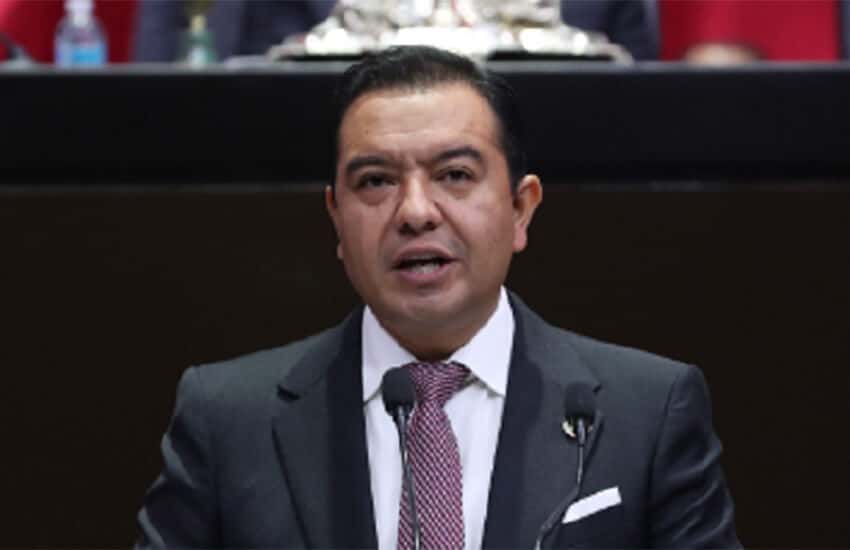
The Mexican legislature’s budget commission secretary Hector Saúl Tellez said Wednesday that money has been wasted on the president’s “pharaonic works” and on social programs “that have not generated better conditions for the population.”
Héctor Saúl Téllez, a member of the lower house of Congress and the Legislature’s budget commission secretary, said federal revenues are “not good” and if they are to be used “for the whims of the president,” public resources will have to be squeezed even further.
“The announcement that there will be a shift to ‘Franciscan poverty’ is very worrying at a time when we continue to experience budget shortages, where there continues to be a lack of resources for health [and] education,” said Congressman Salomón Chertorivski.
He said that if the government carries out this type of plan, it needs to consider how to finance other needs in coming years, such as the payment of pensions. And he also said it’s “foolishness” for the government to continue subsidizing the price of gasoline at a cost of more than 300 billion pesos (US $14.8 billion).
“Saying that there are still more cuts to come is a shame, especially with the lack of growth, with the lack of recovery that we have had after the bad decisions throughout the pandemic,” he added. “The resources are simply not enough.”
AMLO did not address his administration’s cost overruns on projects like the Maya Train, currently under construction. Government of Mexico
He also dismissed “Franciscan poverty” as merely a “flirtatious phrase” being invoked by the president, and called the concept ridiculous and sad. Likewise, Téllez charged AMLO with making a frivolous and populist statement, and he condemned López Obrador’s government for covertly spending 100 billion pesos (US $4.9 billion) on who knows what.
“What there has been is an embezzlement in budget revenues,” he said. “There has never been austerity … Money has been wasted in the president’s pharaonic works and on social programs that have been a waste because they have not generated better conditions for the population.”
The federal cabinet was to meet Thursday to discuss the new measures.