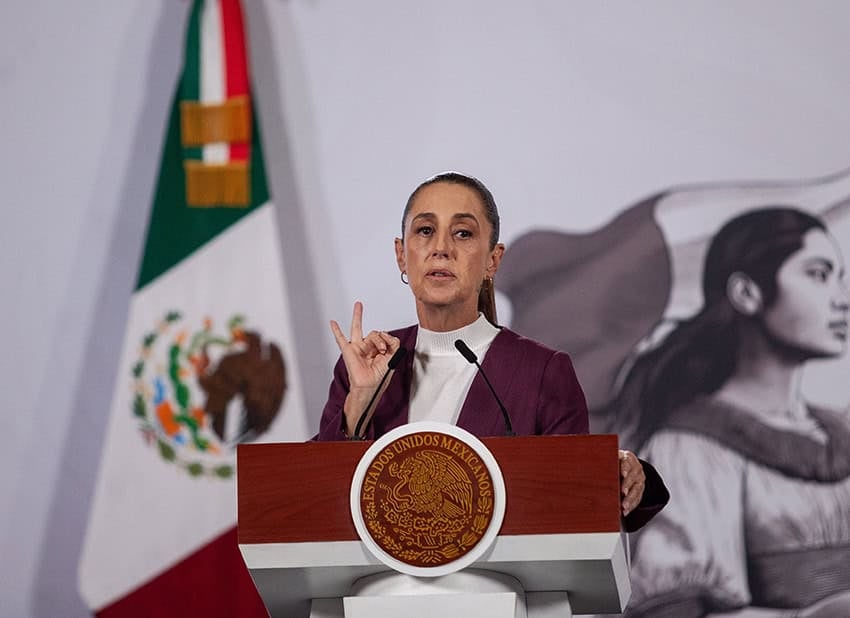
The Senate’s approval of a 40-hour workweek bill, the government’s revocation of mining concessions and the arrival of humanitarian aid in Cuba were among the topics spoken about at President Claudia Sheinbaum’s Thursday morning press conference.
Here is a recap of the president’s Feb. 12 mañanera.
Sheinbaum responds to Senate’s approval of 40-hour workweek bill
Sheinbaum noted that the Senate on Wednesday unanimously approved a bill that seeks to reduce Mexico’s standard workweek from 48 hours to 40.
She acknowledged that the 40-hour workweek is slated to take effect in 2030, after two-hour reductions in each of 2027, 2028 and 2029.
“It was an agreement between unions and employers,” Sheinbaum said, adding that Labor Minister Marath Bolaños worked very hard to achieve the pact.
While it would reduce the number of working hours, the bill passed by the Senate doesn’t stipulate that workers must have two days off per week. The constitutional reform proposal has now been passed to the Chamber of Deputies, but debate on it appears unlikely to commence until late February.
Asked whether it would be possible to not only reduce the standard workweek in hours, but also in days, from six to five, Sheinbaum responded:

“The historic demand of workers has been 40 hours, and we’re complying. In addition, it’s important that [the same] income is guaranteed. It’s not that there [will be] 40 hours at the expense of wages. … That is extremely important.”
Sheinbaum acknowledged that “many workers,” including government employees, already work 40-hour weeks. However, she noted there are “other workers” who spend longer on the job.
According to data from the national statistics agency INEGI, 13.4 million Mexicans currently work more than 40 hours per week. That figure represents just over one in five workers, as Mexico’s workforce is made up of around 60 million people.
Government takes back more than 1,000 mining concessions
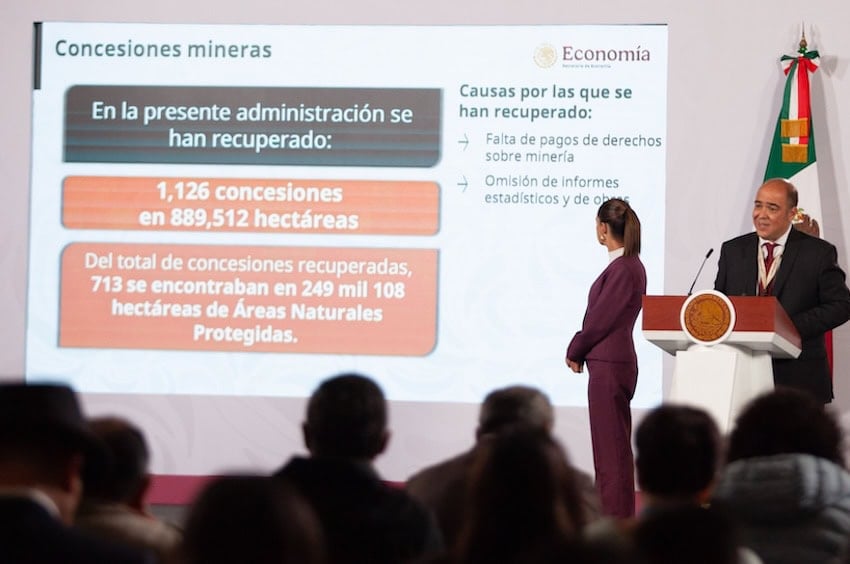
José Fernando Aboitiz Saro, head of the Economy Ministry’s mining division, reported that the current federal government has recovered 1,126 mining concessions covering 889,512 hectares of territory.
“It is almost the size of the state of Querétaro, approximately, to give us an idea of what this means,” he said.
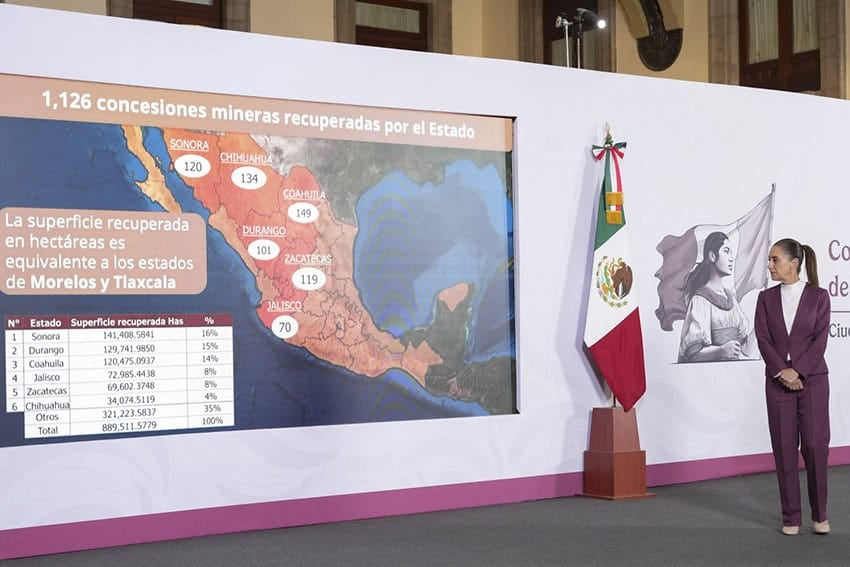
Aboitiz said that among the concessions the government has taken back are more than 700 that correspond to almost 250,000 hectares of land within Protected Natural Areas.
He said the concessions have been canceled due to companies’ failure to pay relevant fees and taxes in a timely manner, and for other bureaucratic reasons.
Economy Minister Marcelo Ebrard said it has been a “priority” of the federal government to also take back concessions that correspond to land where mining activities aren’t currently taking place, or which were acquired for “speculative” reasons.
Aboitiz told reporters that concessions have been canceled across much of the country, with the exception of a few states such as Campeche, Quintana Roo and Tabasco, where he said “virtually” no mining takes place.
According to information he presented, the states where the highest number of concessions have been revoked are Coahuila (149); Chihuahua (134); Sonora (120); Zacatecas (119); Durango (101); and Jalisco (70).
Mexican aid reaches Cuba
Sheinbaum noted that two Mexican Navy vessels carrying more than 800 tonnes of humanitarian aid would reach Cuba this Thursday.
Once the ships return to Mexico, “we’ll send more support of different kinds,” she said.
The departure of the two Mexican Navy vessels last Sunday came 10 days after U.S. President Donald Trump announced that the United States would impose additional tariffs on goods from countries that supply oil to Cuba.
Sheinbaum said that the move — apparently aimed at accelerating regime change in Cuba — “could trigger a humanitarian crisis of great reach, directly affecting hospitals, food supply and other basic services for the Cuban people.”
Mexico — the largest supplier of oil to Cuba in 2025 — is not currently shipping oil to the communist-run island in order to avoid the imposition of additional tariffs on its exports to the United States, but, with its shipments of aid, it is seeking to avoid the kind of humanitarian crisis Sheinbaum warned of.
The president reiterated on Thursday that Mexico could act as mediator in diplomatic talks between Cuba and the United States, if those two countries are willing to engage with each other.
By Mexico News Daily chief staff writer Peter Davies (peter.davies@mexiconewsdaily.com)