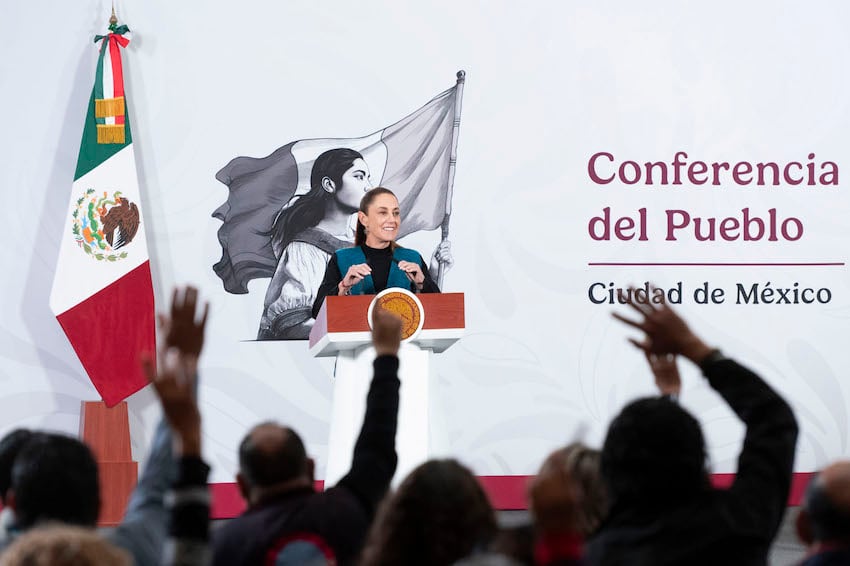
The FIFA men’s World Cup trophy made an appearance at the end of President Claudia Sheinbaum’s Tuesday morning press conference as part of its Coca-Cola-sponsored tour of Mexico ahead of the commencement of the quadrennial tournament in Mexico City on June 11.
The president even held the trophy aloft, eliciting applause from the press corps and Coca-Cola México president Louis Balat, among others.

Earlier in the mañanera, Sheinbaum responded to questions on a range of topics, including the Mexican military, which has been in the spotlight recently after carrying out an operation against the now-deceased Jalisco New Generation Cartel leader Nemesio Rubén “El Mencho” Oseguera Cervantes.
Sheinbaum defends use of military in public security tasks
After noting that the armed forces have played a prominent role in Mexico in recent years, a reporter asked the president “what conditions” would be required in order to reduce the “participation” of the army in “the national life of the country.”
Sheinbaum didn’t directly answer the question, instead launching into a lengthy defense of the Mexican military.
“It’s legal, that’s the first thing,” she said, referring to the use of the armed forces for public security tasks.
“We are not doing anything illegal, as [ex-president Felipe] Calderón did at the time. Felipe Calderón deployed the Army and Navy in the famous ‘war on drugs,’ and there were no legal grounds for doing so,” Sheinbaum said, referring to the militarized war on cartels the former president launched shortly after he took office in 2006.

“… Now there is a legal framework for doing so. So, that is important,” she said.
Broadening her criticism of Calderón’s 2006-12 government, Sheinbaum highlighted that Mexico “had a security minister who was linked to drug-trafficking.”
Although she didn’t mention him by name, she was referring to Genaro García Luna, who was Calderón’s security minister but is now serving a lengthy prison sentence in the United States after he was convicted in 2023 of colluding with the Sinaloa Cartel.
Sheinbaum pointed out that the National Guard is now part of the Ministry of National Defense, but highlighted that it has a different leadership from that of the Mexican Army.
She also stressed that National Guard members receive different training from soldiers, training that is focused on public security rather than national security. Strengthening the almost seven-year-old security force is one of the core tenets of the federal government’s security strategy.
After heaping praise on the Mexican Army — which she described as “something special” and “unique in the world” — Sheinbaum rejected claims made by non-governmental organizations and others that Mexico has been militarized by her government and its predecessor, which put the military to work on a range of non-traditional tasks such as building infrastructure and managing ports.
“This idea of ‘militarization’ that is being promoted is not true,” she said, before highlighting that she, rather than military personnel, has the ultimate responsibility for governing the country.
“Due to the decision of the people of Mexico, I am the supreme commander who makes the decisions,” she said.
Sheinbaum: No evidence that remittances are being used to launder money
A day after the Bank of Mexico published remittances data for January, Sheinbaum asserted that there is no evidence that the transfer of remittances to Mexico is linked to money laundering.
“There is nothing in the investigations that could suggest that remittances are related to any issue of money laundering, nothing,” she said.
Sheinbaum said that the Finance Ministry’s Financial Intelligence Unit has investigated and found no links between remittances and money laundering.
A 2023 study by the think tank Signos Vitales found that around 7.5% of the more than US $58 billion in remittances sent to Mexico in 2022 could be linked to drug trafficking, while last year U.S. authorities accused three Mexican financial institutions of laundering millions of dollars for drug cartels.
Sheinbaum highlighted on repeated occasions that the U.S. government didn’t provide evidence to back up their accusations against CIBanco, Intercam and the brokerage firm Vector, all of which have ceased operating in Mexico. Last November, she also noted that Mexican authorities didn’t find any evidence showing that the financial institutions had links to organized crime or engaged in money laundering.
By Mexico News Daily chief staff writer Peter Davies (peter.davies@mexiconewsdaily.com)