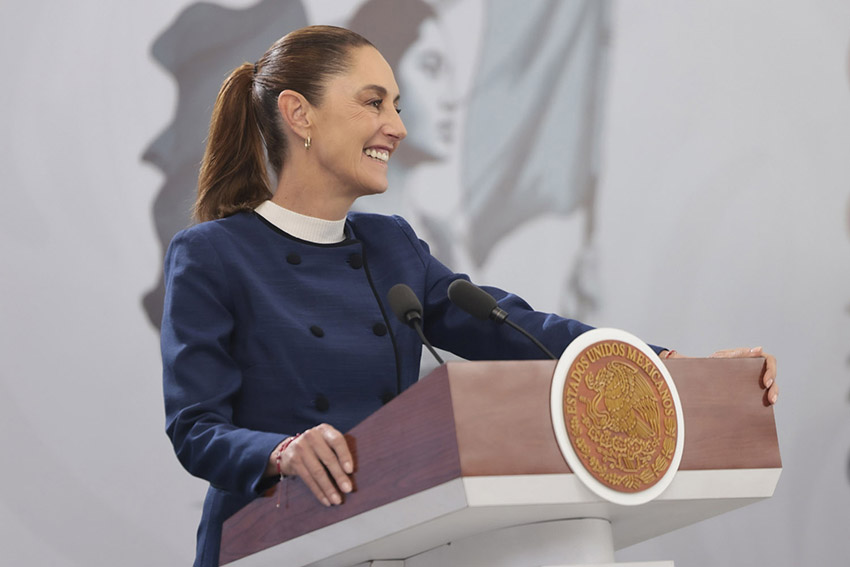
President Claudia Sheinbaum held her Friday morning press conference in Zapopan, a municipality in Jalisco that is part of the metropolitan area of state capital Guadalajara.
Early in the mañanera, Jalisco Governor Pablo Lemus welcomed the president to the state, before declaring that her presence was very “significant” and showed “great solidarity” with “our state,” where violent cartel chaos broke out 12 days ago in response to a military operation targeting Nemesio Rubén “El Mencho” Oseguera Cervantes, the now-deceased Jalisco New Generation Cartel (CJNG) leader.
Sheinbaum said that her government is working to achieve peace and security in Jalisco, as well as “the well-being of the residents of this beautiful state.”
Later in the press conference, security officials presented the latest data on homicides and arrests in Jalisco, and outlined Plan Kukulkán, the government’s World Cup security strategy.
Jalisco homicide data
National Public Security System (SNSP) chief Marcela Figueroa reported that there was an average of 2.55 homicides per day in Jalisco in January.
She highlighted that the daily murder rate in January represents a reduction of 47% compared to September 2024, the final month of Andrés Manuel López Obrador’s presidency.
✅ Reducción del 47% en homicidios dolosos en Jalisco gracias al trabajo coordinado entre el @GobiernoMX y el estado.
Enero de 2026 registra el nivel más bajo desde 2015. pic.twitter.com/tNCbNMaOaL
— Coordinación Nacional de Protección Civil (@CNPC_MX) March 6, 2026

However, according to the data Figueroa presented, the daily homicide rate in Jalisco in January was 47% higher than in September 2025, the month with the lowest number of murders since Sheinbaum took office in October 2024.
The SNSP chief also presented data that showed that Jalisco’s daily homicide rate was 4 in 2025, a reduction of 19.5% compared to 2024.
Among Mexico’s 32 federal entities, Jalisco recorded the eighth highest number of homicides in 2025, according to data presented by Figueroa in January.
Arrests and drug seizures in Jalisco
Federal Security Minister Omar García Harfuch reported that between Oct. 1, 2024 — the date Sheinbaum took office — and Feb. 28, 2026, authorities arrested 890 people in Jalisco for allegedly committing high-impact crimes such as murder, kidnapping and extortion.
He said that authorities seized 626 firearms and over 10 tonnes of drugs in Jalisco in the same period. García Harfuch also said that the Army and Navy dismantled three synthetic drug laboratories in the state during the past 17 months.
“These actions have had a significant impact on the operation and financial capacity of the criminal organizations that operate in the entity,” he said.
The most powerful of those groups is undoubtedly the CJNG. It remains to be seen whether the death of the cartel’s founder and longtime leader will result in an increase in violence in Jalisco as El Mencho’s erstwhile underlings vie to succeed him.
Plan Kukulkán
Two days after Mexican officials met with FIFA representatives to discuss security arrangements for the men’s World Cup in Mexico, García Harfuch announced that Mexico’s security strategy for the event is called Plan Kukulkán, named after the serpent deity of Maya mythology.
He said that the plan is designed to “guarantee conditions of protection before, during and after” the World Cup, which Mexico is co-hosting with the United States and Canada. A total of 13 matches will be played in Mexico at stadiums in Mexico City, Guadalajara and Monterrey.
García Harfuch said that the security plan is “coordinated by the government of Mexico,” and will involve the participation of 20 federal departments as well as state and municipal authorities.
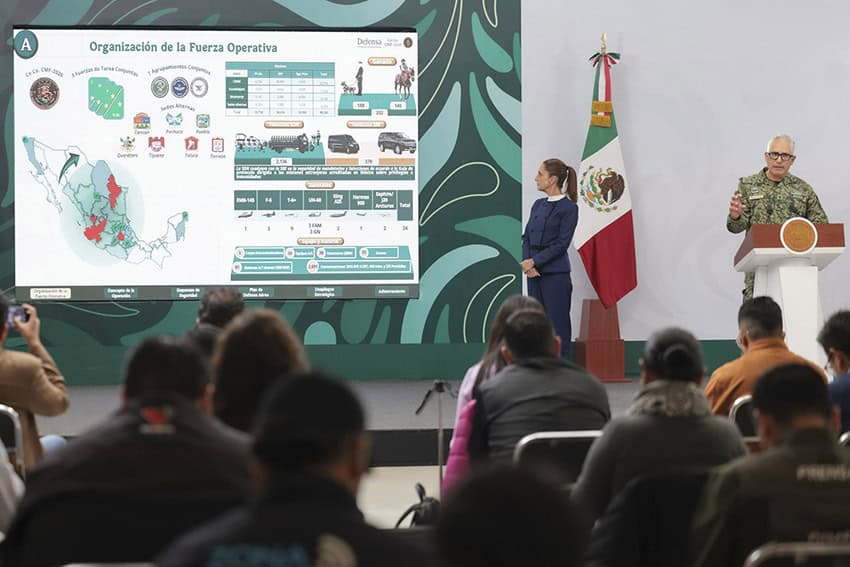
“It includes international cooperation mechanisms with the United States, Canada, and FIFA to strengthen information sharing, operational planning, and the timely management of risks,” he added.
Later in the press conference, Román Villalvazo Barrios — the head of Mexico’s World Cup Coordination Center — said that “joint task forces” will be created to manage security in each of the three host cities.
Villalvazo also said that around 20,000 members of the armed forces and the National Guard, and some 55,000 police officers will contribute to the implementation of Plan Kukulkán. Around 20,000 private security guards will also participate in the execution of the plan, he said.
All told, close to 100,000 security personnel will be deployed to carry out World Cup-related security tasks during the five-week tournament.
After the presentations by security officials, Sheinbaum declared that Mexico is “extremely well-prepared” for the event.
The first World Cup match will take place in Mexico City on June 11, with Mexico squaring off against South Africa at Estadio Azteca.
CJNG’s power has ‘definitely’ declined, says García Harfuch
During the Q&A section of the mañanera, a reporter said that around 200 leaders and members of the CJNG have been arrested, although he didn’t specify the period he was referring to. The reporter asserted that the cartel’s power “has obviously declined” as a result of the arrests, an observation that García Harfuch said was “definitely” correct.
🚨 Omar García Harfuch informó la detención de 70 presuntos criminales en siete estados, tras una jornada marcada por múltiples enfrentamientos.
El funcionario detalló que en Jalisco se registraron 27 agresiones contra fuerzas de seguridad, calificadas como “cobardes”.
Los… pic.twitter.com/4o55Yqt8Rm
— Aristegui Noticias (@AristeguiOnline) February 23, 2026
The security minister added that after the violent response to El Mencho’s death, authorities “were able to reestablish peace” in Jalisco “very quickly.”
Sheinbaum made similar remarks on Monday.
While it may be weakened, the CJNG is still considered one of the two most powerful criminal organizations in Mexico, the other being the Sinaloa Cartel. The CJNG operates in the vast majority of Mexican states, but its heartland is Jalisco.
Could the US carry out a unilateral military action against cartels in Mexico?
A reporter noted that U.S. Secretary of War Pete Hegseth said on Thursday that the United States was prepared to take unilateral action against drug cartels in Latin America.
The Associated Press reported that Hegseth “urged Latin American countries to take a more aggressive approach against drug cartels, warning that the Trump administration would be forced to act by itself if governments fail to effectively combat criminal organizations that directly threaten the United States and border security.”
“America is prepared to take on these threats and go on the offense alone if necessary,” he told defense officials from 16 Latin American and Caribbean countries during a speech at U.S. Southern Command in Miami.
“However, it is our preference, and it is the goal of this conference, that in the interest of this neighborhood, we all do it together with you,” Hegseth said.
The Guardian noted that officials from “three key nations with a significant share of drug production or trafficking — Colombia, Mexico and Brazil — did not attend” the event in Miami.
The aforesaid reporter asked Sheinbaum whether Mexico has avoided the possibility of a unilateral U.S. action thanks to “the downfall of Nemesio Oseguera,” who was located in Tapalpa, Jalisco, as a result of Mexican and U.S. intelligence.
The president — as she has done numerous times before — pointed out that Mexico and the United States have a security “understanding” that allows bilateral “coordination,” including via the exchange of intelligence. However, each country has to operate “in its own territory,” said Sheinbaum, who frequently asserts that her government will not accept any kind of U.S. military action in Mexico or any other violation of Mexican sovereignty.
U.S. President Donald Trump said in January that the United States would start “hitting” cartels on land in Mexico, but after speaking with her counterpart on Jan. 12, Sheinbaum declared that U.S. military action south of the border could be ruled out.
On Friday morning, she said that Mexico and the United States would continue to carry out security operations in their own territory, and noted that officials from the two countries would gather for another bilateral security meeting soon.
By Mexico News Daily chief staff writer Peter Davies (peter.davies@mexiconewsdaily.com)