
At MND, we’re always looking for new perspectives on the United States-Canada-Mexico relationship from leaders and organizations working to improve trilateral relations through fact-based data and reporting.
One of those leaders is Ana Valdez of the Latino Donor Collaborative (LDC), a non-profit organization and think tank she has led as president and CEO since 2014.
Valdez, a Mexico City native, emigrated to the United States in the 1990s and got a volunteer job in the White House when Bill Clinton was president. Fast forward to today, and she is on Forbes’s “50 over 50” list — a selection of women aged over 50 who are doing ambitious, influential and powerful work in the United States.
The LDC, according to the organization’s website, is “dedicated to reshaping the perception of Latinos as part of the American social mainstream.”
This is very important work, Valdez told Mexico News Daily during a recent interview.
“When I [first] came here, I saw a huge disconnect between the perception of who Latinos are in the United States and the reality of who they are,” she said.

“One misconception is that everybody is an immigrant. That matters because about 70% of Latinos in this country have been here for many generations. Some were here even before this [land] was the United States,” Valdez said.
CDMX to LA via Spain and Switzerland
“Since taking the helm of the Latino Donor Collaborative in 2014, Ana Valdez has led an organization that represents the economic interests of all Latinos in the U.S,” states a brief profile of the 64-year-old that Forbes published as part of its “50 over 50” list.
“In 2023 she launched the nonprofit’s Latino Data Collective, which puts economic data and market information about Latinos into the hands of more than 650,000 CEOs, politicians, board directors and media executives.”
Before moving to the United States close to 30 years ago, and joining the Los Angeles-based LDC more than a decade ago, Valdez studied and worked in Europe for a period. Before that, she completed a bachelor’s degree in business and marketing at Mexico’s Tec. de Monterrey university.
“I was born and raised in Mexico City,” she told MND, beginning a highly condensed version of her life story.
Valdez noted later in our interview that she completed a master’s degree in international relations in Spain and subsequently worked with the United Nations in Switzerland.
“After living in Europe for four years, I came to the United States and found the Latino community. I didn’t know about it growing up in Mexico City, and I didn’t know about it in Europe,” she said.
Valdez explained that she traveled to the United States to work on a PhD thesis, but ended up getting a volunteer job at the White House, “and after three months they hired me.”
“I stayed and never finished my PhD,” she said.
In addition to working at the White House in both a volunteer and paid capacity, Valdez held positions at Nielsen and Banamex before her appointment as CEO of LDC.
“My first job was at Nielsen, so I’m a nerd — [I love] using data … to do anything [related] with business,” she told MND.
“I’ve been madly in love with data ever since,” Valdez said before correcting herself to note that her passion for statistics actually dates back to her college days.
The LDC’s mission and vision
The LDC, the organization says on its website, “was founded in 2010 after a group of national business leaders identified a critical gap: the lack of an accurate narrative about Latinos, resulting in the perpetuation of harmful stereotypes.”
“This gap in understanding about U.S. Latinos was particularly troubling, as some states began passing laws that allowed for the arbitrary arrest of individuals based on these stereotypes,” the LDC says.
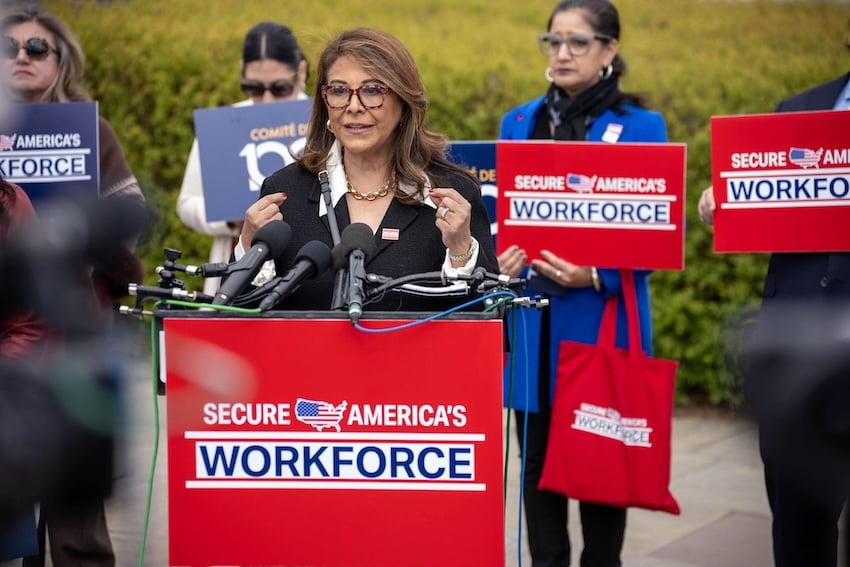
“In response to these alarming developments, co-founders and national leaders Sol Trujillo and Henry Cisneros [a former U.S. secretary of housing] recognized the urgency of creating a bipartisan non-profit organization and producing reputable data and statistics that accurately reflect the identity of Latinos in America and their contributions to the nation.”
The LDC says it “produces the most reputable data on Latinos in the United States,” much of which is compiled from official U.S. government stats, according to Valdez.
The organization says that the statistics it presents are “critical to the U.S. economy, workforce, business development, entertainment, and several other key aspects of American prosperity” given that members of the U.S. Latino community account for 20% of the entire U.S. population and more than one-quarter of Americans aged 18 and under.
The organization says its mission is to “reframe and advance an accurate perception, portrayal, and understanding of the important contributions that American Latinos make to American society,” while its vision is for “American Latinos to be recognized as valued, patriotic Americans in all facets of American life.”
A central element of the LDC’s strategy to reframe perceptions of Latinos in the United States — including some 40 million people of Mexican origin — is the publication of data-heavy reports focusing on the Latino population’s contributions to the U.S. economy and society. Among the more than 60 reports the organization has published are the “2026 LDC U.S. Latino Economic Impact Report” and “Data Beyond Demographics: U.S. Latinas’ Economic Power, Influence, and Growth.”
Mexico News Daily will soon begin presenting some of the key data in LDC reports in articles with an easy-to-read, visually engaging format.
“For us, collaboration is amplification,” Valdez said, referring to a partnership with MND.
“We believe from the bottom of our hearts and minds that this information helps everybody. It helps Americans in Mexico, too. There are so many Americans living in Mexico right now, and it would be a blind spot not to inform them about people who are doing exactly the opposite,” she said.
Changing Latinos, changing perceptions
Valdez told MND that Latinos made up around 7% of the U.S. population in 1960, whereas they account for 20% today, an increase attributable to both immigration and the birth in the United States of millions of Latino babies.
“People didn’t know Latinos before because they were only 7% [of the U.S. population],” she said.
“The preconceived idea of Latinos was perhaps someone seen as a valet parker, a housekeeper or a gardener.”
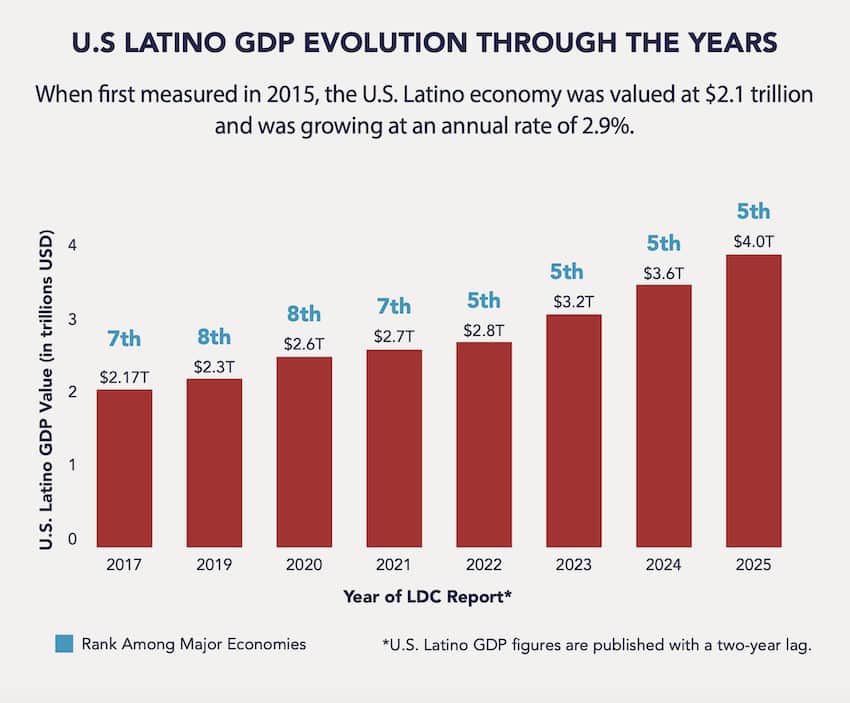
Valdez acknowledged that many Latinos worked — and continue to work — such jobs. However, she emphasized that many Latinos are now business owners or work in professional fields. In a 2025 infographic, the LDC highlights that there are “approximately 5.7 million U.S. Latino enterprises in the U.S.”
Valdez noted that many recent — and in some cases undocumented — Latino immigrants to the United States have attempted to maintain a low profile while the Trump administration carries out an aggressive deportation agenda. However, U.S.-born Latino “kids” are “completely different,” she said.
“…[Market research company] Kantar calls these young people ‘200 percenters,'” Valdez said.
“They feel 100% American and 100% Latino too. Contrary to their parents, they are not ashamed or embarrassed. They are unapologetic about being Latino. They’re proud, comfortable and confident. Their friends and peers want to know more [about Latino culture], want to learn Spanish, want to dance to Bad Bunny,” she said, providing one example of how U.S. perceptions of Latinos, and Latino culture, have changed.
“… Every year, thousands or hundreds of thousands of Latinos turn 18. They vote. They go to college. If they don’t go to college, they work in much better environments than the fields where their parents worked. They are assertive [and] speak English perfectly,” Valdez said.
She subsequently noted that her husband is Mexican-American, “from one of the families that came to what is now the United States when it was still Mexico.”
“… The border crossed them when the United States took over New Mexico and many other states,” Valdez said.
“… When my husband was growing up in Colorado, people were bullied for speaking Spanish. He remembers his mother putting burritos in his lunch. He was embarrassed when he opened it and it smelled, so he would put it away, not eat it and throw it out. He was bullied because of it,” she said.
“Fast-forward to our kids in a school on the west side of Los Angeles. We realized that one of them was charging his friends to bring them home for lunch because everyone wanted real Mexican food. His white friends wanted it,” Valdez said.
“So it is a complete change,” she said.
Beyond greater acceptance in the U.S. of Mexican food and the cuisines of other Western Hemisphere countries — and indeed increased desirability and “trendiness” of such food — there is growing recognition of the immense contribution Latinos make to the United States.
Unfortunately, however, there is still discrimination against Latinos in the U.S., while certain stereotypes and misconceptions persist. The LDC, as it has done since its foundation, will continue to work to counteract those enduring problems.
It’s not just Forbes taking notice of Valdez’s work
Forbes is by no means the only prominent media organization that has taken notice of LDC’s work under Valdez’s leadership. Among the others are CBS News, CNBC, Variety and Axios.
Valdez has also come to the attention of the Mexican government, leading to invitations to speak at President Claudia Sheinbaum’s morning press conferences.
At Sheinbaum’s May 22 mañanera, the LDC CEO presented a range of data about women of Mexican origin in the United States, including one particularly striking statistic — that those women contribute US $1.1 trillion to U.S. GDP on an annual basis.
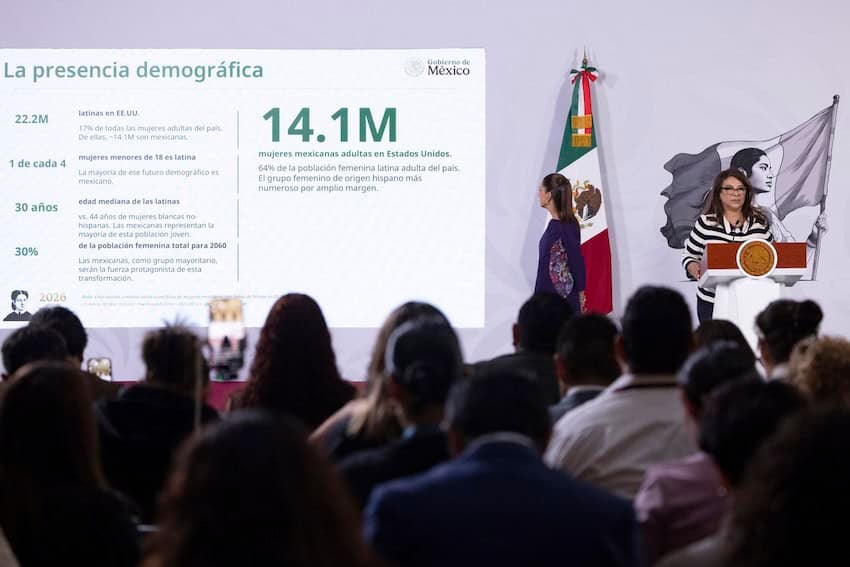
When we asked Valdez why she — a Los Angeles-based data expert focused on Latinos in the U.S. — had been invited to speak at the president’s mañanera on numerous occasions, she noted that Sheinbaum is a scientist who “likes numbers.”
“When a scientist realizes that there are almost 40 million nationals or people with Mexican national background living in the United States, and that Mexico was not in touch with them, she wanted to know more about them and begin engaging them,” Valdez said, noting also that Sheinbaum has been a strong supporter of Mexican deportees and the Mexican community in the U.S., including people at risk of deportation.
By Mexico News Daily chief staff writer Peter Davies (peter.davies@mexiconewsdaily.com)