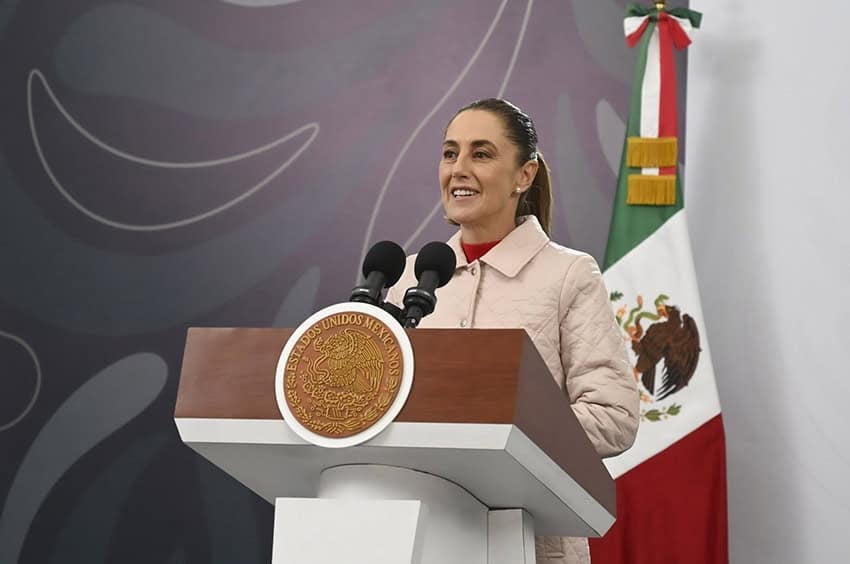
President Claudia Sheinbaum held her Friday morning press conference in Morelia, capital of the state of Michoacán.
“Buenos y fríos días,” Sheinbaum said at the start of her mañanera, simultaneously greeting reporters and acknowledging the frigid start to the day.
“… We’re going to present some of the advances of Plan Michoacán,” she said, referring to the security strategy the federal government devised in response to the murder of the mayor of Uruapan on Nov. 1 and general insecurity in the state.
Almost 2,000 additional troops were deployed to Michoacán as part of the 57-billion-peso (US $3.3 billion) plan, which is based on 12 central tenets (detailed here).
Homicides decline after implementation of Plan Michoacán
Marcela Figueroa, head of the National Public Security System, presented data that showed that the average daily homicide rate in Michoacán declined from 3.48 in October to 1.97 in November, before increasing to 2.45 in December.
Plan Michoacán for Peace and Justice was announced on Nov. 9 and its implementation began shortly thereafter.
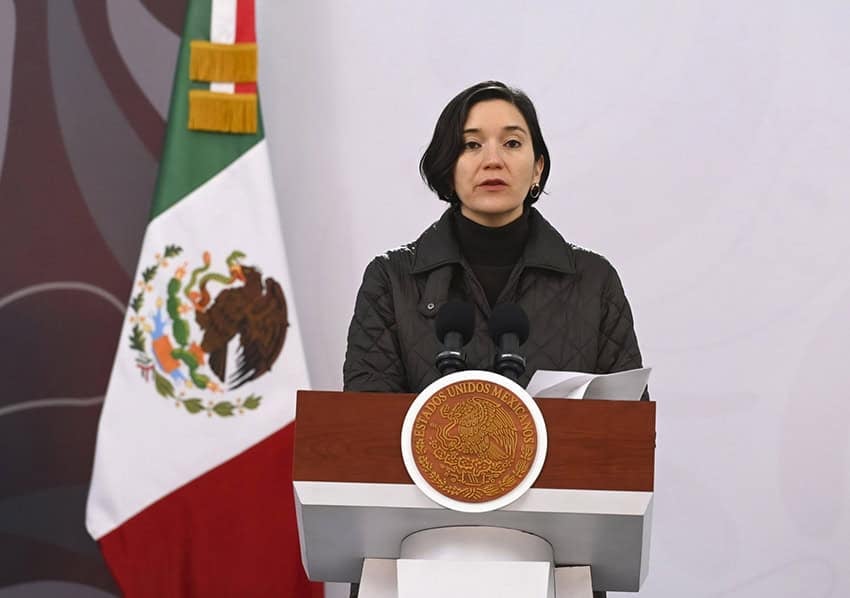
In percentage terms, the reduction in the daily homicide rate between October and November was 43.4%, while the decline between October and December was 29.6%.

Figueroa also presented data that showed that the daily homicide rate in Michoacán across 2025 was 3.5, a decline of almost 15% compared to the 4.1 rate in 2024.
Considering total homicides, Michoacán ranked as Mexico’s seventh most violent state in 2025, with 1,267 murders.
More than 400 arrests in Michoacán since Nov. 10
Security Minister Omar García Harfuch reported that between Nov. 10 and Jan. 20, “within the framework of Plan Michoacán,” authorities arrested 430 people.
In the same period, he said that authorities confiscated 240 firearms, almost 17,000 cartridges, 347 vehicles, 200 explosive devices, 53 kilograms of explosive material, more than 700 kilograms of methamphetamine, 28,800 liters of chemical substances used to make meth and 15,300 kilograms of such substances.
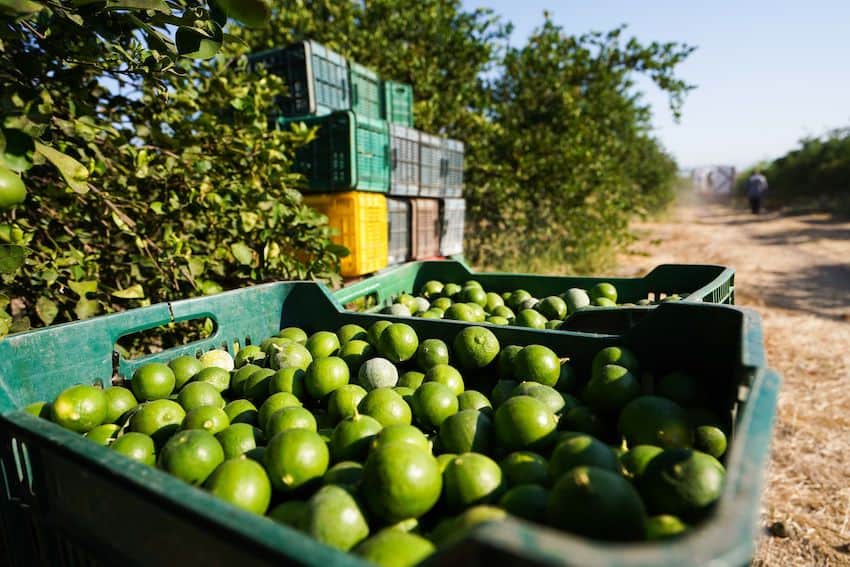
García Harfuch highlighted that soldiers and National Guard personnel have been carrying out patrols aimed at protecting the avocado and citrus industries in Michoacán, which are common targets of extortionists.
Sheinbaum: Plan Michoacán is not ‘temporary’
After Michoacán-focused presentations from various federal officials, Sheinbaum reminded reporters that Plan Michoacán was “designed” by the government after the “unfortunate homicide of Carlos Manzo, mayor of Uruapan.”
“We haven’t just been working in Uruapan, but in the entire state of Michoacán, in coordination with the state government,” the president said.
“And we’re going to keep working.”
Sheinbaum stressed that Plan Michoacán is not solely focused on security issues, but rather is a “comprehensive plan” to attend to the needs of residents of the state, especially young people.
The plan includes economic initiatives, infrastructure projects and investment in housing, and aims to make improvements in the quality of education and health care in Michoacán, among other objectives.
Sheinbaum stressed that the plan will continue until 2030, the year her six-year term will end.
“It’s not a temporary plan, it’s not a one-month or two-month plan, but rather permanent work,” she said.
Sheinbaum says she personally received complaints about mayor of Tequila
A day after the arrest of the mayor of Tequila, Jalisco, on extortion charges, García Harfuch said that around 60 public servants have been detained during the execution of Operación Enjambre (Operation Swarm), a security strategy aimed at combating collusion between organized crime and municipal government officials.
Sheinbaum said that investigations into municipal officials are carried out “based on complaints” received by authorities.
“For example, in the case yesterday of the arrest of the mayor of Tequila, Jalisco, the security cabinet of the government of Mexico and obviously the Federal Attorney General’s Office received a lot of complaints, … a lot of citizens’ complaints,” she said.
“… I even personally received complaints from businesspeople in the area, from citizens, who complained about the situation they were experiencing and accused the mayor,” Sheinbaum said.
Mayor of Tequila, Jalisco, arrested for extortion and alleged cartel ties
In addition to Mayor Diego Rivera Navarro, three directors in the Tequila municipal government were arrested on Thursday. All of the detainees were allegedly involved in an extortion scheme that targeted businesses, including tequila makers, in Tequila, located about 60 kilometers northwest of Guadalajara.
The four suspects allegedly have links to the Jalisco New Generation Cartel.
Sheinbaum noted that the mayor is from Morena, the party founded by former president Andrés Manuel López Obrador, and which currently controls both houses of federal Congress.
“No political party, least of all Morena, can be a cover for crime or corruption. That must be made very clear,” she said.
Asked how Rivera was able to become Morena’s candidate for mayor in Tequila, Sheinbaum said there was no prior evidence that he had links to organized crime or that he would engage in corruption as mayor.
She said that before municipal, state and federal candidates are endorsed by Morena, the party asks the Federal Attorney General’s Offices and state Attorney General’s Offices whether those persons are under investigation for any crime.
“The response was negative in all cases, of all candidates,” Sheinbaum said.
By Mexico News Daily chief staff writer Peter Davies (peter.davies@mexiconewsdaily.com)