Among the topics President Claudia Sheinbaum spoke about at her Monday morning press conference were Bad Bunny’s performance at the Super Bowl in California on Sunday and a New York Times article headlined “Mexican Cartels Overwhelm Police With Ammunition Made for the U.S. Military.”
Sheinbaum also acknowledged that two Mexican Navy vessels carrying humanitarian aid are on their way to Cuba, and pledged that Mexico will provide more support to the embattled Caribbean island nation.
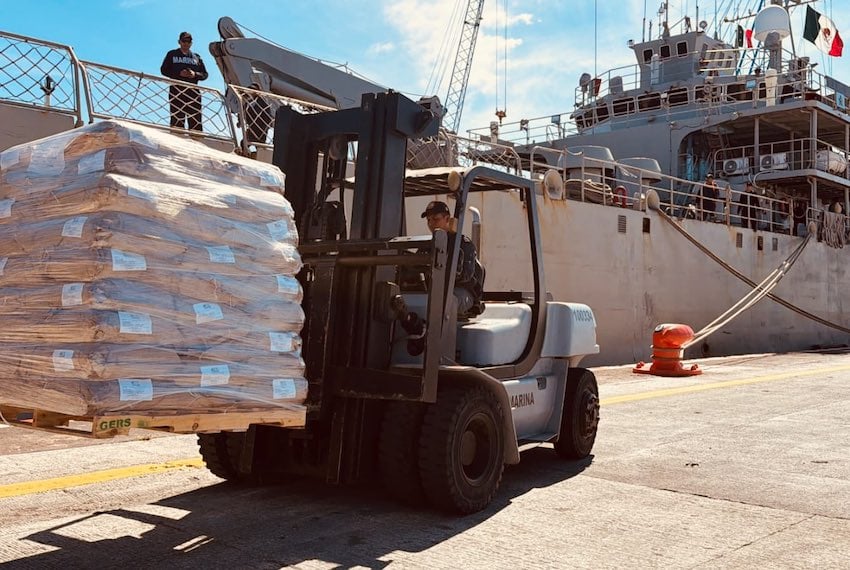
(Click here to read Mexico News Daily’s report on the dispatch of aid and Sheinbaum’s remarks.)
‘The best antidote to hate is love’: Sheinbaum reacts to Bad Bunny’s Super Bowl performance
A reporter noted that Bad Bunny — a Puerto Rican rapper and singer whose real name is Benito Antonio Martínez Ocasio — performed at the Super Bowl on Sunday and sent “a very important message of unity for Latin America.”
He also noted that, during a performance filled with “symbolism,” Bad Bunny conveyed the message, “the only thing more powerful than hate is love.”
“What is your opinion about this message, presidenta?” the reporter asked.
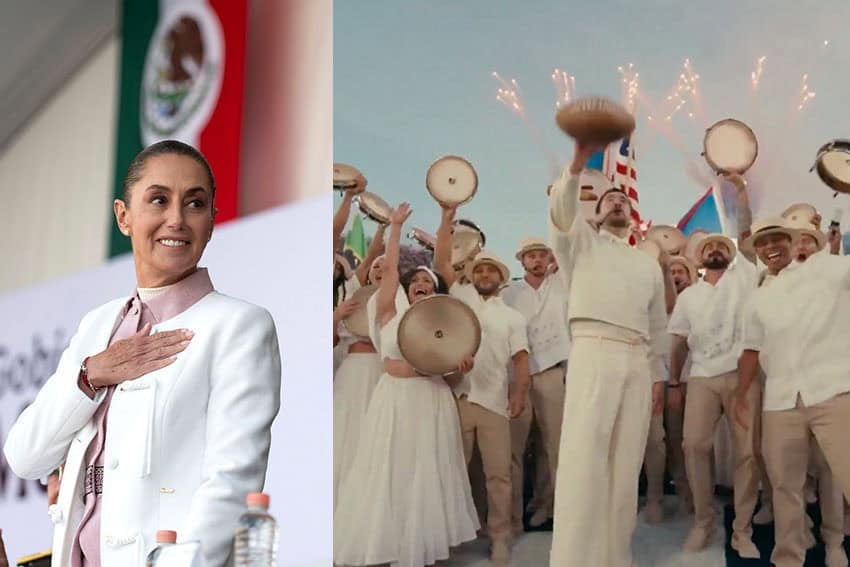
“Very interesting, isn’t it? That he sang in Spanish at the Super Bowl and that the message is of unity of America, of the American continent,” Sheinbaum said.

She noted that the man known as the “King of Latin Trap” mentioned “all” (or at least most of) the countries of the Americas during his performance, “including the United States and Canada.”
“So, he’s speaking about the American continent. Very interesting, isn’t it? And a lot of symbols indeed. And indeed, the best antidote to hate is love,” Sheinbaum said.
“… We want to strengthen America, the American continent,” the president — an advocate of adding other countries in the region to the USMCA free trade pact — said later in her mañanera.
“… In that way, we could complete a lot [better] with any [other] region of the world,” Sheinbaum said.
During his performance, Bad Bunny shouted “Seguimos aquí” (We’re still here) — a reference to Latinos in the U.S. and across the Americas at a time when the Trump administration is carrying out an aggressive deportation agenda — and held up a football emblazoned with the message “Together, We are America.”
ABC News reported that “by naming each nation [of the Americas], Bad Bunny underscored how expansive and diverse the Americas are, … and highlighted a perspective beyond one that views ‘America’ simply as shorthand for the U.S.”
The New York Times reported that the performance “was a kaleidoscopic blast of merriment — a showcase of some of the most ecstatic and celebratory aspects of Latin culture.”
In Mexico News Daily, Charlotte Smith wrote that what she saw “wasn’t a halftime performance, it was daily life rendered without apology.”
Opinion: Bad Bunny’s Super Bowl performance reaffirmed the life I’ve chosen here
“It was the kind of imagery Anthony Bourdain understood so well. Not the postcard version of a place, but the unstyled, lived-in one,” she said.
The news outlet Infobae reported that there were “four winks” to Mexico in Bad Bunny’s performance: the presence of the all-female mariachi group Mariachi Divas; the inclusion of a taco stand (Villa’s Tacos, Los Angeles); the presence of Mexican boxer Emiliano Vargas sparring with a Puerto Rican boxer; and the mention of Mexico along with other countries in the Americas.
Mexican government ‘reviewing’ NYT report
A reporter brought up a Feb. 7 New York Times report that states that:
“Millions of pages of court documents, seizure records and government data obtained by the International Consortium of Investigative Journalists and The New York Times show how agreements between the Army and the private contractors that run Lake City [Army Ammunition Plant] have allowed .50-caliber ammunition and components made at the plant to enter retail markets and fall into the hands of Mexican cartels.”
The report also states that demand for .50-caliber ammunition in Mexico, “where cartels have deep pockets and a seemingly endless appetite for .50-caliber firearms,” is high.
“Cartel gunmen armed with .50-caliber firearms have downed helicopters, assassinated government officials, shot at police and military forces, and massacred civilians,” the report says.
“… Data makes clear that the U.S. Army plant has been a major source of the destructive ammunition being used to wage military-style battles with Mexican authorities.”
In light of the report, the reporter asked Sheinbaum whether she thinks there is only “a limited effort” or “very few actions” in the United States to control the flow of weapons to Mexico.
“We’re reviewing this report,” the president said.
“It came out in The New York Times, yesterday I think, or the day before yesterday. … We’re reviewing the report in order to speak with the U.S. government about this issue and to see how it is possible that these weapons [and ammunition], which are for the exclusive use of the U.S. Army, are coming into Mexico,” Sheinbaum said.
For years, Mexico has been asking the United States to do more to stop the southward flow of firearms, many of which end up in the hands of members of violent drug cartels.
Last September, Mexico and the U.S. announced the launch of a new bilateral initiative aimed at disrupting the southward flow of illicit weapons across the Mexico-U.S. border.
At the time, Sheinbaum said that the agreement to conduct Mission Firewall, as the initiative is called, was “very important.”
She also said that “for the first time, the United States recognizes that it has to do operations to control … the illegal trafficking of weapons to Mexico.”
By Mexico News Daily chief staff writer Peter Davies (peter.davies@mexiconewsdaily.com)