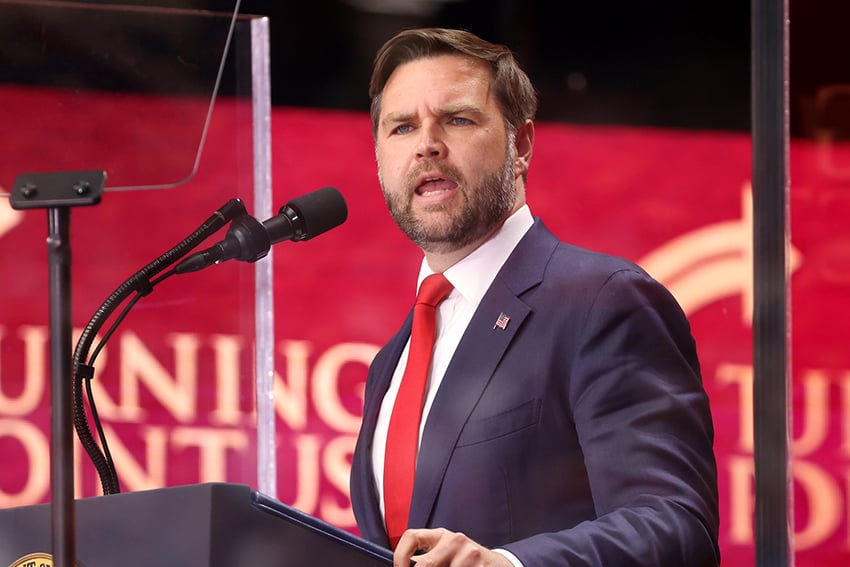
The United States reserves “the right” to take action against drug cartels on Mexican soil, U.S. Vice President JD Vance said this week.
Vance made the remark in an interview with N+ Univision that is set to be broadcast in full this Sunday.
¿Qué tan posible es una invasión de Estados Unidos a México para atacar al crimen organizado? JD Vance le responde a Ilia Calderón en una entrevista especial.
Puedes ver la entrevista completa en ViX y nuestro canal de YouTube. Cada domingo estrenamos episodio de “Esta Semana”,… pic.twitter.com/cM4Ov3hh2Z
— N+ UNIVISION (@nmasunivision) June 17, 2026
During the interview, a snippet of which was released on Wednesday, journalist and news anchor Ilia Calderón reminded Vance that before he became vice president, he said that “the president should take military actions against the drug cartels in Mexico.”
“But President Claudia Sheinbaum has stated … ‘No [U.S.] military action on Mexican soil, that’s a red line,'” Calderón said. “Will the United States respect that red line?” she asked Vance.

“Well, what we want to do is work with the Mexican authorities to ensure they are able to take care of the cartels themselves. We, of course, are going to have to take defensive actions to protect the American people. We want to work with the Mexican government, but we really do need to take out these cartels,” Vance said.
“They’re very, very bad organizations, as I’m sure you know well,” he said.
Vance went on to assert that “the cartels” had “free rein of Mexico” when U.S. President Joe Biden was in office, “because they had so much money … from the United States because of the drug and sex trafficking trade.”
After the vice president described cartels as “like a cancer on Mexico,” Calderón pushed Vance to provide a “yes or no” answer about U.S. military action in Mexico.
“Well, we would take military action if we feel like we have to to protect our people,” Vance said.
“We don’t want to do that unless we’re working with the government of Mexico, but we have to reserve the right. Let me give you a very concrete example,” he said.
“If you have a Mexican drug cartel that has a massive shipment of weapons and fentanyl that is about to come into the United States of America and the only way to stop it is to go after that cartel, of course we have to go after that cartel,” Vance said.
“We’d love to work with the Mexican government, but we have to defend our own people,” he said.
N+ Univision’s publication of an excerpt of the interview on Wednesday came the same day as U.S. President Donald Trump said — and not for the first time — that the United States would shift its focus to combating drug cartels on land rather than at sea, where U.S. military strikes on alleged drug-carrying boats have killed more than 200 people since September.
“Drugs are down by water 97% … and now we’re going to go and focus on the land,” Trump told a press conference at the G7 Summit in France.
“They come through Mexico. Mexico has lost control of their country. The cartels run Mexico. And it’s sad,” he said before asserting that President Claudia Sheinbaum is “a very good woman,” but “a very scared woman.”
Sheinbaum told her Thursday morning press conference that Trump is “not well-informed” about the situation in Mexico.
U.S. military action in Mexico against Mexican cartels — six of which were designated as foreign terrorist organizations by the U.S. government last year — has been seen as a possibility since Trump returned to the White House in January 2025.
Asked on the very first day of his second term whether he would consider “ordering U.S. special forces into Mexico” to “take out” drug cartels, the U.S. president responded: “Could happen. Stranger things have happened.”
Since then, Trump has intermittently threatened to take action against cartels in Mexico. In January, for example, he said that the U.S. would start “hitting land, with regard to the cartels.” In May, Trump said that the United States would take action against cartels in Mexico if the Mexican government doesn’t do so itself.
Despite the threats, Sheinbaum has repeatedly ruled out the possibility of U.S. military action in Mexico, while highlighting the security results her government has achieved, including a significant reduction in homicides and the arrest of well over 50,000 alleged criminals in the past 20 months. She is confident, publicly at least, that her government’s crime-fighting results and its ongoing security collaboration with the United States — even amid tensions in the bilateral security relationship — will stave off U.S. military action in Mexico.
Sheinbaum has already characterized the CIA’s alleged participation in a recent drug lab raid alongside Chihuahua state forces, and U.S. prosecutors’ drug trafficking accusations against the governor of Sinaloa and other officials, as a violation of Mexican sovereignty and/or interference in affairs that solely “correspond to Mexicans.”
Crossing the “red line” with a U.S. military attack on Mexican soil would cause even more serious damage to a bilateral security relationship whose closeness has been touted by Mexican and U.S. officials alike.
Mexico News Daily