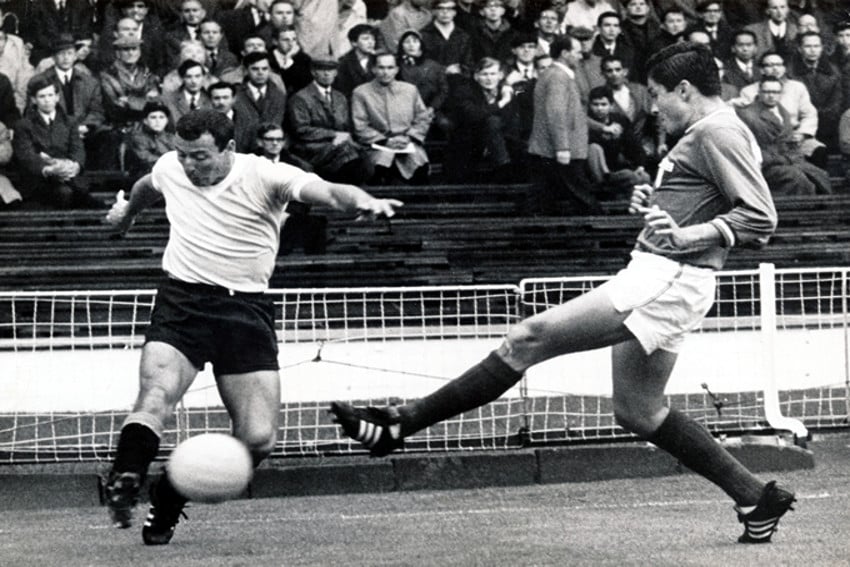
Sixty years ago, the 1966 FIFA World Cup was staged in England, the spiritual home of the sport, where the rough street game had been given both rules and passion, and Mexico’s national selection team that year arrived at Wembley with an experienced Mexican coach and a team full of strong players.
Mexico’s play during the Cup was solid and steady, even against bigger names like England and France. The team had enthusiastic fans cheering them on at Wembley. Mexico was also on a high, having been chosen to host the next World Cup in 1970, as well as the Olympics in 1968. It all should have added up to a Cup performance to remember here in Mexico. But once the tournament started, the national team never made it out of the group round. What went wrong?
A strong start
Embed from Getty Images
Mexico’s 1966 World Cup team members pose for a photographer with London’s Evening Standard newspaper two days into the tournament.
The 1966 tournament, like many from the era, employed a format that remained largely unchanged: 16 teams in four groups, with the top two in each group advancing to the knockout stages. It was a very exclusive affair, with Europe and South America reserving 14 of the 16 places.
One spot went to North America — with Mexico always the favorite to qualify — and one had to be shared between Asia and Africa. In 1966, it was North Korea, of all countries, that came through a heavily boycotted qualifying tournament.
Mexico had a far less controversial path to the finals. The first round of matches took place in March 1965, with Mexico’s national team dispatching Honduras and the U.S.
The second round started a month later, when Mexico joined the other group winners, Jamaica and Costa Rica. Two away games, a draw with Costa Rica and a 3-2 win in Jamaica put the Mexicans in control, and they went through undefeated. Over the two rounds, they had won six of their eight games, scoring 20 goals and conceding just four.

Isidoro Diaz, one of Mexico’s most underrated players of this period, was a standout with five goals.
A balance of veterans and bright young players
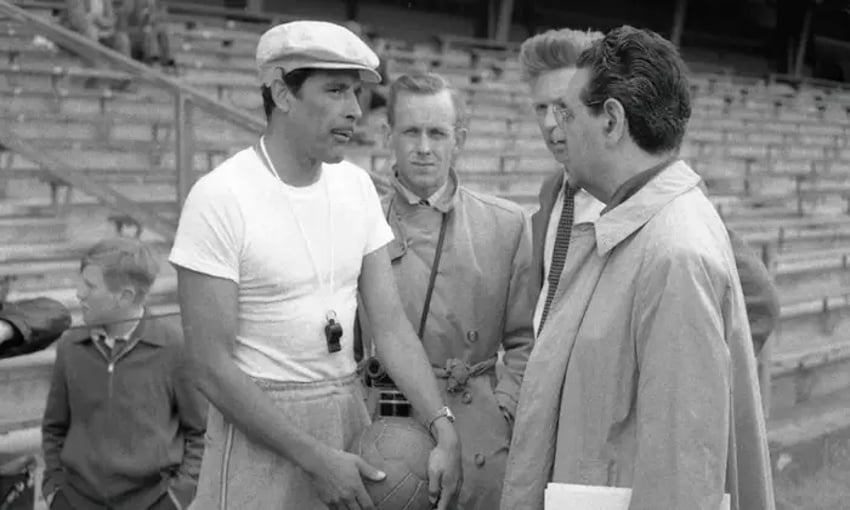
The draw for the finals took place in the Royal Garden Hotel in London. For the first time, the ceremony was televised live. There were four pots, representing South America, Europe, Latin Europe and the rest of the world. The last group consisted of Mexico and North Korea, with Bulgaria and Switzerland considered the weakest of the European teams. By the time this fourth pot was brought forward, the groups were already taking shape, and Mexico was the first name out, placing them in Group 1 alongside England, Uruguay and France.
Mexico started the World Cup year with a series of friendly games against local clubs. Preparations picked up momentum in June with the opening of Estadio Azteca. This was celebrated by a club tournament, after which Tottenham stayed on to play the Mexico national team, the visitors winning 1-0. The great Ignacio Trelles was the coach for his third World Cup tournament and was notably loyal to his regular players.
Even so, four years is a long time in football, and the squad for England was a balance of veterans (eight players from 1962) and new faces. Raúl Cárdenas was missing from the defense after three World Cups, but Gustavo Peña was an excellent replacement. Two young strikers, Aaron Padilla and Enrique Borja, had been added, and 22-year-old goalkeeper Ignacio Calderón was in the squad. Five of the players came from Club Deportivo Guadalajara, which was expected, as Chivas were the team of the decade, having won the Mexican championship in 1964 and 1965. However, 10 clubs would contribute players.
Antonio Carbajal’s milestone Cup
Upon reaching London, Mexico based itself in the Alexandra National Hotel. Little was known of Mexican football in those pre-Internet days, and the press, in search of a story, focused on Antonio Carbajal, the 37-year-old goalkeeper who would be appearing in his fifth World Cup. This is still a record — although barring injury, both Cristiano Ronaldo and Lionel Messi look set to play in a sixth tournament later this year.
There was a bit of drama before a single ball was kicked, with the World Cup trophy being stolen from a display. There was a ransom demand, an arrest and a hero dog who found the trophy while being taken for a walk.
Embed from Getty Images
The Jules Rimet Trophy is placed into a safe at Cannon Row Police Station in London, March 1966. Stolen at a public exhibition, the trophy was found a week later in a garden hedge by a dog named Pickles.
The tournament kicked off on a Monday evening with a dull 0-0 draw between England and Uruguay. Two days later, Mexico came out onto the Wembley pitch to play France. Despite 75,000 tickets having been sold, the stadium was half empty. Many fans had bought blocks of tickets to secure their seats for the semifinals and final, and it seems that some of these did not consider this a particularly attractive match.
However, there was no lack of support from the Mexican community in London, with the press photographers drawn to the small gathering of sombrero-wearing supporters that gathered in one section. It was all good-natured. When the fans got a bit excited, jumping up and down and waving their coats in the air, the police walked over more because they were bored than because they feared a riot.
Mexico vs. France
Embed from Getty Images
Mexican fans rush the field during the Mexico vs. France match. They placed a sombrero on the head of Mexican player Guillermo Hernández.
This match was a typical Mexican performance under Trelles, packing the defense and counting on quick counterattacks. Ignacio Calderón was preferred to the veteran Antonio Carbajal in goal, and while he seemed hesitant to come out of the six-yard box, he was a big man who would not be bullied on his line. There was plenty of action and a fair bit of muscle, the Mexican defense giving out as good as they received. The halftime band marched on with the score still 0-0, but then, in the 48th minute, Mexico produced the breakthrough. A young Enrique Borja muscled the ball away from Gabriel De Michèle, and although he was facing the wrong way, his natural striker’s instinct kicked in; he twisted and turned to put the ball into the net as if by sheer determination. Both sides now began searching for a decisive goal: France to get back in the game, Mexico to secure a second point.
The goal, when it came, was soft. France’s Gérard Hausser was outside the penalty area with four defenders between him and the goal. However, the defenders had not closed him down, and he saw the opportunity to shoot. His shot hit the post and had the luck to bounce in. It was one of only two goals Hausser would score in his short international career.
It was probably a matter of bad luck that Mexico didn’t come away with more. The team had an early goal discarded, and both sides might have claimed penalties.
Mexico vs. England

During the 1966 match between Mexico and England, fans on both sides were on the edge of their seats for a full 37 minutes before either side scored.
Their second game was against England, which was probably the toughest of the two remaining matches. Mexico continued the same tactics, but more so, at times packing eight or more men between the ball and the goal, so England resorted to a series of long crosses.
The front men for England were Roger Hunt and Jimmy Greaves, small, nimble players who wanted the ball on the ground, and the home crowd grew restless as the minutes ticked by. Then, in the 37th minute, England finally scored. Bobby Charlton collected the ball in his own half, ran forward unchallenged, edged to his right to create more space and let off a blast from well outside the penalty area. It was probably the most iconic goal of a long and distinguished career.
Mexico came out for the second half a little more adventurous, but they also seemed limited to sending long balls into the area. Only Borja and Padilla showed any flair, reported The Times newspaper. The issue was decided in the 75th minute when Roger Hunt pounced on a mistake from Calderón to tap in a goal that was as scrappy and simple as the first had been brilliant.
Antonio Carbajal’s last World Cup appearance
England would not play their final game until the following day, so there were numerous permutations. However, presuming England did not totally collapse against France, then Mexico would have to beat Uruguay by at least two goals, while Uruguay would secure its place in the next round with a draw. The major change on the Mexican side was giving the goalkeeper’s jersey to Antonio Carbajal. Whether this was in order to secure his record of playing in five World Cups, or due to concerns over the way Calderón had fumbled the ball — leading to the second English goal — is uncertain.
A respectable crowd of 61,000 gathered on a rainy and gray Tuesday afternoon. The first half was surprisingly one-sided, with Mexico running their more favored South American opponents into the ground. There was a stream of near misses, including hitting both post and bar, and one great save and lots of safe hands from goalkeeper Ladislao Mazurkiewicz. The English fans, always likely to cheer for the underdogs, became more pro-Mexican as the Uruguay defenders resorted to some nasty fouls.
An underestimated team
Whatever coach Ondino Viera said at halftime worked, and the second half saw Uruguay far more competitive in midfield. Both sides created chances, but the game ended goalless. The English press praised the performance of the “brave and now-underestimated Mexicans as they fought for a win.” Their play, the report continued, “was sharp and intelligent.” Isidoro Diaz was described as “a bulky left wing half with a silky touch and a fearsome tackle.” Enrique Borja and Aaron Padilla also got mentions.
And so Mexico departed from the World Cup. They had taken two points, and the narrow defeat to England looked better and better as the home side made their way through the tournament. Much of the attention was once again on Antonio Carbajal and his fifth World Cup appearance.
“We shall never see the likes of Carbajal again,” suggested the Times.
Mexico, the reporter also noted, had played well and had only been let down by their inability to score. They might well, he predicted, be a force next time, when the tournament would be coming to Mexico.
Bob Pateman lived in Mexico for six years. He is a librarian and teacher with a Master’s Degree in History.