President Sheinbaum says passenger service on the Interoceanic Train will not resume until early 2027, as her government reworks a deadly stretch of track in Oaxaca and tries to secure land rights for a safer route.
Sheinbaum said at her Monday morning press conference that specialists have delivered recommendations that are now under review with the federal Agency for Trains and Integrated Public Transport (ATTRAPI).
“We will announce them here and make them public,” she said. “We hope that passenger service will be operational next year.”
She acknowledged, however, that the government still lacks a finished plan and that agreements with several communities in Oaxaca will need to be struck before work can begin.
She also suggested passenger service could resume on an interim basis before the unsafe stretch is fully bypassed.
The planned overhaul follows a December derailment near Nizanda, Oaxaca, in which 14 people were killed and almost 100 injured, according to federal authorities.
Attorney General Ernestina Godoy later said the crash was caused by excessive speed on a curve where the limit was 50 km/h (about 31 mph), citing black-box data showing the train hit 111 km/h (about 69 mph) on straight sections and exceeded the limit on six curves before leaving the tracks.

Two drivers were arrested on homicide and injury charges after the crash, but were later released under a settlement agreement with victims’ families.
13 dead and more than 100 injured after train derails in Oaxaca
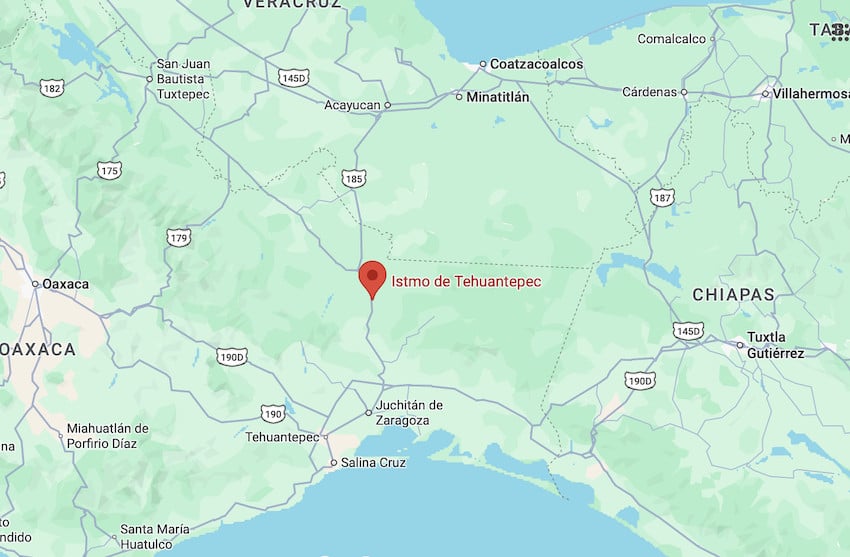
Sheinbaum said the priority is to bypass a section known as “Rabbit Ears” — which includes sharp curves and steep slopes — on the approach to Salina Cruz, a key Pacific cargo port in the state of Oaxaca.
Rail specialist Carlos Barreda said the fix will likely require roughly 70 kilometers of new track and could take about a year.
The Interoceanic Train, a roughly 300-kilometer rail corridor linking Salina Cruz with the Gulf port of Coatzacoalcos, Veracruz, was inaugurated for passenger service in 2023 under former president Andrés Manuel López Obrador. It’s part of a broader Isthmus trade route billed as an overland alternative to the Panama Canal.
The cross‑isthmus Line Z includes multiple passenger stops in Veracruz and Oaxaca, though sources differ on the exact number of stations in regular use.
Freight trains have operated on the route for decades and continued running after the accident, but Line Z passenger operations were suspended immediately after the derailment.
The broader Interoceanic Corridor project includes additional links to Palenque, Chiapas, and toward the Guatemalan border. However, those elements of the corridor lie outside the main passenger route now under safety review.
With reports from El Financiero, Vanguardia, López-Dóriga Digital and Reforma