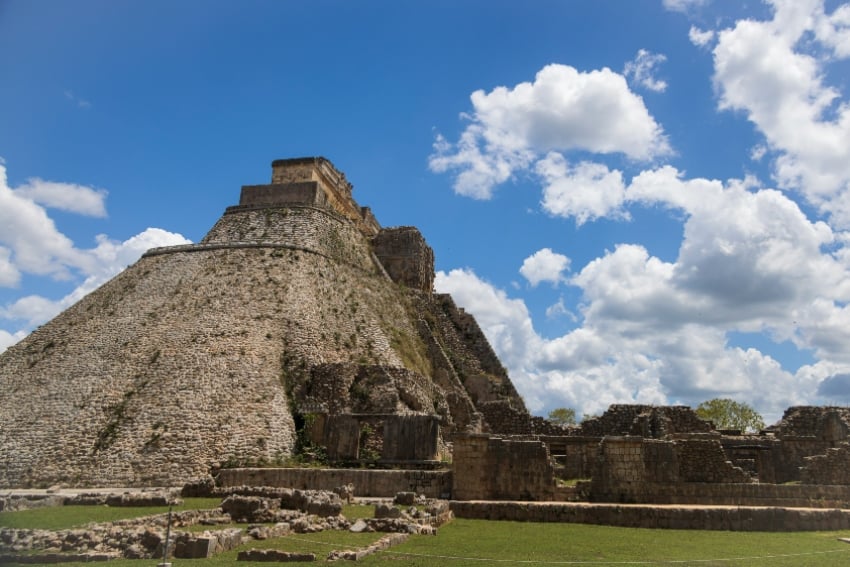
As explorer John Lloyd Stephens wrote in “Incidents of Travel in Yucatán” (1843), “It stood in its suit of somber gray.” He and his companion, illustrator Frederick Catherwood, were seeing Uxmal for the first time, an ancient Maya city abandoned a millennium earlier. Their accounts are amongst the few precious sources for understanding the exploration of Uxmal during the 19th century, a time when technology, science and geopolitics were rapidly transforming the world.
There is a thing or two that make Uxmal one of the most distinctive expressions of the Puuc architectural style. In contrast with other magnificent Maya buildings, such as the main constructions of Chichén Itzá or Tikal, the spirit of the Soothsayer’s Temple (Pirámide del Adivino) feels almost mystical and, at the risk of sounding redundant, magical. This is a site that has enchanted every traveler who steps onto its ever-growing carpet of grass.
What we know about Uxmal
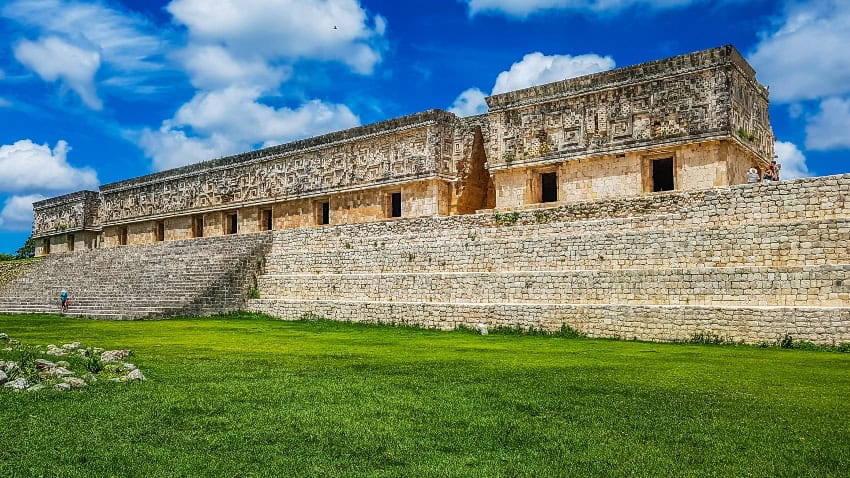
Uxmal lies in the western part of Yucatán, about 80 kilometers south of Mérida. It is considered the most representative site of Puuc architecture, which flourished roughly between 800 and 1,100 C.E. Yet archaeological evidence shows earlier occupations: one around 300 C.E. and another around 700 C.E. It was the final stage of the city, the one that produced its most iconic monuments. Such buildings continue to impress both locals and foreign visitors today.
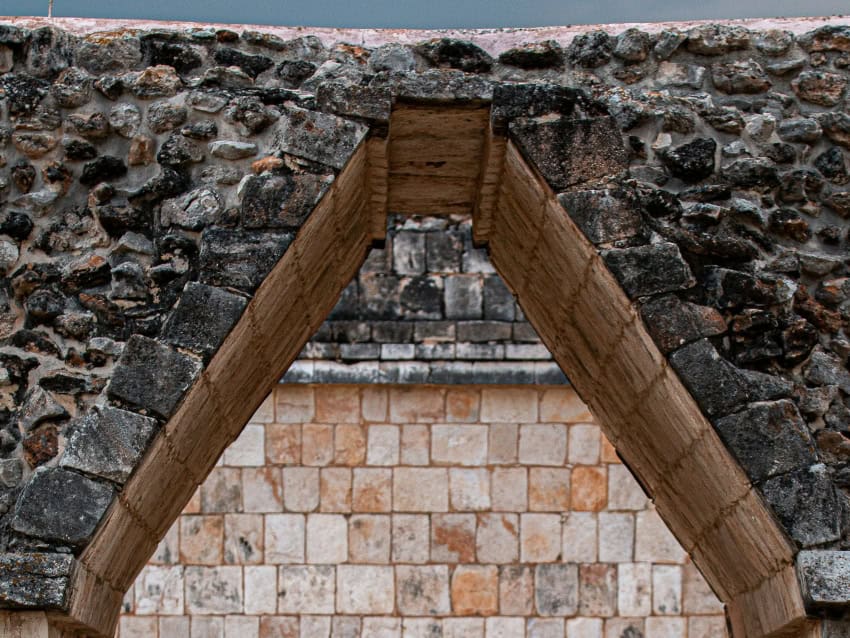
Exploring Uxmal can feel overwhelming, but only because the city preserves endless secrets for those who look closely. As with all great architectural wonders, every engraving and every stone seems meticulously placed — sometimes for structural reasons, sometimes for symbolic meaning. From its interior corbel arches to its ornate façades, every corner has something to say.
Three Times Founded
The origin of Uxmal’s name remains uncertain, but many studies suggest it means “Three Times Founded” or “Three Times Harvested” in Yucatec Mayan. The name possibly refers to the city’s repeated resettlements during centuries of rivalry between Maya city-states.
Another possible meaning of the word Uxmal is “Future”. The name proves to be right, as the site, its silent stone monuments and its majestic architecture seem to always be waiting, sitting in expectation for future eyes to be laid upon them and new minds to decipher their hidden messages.
Uxmal’s buildings
Uxmal is known for its remarkably preserved buildings, among the finest in the Maya world. The main character of the site is, of course, the Soothsayer’s Temple, a 35-meter pyramid with an unusual oval base. It consists of five superimposed temples built at different moments, a common tradition in Mesoamerican sacred architecture. The structure was likely dedicated to Chaac, the Maya Lord of Rain and Thunder, to whom many Uxmal temples appear to pay homage.

Before the pyramid stands the Cuadrángulo de las Monjas (Quadrangle of the Nuns), named by the Spanish conquistadors for its convent-like layout. But, from what we know now, it likely functioned as a palace or administrative complex — the Maya were especially fond of enclosed courtyards.
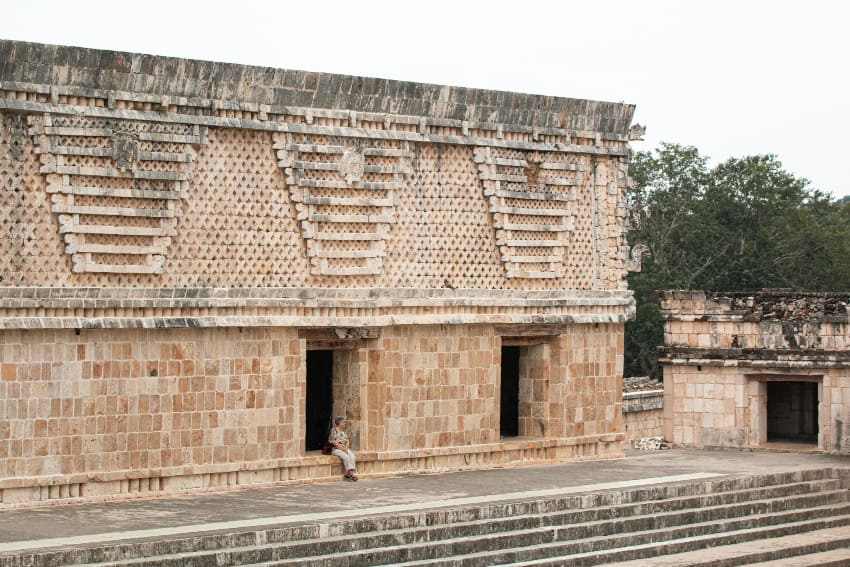
The House of the Governor, one of the masterpieces of Puuc design, features exquisitely carved façades. The so-called “elephant trunks,” once misinterpreted by early explorers, are actually stylized masks of Chaac. On the other hand, the stone carvings that Empress Charlotte mistook for the biblical devil in the guise of a snake show is actually one of the most important deities of the Mesoamerican pantheon. Called Quetzalcoatl by the Nahua people of central Mexico, and Kukulkan by the Maya, the lord of light, creation and wisdom is a deity worshipped all over Mesoamerica, and, needless to say, it is not related to a devil of any kind.
Like many travelers whose hearts remain tied to these ruins, Stephens and Catherwood returned several times. “The ruins of Uxmal presented themselves to me as a home,” Stephens later wrote, “and I looked upon them with more interest than before.”
Your visit
If Uxmal is on your bucket list, here’s what you should know before you go:
How to get there: The easiest route is to drive from Mérida, though ADO buses also depart from the city’s main terminal.
Weather: Expect heat and sun year-round; bring a hat, sunscreen and plenty of water.
Entry fees: Visitors must pay two separate fees: one to the National Institute of Anthropology and History (INAH) and another to the State of Yucatán.
Time needed: Given the size of the site, set aside at least three hours for the visit.
Post scriptum for explorers
In case you have the adventurer expertise of Stephens and Catherwood, Uxmal must not appear to be a challenging visit. There are other sites on the Puuc route that are worth visiting: Kabah, Sayil, Xlapak and Labná.
Although the architectural resemblance is undeniable, each one has its own personality and exposes different aspects of the Maya cities of the moment. In contrast with Uxmal, these sites still have a lot of archaeological work to be done. The upside is that they are also less crowded and can be explored at a slower pace.
Lydia Leija is a linguist, journalist and visual storyteller. She has directed three feature films, and her audiovisual work has been featured in national and international media. She’s been part of National Geographic, Muy Interesante and Cosmopolitan.