
I land in Ixtapa-Zihuatanejo and, as expected at a tiny airport like this, walk right off the plane onto the tarmac. A wave of toasty humidity envelopes me like a steam room. The sun is high and heavy, everything I’d hoped for from Guerrero’s coast on a bright Thursday in March. Exiting toward the taxi stand with me are throngs of tourists from the U.S., Canada and Mexico, cheerfully dressed in linen tops and straw hats. It’s hard to believe we’d all just landed in a state the U.S. classifies under a Level 4 “Do Not Travel” advisory, citing crime and kidnapping.
Not that the U.S. government is entirely wrong for labeling it as such. In 2023, Guerrero recorded close to 1,900 homicides, and in April 2025, authorities were hit with yet another mass killing in Tecoanapa, one of several that rank the state among Mexico’s most lethal. Acapulco, Guerrero’s biggest city, still posts a homicide rate around 70 per 100,000 residents — it’s regularly considered one of Mexico’s most dangerous cities.
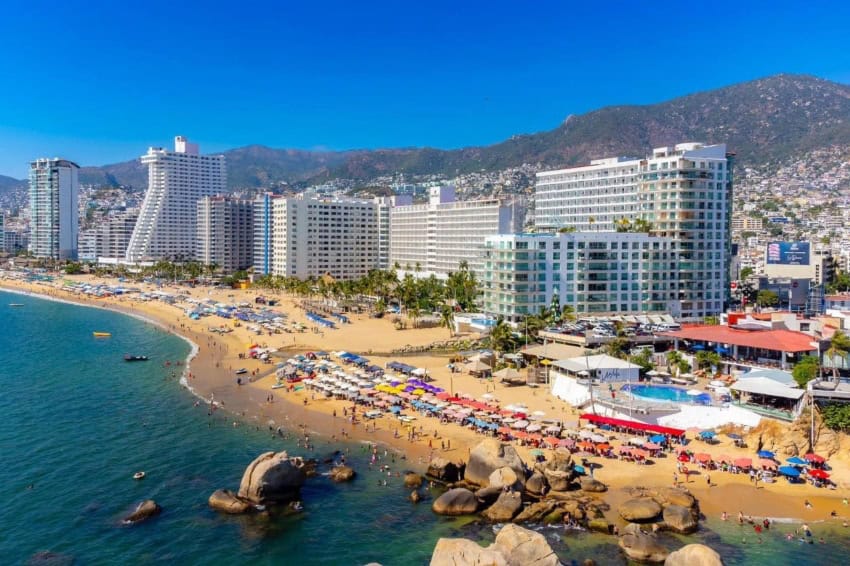
Traveling through Guerrero
I settle into my hotel-arranged transfer, and we begin our drive along the coast. The scenery is what you’d expect from such a low-income state: clusters of small-town life where stray dogs, coconut candy stalls and the occasional tire repair shop with a peeling yellow facade and shoddily handpainted sign line the roadside. A string of mopeds — imported from China — zip past us, holding one, two or even three riders.
After about 45 minutes, the landscape turns markedly more verdant — low forest with coconut palms jutting out, mango orchards and the occasional glimpse of a shimmering Pacific Ocean. We pull up to a nondescript gate with a wooden sign that reads Playa Viva Hotel; a blue arrow points the way. The driver hops out to slide the rusted gate open, and we rumble down a dirt road toward one of the wildest, most untouched beaches I’ve seen since dedicating my free time to chasing coasts after moving to a landlocked city for the first time in my life.
Upon check-in, I’m taken to my room — a luxury treehouse, really, with one wall missing so that the ocean remains in full view, and no doors or keys to speak of. If Guerrero is this dangerous on paper, how has Playa Viva flourished for nearly two decades with nary a lock in sight?
Guerrero’s Pacific Coast: What the travel advisory doesn’t tell you
Guerrero’s 500-kilometer Pacific shoreline breaks into three loose regions — the wilder Costa Grande in the north, Acapulco’s urban bay in the center, and the quieter Costa Chica heading south toward Oaxaca — and they are not equally dangerous.
While U.S. government employees are prohibited from traveling to any of these, the Secretaría de Seguridad Pública de Guerrero simultaneously insists safety is a priority — during the 2025–2026 winter season, the state government posted messaging insisting that “Guerrero is a destination ready to be enjoyed; here, safety is part of the experience.” In a classic example of two things being true at once, Guerrero can be a genuinely violent state, without that violence infiltrating the tourist experience. It simply depends on which parts you visit.

Costa Grande, where most of this story takes place, sits well below the state average in reported crime, with most incidents concentrated in urban Zihuatanejo rather than the small coastal villages. Hoteliers and tight-knit communities here are trying to build a different kind of Guerrero — one that trades on ecology, culture and a slower pace.
Three Guerrero beach towns worth knowing
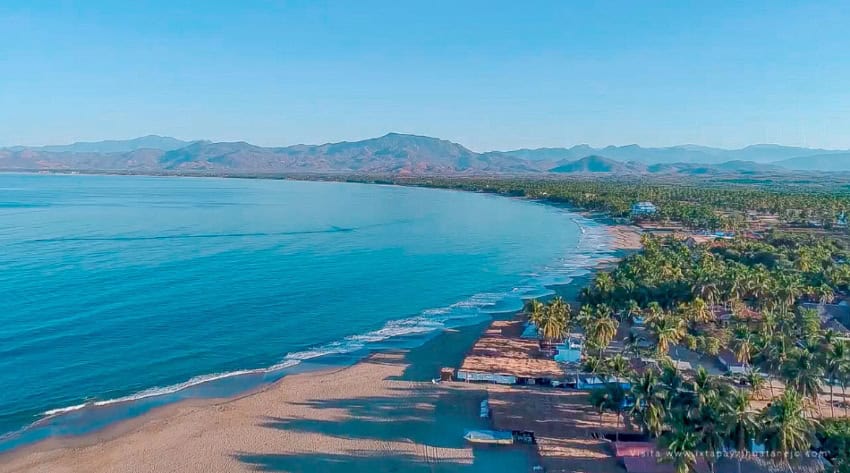
Juluchuca
This is where Playa Viva has operated since 2008 — a village of roughly 700 residents with outsized ambitions for changing outsiders’ perceptions. The hotel has incubated ReSiMar (Regenerando Sierra y Mar — regenerating from the mountains to the sea), a nonprofit working across five interconnected areas: water, fisheries, permaculture, ecosystem restoration and education throughout the Juluchuca micro-watershed. It’s an attempt to restore what Playa Viva founder David Leventhal calls “the abundance that used to exist” — dense forest, lagoons full of fish and communities with real economic alternatives to resource extraction.
Barra de Potosí
South of Juluchuca, Barra de Potosí is a fishing village of around 500 residents at the mouth of a protected 800-hectare mangrove lagoon. The ecosystem hosts over 200 bird species, nesting sea turtles and, in winter, humpback whales. Local cooperatives run boat tours through the channels and operate a turtle camp on Playa Blanca — the long sweep of beach connecting Barra to Zihuatanejo — where visitors can join hatchling releases at dawn.
Troncones
Perhaps the most recognizable Costa Grande town outside Zihua and Ixtapa, Troncones is known for its long surf beach and low-rise casitas. It draws surfers, wellness travelers and anyone looking for a less-developed Pacific alternative — the kind of place often described as what Tulum was 20 years ago.
Regenerative tourism in Guerrero: Betting on abundance
Two forces may just save Guerrero’s coast from being swallowed by its own reputation: genuine community-rooted regeneration and state-run seasonal security operations. Together, they’re building something worth watching.
Playa Viva is the clearest local example of regeneration in practice, both environmental and reputational. The Juluchuca-based eco-resort is dedicated to restoring the local watershed, improving education and protecting wildlife — and it backs those commitments financially. A share of guest spending supports local jobs: turtle patrol wages, purchases of local produce and guides for lagoon tours and horseback rides.
ReSiMar grew out of that same ethos — a nonprofit founded in 2021 to restore the Juluchuca watershed and keep locals from relocating for work through community-led work in farming, fisheries, education and conservation. The ambition is larger than one beach: a model proven here that could be replicated along other stretches of Mexico’s Pacific coast.
Guerrero’s tourist security operation: What it looks like on the ground

In winter 2025, Governor Evelyn Salgado launched Operativo Temporada Vacacional Invierno 2025, deploying more than 6,800 security personnel and 727 patrol units — drawn from state police, the army, the navy and the National Guard — across Guerrero’s tourist corridors. Mobile surveillance towers and panic buttons were installed along beach zones and highways, backed by drones, helicopters, Black Mamba armored units, canines, ambulances and sea-rescue craft. Separately, COFEPRIS sampled water quality at nearly 300 Mexican beaches, declaring the vast majority of Guerrero’s tourist strands safe for swimming while flagging a handful of Acapulco beaches as temporarily unsuitable due to elevated bacteria levels.
On the ground, the operation is hard to miss.
Security was heavily armed — something I noticed and perhaps scoped out subconsciously, as the country was still processing a wave of violence following El Mencho’s death. The level of visible weaponry wasn’t out of the ordinary for Mexico, but I found myself wondering whether a tourist from Ottawa or the American Midwest would feel reassured or unsettled by it.
Leventhal, who has frequented Juluchuca for nearly two decades, offers a different frame of reference. “The media narrative around Mexico and security is very loud. The reality, especially in a small coastal community, can feel quite different.” Playa Viva’s remoteness — not on a border, not a transit corridor, but on a beach where boats can’t easily land — has been both its tourist draw and its quiet protective shield.
Should you visit Guerrero?
There’s no simple yes or no. Guerrero is dangerous in parts, and largely between people with specific reasons to be in conflict. Follow the standard Mexico travel logic: Drive during daylight, stay in reputable lodging, book tours with local cooperatives and don’t buy anything illegal. Do that, and you may find the Guerrero coast more rewarding than the overcrowded beaches of Los Cabos or Cancún.
This is where you wake before sunrise to the sound of crashing waves, pull on a sweater, and walk to the local sanctuary to watch a daily release of baby turtles. Where beach walks take you past lush lagoons, home to roseate spoonbills and white herons. Where an afternoon on a regenerative farm connects your meal to the soil it came from and the people who tend it.
A practical guide for travelers
Then there’s the longer excursion: Slide onto an ATV and climb into the Sierra Nevada Mountains to the Gutiérrez family’s off-grid home for a home-cooked lunch and a tour of the cacao and coffee farm that’s been supplying Playa Viva’s kitchen since the hotel opened. Without a cruise terminal in sight, humpbacks come close to shore in winter — sightings on a morning beach walk are common between December and March.
Guerrero will not be for everyone — a grand part of its appeal. The travelers who come tend to be self-selecting: curious, flexible, unbothered by a dirt road or a lack of Michelin Guide-rated restaurants. Here, it seems the biggest threat is the occasional mosquito or one too many Guerrero mezcals. The wild coast makes the journey south more than vale la pena.
For current travel safety information, consult the U.S. State Department at travel.state.gov and Mexico’s official tourism resource at visitmexico.com.
Bethany Platanella is a travel planner and lifestyle writer based in Mexico City. She lives for the dopamine hit that comes directly after booking a plane ticket, exploring local markets, practicing yoga and munching on fresh tortillas. Sign up to receive her Sunday Love Letters to your inbox, peruse her blog or follow her on Instagram.