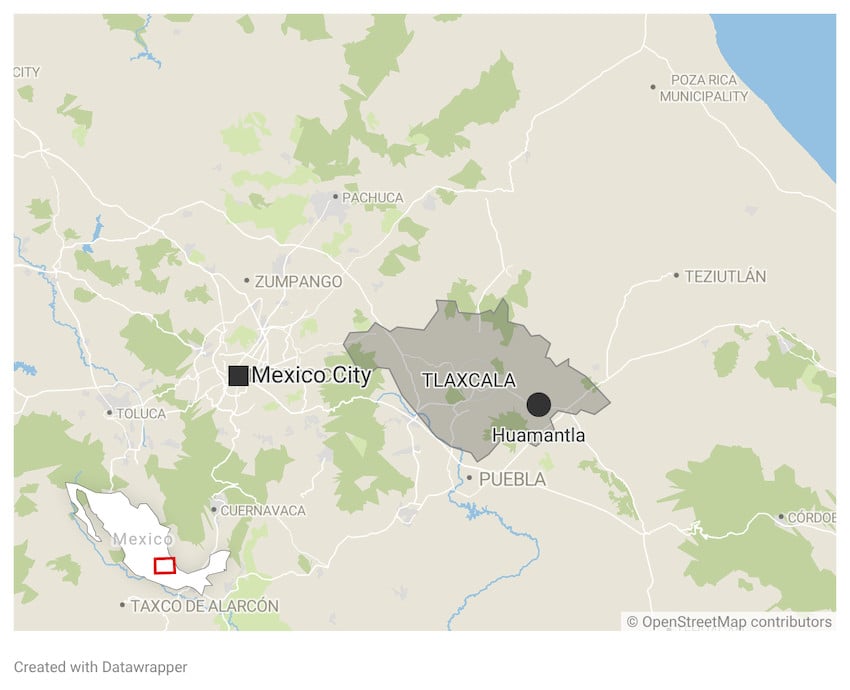
There’s a running joke in Mexico that Tlaxcala — among the least populous states in the nation, bordering the State of Mexico to the east — “no existe.” Or, it doesn’t exist. In 2021, the state’s tourism board cunningly flipped that notion by introducing a new official state motto to humorous fanfare: “Tlaxacala si existe.” That is, Tlaxcala does, in fact, exist on the map and as a travel destination.
Yet, despite the state’s historic capital being less than two hours away from the heart of Mexico City and under one hour from Puebla, it still gets overlooked by Mexico’s masses. Due to its miniature size (it’s literally and geographically the smallest state in all of Mexico), Tlaxcala has only two Pueblos Mágicos. But one of them has a few tricks up its sleeve for intrepid travelers: Huamantla.
The travel attractions of Huamantla
Resting at the base of La Malinche — a towering, inactive volcano that dominates central Mexico’s arid landscape as one of the tallest peaks in the country — Huamantla is a relatively quiet and noticeably slow town on most days. Its biggest annual draws are the Feria de Huamantla in August, featuring the famous “La noche que nadie duerme” (“The Night When Nobody Sleeps”), where streets are covered with intricately designed sawdust carpets, and the “Huamantlada,” a bull-running event akin to Veracruz’s weeks-long Xiquenada. If that isn’t enough to fill up your calendar, there’s also the Carrera de Carcachas (Jalopy Car Race) for good measure. Taking place during the same time as the Feria de Huamantla, it features beat-up vehicles that are taken en masse to nearby dirt roads for a chaotic and frenzied rally-style off-road race.
But perhaps most magical, at least for theater aficionados and for families traveling with young ones, is the town’s deep connection to puppetry. Huamantla is home to both the Rosete Aranda International Puppet Festival and Mexico’s National Puppet Museum, the latter of which is located in Parque Juárez, the town’s spacious main square.
The Puppet Festival began in 1983 and showcases an array of local and visiting puppeteers who put on colorfully entertaining shows for all ages. Named after the Rosete Aranda theater company — which was founded in Huamantla by a group of Tlaxcaltecan siblings in 1835, and is credited as being one of Mexico’s forebearers of inventive puppetry — the festival recently celebrated its 40th anniversary. Occurring every year in October for roughly two weeks, last year’s edition included 60 performances delivered by more than 35 domestic and international troupes that travel throughout Tlaxcala during that time to put on shows.
Mexico’s puppetry capital
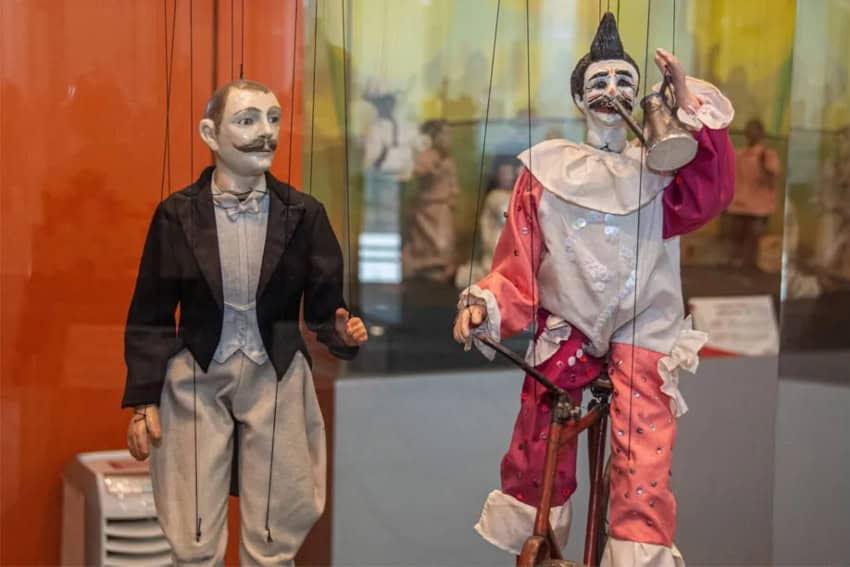
As the story goes, Huamantla’s skillful craftsmanship and adoration of puppetry began in 1830, when an Italian immigrant named Margarito Aquino arrived and created a makeshift theater inside his home for the provincial audience. The children of Huamantla took on the tradition, using clay heads, local fabrics and strings-and-rods to create their own puppets. Some of those children went on to pursue puppetry as successful careers, traveling around Mexico and the United States and, in their heyday, getting invited by President Benito Juárez to perform at the Presidential Palace in Mexico City. The theater company operated until 1962, but with the rise of television and other forms of entertainment, it finally closed after more than a century. However, some of the 5,000 original puppets in the Rosete Aranda collection are now on display year-round in Huamantla’s National Puppet Museum.

The museum opened to the public in 1991 and boasts puppets from all over the globe (China, Taiwan, Turkey and Indonesia, to name a few). Though creepy at times — imagine being in a silent room, surrounded by an army of lifeless puppets watching your every move — the museum is a worthwhile experience that traces the evolution, styles and characteristics of various forms of puppetry in a free, self-guided tour.
The National Puppet Museum
Highlights include reimagined scenes taken from children’s fairy tales, using elaborately positioned puppets, such as Snow White; surreal, otherworldly puppets like a giant anthropomorphic maguey, a family of mice, a dancing cucharacha and various renditions of Mexicanized devils; miniature replicas of famous Mexicans like Frida Kahlo and Diego Rivera; and an entire section dedicated to Dia de muertos-inspired puppets, all housed in an unlit room with black light paint to mimic the spiritual underworld. Rooster fights, bull rings, a platoon of soldiers marching into battle, a band of mariachis — the museum has it all, in the form of puppets. Upon exiting the museum’s main gallery, you can even take a swing at puppeteering a large, wooden Pinocchio on a small stage.
View this post on Instagram
With over 500 puppet artifacts, the museum — and Huamantla itself — is a living and active relic of Mexican history, and a display of ingenious Mexican imagination, awaiting in the shadows of a dormant volcano. At the center of Mexico’s de facto puppet capital, it’s the museum that steals the show.
Alan Chazaro is the author of “These Spaceships Weren’t Built For Us” (Tia Chucha Press, 2026), “Notes from the Eastern Span of the Bay Bridge” (Ghost City Press, 2021), “Piñata Theory” (Black Lawrence Press, 2020), and “This Is Not a Frank Ocean Cover Album” (Black Lawrence Press, 2019). He is a graduate of June Jordan’s Poetry for the People program at UC Berkeley and was selected as a Lawrence Ferlinghetti Poetry Fellow at the University of San Francisco. His work can be found in NPR, The Guardian, SLAM, GQ, L.A. Times, and more. He is currently based in Veracruz.