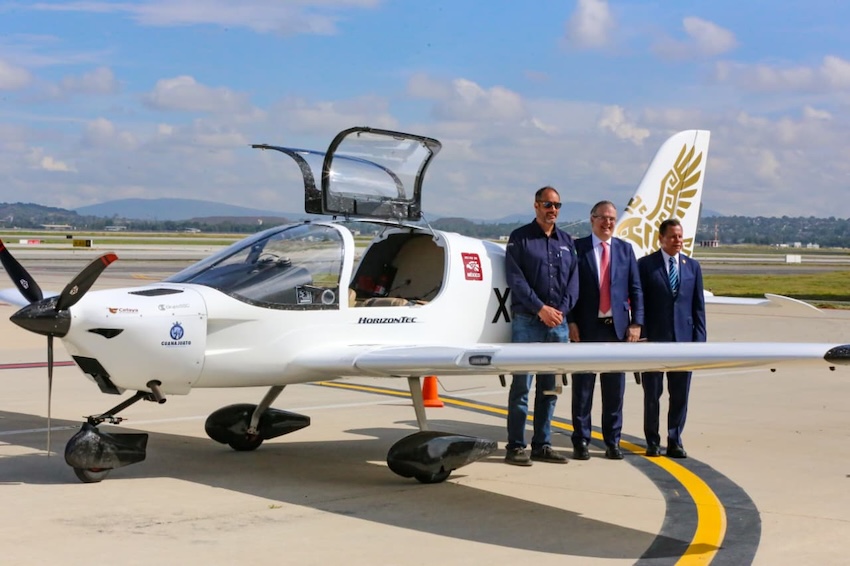
Mexican aviation marked a milestone this week as the Halcón 2.1 — the first aircraft in nearly 70 years to be 100% designed and manufactured in Mexico under international standards — has received certification to go into production.
It celebrated Wednesday by taking Mexico’s Economy Minister Marcelo Ebrard on an exhibition flight.

Developed over 11 years by Celaya, Guanajuato–based Horizontec, the two-seater, light-sport aircraft took to the skies from Felipe Ángeles International Airport north of Mexico City in what Ebrard called a historic occasion.
Officials are hoping the airplane (“Falcon 2.1” in English) will help restart a 100%-Mexican domestic aircraft industry that has been dormant since 1957 — for all categories, not just light-sport aircraft.
“This is the 0001 mark; that is, we’re back in aviation,” Ebrard said. “Mexico is producing again and taking off, and we’re going to do very well. We’re going to go far.”
Ebrard said Mexico is the 12th-largest producer of general aeronautics worldwide, “and we’re climbing. We’re expected to be 10th.”
He said virtually all airplane parts are produced in Mexico, from turbines to complex alloys, fuselages and electronics. “But we didn’t have our own aircraft,” he said, adding that the type certification from Mexico’s Federal Civil Aviation Agency (AFAC) will have a significant impact.

“Not only [is this milestone] very important for restoring Mexico’s influence in its own aviation sector, but also in all other sectors of the economy, because now what argument could there be for us not to do the same in whatever we set out to do?”
He noted that Mexico has dived into electric vehicles, alluding to the Zacua (a car produced since 2017), the Olinia (in the planning stages) and the Taruk (an electric bus).
Mexico has also been manufacturing EV motors and batteries, and Ebrard said the nation can build much more on its own, from semiconductors to artificial-intelligence models.
“If we export, that’s great … We’re a major exporting power,” he said. “But we should import less … we import too much.”
The AFAC certification will allow the Halcón 2.1 to be used in flight schools, for aerial surveillance and for recreational flights. It has a three-blade propeller that allows it to reach an altitude of 18,000 feet.
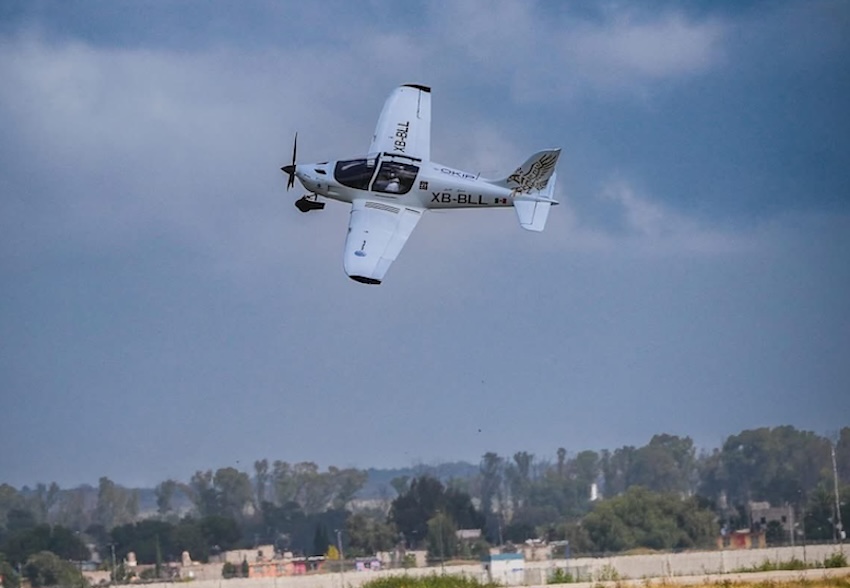
Horizontec first unveiled the plane in 2022 as the Halcón 2. Its maiden flight was at the airport in Celaya, marking the first of 50 test flights needed to signify airworthiness. This week’s flight marked the end of that process.
“Hopefully, we’ll have the opportunity to design, develop and generate other aircraft,” said Giovanni Angelucci, co-founder of Horizontec with Eduardo Carrasco. “But what this aircraft demonstrates is that it meets international standards, is safe and airworthy.
“The most important thing, though, is that it’s made in Mexico.”
Mexico’s aviation-building efforts since 1957 have involved assembly, modifications or prototypes.
But there had not been an aircraft 100% designed and built within Mexico, and certified for use, since models in the mid-20th century like the Lascurain Aura.
Built from carbon fiber and resins, the Halcón 2.1 has a 141-horsepower Rotax 915 iS engine and a Garmin glass cockpit. Able to cruise at 250 kilometers per hour, it has a range of approximately 1,100 kilometers. It uses premium automotive gasoline, slashing operating costs to nearly a quarter of comparable models, and costs around US $200,000.
Horizontec said it has 18 orders and expects further growth, including in the export market, particularly to the U.S.
“The Halcón 2.1 not only represents technological innovation, but also confidence in national talent,” said Gen. Miguel Enrique Vallín Osuna, AFAC’s director general. “When Mexican talent takes off, it has no limits.”
With reports from La Jornada, El Economista, Avion Revue and A21