The Ministry of Finance and Public Credit (SHCP) is confident that Mexico can recover its “stable” long-term ratings outlook from S&P Global Ratings, which this week downgraded its outlook for the country to “negative.”
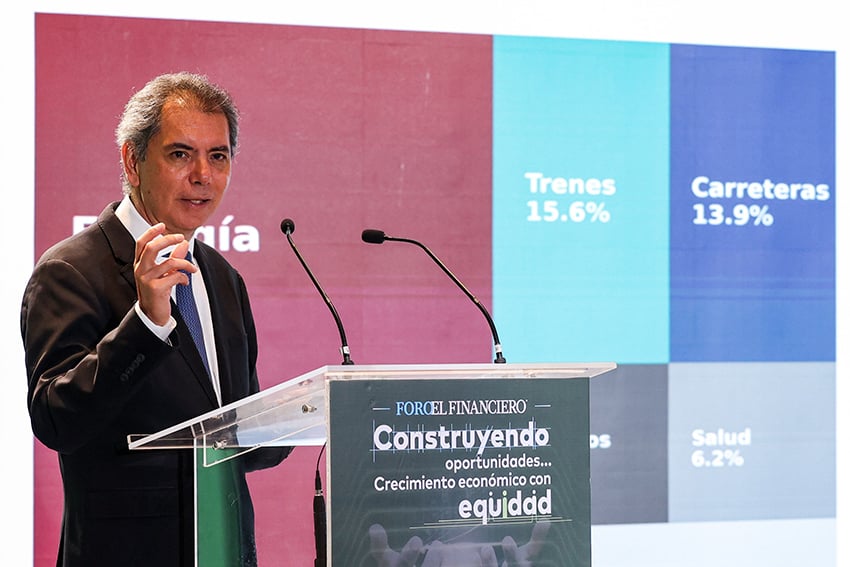
Finance Minister Édgar Amador Zamora said as much on Wednesday during his participation in a forum organized by the El Financiero newspaper that convened both public officials and representatives of the private sector.
La estrategia financiera del gobierno mexicano para 2026: Plan México, Programa de Infraestructura. https://t.co/HqbkW7069s
— Hacienda (@Hacienda_Mexico) May 13, 2026
Amador expressed confidence that a range of actions to be taken this year, including measures to ensure an additional reduction of Mexico’s Public Sector Financial Requirements (RFSP), will allow Mexico to recover its stable outlook with S&P. Recovering a stable outlook is important because it would reassure international investors that Mexico’s debt burden is no longer on a worsening path, reducing the risk of full downgrades to its credit ratings, which would have a negative impact on investment.
Amador’s remarks on Wednesday came after S&P announced on Tuesday that it had “revised its outlook on the long-term ratings on Mexico to negative from stable,” a move the rating agency said reflected “the risk of very slow fiscal consolidation largely due to low economic growth resulting in a faster-than-expected buildup in government debt levels and higher interest burden.”

Although it changed its outlook, S&P affirmed the ‘BBB’ long-term foreign currency and ‘BBB+’ long-term local currency sovereign credit ratings for Mexico. Both ratings are investment grade.
S&P said that in the next 24 months it could “downgrade Mexico if it fails to reduce its fiscal deficits in a timely manner that stabilizes and contains the government’s debt, interest burden and contingent liabilities.”
In the same time period, S&P said it could revise its outlook for Mexico to stable “if effective policy implementation translates into meaningful fiscal consolidation, helping to stabilize debt levels and the government’s interest burden.”
SHCP aims to reduce public debt to 4.1% of GDP
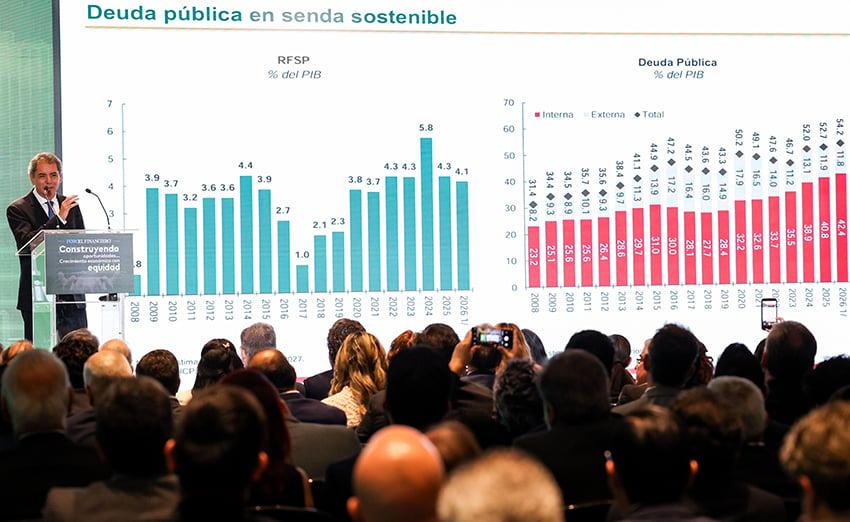
During a speech titled “The Mexican government’s 2026 financial strategy,” Amador said that the SHCP anticipates that Mexico’s Public Sector Financial Requirements (RFSP) will decline to 4.1% of GDP from 4.3% in 2025 (excluding support for state oil company Pemex).
RFSP takes into account the financing needs of the federal government and federal public sector entities (excluding Pemex in the percentages cited by the finance minister on Wednesday).
Amador highlighted that Mexico’s RFSP declined 1.5 points last year to reach 4.3% of GDP.
“Few economies achieved what we achieved last year,” he said.
Amador said that such a large decline in RFSP as a percentage of Mexico’s GDP hadn’t occurred “in decades.”
“This demonstrates the solid commitment of the federal government to having sustainable finances in the long term,” he said.
Amador anticipates economy will bounce back from Q1 contraction
Amador also spoke about the outlook for growth in Mexico, which S&P rightfully acknowledged has been “low.”
The Mexican economy grew just 0.2% in annual terms in the first quarter of 2026 and contracted 0.8% on a quarter-over-quarter basis, according to preliminary data from the national statistics agency INEGI.
Amador said he was confident that the economy would resume a path of growth in the quarters following Q1. Similarly, President Claudia Sheinbaum asserted on Thursday that public and private investment will have a significant impact on economic activity in the second half of 2026. She vowed to prove S&P wrong.
The SHCP is forecasting that the Mexican economy will grow in the range of 1.8%-2.8% this year, a prediction higher than those of most other organizations including the Bank of Mexico and the International Monetary Fund. Amador said on Monday that he and his government colleagues were “convinced” that the Mexican economy would recover strongly from the first-quarter contraction.
“There will be a very significant revitalization of the country’s economy,” he said, adding that public sector, private sector and “mixed” (public-private) investment will drive the recovery.
“… Mexico is ready to grow, to grow in a sustained way,” Amador said.
S&P downgrades Mexico’s rating and sees just 1% growth in 2026
On Wednesday, the finance minister said that investment in infrastructure through the National Infrastructure Plan will have a multiplier effect.
“[For] every peso invested in infrastructure, a multiple of each peso will become GDP,” he said.
In February, the federal government unveiled a mixed public-private investment plan, committing 5.6 trillion pesos (US $325.2 billion) toward spurring major infrastructure and development projects over the next four years across eight sectors: energy, railways, highways, ports, healthcare, water, education and airports.
SHCP highlights strengths of Mexican economy
In a statement acknowledging that S&P had revised its outlook on Mexico’s long-term ratings to negative, the Finance Ministry said that at the conclusion of the first quarter of 2026, “Mexico maintained solid macroeconomic conditions, even amid a complex external environment.”
The SHCP said that the Mexican economy “has a resilient labor market [with] an unemployment rate of 2.6% and real increases in work income.”
“Similarly, the [USD:MXN] exchange rate and inflation remain stable, while the Mexican government continues to implement measures to mitigate price increases for certain products affected by the geopolitical environment and adverse weather conditions,” the ministry said.
Among other favorable outcomes, SHCP highlighted that the budget deficit, at 207 billion pesos (US $12 billion) at the end of the first quarter, was 172 billion pesos lower than forecast.
The Finance Ministry also highlighted that Mexico has investment-grade ratings “with the eight agencies that assess its sovereign debt.”
Those investment-grade ratings, the SHCP said, are a “reflection of the confidence in the responsible management of economic policy and the sustainability of public finances.”
With reports from El Economista and El Financiero