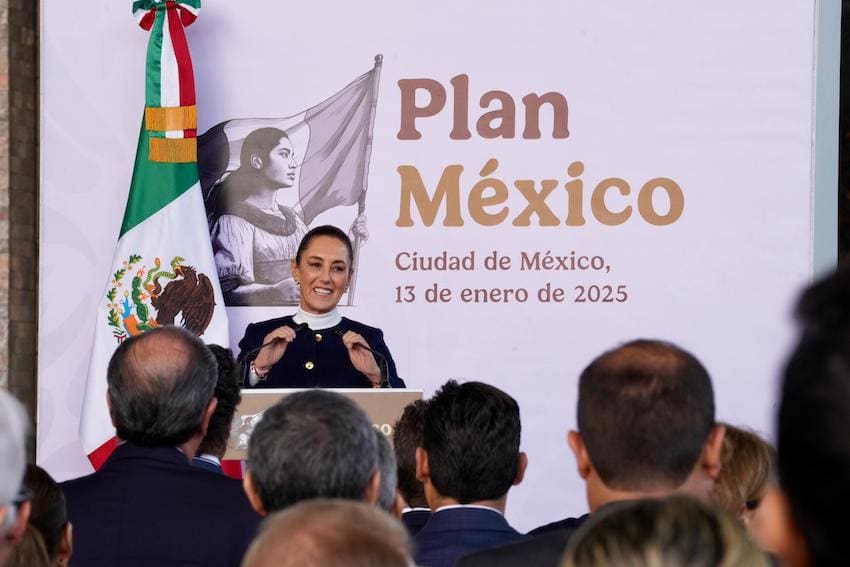
A year ago today, President Claudia Sheinbaum presented Plan México, an ambitious economic initiative with 13 goals.
Twelve months on from that presentation, what progress has been made toward achieving the goals by 2030, the final year of Sheinbaum’s six-year presidency?

The Mexico City-based think tank México ¿cómo vamos? (MCV) considered that question in a report published last Thursday. This article is informed by the report, titled “A un año del Plan México, ¿cómo vamos?” (One year into Plan México, how are we doing?)
MCV looks at six of the 13 Plan México goals, delivering a report card that is far from flattering
A future Mexico News Daily article will evaluate the progress that has been made toward the attainment of the other seven goals.
While the federal government has set 13 Plan México goals, it is important to note that the plan itself is not set in stone. Instead, it will be modified to adapt to the prevailing economic and geopolitical conditions, and the government will also seek to enhance it with complementary initiatives.
Indeed, the plan was strengthened last April with the announcement of 18 related “programs and actions,” including commitments to accelerate the construction of public infrastructure projects and homes, and to increase domestic production of a range of goods, including vehicles, pharmaceuticals, medical devices and petrochemicals.

Goal 1: To make Mexico the world’s 10th-largest economy by 2030
According to data from the World Bank, Mexico is the world’s 13th-largest economy.
Its goal of becoming the 10th-largest economy didn’t get off to a great start in 2025 as economic growth significantly slowed.
Final data for 2025 has not yet been released, but the International Monetary Fund forecast last October that Mexico would record a GDP growth rate of just 1%.
“Due to the [0.2%] contraction recorded in the third quarter, even 1% appears optimistic,” MCV wrote.
Annual economic growth in the first nine months of 2025 was just 0.4%, according to the national statistics agency INEGI.
MCV highlighted that the economy of Brazil — currently the world’s 10th largest economy — was projected to grow at 2.4% in 2025, easily outpacing the rate of growth in Mexico.
According to MCV’s traffic light system — based on the most recent official data — the “economic growth light” is currently red, the worst of three possible ratings.
Goal 2: To keep investment levels above 25% of GDP from 2026
Given that 2026 just started, the attainment (or otherwise) of this goal cannot yet be measured.
To achieve the goal this year, the level of investment as a percentage of GDP — including public investment, domestic private investment and foreign direct investment — will have to increase from the percentage recorded in late 2025.
Capital flight from Mexico, a problem since April, slowed at the end of 2025
MCV wrote that investment levels declined from 24.8% of GDP in the third quarter of 2024 to 22% of GDP in the third quarter of last year.
The think tank added that its “investment traffic light” changed from green to yellow in the period.
MCV also wrote that the fulfillment of Goal 2 is “fundamental to position Mexico among the world’s 10 largest economies (Goal 1), create 1.5 million additional jobs in advanced manufacturing and strategic sectors (Goal 3) and increase by 15% the national [Mexican] added value in global value chains [used by manufacturers in Mexico] (Goal 5).”
Goal 3: To create 1.5 million additional jobs in manufacturing and other strategic sectors
Citing “transformation industry” data from the Mexican Social Security Institute (IMSS), MCV noted that 127,200 jobs in that sector (which includes manufacturing) were lost in 2025, the worst result since 2008 amid the global financial crisis.
Based on that data, the goal of adding 1.5 million additional jobs in manufacturing and other strategic sectors appears even more distant now than it did a year ago.
The loss of jobs occurred even as the value of Mexico’s exports — which is mainly derived from the shipment abroad of manufactured goods — continued to grow.
MCV also noted that 278,697 IMSS-affiliated formal jobs were created in 2025.
The figure, the think tank highlighted, is “far from the national goal of creating 1.2 million jobs per year.”
Consequently, MCV’s “job creation traffic light” is currently red.
Goal 5: To increase by 15% the use of national content in products made in various sectors
In January 2025, Sheinbaum said that the goal was to increase by 15% the use of domestically made content in products made by the following sectors: automotive, aerospace, electronics, semiconductors, pharmaceuticals and chemicals.
According to data from INEGI, the percentage of domestic content in products made in Mexico by export-oriented companies increased to 44.2% in 2024 from 42.6% in 2023.
Data for 2025 has not yet been released, and therefore, progress on this goal within the context of Plan México can not yet be assessed.
To achieve a 15-point increase in national content in manufactured goods in the six years from 2025 to 2030, an average annual increase of 2.5 percentage points is required, significantly higher than the 1.6-point increase recorded in 2024.
MCV wrote that “achieving Goal 5 requires accelerating investment, ensuring
sufficient energy at competitive prices, integrating small and medium-sized companies [into the production chain] and consolidating an industrial policy that transforms Mexican companies into key players in the North American co-production model.”
The think tank said that its “export value added traffic light” remains at yellow, as its view is that “at least 50%” of content in products made in Mexico should be sourced within the country.
Goal 8: To reduce the average time between an investment announcement and the execution of a project from 2.6 years to 1 year
According to the federal government, the achievement of this goal will be supported by a 50% reduction in the bureaucratic procedures investors have to complete in order to commence a project.
MCV wrote that achieving the goal remains a “challenge” in Mexico, but did not say whether any progress had been made in 2025.
On a positive note, the Sheinbaum administration has set up a “National Digital Window for Investments” (Ventanilla Digital Nacional de Inversiones), a website touted as a “one-stop shop” for investing in Mexico. Its aim is to simplify the bureaucratic procedures investors have to complete and consequently reduce the time between the lodging of an application for the approval of a project and the granting of the relevant permits.
In its report, MCV wrote that the competitiveness of Mexico depends on a variety of other factors beyond expediting the approval of investment projects.
“To be among the most competitive countries in the world, a solid rule of law, legal certainty, respect for human rights, human capital, and preservation of natural resources, among other things, are required,” the think tank said.
In 2025, MCV added, Mexico ranked 55th out of 69 countries in IMD Business School’s 2025 World Competitiveness Rankings. Mexico fared particularly poorly in the “government efficiency” category, ranking 62nd out of the 69 countries.
Due to Mexico’s position on the rankings, MCV’s “competitiveness traffic light” is currently red.
Goal 13: To reduce poverty and inequality
When she presented Plan México a year ago, Sheinbaum said that this goal was a “substantive,” or overarching, one.
Data published by INEGI last year showed that more than 13 million people were lifted out of poverty in Mexico between 2018 and 2024, a period that obviously precedes the announcement of Plan México.
In its report, MCV noted that the percentage of the Mexican population in a situation of pobreza laboral — i.e., they have jobs but still live in poverty — declined to 34.3% in the third quarter of 2025 from 35.1% a year earlier.
However, “an estimated 44.9 million Mexicans [still] live in a situation where their household income is insufficient to purchase the basic food basket for all … [household] members,” the think tank wrote.
Cost of Mexico’s ‘basic food basket’ is up 4.4% in urban areas
While modest progress was made in reducing pobreza laboral in the 12 months to the end of September 2025, the government — a self-styled champion of Mexico’s poor — still has a lot of work to do.
MCV noted that its “pobreza laboral traffic light” is yellow, adding that the goal is for “less than 20.5% of the population” to be in a situation in which their income is “insufficient to purchase the basic food basket for all members of the home.”
Of course, having no one living in a situation of pobreza laboral would be a more desirable situation.
Among the ways in which the federal government is aiming to reduce poverty in Mexico is by significantly increasing the minimum wage on an annual basis (13% in 2026) and providing an array of social and welfare programs to citizens.
Last August, Sheinbaum said that the reduction in poverty between 2018 and 2024 was the result of the increase in the minimum wage in recent years — it almost tripled during former president Andrés Manuel López Obrador’s term — government welfare programs and “access to rights” for citizens.
She will be hoping that her government — through Plan México and other initiatives — can achieve similar success.
MCV’s recipe for Plan México success
MCV’s assessment of the progress toward the attainment of the six above-mentioned goals underscores the ambitiousness of Plan México. Indeed, achieving some of the goals appears more difficult now than it did when Sheinbaum announced the plan on Jan. 13, 2025.
At the very end of its 14-page report, MCV wrote that it has established a “clear diagnosis” of the situation in Mexico a year after the announcement of Plan México, and set out a course of action to improve it.
“Mexico needs more investment to grow [economically] and to create quality jobs that will enable us to be more competitive in high value-added industries and to offer higher wages in order to reduce poverty and inequality,” the think tank said.
“Mexico can advance … [toward the achievement of] these goals if we provide greater legal certainty, openness to investment in the energy sector, and a more robust rule of law,” MCV wrote.
Achieving those goals will create the “essential conditions to trigger a virtuous circle of investment, economic growth, quality employment and social progress,” the think tank said.
By Mexico News Daily chief staff writer Peter Davies (peter.davies@mexiconewsdaily.com)