As part of an exploration into Mexico’s long and rich history, Mexico News Daily has teamed up with one of the country’s top Maya experts to examine the ancient world that flourished across Mesoamerica. This is Part 5 in a series of articles on the history of the Maya. Follow the links to read Part 1, Part 2, Part 3, Part 4 and Part 5.
The Postclassic period, spanning approximately from A.D. 1000 to the fall of the last Maya political capitals of the Highlands around 1524, has been the victim of a persistent historical misinterpretation. For much of the 20th century, traditional archaeology and popular imagination consolidated the idea that, following the “collapse” of the great cities of the Classic Period, Maya political entities sank into a stage of decadence and cultural degradation, lacking the architectural or intellectual sophistication that characterized centers such as Tikal, Calakmul or Palenque.
However, contemporary research has dismantled this narrative. What we understand today is not a process of decline, but rather a political, economic and social reconfiguration. The Postclassic period did not mark the end of Maya culture, but the exhaustion of a specific model of rule: that of the sacred lords, or k’uhul ajaw. In their place, more pragmatic regimes emerged, along with corporate power structures and an economy that specialized in long-distance maritime trade. This transition demonstrates an extraordinary capacity for adaptation in the face of environmental, political and social crises.
The reorganization of the Maya Lowlands
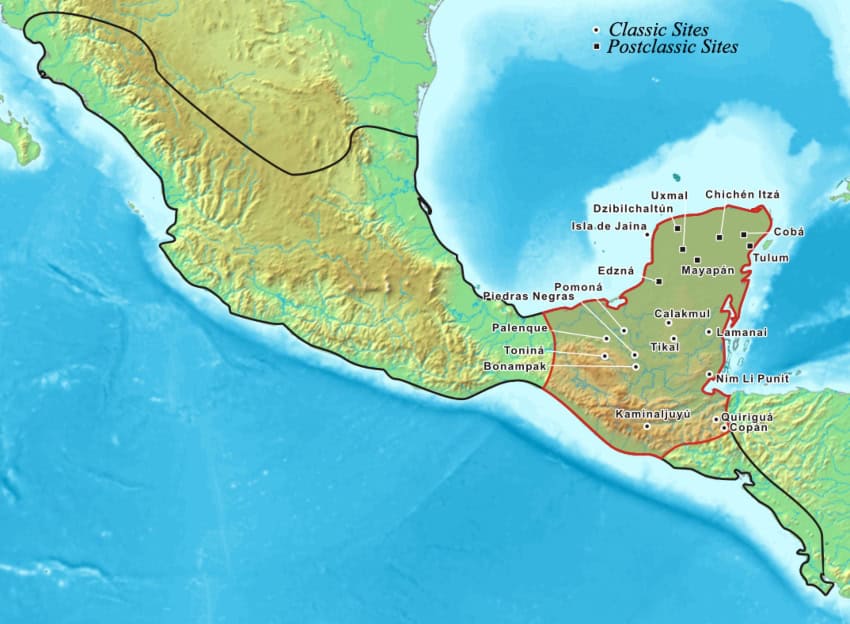
Around A.D. 1000, the landscape of the Maya Lowlands underwent a radical transformation. The cities that had dominated the Classic period — Tikal, Calakmul, Caracol and Copán, among others — experienced a process of progressive depopulation. It is important to note that this phenomenon did not imply a total and instantaneous abandonment. Recent archaeological research has detected persistent occupations on the peripheries of these great cultural centers.
The fall of the system of sacred rulers was a phenomenon driven by different causes, as critical environmental changes were added to shifts in power structures, with notable prolonged droughts that undermined the agricultural base. This scenario triggered a massive social displacement toward two key geographic regions: the Northern Lowlands, on the Yucatán Peninsula, and the Highlands, in the present-day territories of Guatemala and Chiapas.
Chichén Itzá and the marked period of transition
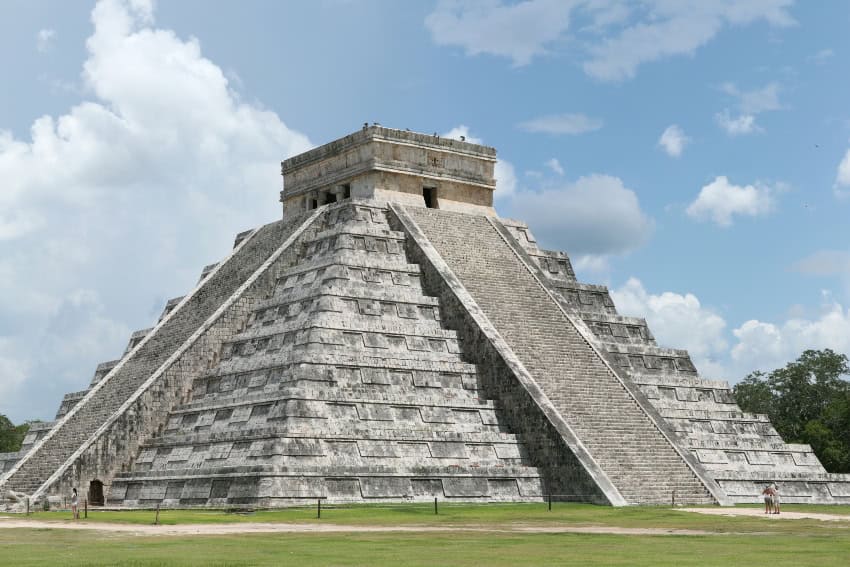
During the 9th and 10th centuries, Chichén Itzá in the Yucatán Peninsula consolidated itself as the political center of the region, under the leadership of notable rulers such as K’ahk’ Upakal, who succeeded in establishing relations with the city of Ek’ Balam. Chichén Itzá was a markedly cosmopolitan city where diverse linguistic and ethnic groups coexisted.
The iconography of the murals of the Temple of the Jaguars offers a window into this period of change. The scenes of sieges and conflicts suggest a climate of endemic warfare, likely driven by competition for control of the coastal trade routes, as salt, obsidian, jade and quetzal feathers became some of the most coveted commodities.

From the perspective of the Maya cosmic worldview, the Feathered Serpent, Kukulcán, symbolized political legitimacy tied to commerce and warfare, as the role of the sacred lords waned in importance. Although by the time of the Spanish arrival, Chichén Itzá no longer held its former political control, its prestige as a ceremonial center was maintained among the community, functioning as a site of sacred pilgrimage well into the colonial period.
The Chontal Maya: The great navigators
One of the pillars of Postclassic prosperity was the rise of maritime trade, led by the Chontal Maya, or Putunes. These groups, originating from the region of Tabasco and Campeche, became the great navigators of this historical context. Thanks to their skill in navigating large-draft canoes, they established a network of strategic enclaves connecting the Gulf of Mexico with the Caribbean Sea.
In this regard, the island of Cozumel played a fundamental dual role: on one hand, it functioned as the sanctuary of the goddess Ixchel, and on the other, as a major commercial port. From there, Chontal trade routes extended southward, reaching the mouth of the Motagua River and the Gulf of Honduras. This network not only mobilized luxury goods for the elite, but also basic necessities such as fish, honey, cacao and possibly salt from the salt flats of northern Yucatán, among others. This mercantilist economy was the vital support that allowed large populations to persist in a politically fragmented environment.
The rise and fall of Mayapán
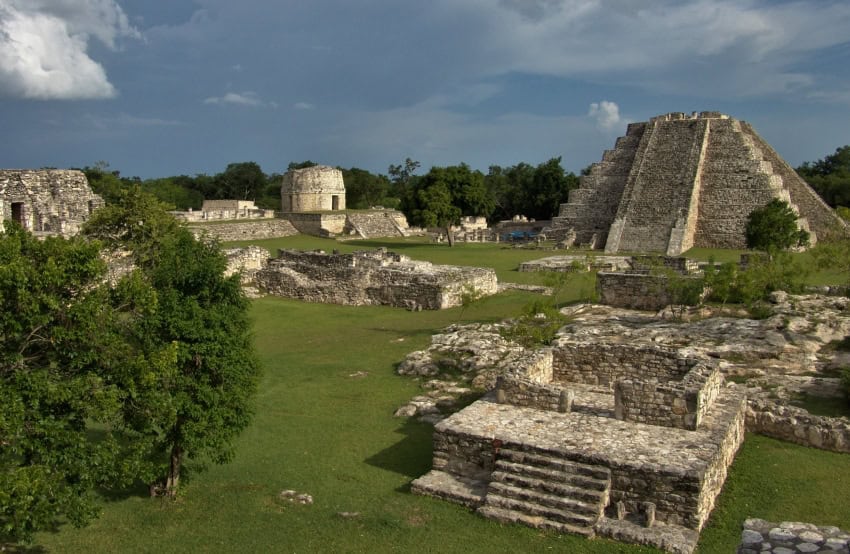
Following the decline of Chichén Itzá around A.D. 1200, the city of Mayapán emerged as the new capital of the peninsula. Mayapán was a densely populated city protected by a wall more than nine kilometers long. This characteristic reflects the need for centralized defense in the face of a climate of constant insecurity. The “League of Mayapán,” a system of governance used to maintain regional stability, was made up of the cities of Chichén Itzá (led by the Itzá lineage) and Uxmal (led by the Xiu), while the Cocom maintained control of Mayapán. The imposition of this political entity on the regional landscape ended violently in the mid-15th century, when accumulated tension among noble families — exacerbated by the authoritarianism of the rulers — culminated in a revolt led by the Xiu lineage against the Cocom.
Archaeological excavations at the center of Mayapán show evidence of fires, deliberate destruction of monuments, and human remains that confirm a traumatic collapse. This event was not merely a change of dynasty, but the end of the last great centralized structure in Yucatán. Following the fall of Mayapán (around A.D. 1441), the peninsula fragmented into 16 independent provinces — in constant conflict over control of territory and resources — called cuchcabalo’ob, each headed by a halach winik, or “true man-ruler.” After this rupture, the Xiu lineage settled in Maní, the Cocom in Sotuta, and the Cupul in the region of the same name, whose capital was Zací (present-day Valladolid in the eastern part of the Yucatán Peninsula).
It was precisely this disunity that the Spanish conquistadors encountered in the 16th century; the enmity between the Xiu and the Cocom was so deep that the former allied with Francisco de Montejo to confront the latter, inadvertently facilitating the conquest of the Northern Lowlands.
The Maya Highlands
While the north was fragmenting, in the Highlands of Guatemala, states of great complexity and marked militarism were consolidating. The most prominent was the K’iche’ state, with its capital at K’umarkaj (or Utatlán). Unlike the Yucatecan model, the K’iche’ system of government was a meritocratic and rotational hierarchy among elite lineages.
In this system, the sons of the nobility were integrated into a structure of military ranks, where advancement depended on performance in warfare and administration. The highlands became a mosaic of highly competitive warrior states, such as the Kaqchikels (with their capital at Iximché), who were initially allies of the K’iche’ before rebelling and organizing their own territory.
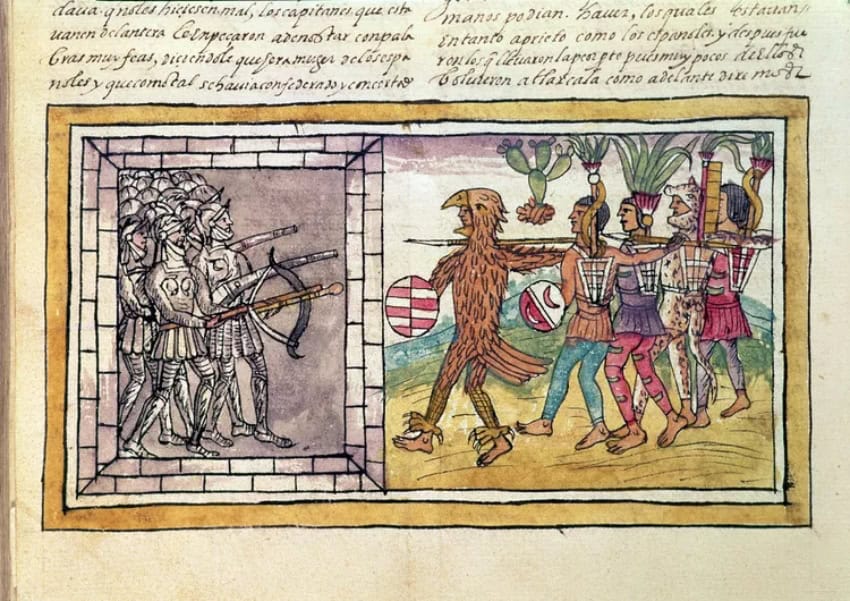
By the time of the Spanish arrival in the 16th century, the region was marked by endemic warfare among these groups. The Kaqchikels attempted to take advantage of the arrival of the conquistadors by initially allying with Pedro de Alvarado to subdue their K’iche’, Tz’utujil and Pipil rivals. However, this alliance was short-lived; due to mistreatment and tribute demands, the Kaqchikels rebelled against the Spanish, but in 1526 they were completely defeated and their capital of Iximché fell to the conquistadors.
Years earlier, in 1524, the Spanish had already defeated the K’iche’, and their capital K’umarkaj had been destroyed; meanwhile, Zaculeu, capital of the Mam, had also succumbed in 1525, after enduring a Spanish siege for several months.
Epilogue
The Postclassic period is a testament to the resilience of a civilization that adapted to survive. The abandonment of the great city-states did not mean the “collapse” of their culture; on the contrary, Maya identity persisted through its various groups, its languages and cosmic worldview that, with the arrival of the Spanish, underwent a complex process of syncretism. The Postclassic should not be seen as the end of Maya culture, but as a period of transformation — a new process of change on the eve of the encounter between two distinct and distant civilizations — one that once again demonstrated the capacity for adaptation, resistance and resilience of the Maya peoples to this day.
It would not be until 1697 that the last capital of the ancient Maya, Tayasal (Noh Petén) in Flores, Guatemala, was overthrown by the Spanish conquistadors. However, it should be noted that between 1847 and 1901, the conflict known as the Caste War took place, in which the peninsular Maya populations rose again in a struggle for their autonomy. Today, Maya cultural identity, its languages and traditions remain alive in Yucatán, Guatemala, Chiapas and Belize — with current populations continuing to demonstrate their millennia-old capacity for adaptation, recovery and resistance.
Pablo Mumary holds a doctorate in Mesoamerican studies from UNAM and currently works at the Center for Maya Studies at IIFL-UNAM as a full-time associate researcher. He specializes in the study of the lordships of the Maya Lowlands of the Classic period.