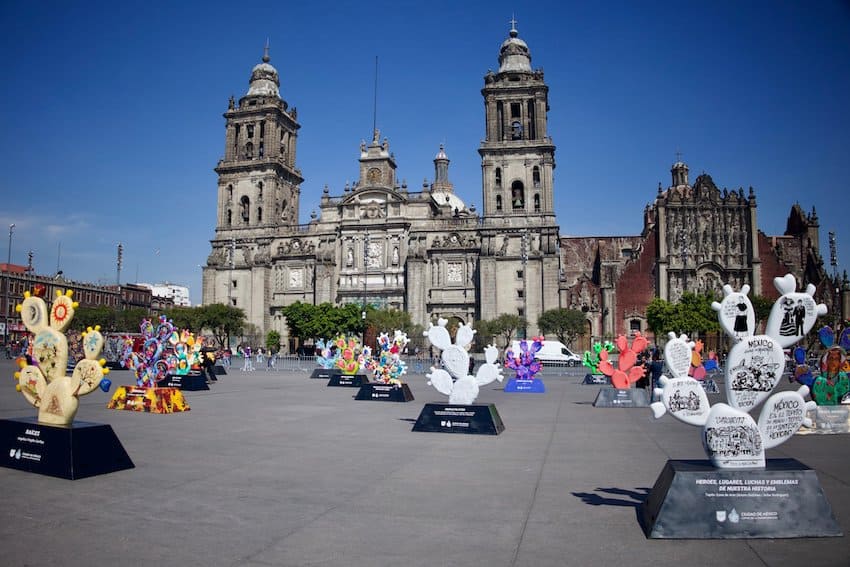
Mexico City Mayor Clara Brugada inaugurated the “Nopalera en el Corazón” (Cactus Field in the Heart) exhibition in the capital’s main plaza on Friday, featuring 200 nopal cacti sculptures created by local artists.
The month-long display, running through Feb. 9, celebrates the nopal as both a national symbol and a statement of sovereignty. Each piece was designed by individual artists or collectives from across the city, transforming the Plaza de la Constitución into what Culture Minister Ana Francis López Bayghen described as “a garden of resistance, memory and contemplation.”
La exposición “Nopalera en el corazón” es una expresión artística y también política, porque este símbolo identitario de nuestro país y de nuestra ciudad habla de nuestra historia, de nuestra resistencia y de la manera en que nos miramos como pueblo.
Son 200 esculturas… pic.twitter.com/R3haxE6i7H
— Clara Brugada Molina (@ClaraBrugadaM) January 9, 2026
“This exhibition is an artistic and political expression of national sovereignty,” Brugada said during the opening ceremony. “Here is the nopal as an element of our identity, as a symbolic element of our country and our city.”
The project expands on an initial showcase of 50 pieces displayed at the Nopal Fair 2025 at the Monument to the Revolution. Of the 200 new works, 113 were created by male artists, 63 by women and 23 by artistic collectives.

Sculpture artists employed diverse techniques including printmaking, vinyl paint, aerosol and sculptural elements. Their themes range from social justice proclamations to pre-Columbian references and abstract designs.
Brugada announced plans for accompanying cultural programming throughout the exhibition, including music, theater and talks. She also revealed intentions to display the sculptures at emblematic locations during the 2026 FIFA World Cup and called on artists to create a similar exhibition featuring axolotls before Easter.
Mexico News Daily