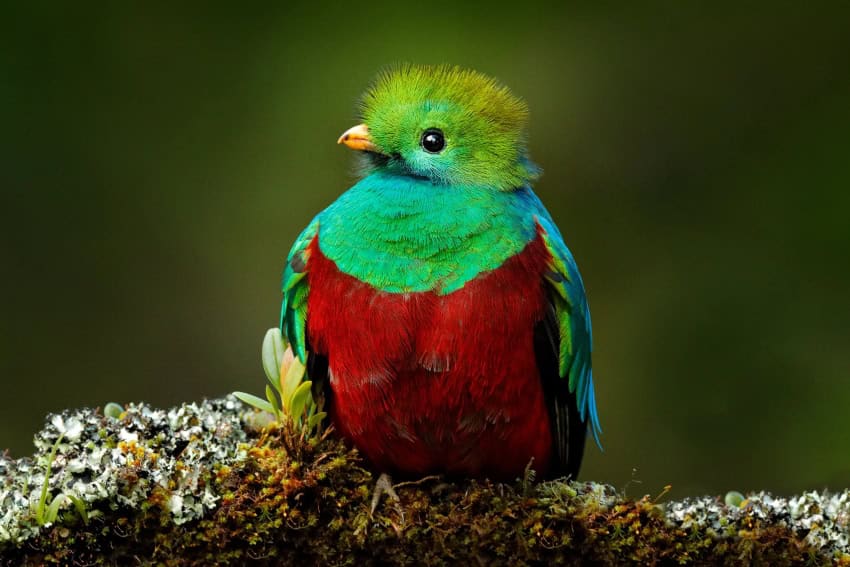
Quetzals, the godlike birds of pre-Columbian lore, are lovely small, colorful forest dwellers that “twitchers” — as bird spotters like to call themselves — will travel a long way to see. There are five recognized species, plus the eared quetzal, a slightly more distant relation, despite the name.
While their range stretches from the Amazon to Central America, only one species — the resplendent quetzal (Pharomachrus mocinno) — is found as far north as Mexico. This bird has interacted with humans for many centuries. Pre-Hispanic civilizations associated the bird with Quetzalcóatl, the feathered-serpent god of life, light, knowledge and the winds.
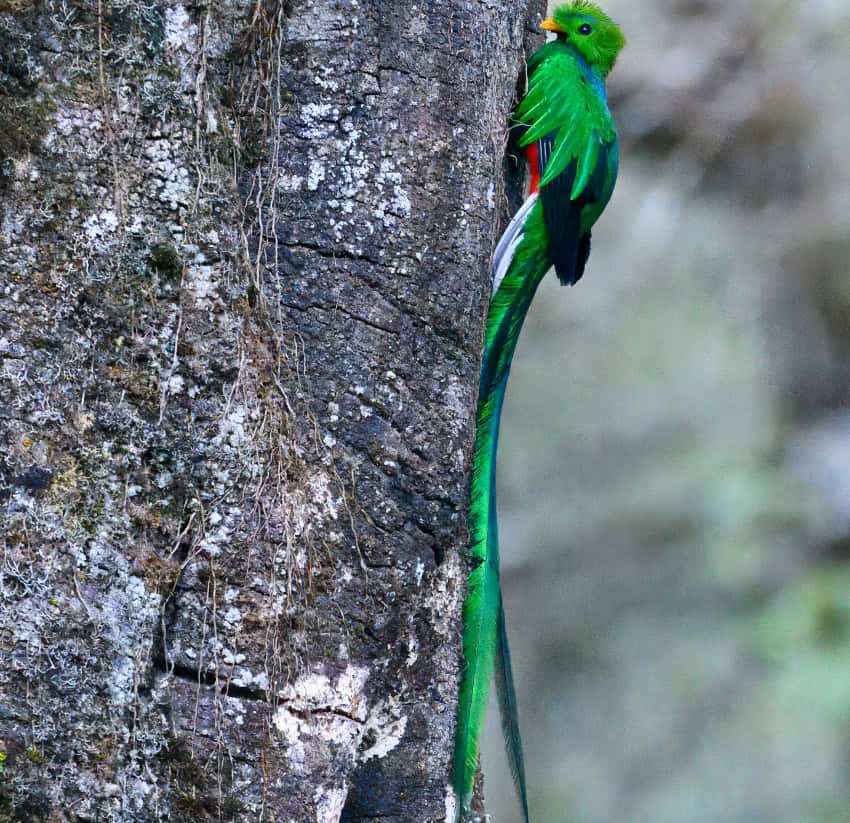
A majestic bird of Mayan legend
One Mayan legend tells how the resplendent quetzal is said to have gained its color: It had been an all-green bird until one accompanied the Maya K’iche prince Tecún Umán into battle against the Spanish conquistador Pedro de Alvarado. When the faithful bird landed on the body of the injured Tecún, the legend says, the prince’s blood gave the resplendent quetzal its characteristic red chest feathers.
The elite societies of both the Mexica and the Maya coveted the bird’s long green tail feathers. Amy A. Peterson and A. Townsend Peterson of the Center for Latin American Studies at Tulane University concluded in a 1992 study that at the height of the Mexica Empire, between 6,20 and 31,000 resplendent quetzals were harvested every year.
The fact that the birds survived such losses suggests that they were far more abundant in pre-Hispanic times than they are today. These estimates are clouded by the question of whether the long tail feathers might have been plucked and the birds then released. We have no idea what the fatality rate from such treatment might have been.
Centuries later, science finally names it ‘resplendent’
Although long familiar to locals, the bird was not officially recognized by science until 1832, with the work of distinguished naturalist Pablo de la Llave, who had been involved in the first study of Michoacán’s orchids.
In 1831, he was appointed director of Mexico’s National Museum of Natural History. De la Llave used this role to publish a small journal in which he described and named several birds, including the resplendent quetzal, as well as the equally colorful rufous-tailed hummingbird.

Where to see the resplendent quetzal
The best spot to see the birds in Mexico is the El Triunfo Biosphere Reserve, located in the central portion of the Chiapas Sierra Madre and known as the “Galapagos of the Cloud Forests.” Designated a state park in 1990 and a UNESCO international biosphere reserve in 1993, the park’s amazing biodiversity includes 997 different plants, 112 mammals and nearly 100 amphibian and reptile species.
The bird count hovers around 147 species, of which 79 are year-round residents. In addition to the resplendent quetzal, the star attractions here are the highland guan, spotted nightingale-thrushes, the wine-throated hummingbird, the green-throated mountain-gem, the rufous sabrewing and the sparkling-tailed hummingbird.
If you are a “twitcher,” then you are now in rapture from reading that list and already planning your first visit to this forest biosphere. If you are not a bird-watcher, let me just say that El Triunfo is one of the greatest places in the world to see rare and beautiful birds.
El Triunfo is considered safe to visit, but finding the rarer animals requires both considerable effort and local knowledge, and usually requires joining a tour. A typical trip might include a two-night stay in a mountain cabin, or perhaps a farm around the park’s edge. The resplendent quetzal tends to stay within a set range but, within its home, migrates up and down the slopes. The best time to see this bird is when it’s most active, during the March–April breeding season. At this point, they gather at higher altitudes.
The bird that eats an avocado whole
The relatively easy access to the forest — both here in Mexico and across the bird’s central American range — has led to several studies over the years, giving us a good understanding of the bird’s life cycle. Its diet consists mainly of fruits, but it might prey on insects, lizards, frogs and snails. It is not a fussy eater and has been seen dining on over 40 different plant species.
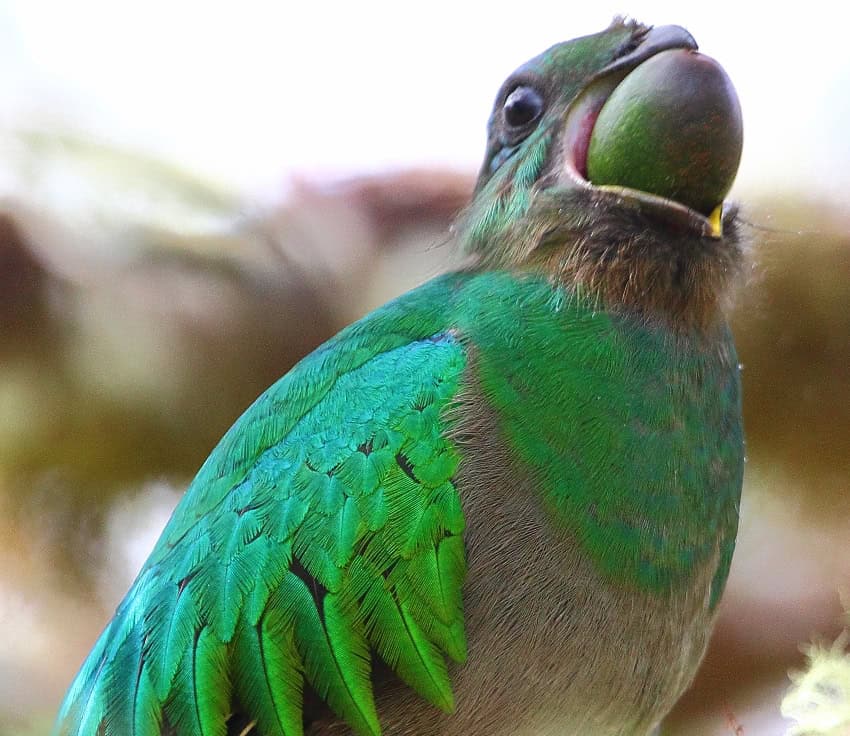
Most dramatically, it has a taste for wild avocados, helping wild avocado trees disperse through the forests. The birds swallow the avocados whole, often to the horror of tourists, convinced that the bird must choke on its giant meal! But having consumed the avocado flesh, the bird will regurgitate the pits.
The birds like to build their nests in the holes of decaying hollow trees, as far off the ground as possible. The female usually lays one to three eggs, and they are good parents, sharing the task of caring for eggs and young. It is while feeding their chicks that the birds are most likely to add insects and other small animals to their diet.
While the birds have been studied, there have not been regular counts, so any population quote has an element of estimation. The most commonly given figure is between 20,000 and 50,000 birds worldwide, with some estimates more optimistic, but numbers are generally presumed to be declining, although in some well-protected areas, populations might be holding steady.
Are resplendent quetzals endangered?
Overall, the birds are classified as “near threatened” on the International Union for Conservation of Nature and Natural Resources (IUCN) Red List, a designation that might be cynically seen as “hedging your bets.”
The main concern is ongoing deforestation. This not only destroys the bird’s habitat but leaves populations increasingly fragmented. Three hundred birds in one forest is a very different prospect for survival than 300 birds spread over six small and isolated populations.
There are also concerns that climate change might have an impact, perhaps allowing birds such as the keel-billed toucans (Ramphastos sulfuratus) to migrate further up the mountain slopes, where they might compete with the resplendent quetzal for nest holes.
Mexico-Texas program offers hope for breeding in captivity
There is a need for regular bird counts, which would help direct conservation projects. We need to confirm, for example, if the birds are still being hunted, which would highlight the need for local education programs. Or perhaps a greater concern should be to establish safe migration corridors between the higher and lower forests, through which the birds pass during the year.
One interesting challenge has been to get the birds to breed in captivity, something that until quite recently was thought impossible.
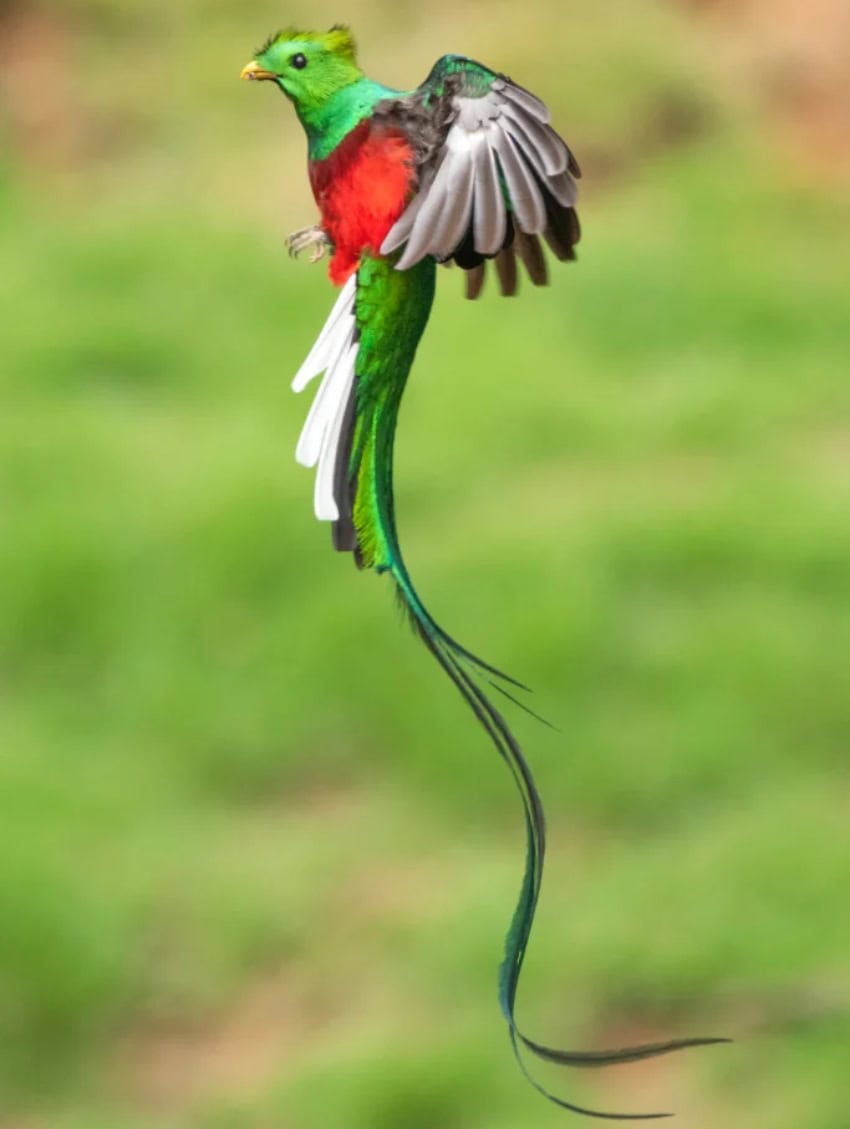
ZooMAT, in Chiapas, with help from the Dallas World Aquarium, has started to solve this problem. By removing the eggs and placing them in an incubator, they have been able to raise a small number of birds in captivity.
Future captive-bred birds might be released into the wild, increasing numbers and mixing up the DNA and with that hopefully improving the health, adaptability and robustness of the population. For now, however, there is still hope that the wild populations can be protected and will slowly increase in number.
Bob Pateman lived in Mexico for six years. He is a librarian and teacher with a Master’s Degree in History.