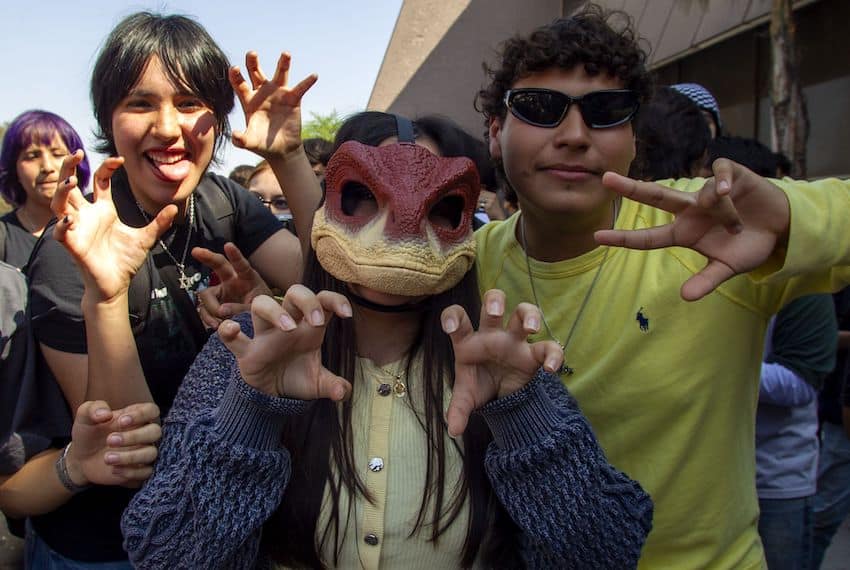
Teenagers trotting on all fours and wearing tails have turned “therian” — an online trend in which people identify as animals — into Mexico’s latest flash point, jumping from TikTok feeds into town plazas, campuses and even Congress.
The term “therian” refers to people who identify on a psychological or spiritual level with a non-human animal.

They often express that inner life in public with masks, ears or tails, or moving like an animal, but without believing they literally change bodies. Making animal sounds is optional and not widespread.
The concept grew out of internet forums in the 1990s and is now a niche global subculture, especially visible in parts of Latin America after taking root in Uruguay and Argentina.
In the United States and Canada, the movement is small, scattered and mostly on TikTok, Instagram and YouTube.
But the phenomenon of young people presenting themselves as dogs, cats or wolves is on the rise in Mexico. According to the newspaper El País, there was a 500% spike last week of Google searches in Mexico for “what is a therian.”
Recent “therian gatherings” in Mexico City, Monterrey, Cancún and Mérida have drawn crowds of curious onlookers, cameras and, in some cases, hostility.

At the Mexico City campus of the National Autonomous University of Mexico (UNAM), a much-hyped “therian race” drew hundreds of spectators and dozens of reporters, but only a handful of people who actually identified with the phenomenon.
One shopkeeper who said he spiritually identifies as a dog told El País, “I think it’s easier to find affection as another species than as a human.” Another attendee said, “My love for dogs and the lack of affection at home led me to make this decision.”
Elsewhere, tensions have flared. In Mérida, the first therian meetup at the Monumento a la Patria ended with a young woman dubbed “Lady Therian” being detained after she hurled eggs and insults at people gathered for the event. Later, she declared online that she did not regret her actions.

In Monterrey, the backlash is shaping policy debates. A lawyer, Mauricio Castillo, appeared at the Nuevo León Congress with a 28-year-old man wearing a horse head costume to file a citizen initiative.
The “Therian Law” proposal seeks to protect freedom of expression and respect for young people who identify with the community. It would introduce school coexistence protocols, citizen oversight programs, and sanctions for teachers or administrators who allow bullying of students, including therians.
“We are trying to feel dignified in the eyes of society, because they always think we’re crazy and don’t take our opinions into account,” the horse-headed man told reporters. “We are trying to avoid that kind of discrimination.”
A parallel bill — described by local media as the Law of Protocols for Coexistence and Protection of Students in Educational Environments — similarly seeks to shield young people who identify with the community from harassment in public and private schools.
Experts caution against pathologizing the trend. Juan Martín Pérez, coordinator of the Network for Children’s Rights in Mexico (REDIM), told El País that therians are “functional people, with everyday lives, who find in this an identity dimension,” arguing that the current uproar reflects a broader “moral panic” fueled by social media and adult anxiety over youth identity.
With reports from El País, El Universal, TV Azteca and Ámbito