A 1,400-year-old Zapotec tomb carved into a hillside in the state of Oaxaca is being hailed as Mexico’s “most significant archaeological discovery of the last decade.”
President Claudia Sheinbaum said as much last week when she announced the find at a press conference. A delegation led by Mexico’s Minister of Culture Claudia Curiel de Icaza made a subsequent on-site visit this week.
“Stabilization work is underway to open it to the public at the end of the year,” Curiel said. “It is one of the most important findings of Zapotec culture … due to its state of preservation and the information it will provide us about the cosmogony of these peoples.”
“This site is something wonderful,” added Oaxaca Governor Salomón Jara Cruz, who was part of the contingent that was able to go into the tomb. “Finding such beautiful [and ancient] remains is something unique.”
The tomb — dated to about 600 AD and known as Tomb 10 of Huitzo — lies in the newly registered Cerro de la Cantera archaeological site, in the municipality of San Pablo Huitzo.
It is in the state’s Central Valleys region, former territory of the Zapotec nation, about 35 kilometers northwest of Oaxaca city.

Tomb 10 was discovered last year (no exact date was given) after an anonymous report of looting, which led the National Institute of Anthropology and History (INAH) to start rescue excavations that uncovered the chamber.
According to INAH, the funerary complex belongs to the Late Classic period (600 AD to 900 AD), a time in Mesoamerican history when major city-states flourished and then began to decline.
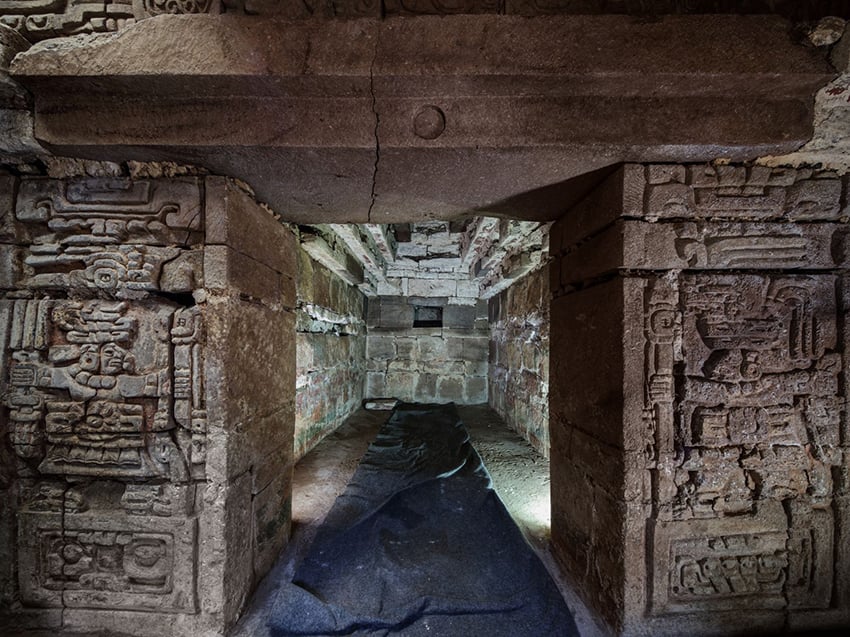
INAH specialists say the crypt, reached by a shaft, is a stepped-vault chamber made with limestone slabs and gray quarry stone, covered with stucco and measuring about 5.55 meters in length.
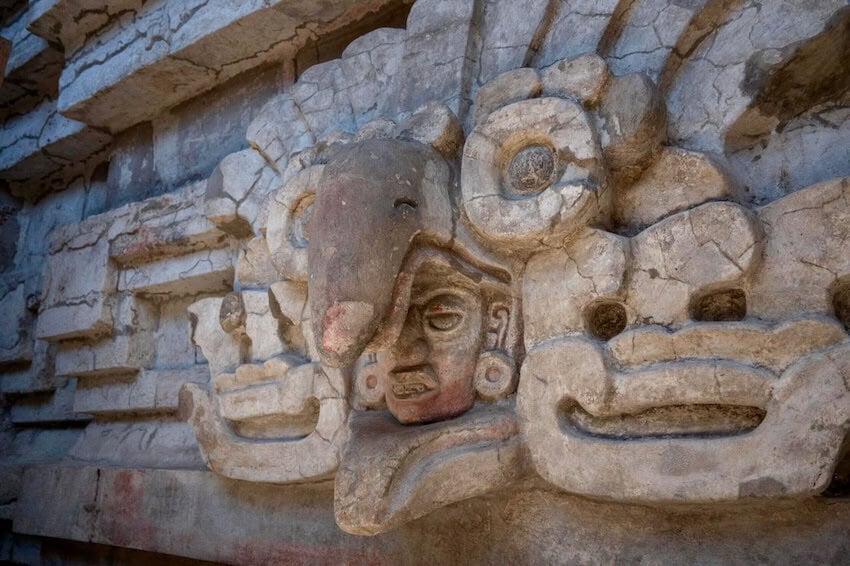
One of its most striking features is an owl sculpture over the entrance. In Zapotec cosmology, owls symbolize night and death; its beak covers the stuccoed and painted face of a Zapotec lord, likely an ancestor for whom the tomb was dedicated and who served as an intercessor with the gods.
A lintel above holds a frieze of stone slabs engraved with calendrical names, while the jambs show a man and a woman — who “may have served as guardians of the site” — with headdresses and artifacts in both hands.
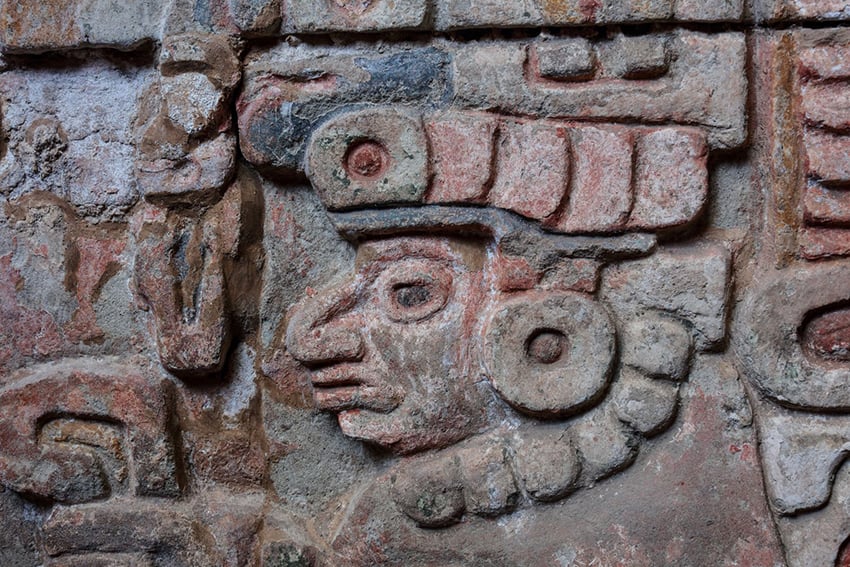
Inside, sections of mural painting in ocher, white, green, red and blue depict “a procession of figures carrying bags of copal incense and walking toward the entrance.”
Tomb 10 appears linked to the ancient kingdom of Huijazoo, whose capital stood on a nearby hill, Cerro de la Campana. Tomb 5, which was discovered in 1985, is well-documented in scholarly works and the media.
Given the proximity between Tomb 5 and Tomb 10, INAH considers the area to have been an acropolis contemporary to Monte Albán, the great Zapotec capital of its time.
With reports from El País, El Diario de México and Infobae