THE MND MEXICO WELL-BEING SERIES
A data-driven look at well-being in Mexico
MND Intelligence · Part I: Health and healthcare
Since the second quarter of 2026, Mexico News Daily has published the MND Sheinbaum Index™ and the MND Economy Index™ on a monthly basis.
The former examines what is happening in Mexico on President Sheinbaum’s watch by assessing the country’s performance across eight key pillars, including security, employment and economic growth.
As its name suggests, the MND Economy Index™ focuses specifically on Mexico’s economic performance across 10 pillars, including inflation, manufacturing health, the investment climate, economic growth and productivity.
In our inaugural MND Sheinbaum Index™ article, we noted that two pillars conspicuously absent from the index were education and healthcare — not because they are unimportant, but because official data for those areas is not published monthly, or even quarterly.
To fill that gap, Mexico News Daily is launching the MND Mexico Well-being Series, which will examine how Mexico is performing across key areas that directly affect people’s lives, including education, healthcare, poverty, happiness and gender equality. We will publish a total of six articles — five that examine a range of data points and a final report that holistically considers how Mexico is doing in the different areas assessed.
In these articles, we will present data that is directly relevant to Mexicans’ well-being and compare Mexico with other countries. We will draw on the most recent internationally comparable data, as well as data from the past decade, to assess what has changed in Mexico during the eight years that the ruling Morena party has been in office.

Improving the well-being of Mexico’s most disadvantaged people is a stated priority of both Morena and President Sheinbaum.
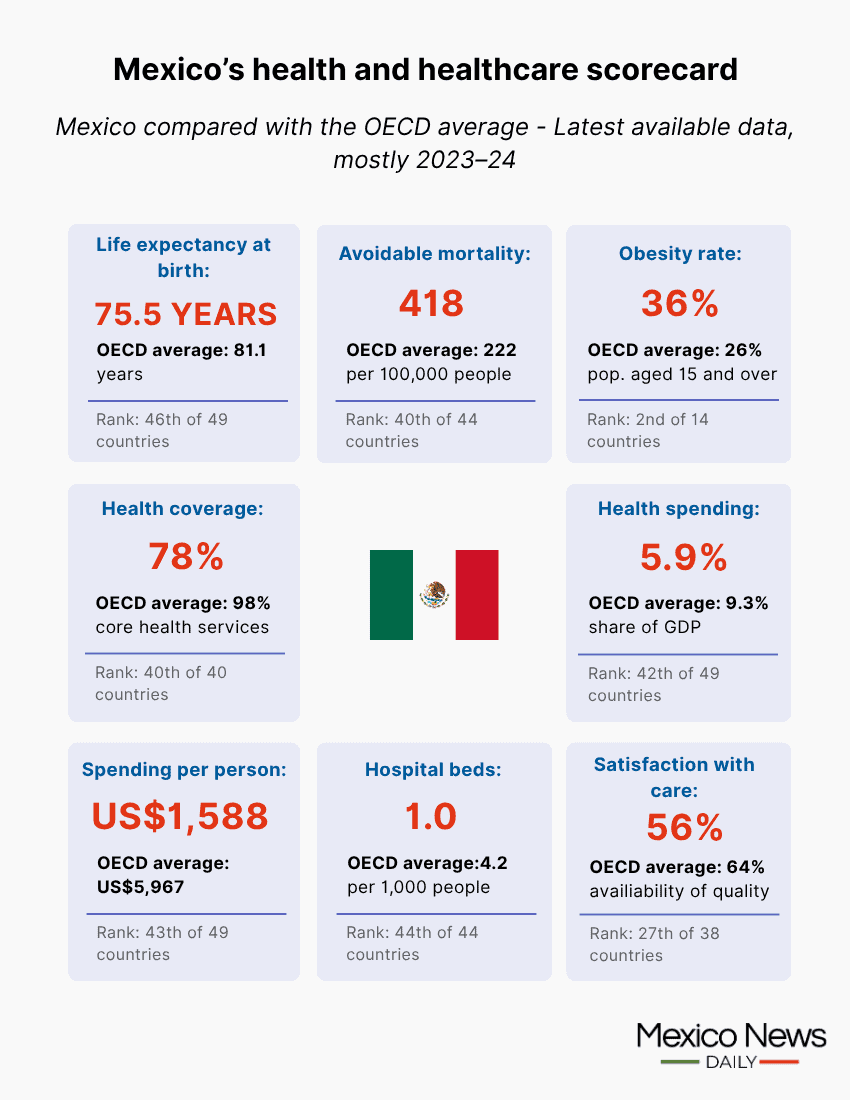
We launch the MND Mexico Well-being series today with an article focused on health and healthcare in Mexico. There are hundreds of relevant indicators, but for this article, we selected eight that we believe are among the most important.
We compare Mexico with other countries that belong to the Organization for Economic Co-operation and Development (OECD) as well as OECD partner and accession countries included in the organization’s internationally comparable datasets. We recognize that many OECD members are wealthier than Mexico and can therefore spend more on healthcare.
However, it is important to note that Mexico is one of the world’s 15 largest economies and is aiming to become the 10th biggest by 2030. An aspiration to become a world-leading country in health and healthcare would be an admirable complementary goal.
As the data below will show, Mexico currently scores poorly across most of these eight measures relative to its OECD peers. That does not necessarily indicate that Mexico’s healthcare system is “worse” than those of wealthier nations. Consider the United States: It spends 17.2% of GDP on healthcare — nearly double the OECD average of 9.3% and more than any other country in the world — yet its life expectancy of 78.4 years is 2.7 years below the OECD average. Its avoidable mortality rate is higher than the OECD average despite that spending. High spending, in other words, does not automatically translate into better outcomes. Instead, the data points to where Mexico has clear room to improve, and gives policymakers, researchers and citizens a shared, measurable framework for tracking whether that improvement happens and how they can contribute.
For practical reasons — and to ensure a more consistent comparison — this analysis is limited to OECD countries, among which are nations that are richer than Mexico in per capita terms, but which have significantly smaller economies. We acknowledge that Mexico’s relative performance on health and healthcare would likely appear more favorable in a comparison with all countries worldwide.
Below you will find a snapshot of health and healthcare in Mexico. In parentheses after each indicator is Mexico’s comparative position among the countries for which comparable OECD data was available, expressed as a decile where the size of the comparison group allows for one.
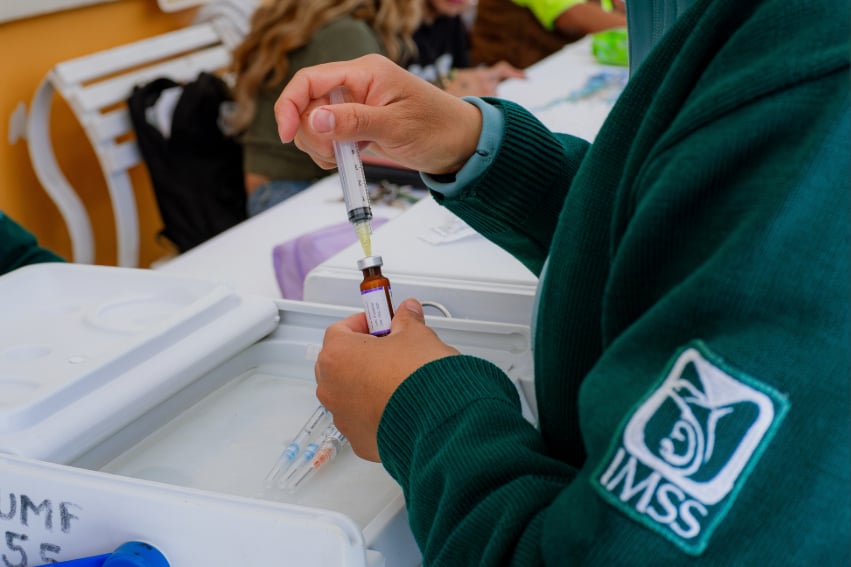
It is worth remembering that the majority of Mexicans access healthcare through Mexico’s public system rather than the private system. Patients’ experiences in the two systems can vary significantly.
An MND survey conducted earlier this year found that 92.9% of respondents — mainly foreign residents of Mexico — rated the quality of private healthcare they have received in Mexico as “excellent” or “good.” As you’ll see below, a poll conducted by Gallup found a much lower satisfaction rate vis-à-vis healthcare in Mexico.
As always, we are interested in hearing about your views on health and healthcare in Mexico. Please comment below.
For now, though, let’s get into the data.
LIFE EXPECTANCY AT BIRTH (bottom decile)
According to the OECD’s “Health at a Glance 2025” report, life expectancy at birth in Mexico was 75.5 years in 2024.
That was 5.6 years below the OECD average of 81.1 years.
Among the 49 countries included in “Health at a Glance 2025”, Mexico ranked 46th — one place below Latvia and one above India. It therefore ranked in the bottom decile of the countries assessed.
Has Mexico improved on this indicator over the past decade?
According to the OECD’s “Health at a Glance 2017” report, life expectancy at birth in Mexico was 75 years in 2015. Therefore, life expectancy increased by just six months over the ensuing nine years.
In 2015, Mexico’s life expectancy was also 5.6 years below the OECD average, then 80.6 years. The gap was therefore unchanged by 2024.
Among the 44 countries included in “Health at a Glance 2017,” Mexico ranked 36th — one place below Hungary and one above Brazil. It was therefore in the second-lowest decile of the countries assessed.
MORTALITY FROM AVOIDABLE CAUSES (second-lowest decile)
According to the OECD, “Indicators of avoidable mortality offer a general ‘starting point’ to assess the effectiveness of public health and healthcare systems in reducing deaths from various diseases and injuries.”
“Avoidable mortality includes deaths from preventable causes that can be avoided through effective public health measures and primary prevention interventions, and treatable deaths that are amenable to policy action through timely and effective healthcare interventions,” the OECD says.
Among “avoidable” causes of death are tobacco-related cancers and cardiovascular conditions as well as diabetes, which is highly prevalent in Mexico.
In 2023, Mexico’s mortality rate from avoidable causes was 418 deaths per 100,000 people, according to the OECD.
That was almost double the OECD average of 222 deaths per 100,000 people.
Among the 44 countries included in “Health at a Glance 2025,” Mexico ranked 40th — fifth worst — on this measure, placing it in the second-lowest decile of the countries assessed.
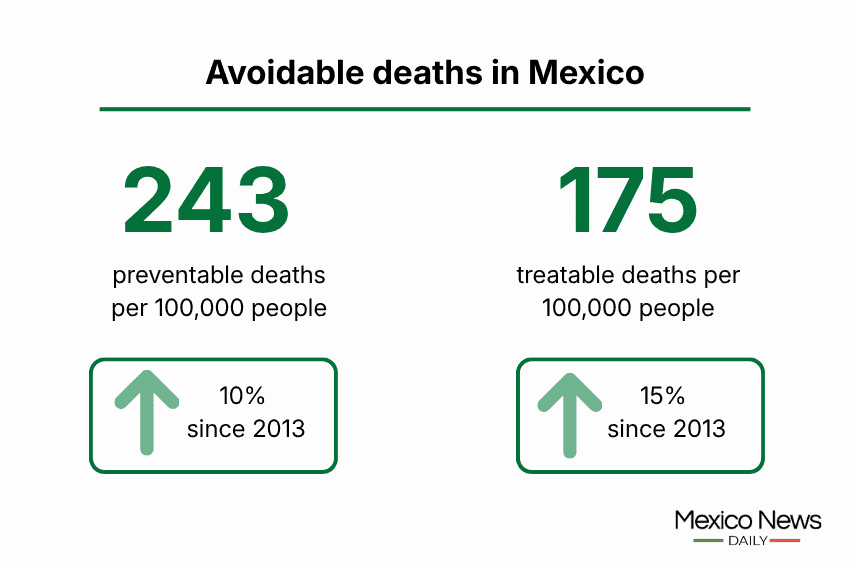
Mexico’s avoidable mortality rate was made up of a preventable mortality rate of 243 deaths per 100,000 people and a treatable mortality rate of 175 deaths per 100,000 people.
Has Mexico improved on this indicator over the past decade?
No. Mexico’s preventable and treatable mortality rates both increased between 2013 and 2023.
The preventable mortality rate rose by approximately 10% during the period, while the treatable mortality rate increased by about 15%.
OBESITY RATE (second highest rate)
According to data in the OECD’s “Health at a Glance 2025“ report, 36% of Mexico’s population aged 15 and over is obese. A broadly similar share is overweight but not obese, pushing Mexico’s combined overweight-and-obesity rate above 70%.
The OECD average obesity rate is 10 percentage points lower, at 26%.
Among the 14 countries for which measured data was included in the OECD report, Mexico had the second-highest obesity rate. Only the United States had a higher rate, at 41%. Mexico’s rate was more than seven times that of Japan, which recorded the lowest rate, at 5%.
Has Mexico improved on this indicator over the past decade?
No.
In 2015, Mexico’s obesity rate was 33.3%, almost three percentage points lower than it is today. However, the overweight rate was higher, at 39.2% in 2015. Mexico’s combined overweight-and-obesity rate has therefore remained broadly stable over the past decade.
In 2015, Mexico also had the second highest obesity rate among OECD countries, lower only than the United States.
POPULATION COVERAGE FOR HEALTHCARE (bottom decile)
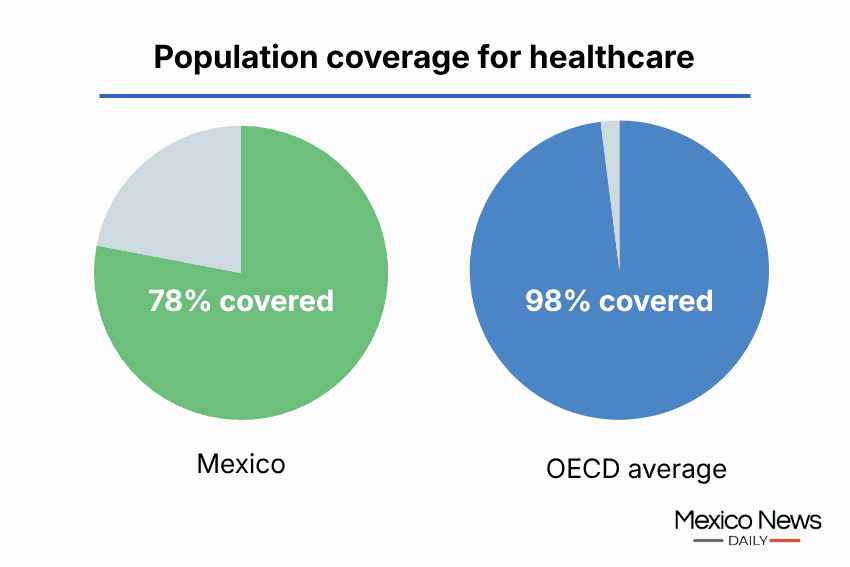
Mexico’s population coverage for what the OECD calls a “core set of health services” was 78% in 2023.
The OECD average was 20 points higher at 98%.
Among 40 countries included in the “Health at a Glance 2025” report, Mexico ranked last on this measure, placing it in the bottom decile.
Has Mexico improved on this indicator over the past decade?
No.
In 2015, 92.3% of the Mexican population had “total” public health coverage, according to the OECD.
Among 37 countries included in the “Health at a Glance 2017” report, Mexico ranked 33rd on this measure, one spot below Lithuania and one position above Chile.
A 2025 academic paper states that “between 2000 and 2015, Mexico reduced the uninsured population from 55% to 6.2%, largely driven by Seguro Popular (SP) expansion benefiting Indigenous peoples, rural and low-income households in high-deprivation states.
Seguro Popular was a universal healthcare program that was established during the 2000-2006 presidency of Vicente Fox.
The aforesaid academic paper says that after “SP’s dismantling in 2019, the launch of Health Institute for Welfare (INSABI), and the COVID-19 pandemic, uninsured rates rose sharply to 29.1% by 2023.”
HEALTH EXPENDITURE AS A PERCENTAGE OF GDP (second lowest decile)
In 2024, Mexico’s public and private sector health expenditure as a percentage of its gross domestic product was 5.9%, according to the OECD.
The OECD average was 3.4 percentage points higher at 9.3% of GDP
Among 49 countries included in the “Health at a Glance 2025” report, Mexico ranked 42nd on this measure, placing it in the second lowest decile.
Has Mexico improved on this indicator over the past decade?
Yes and no.
In 2016, Mexico’s health expenditure as a percentage of its GDP was 5.8%. Thus, health spending as a proportion of GDP increased 0.1 percentage points between 2016 and 2024.
There was a difference of 3.2 percentage points between the OECD average (9% of GDP) and Mexico’s health expenditure in 2016, slightly lower than the gap in 2024.
Among 44 countries included in the “Health at a Glance 2017” report, Mexico ranked 38th on this measure, placing it in the second lowest decile.
HEALTH EXPENDITURE PER CAPITA (second lowest decile)
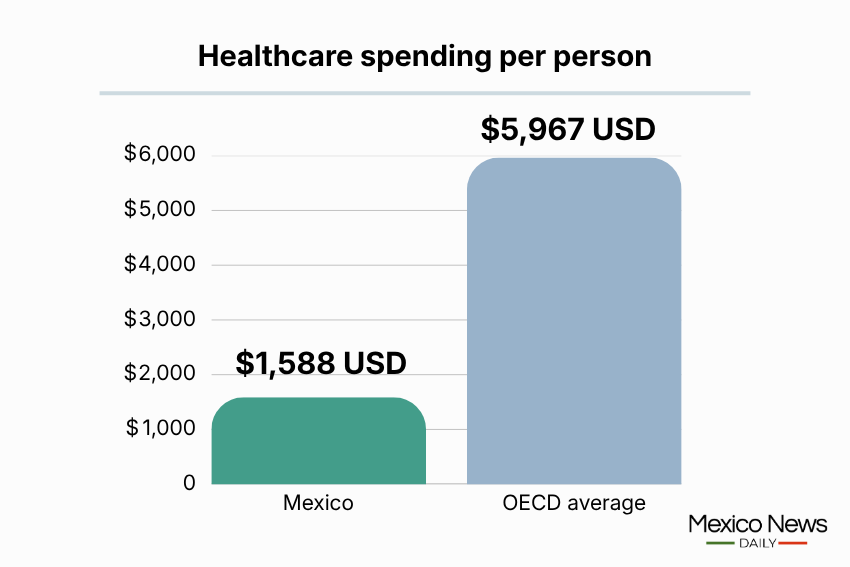
Health spending per capita in Mexico — including government spending and individual spending — was US $1,588 in 2024, according to the OECD.
The OECD average was 275% higher at $5,967.
Among 49 countries included in the “Health at a Glance 2025” report, Mexico ranked 43rd on this measure, placing it in the second lowest decile.
Has Mexico improved on this indicator over the past decade?
Yes and no.
According to the OECD, health expenditure per capita grew 1.6% annually in real terms between 2014 and 2018 and 2.1% annually in real terms between 2019 and 2024. The latter period, during which the annual growth rate was 0.5 percentage points higher, corresponds to the six-year term of former President Andrés Manuel López Obrador.
In 2016, health spending per capita in Mexico was US $1,080, according to the OECD.
The OECD average that year was 271% higher at $4,003. Thus, the difference between per capita health spending in Mexico and the OECD average was slightly lower in 2016 than in 2024.
In 2016, Mexico ranked 39th out of 44 countries assessed by the OECD, placing it in the second lowest decile.
HOSPITAL BEDS PER 1,000 PEOPLE (bottom decile)
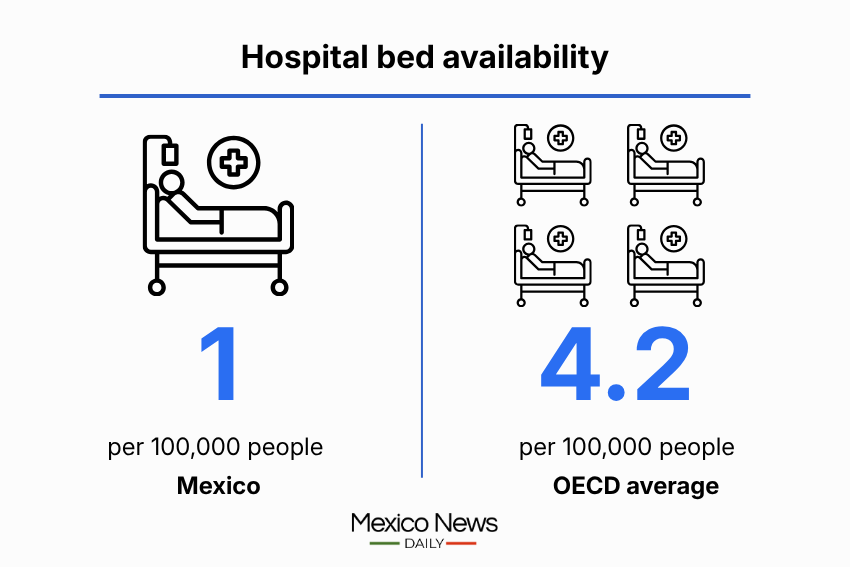
In 2023, Mexico had just one hospital bed per 1,000 people, according to the OECD.
The OECD average was significantly higher at 4.2 beds per 1,000 people.
Among 44 countries included in the “Health at a Glance 2025” report, Mexico ranked last, placing it in the bottom decile.
Has Mexico improved on this indicator over the past decade?
No, but it has worsened either.
The number of beds per 1,000 people in Mexico in 2023 was unchanged from a decade earlier, according to the OECD.
The federal government is aiming to increase the number of public hospital beds in Mexico by 9,139 during its six-year term (October 2024 to September 2030), but in a country of some 130 million people, the achievement of that goal would not significantly change the national ratio.
SATISFACTION WITH AVAILABILITY OF QUALITY HEALTHCARE (third lowest decile)
The results of a 2023 Gallup World Poll included in the OECD’s “Health at a Glance 2025” report show that 56% of Mexicans are satisfied with the availability of quality healthcare in the area where they live.
The OECD average was eight points higher at 64%.
Among the 38 countries included in the OECD report, Mexico ranked 27th, placing it in the third lowest decile.
Has Mexico improved on this indicator over the past decade?
Yes, but only marginally.
The percentage of Mexicans who were satisfied with the availability of quality healthcare in the area where they live was 55% in 2014.
The overall picture
Mexico’s health and healthcare performance compares poorly with that of the other countries assessed across the eight indicators examined in this article. Life expectancy is 5.6 years below the OECD average, while Mexico’s rate of mortality from avoidable causes is almost twice as high.
The country also has one of the OECD’s highest obesity rates, the lowest coverage for a core set of health services and the fewest hospital beds per capita among the countries assessed. Health spending — both as a share of gross domestic product and per person — remains far below the OECD average.
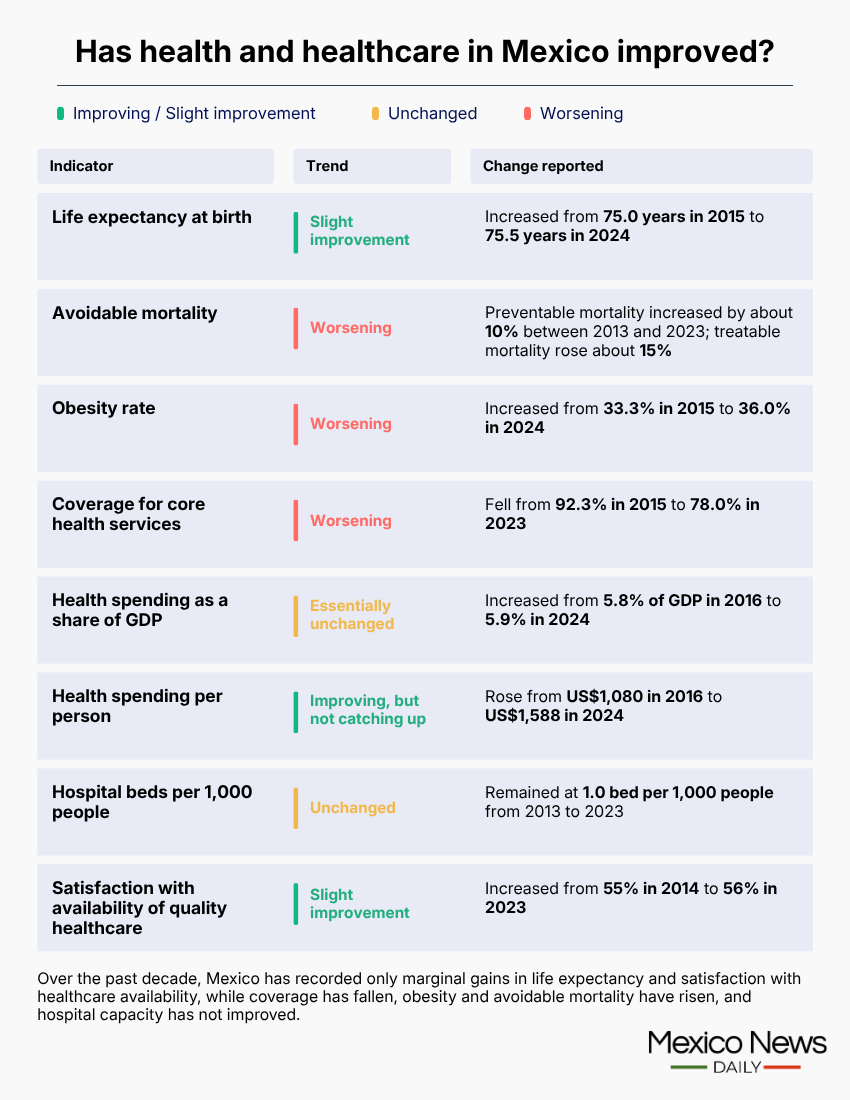
The results point to weaknesses in both public health and the healthcare system itself. High obesity and avoidable mortality underline the need for more effective prevention, while low healthcare coverage, limited spending and scarce hospital capacity indicate continuing problems with access to and delivery of care. The federal government is aiming to address these issues through a range of initiatives (see below).
The longer-term picture is also troubling. Over roughly the past decade, Mexico has made little progress in closing gaps with the OECD average: life expectancy has increased by only six months, health coverage has declined, hospital-bed availability has not improved and both preventable and treatable mortality rates have risen. Satisfaction with the availability of quality care has increased only marginally.
It should be noted that significant changes in health outcomes and major improvements to a national healthcare system do not typically happen at lightning speed, but rather over a period of decades. Even though Morena has been in office at the federal level for eight years, it may still be too soon to fairly assess its health and healthcare record. Current health and healthcare shortcomings are the product of a large range of factors, as well as changing circumstances and policy choices over a long period of time.
One example of how circumstances have changed is the implementation of the North American Free Trade Agreement in 1994, which contributed to a reshaping of the Mexican diet.
What is the federal government doing to improve health outcomes and healthcare in Mexico?
Listed below are some of the major health and healthcare initiatives that have been implemented in Mexico in recent years or are currently in the process of being implemented. Click the links in the bullet points to read more about the different initiatives.
- The federal government is in the process of creating a Universal Health Service. The aim is to guarantee free public healthcare for all Mexicans regardless of which institution they are affiliated with.
- The government is planning to spend 1.1 trillion pesos on healthcare in 2027, a year-over-year increase of 10.9%. A portion of the funds will be used to open thousands of new IMSS-Bienestar healthcare centers to support the universal healthcare initiative. The IMSS-Bienestar currently operates in 24 of Mexico’s 32 states. The other eight states — governed by opposition parties — have decided against signing onto the scheme.
- In 2025, the government launched Rutas de la Salud (Health Routes), a medication and medical provisions delivery program designed to resolve supply shortages.
- In 2023, the government opened a “mega pharmacy” in México state, described by former President Andrés Manuel López Obrador as “a warehouse with all the medicines of the world in reasonable quantities” that would serve as a “definitive way out” of medication shortages.
- The excise tax on soft drinks increased 88% to 3.08 pesos per liter in January.
- A ban on junk food in schools took effect in early 2025.
- The government reported in July that 30 public hospital projects had been completed since President Sheinbaum took office in October 2024. An additional 33 projects were slated for completion in 2026.
- The government is aiming to increase the number of public hospital beds in Mexico by 9,139 during its six-year term (October 2024 to September 2030).
- The federal government has hired thousands of Cuban doctors to enhance the public health system’s capacity, especially in rural areas of Mexico.
- In 2025, the government commenced the Salud Casa por Casa program, in which seniors and people with disabilities receive periodic visits from healthcare personnel in their homes. The program focuses on preventive health and the provision of basic medical care.
The success and wisdom of the initiatives outlined above are debated in some cases. As expected, the government defends them while opposition parties have been critical of some of the initiatives.
FURTHER READING:
- The OECD’s “Health at a Glance 2025” country note for Mexico was a primary source for this article. It includes additional health and healthcare indicators not included in this report.
- A 2025 report (Spanish) by the Mexico City-based think tank Fundar includes a number of recommendations aimed at improving health and healthcare in Mexico. Among its recommendations are to “promote a culture of prevention” and increase funding for all public health institutions.
- This World Bank document outlines “several persistent challenges that have historically constrained Mexico’s progress” toward achieving universal health coverage.
Mexico News Daily