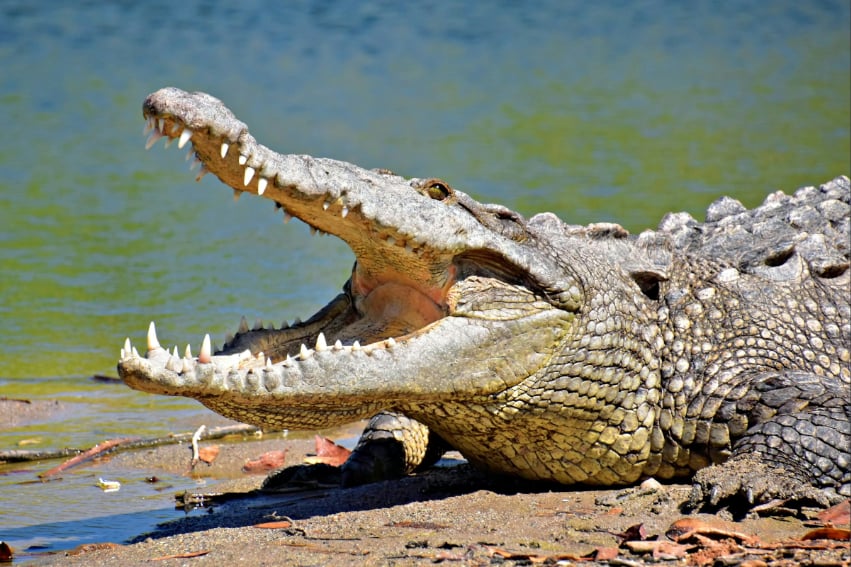
Puerto Vallarta’s crocodiles may be headed for a new neighborhood.
Jalisco state officials and Mexico’s Environment Ministry (Semarnat) were scheduled to meet virtually Thursday to review proposals for managing crocodiles and potentially relocating some of them to the Estero El Salado, a protected urban estuary.
The discussion follows weeks of increased sightings in and around Puerto Vallarta, where development has brought homes, roads, hotels and tourists closer to wetlands long occupied by crocs.
In addition to the sightings, there has been at least one death. A 28-year-old man was killed by a crocodile in June on a beach near the Marriott Puerto Vallarta Resort and Spa.
Sergio Ramírez López, director of the Jalisco Civil Protection and Fire Department, said the state proposal is not simply to capture reptiles and release them into their new digs.
“You capture an animal, take it to the El Salado Estuary, it competes with other males, and it ends up going somewhere else,” Ramírez López told UDG TV.

Instead, officials want to first adapt the estuary to accommodate additional animals and reduce territorial competition, he said. There is no timetable and Semarnat would have to validate any plan, he added.
Paola Bauche, Jalisco’s environment secretary, said crocodiles are part of the region’s natural habitat and that authorities do not believe the population is excessive.
An estimated 300 to 350 live in Puerto Vallarta and Banderas Bay, with about 40 measuring more than 2 meters.
Rainy-season flooding and higher water levels allow them to move between the Boca Negra and El Salado estuaries by using the sea. The animals also are in their reproductive period, increasing their mobility and the likelihood of encounters with people.
Bauche said 11 American crocodiles (Crocodylus acutus) — a species under federal protection due to its key role in the ecological balance of estuaries, wetlands and rivers — have died in recent months in the P.V. area.
Although he didn’t specify the causes, at least two of the crocodiles were killed by humans, according to a Mexico News Daily report that also detailed the capture of a 3.7-meter (12-foot) crocodile. One of the dead crocs was found decapitated and another tied up and shot.
Jalisco officials have been working with federal and municipal authorities, hotel owners and specialists on prevention, signage and public outreach that includes a bilingual campaign aimed at ending cruelty toward crocs.
Hotels in Puerto Vallarta and along the Costalegre have been asked to standardize wildlife-warning systems. In Manzanillo, Colima, authorities have installed purple flags on beaches for the first time to warn of crocodile sightings.
For all the concern they can generate, Puerto Vallarta’s crocodiles were recently “honored” at the city’s first Crocodile Festival.
Held on Aug. 22, one day ahead of National Crocodile Day in Mexico, the event at Estero El Salado State Park paired conservation education and estuary tours with practical safety advice on coexisting with the reptiles that continue to fascinate residents of Mexico.
With reports from El Occidental and UDG TV