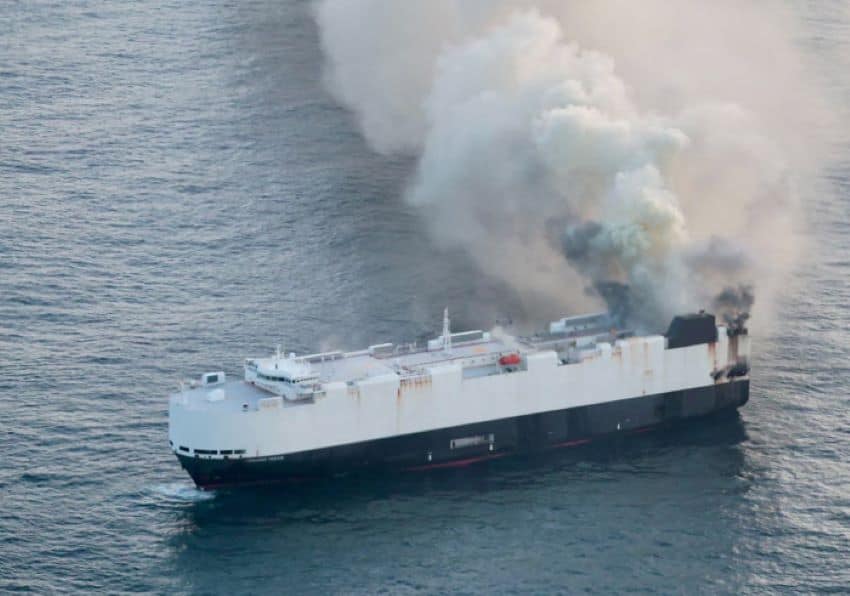
A cargo vessel carrying 3,048 new vehicles to Mexico sank in the North Pacific Ocean on June 23 after being abandoned weeks earlier when fire disabled the ship.
The Morning Midas sank in international waters off Alaska’s Aleutian Islands chain, the ship’s management company, the London-based Zodiac Maritime, said in a statement.
🚨Cargo ship Morning Midas sinks in Pacific Ocean after days of fire
3,000 cars onboard, including 800 EVs, Lithium batteries, 1500 tons of fuel now sitting 16,000 feet underwater. Pollution risk being monitored#morningmidas pic.twitter.com/r6u31EB1zC
— Nabila Jamal (@nabilajamal_) June 25, 2025
The carrier departed on May 26 from Yantai, China, and was headed for the port of Lázaro Cárdenas in the Pacific coast state of Michaocán.

Bloomberg News reported the ship’s load included at least 800 new electric vehicles (EV) manufactured by Chinese automakers Chirey and Great Wall Motor. The newspaper El Financiero reported that there were also automobiles produced in China by General Motors aboard the ship.
Zodiac Maritime has yet to offer details on the vehicle models lost in the disaster.
The vessel was under charter to Anji Logistics, a subsidiary of Chinese automaker SAIC Motor, according to US-based reports cited by multiple publications.
The Coast Guard said it received a distress alert June 3 about a fire aboard the Morning Midas, which then was roughly 300 miles (490 kilometers) southwest of Alaska’s Adak Island.
A large plume of smoke was initially seen at the ship’s stern coming from the deck loaded with electric vehicles, the U.S. Coast Guard and Zodiac Maritime said at the time, according to the AP.
The newspaper The Maritime Executive reported that a salvage team from Resolve Marine, a marine response company, took a week to reach the vessel because of its remote location, approximately 360 nautical miles southwest of the Aleutians in Alaska.
The Morning Midas was reportedly still burning when teams reached it on June 9, believing the water integrity had been maintained. A towline was attached on June 11, and by the time a second salvage vessel, the Garth Foss, arrived on June 16, thermal scans and visual inspections showed no signs of an active fire onboard.
However, the fire damage was compounded by bad weather and water seepage, causing the ship to sink in waters about 16,404 feet deep and about 415 miles from land, Zodiac Maritime said in a statement.
Preliminary investigations suggest the fire might have originated from an electric vehicle onboard, according to Mexico Business News.
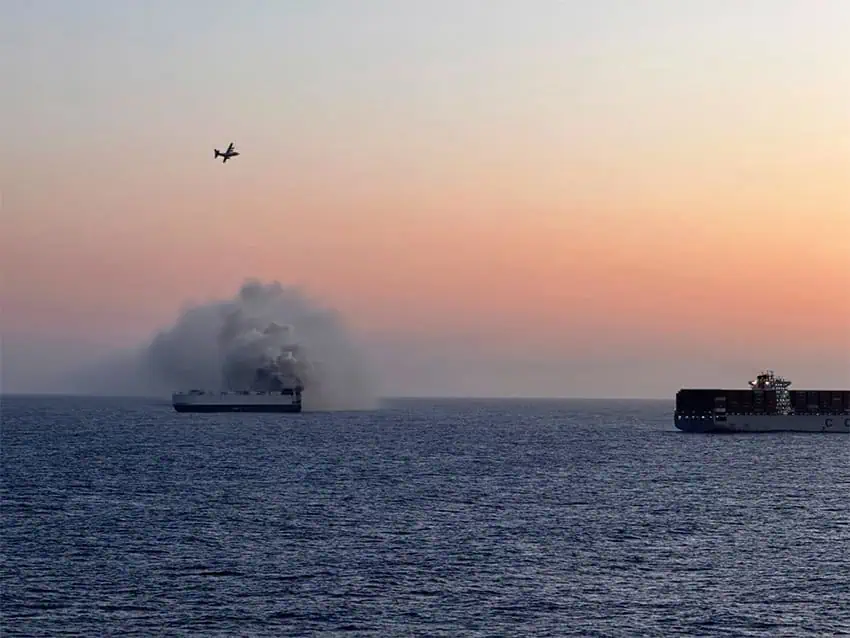
There were 22 crew members onboard the Morning Midas. All evacuated to a lifeboat and were rescued by a merchant marine vessel. There were no injuries.
The U.S. Coast Guard was on site to assess pollution damage as there was approximately 350 metric tons of gas fuel and 1,530 metric tons of very low sulfur fuel oil onboard.
A Coast Guard spokesperson said on Thursday that there was no visible pollution, but two salvage tugs containing pollution control equipment remained on scene to monitor for any signs of pollution or debris, Zodiac Maritime said.
Zodiac Maritime was also sending another specialized pollution response vessel to the location as an added precaution.
With reports from El Financiero, Mexico Business News, USA Today and the Los Angeles Times