The group stage of the 2026 FIFA men’s World Cup is now over and the knockout stage has begun, with Canada becoming the first team to reach the round of 16 thanks to a 1-0 victory over South Africa in Los Angeles on Sunday.
The Mexican team, known as El Tri or more formally la Selección Nacional de México, gets its chance to reach the round of 16 this Tuesday night when it takes on Ecuador at the Mexico City Stadium (aka Estadio Azteca).
The first two weeks of the tournament were an exciting — and emotional — time for Mexican football fans both here and abroad in places such as New York, where large numbers of Mexicans celebrated the 1-0 victory over South Korea and bonded with fans from the East Asian nation.
In Mexico City, a seemingly incredulous 800,000 people (per Mexico City Mayor Clara Brugada) descended on Paseo de la Reforma and the Angel of Independence monument to celebrate Mexico’s win over Czechia last Wednesday night, a victory that gave El Tri an unprecedented perfect record in the group stage of the World Cup — three wins, zero losses, zero ties, six goals scored and zero goals conceded.
I’ve been lucky enough to witness some of the World Cup action up close — well, from the media tribune high up in the stadium — and have experienced some of the broader World Cup vibe in Mexico City, one of the tournament’s sixteen host cities. Here are some observations from the past two weeks or so in the axolotl-adorned capital — a kind of “World Cup notebook” largely based on things I jotted down in my notebook while watching matches, or wrote in my mind as I traveled to and from Mexico City Stadium.

For El Tri — and Mexico — a dream tournament … so far
The 2026 World Cup opened at Mexico City Stadium on June 11 and there hardly could have been a better start for El Tri, which defeated South Africa 2-0. Mexico continued its winning ways in Guadalajara with a 1-0 victory over South Korea on June 18 before returning to “El Azteca” for a dominant 3-0 triumph over Czechia on June 24.
Many millions of Mexicans will be hoping, wishing — praying! — that this racha (streak) of wins continues with a victory over Ecuador on Tuesday night, and then continues some more with a triumph in the round of 16 clash, possibly against England, scheduled for this Sunday at Mexico City Stadium. Could Mexico, with Álvarez, Jiménez, Rangel et al., go further in a World Cup than it has ever gone before? Only time will tell.
The first day of the tournament in Mexico City was also a success for FIFA and the governments of Mexico and Mexico City. While protests occurred, they didn’t cause major disruptions to the World Cup opening ceremony and first match, although they did indirectly shut down a key public transport route for fans after they left the match (see below).
To date, it’s hard to argue that the World Cup in Mexico hasn’t been a success. While international visitor numbers might not have been as high as anticipated, the group stage of the tournament generated an economic impact of around US $1 billion for Mexico, according to the Confederation of National Chambers of Commerce, Services and Tourism.
There are now just three remaining matches to be played in Mexico: a round of 32 game between the Netherlands and Morocco in Monterrey on Monday night, Tuesday night’s clash between Mexico and Ecuador and a round of sixteen fixture at Mexico City Stadium on Sunday that will hopefully involve El Tri.
Mexico’s wins have sparked exuberant celebration
Three wins in three World Cup group matches. El Tri had never achieved this feat before 2026. And didn’t Mexican fans enjoy the three victories!
You’ve probably seen photographs and videos of hundreds of thousands of fans packing Paseo de la Reforma in the vicinity of the Angel of Independence after Mexico’s victories. The exuberant celebrations — as rain fell in the capital in some cases — speak for themselves. Similar scenes have been seen in many other parts of the country, albeit with fewer revelers, including around the iconic Glorieta La Minerva in Guadalajara. (Yes, the rubbish left behind isn’t a great look.)
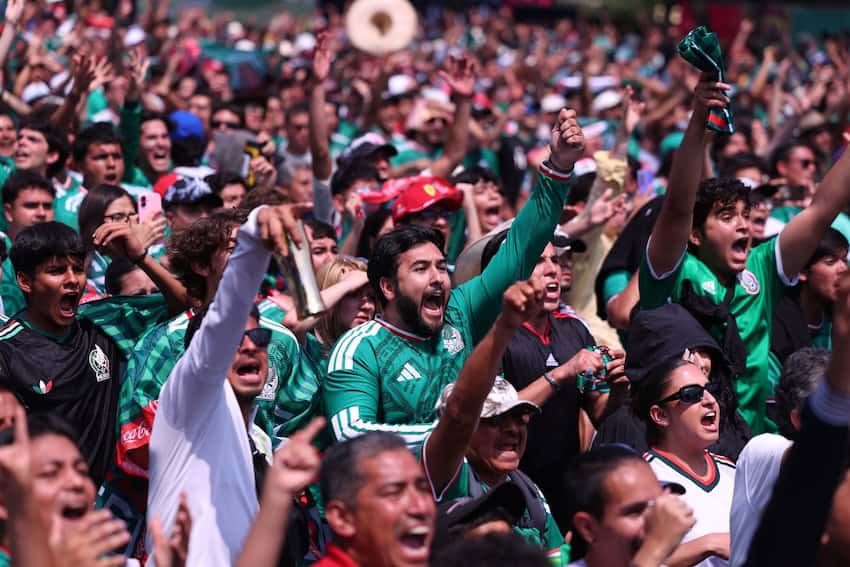
Mexicans, it seems, don’t just celebrate World Cup victories — they feel them, in a way that seems distinct from fans in many other countries. The joy is visceral, and it’s shared: with family, with friends, with complete strangers.
President Sheinbaum put it this way: “Sorry [ahem, why the apology?!], what people experience in Mexico isn’t experienced in the United States or Canada.” In Mexico, she said, there is “happiness,” a very warm welcome for World Cup visitors and great “jubilation related to the World Cup” — on the streets, in public squares and elsewhere.
Even Mexicans opposed to the staging of the World Cup in Mexico — people who believe that addressing the nation’s various problems, including the missing persons crisis, must take precedence over the hosting of a football tournament — have supported El Tri and screamed with joy when la selección has scored. This viral video aptly explains the contradiction, the “cognitive dissonance.”
Mexicans’ passion for World Cup football has extended beyond Mexico’s matches. On Sunday, I went with my family to the official FIFA Fan Festival in the Zócalo, Mexico City’s main square, where the sizable crowd of mostly Mexican fans lived every moment of the match between Canada and South Africa, letting out gasps, cheers, groans, screams and virtually every other audible expression of emotion you can think of as they watched the action on the giant screen.
An exhilarating stadium experience
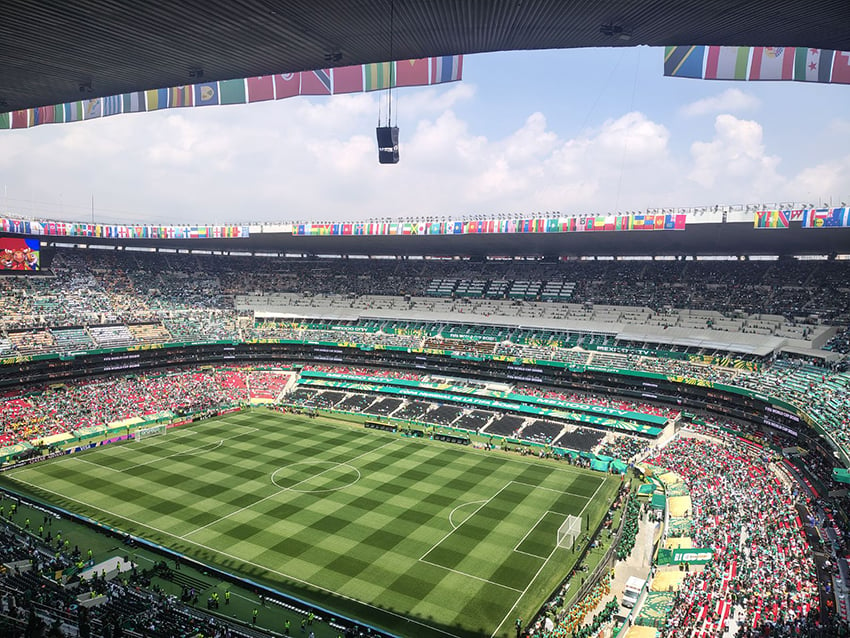
Each of the three times I attended a World Cup match at Mexico City Stadium this month, the experience was exhilarating and unforgettable. Of course, the raucousness reaches its crescendo when Mexico (or Colombia as the case might be) scores a goal. On five occasions so far this tournament, El Tri has found the back of the net in Mexico City, sending the vast majority of the 80,000+ fans into raptures.
The time between goals is liberally peppered with deafening chants of “!Olé!” or “¡México, México!,” of impromptu renditions of “Cielito Lindo,” of waves (Mexican, of course!) sweeping around the stadium, of piercing whistles when opposition teams maintain possession for longer than is liked (or deemed acceptable), and all manner of other collective expressions of staunch support for El Tri.
If only words could do it justice…
When Colombian fans took over Mexico City Stadium earlier this month, they created their own unique and equally — or dare I say more? — rambunctious atmosphere (see below).
The Colombians arrive with energy galore
There was a smattering of South Africans at Mexico City Stadium on June 11, and foreigners from many countries around the world have enjoyed watching the World Cup from Mexico City. But, from my point of view at least, the quadrennial tournament didn’t really become a major international event in the capital until hordes of Colombians arrived for the June 17 match against Uzbekistan.
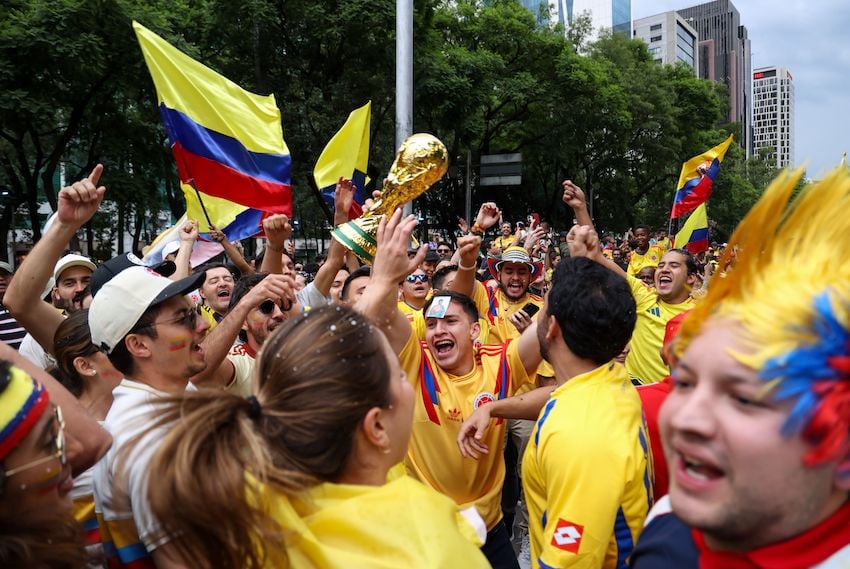
The atmosphere they collectively created in the stadium, in the streets around the stadium, in the metro, in central Mexico City and wherever else they went in numbers was simply fantastic. A sea of yellow, a cheerful chorus of carnivalesque Colombians, a brigade of bogotanos here, a mass of medillenses there.
Outside the stadium, I could see the economic impact Colombians were making on Mexico City in real time — in the OXXO and 7-Eleven-bought beers they were drinking, in the tacos they were eating in stadium side streets. Of course, that was the small (albeit not unimportant) potatoes of economic impact — the more meaningful one came from money spent on accommodation, in restaurants, in shops and in bars in Mexico City, and subsequently in Guadalajara, where Colombia defeated the Democratic Republic of Congo last Tuesday.
On June 17, after downing their pre-match beers, los colombianos created a home match atmosphere for Los Cafeteros inside “The colossus of Santa Úrsula,” as “El Azteca” is colloquially known. A rapturous rendition of the National Anthem of Colombia provided a brief but fierce lesson in patriotism that left me wishing that I was Colombian myself just so I could participate in the camaraderie.
When Colombia’s Daniel Muñoz toed a lofted pass into the back of the net in the 40th minute, the tens of thousands of Colombians in attendance had the collective strength and voice power to bring the house down. But a 60th minute goal from Uzbekistan to tie the match precipitated minutes of quiet and tension — Colombian fans became a dormant volcano — … until BOOM!! A 65th-minute goal by Luis Díaz reinitiated the joviality, and everything was right with the (Colombian view of the) world again.
The CDMX public transport system has been impressive
I live in a southern neighborhood of Mexico City that is about 10 kilometers north of Mexico City Stadium. Prior to each of the three World Cup matches I attended this month, I walked around 10 minutes to the Parque de los Venados metro station on Line 12 and traveled two stops along that line before disembarking at the Ermita station to change to Line 2. I then journeyed two stops down Line 2 to Tasqueña station, where I changed to the light rail (tren ligero) to complete the trip to the stadium.
Mexican fans continue to celebrate on the light rail. pic.twitter.com/mikIfiJ4Iu
— Mexico News Daily (@mexicond) June 25, 2026
Despite large numbers of fans traveling to the matches, my public transport trips were orderly and relatively quick. After the Colombia-Uzbekistan and Mexico-Czechia matches, large crowds gathered outside the stadium’s light rail station, but getting onto the platform and onto a train was much quicker and much easier than I anticipated. Overall, I have been satisfied and pleasantly surprised by the efficiency of the Mexico City public transport system as it came under increased pressure on match days.
For me, the only public transport hiccup on match days has been the suspension of light rail service on the opening day of the World Cup due to damage protesters caused to stations and objects they threw onto the tracks. In the absence of other transport options, that left me — and thousands of others — with a long walk to the Tasqueña metro station, but, in the company of happy fans, the walk was a jubilant and enjoyable one that seemed shorter than it actually was.
The little moments that matter
Yes, the World Cup is about money, perhaps as much as it’s about football (or soccer if you prefer). Fans have complained about “rip-off” ticket prices and the greed of FIFA. These complaints are hard to dismiss. But what has heartened me are the interactions between fans of opposing teams in and around Mexico City Stadium, interactions that simply wouldn’t have occurred had they not been facilitated by the World Cup. As I watched friendly engagements between Colombians and Uzbeks, I wondered, do these countries have embassies in each other’s countries? (Answer: They do not). In the absence of formal diplomatic relations, Colombians and Uzbeks — supporting their national team as it competed at a World Cup for the first time — conducted well-meaning, unofficial football-based personal diplomacy. It was a joy to see.
Over the last couple of weeks, I have seen similarly friendly interactions between Mexicans and South Africans, and between Mexicans and Czechs. Such amiable engagements no doubt also occurred in and around stadiums in Atlanta, in Kansas City, in Toronto, and in Monterrey. The friendly relationship between Mexican and Korean fans, whose teams faced off in Guadalajara, is famous and dates back a number of years.
Have you heard the chant “¡Coreano, hermano, ya eres Mexicano!” (Korean, my brother, you are now Mexico!)?
En una taquería de Guadalajara vieron a un grupo de coreanos comiendo y les pusieron Gangnam Style. En lugar de ofenderse o algo, todos se levantaron a bailar juntos.
El Mundial es la prueba de que países con culturas totalmente distintas pueden convivir y llevarse bien. 🇰🇷🇲🇽🥰 pic.twitter.com/4fPK2w01Mw
— Sergio 🇫🇷 (@Seergiot3ck) June 11, 2026
These unlikely human interactions between people from different countries and cultures may be brief in many cases, but at a time of significant conflict in the world, maybe they are more meaningful than we think. Perhaps the FIFA Peace Prize should have been awarded to “the football fans of the world,” rather than U.S. President Donald Trump.
Community — and World Cup fever — via Panini
In May, I bought the Panini World Cup 2026 album and a few packets of stickers as a way to get my four-year-old son interested in the tournament. It was a bit of a slow burn at first, but 18 days after the World Cup began — and after countless cries of “¡gooooooool!” emanating from our television set (and perhaps my larynx on occasion, too) — I can say my son is a World Cup enthusiast, if not an avid, minute-by-minute watcher of games.
Messi, Mbappé, Cristiano Ronaldo, Julián Quiñones, Raúl Jiménez and Alphonso Davies, among various other footballers’ names, now roll off my son’s tongue regularly, as do the names of the 48 competing countries. Inquiries of “Dad, can you play football [in our living room]? have become more and more frequent.
In addition to helping to create “World Cup fever,” the act of collecting Panini stickers (estampas in Spanish) helps create community. If you want to complete your collection, it’s basically mandatory to gather with your fellow collectors at public swap meets. Over the past month or so, I’ve handed over and received countless estampas in front of the iconic Palace of Fine Arts in the historic center of Mexico City, where literally hundreds of Panini aficionados congregate on a daily basis, and at the Oasis Coyoacán shopping center in southern Mexico City — another mecca for sticker-swapping football fans.
Just as World Cup fans from different countries have meaningful interactions in and around stadiums, Panini sticker collectors do the same, sharing their passion for football as they try to help each other complete their sets. Personally, I’ve engaged with many Mexicans, young and old, at these swap meets as well as people from Uruguay, Spain and Germany, among other countries. Kids, moms, dads, uncles, aunts, grandmas and grandpas all huddle together with a glint in their eyes as they search for those elusive estampas they need.
The unofficial mascot that’s outshining the official ones
If you haven’t heard of Merlin, the “World Cup duck,” yet, perhaps you’ve been living under a rock (no offense intended!), or at least not reading Mexico News Daily’s World Cup section!
I think it’s fair to say that Merlin’s popularity has exceeded that of the official 2026 World Cup mascots. Does anyone remember their names?
By Mexico News Daily chief staff writer Peter Davies (peter.davies@mexiconewsdaily.com)