
Coronavirus restrictions shouldn’t be lifted until case numbers have been on the wane for at least two weeks, say two experts who spoke with the newspaper El Universal.
While federally mandated social distancing measures concluded Saturday in favor of state-based restrictions, Mexico has not even reached the end of the first wave of the pandemic, said Alejandro Macías, an infectious disease doctor, former government health commissioner and member of the National Autonomous University’s coronavirus commission.
“In fact we haven’t even reached the plateau,” Macías said, citing official statistics presented by Health Ministry officials at nightly coronavirus press briefings.
“What we’ve seen is that the epidemic is on the rise and at least two weeks should pass without these increases [in case numbers] in order to talk about an end to the lockdown,” he said.
Macías expressed support for the federal government’s color coded “stoplight” system to determine each state’s readiness to lift restrictions but said that it’s too early to predict how the pandemic will develop.
“At this time I don’t think that we can apply a timetable to the virus,” he said.
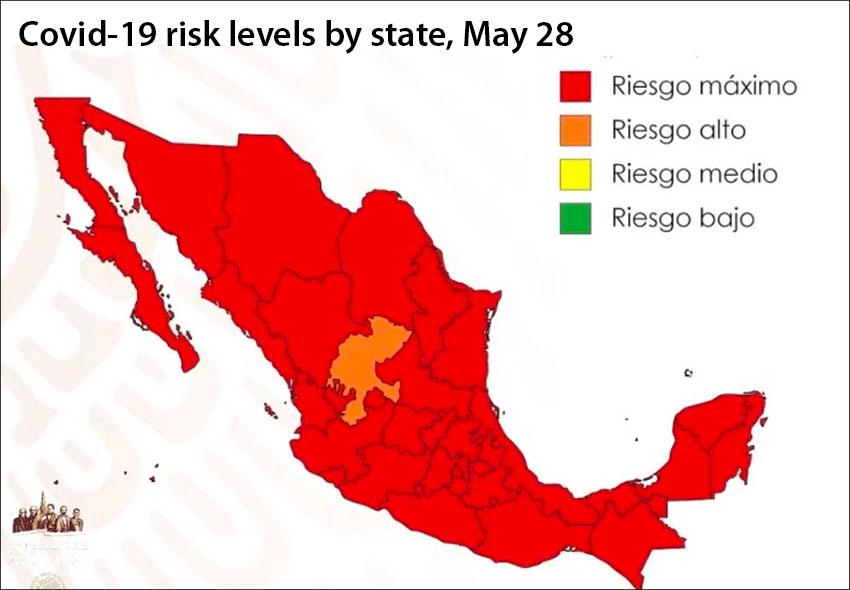
In order to limit new outbreaks once restrictions are eased – every state in except Zacatecas is currently in the “red light” phase, according to the stoplight system – authorities should implement specific coronavirus mitigation measures on public transit and in areas that attract large numbers of people, Macías said.

He also said that health authorities need to ramp up Covid-19 testing, especially at businesses where employees are returning to work.
Rodolfo de la Torre, director of social development at the Espinosa Yglesias Study Center think tank, agreed that restrictions shouldn’t be eased until cases are seen to be declining for at least two weeks. He also said that more widespread testing is needed.
“According to the map presented by the government, 30 states [and Mexico City] have [widespread] active transmission. An opening [of the economy] is not viable without thinking about increasing the number of tests, at least in workplaces,” he said.
Both Macías and de la Torre suggested that President López Obrador’s decision to resume his work tours (he was in Quintana Roo on Monday) was the wrong one, the latter saying that “he should set an example and wait a little longer.”
Sharing Macías’ view on the development of the pandemic in Mexico is the United States-based New England Complex Systems Institute (NECSI), a research institute and think tank.
It said that Mexico is one of 52 countries around the world where the coronavirus pandemic is far from being under control. Among the other countries in the same category are the United States, Brazil and Russia, which rank first, second and third, respectively, for confirmed Covid-19 cases.
NECSI warned the 52 countries against reopening their economies before their outbreaks are under control due to the risk of large new outbreaks.
“Reopening too early runs the risk of triggering exponential growth again. This might erase all of the benefits gained from the lockdown so far. It could increase the total amount of deaths, overwhelm the medical system, and create a scenario where another lockdown is necessary.”
Mexico had recorded more than 90,000 confirmed Covid-19 cases as of Sunday while the official death toll from the disease is 9,930.
Source: El Universal (sp)