Sheinbaum’s mañanera in 60 seconds
-
🏗️ Fracking feasibility panel debuts: Sheinbaum introduced a multidisciplinary group of Mexican scientists tasked with assessing whether “sustainable fracking” is technically and economically feasible across different regions of Mexico.
-
🧪 Science minister sets the terms: Rosaura Ruiz predicted that the group would recommend biodegradable chemicals and recycled water use in any fracking operations, framing the effort as applying “science for social well-being” without harming ecosystems or water supplies.
-
🛢️ Geoscientist gives fracking a green-ish light: Luis Fernando Camacho Ortegón said he’s monitored U.S. fracking for 20+ years and that current technology has reached “a very stable level of security,” citing no serious accidents in the Eagle Ford Shale region of Texas.
-
❓ Is the decision already made? A reporter pressed Sheinbaum on whether the panel’s composition signaled fracking is a done deal. She flatly said “no,” insisting that scientists with opposing views are also part of the group — just not present on Wednesday.
-
🤝 Communities get a veto: Sheinbaum pledged that Indigenous and local community consultations will happen before any fracking decision, saying “we’re not going to do anything against the communities.”
-
🇺🇸 Texas dependency is the real driver: The president said Mexico can’t keep sourcing 75% of its gas from Texas fracking operations, framing domestic fracking research as a matter of energy sovereignty, not just economics.
-
🌐 Foreign tech yes, foreign control no: Sheinbaum floated the idea of Pemex hiring foreign fracking technology rather than ceding resource control, declaring flatly: “We’re not going to hand over our resources to foreign countries.”


Why today’s mañanera matters
President Sheinbaum’s Wednesday morning press conference focused on the possibility of “sustainable” fracking taking place in Mexico.
While Sheinbaum stressed that no decision has yet been made, she appears to be strongly in favor of allowing the controversial gas extraction technique, provided that there are guarantees that it won’t create environmental problems or adversely affect local communities. The main aim is to reduce Mexico’s dependency on natural gas imports from the United States.
Sheinbaum has acknowledged her previous opposition to fracking, but now asserts that it can take place safely via the use of new technologies. A scientific committee has been formed to offer an expert opinion on the topic, and it appears likely that its conclusions will be used to legitimize a government decision to allow “sustainable” fracking.
Fracking has already taken place in Mexico, but the practice was largely paused by former president Andrés Manuel López Obrador. Sheinbaum’s apparent push to launch a “sustainable” fracking initiative in Mexico represents a major break with the policy of her predecessor, political mentor and founder of the political movement she now leads.
Today’s mañanera was extremely significant as the president unveiled the experts who will assess the feasibility of “sustainable” fracking and reiterated her openness to the use of the gas extraction method. If fracking is approved by the Sheinbaum administration, the president’s Wednesday morning press conference will be seen as an important milestone on the journey to such a decision.
Sheinbaum introduces scientific group that will assess fracking feasibility
At the very start of her press conference, Sheinbaum highlighted that a group of Mexican scientists from various universities was in attendance.
“They’re going to help us with a question we posed a week ago — Under what conditions is the non-conventional exploitation of gas in our country feasible or not feasible?” she said.
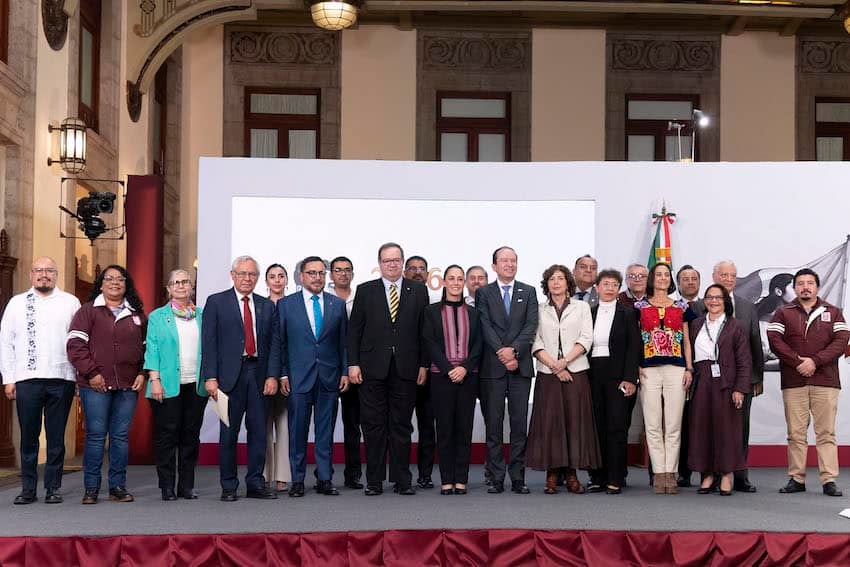
On repeated occasions, Sheinbaum has expressed her openness to allowing a form of “sustainable” fracking in Mexico.
On Wednesday, she said that the scientific group will assess whether such fracking is feasible in different parts of the country.
“This is the task that we gave them,” Sheinbaum said.
The group is slated to offer an initial opinion on the feasibility of sustainable fracking in Mexico in two months.
Science minister: ‘The commitment of this government is to reach energy sovereignty’
Speaking immediately after Sheinbaum’s opening remarks, the federal minister for science, humanities, technology and innovation, Rosaura Ruiz declared that “as the president has said in recent days, the commitment of this government is to reach energy sovereignty, without compromising water security or the health of our ecosystems.”
Ruiz subsequently noted that the ministry she leads put together the “multidisciplinary” scientific group that will assess the viability of sustainable fracking in Mexico.
She said that the group will “recommend the use of chemicals” for fracking “that are biodegradable.”
Ruiz also spoke about the importance of using recycled water in fracking so as to “not affect catchment areas and human consumption, especially in arid areas.”
The science minister asserted that she, other officials and the scientific group “are here to give confidence and scientific rigor to the people of Mexico.”
“We’re not improvising, we’re applying science for social well-being and the protection of our soil,” she said.
Geoscientist: Current fracking technology has a ‘very stable level of security’
Asked whether fracking in Texas affects the environment in Mexico, Sheinbaum referred the question to a member of the scientific group.
Luis Fernando Camacho Ortegón, a geoscientist from the Autonomous University of Coahuila, said that he and other scientists have been monitoring “the non-conventional hydrocarbons industry” — i.e., fracking — in the United States for over 20 years.
He said that fracking techniques were previously inefficient and acknowledged that fracking has caused “some problems.”
However, Camacho asserted that fracking technology has improved a lot, and told reporters — in a contested claim — that there have been no accidents or contamination related to fracking in the Eagle Ford Shale region in Texas.
“We haven’t heard of any accident or serious problem,” he said, adding that “the current technology” used in fracking “has reached a very stable level of security.”
Sheinbaum rejects suggestion that a decision about fracking has already been made
A reporter asserted that the “composition” of the scientific group and the remarks of its members indicated that a decision about allowing fracking in Mexico has already been made.
“Fracking will be carried out, [gas] will be extracted and what we’re [really] asking is where and how,” he said.
“… Has the decision already been made?” asked the reporter, who said that the scientific group appears to be “strongly” in favor of fracking.
“No,” Sheinbaum responded.
“That’s why we’re consulting the scientists,” she said.
Sheinbaum asserted that “many” members of the scientific group have “spoken out against this form of gas extraction,” although few if any of them were present at today’s mañanera.
“Today we introduced those who are here,” she said.
Ruiz subsequently said that not all of the members of the scientific group were able to attend the president’s press conference. She also asserted that the scientists who are part of the group have “different positions” on the issue of fracking. The science minister echoed the president’s remarks, declaring that no decision on allowing fracking has been made.
Sheinbaum: ‘We’re not going to do anything against the communities’
Sheinbaum told reporters that consultation processes with Indigenous people and other citizens will take place before any decision about fracking is made.
“We’re not going to do anything against the communities … because we’re not like that,” she said.
“… That must be made clear,” Sheinbaum said.
“The first thing is to see the technical and scientific viability [of sustainable fracking],” added the president.
She said last week that the “sovereignty” of Mexico, “the development of the country” and its “environmental future” will be central considerations in any decision her government makes about fracking.
On Wednesday, Sheinbaum said that the scientific group will offer an opinion on the feasibility of sustainable fracking in around two months, including information on the cost of “new technologies” that could be used to extract gas from non-conventional deposits. She said the group might determine that sustainable fracking in Mexico is “too expensive.”
Sheinbaum: We can’t continue depending on gas from Texas
Sheinbaum declared that “what we can’t do” is continue depending on gas fracked in Texas in order to meet 75% of Mexico’s gas needs.
“While we can continue buying, we have to seek energy sovereignty,” she said.
“It’s very important to continue researching [the feasibility of sustainable fracking],” Sheinbaum said.
“And we’re not hiding anything. If I wanted to hide something, we wouldn’t be publicly presenting what we’re doing,” she said.
‘We’re not going to hand over our resources to foreign countries’
Sheinbaum raised the possibility that state oil and gas company Pemex could “hire” the technology required to carry out sustainable fracking from a foreign company or companies.
In response to a reporter’s assertion that the hiring of technology would create a “technological dependency,” the president highlighted that Mexico already depends on foreign technology “in many areas,” including in the energy and health sectors.
Asked whether she could rule out foreign companies coming in to Mexico to carry out fracking, Sheinbaum declared that “we’re not going to hand over our resources to foreign countries.”
Asked whether the extraction of gas in Mexico via fracking would bring down gas prices, the president responded:
“Beyond the price, [the important thing] for all Mexicans is availability … [of] gas in our territory. That is extremely important for all Mexicans. Sovereignty is a matter for everyone. It’s not just an individual benefit, it’s a collective benefit. It’s about the homeland, the nation, the future of Mexico.”
Sheinbaum said last week that the commencement of sustainable fracking in Mexico — if approved — could take 10 to 15 years. However, it appears that the government is interested in moving as quickly as possible in order to promptly ease, if not eliminate, Mexico’s dependency on U.S. oil.
By Mexico News Daily chief staff writer Peter Davies (peter.davies@mexiconewsdaily.com)