
The government’s pursuit of an affordable, Mexican-made electric vehicle (EV) proceeds apace, with hopes to display prototypes at the 2026 FIFA World Cup.
The Olinia project aims not only to offer an alternative mode of transportation but also to position the country as a leader in developing its own technology.
@claudiasheinbaum En 2027, las y los mexicanos podrán adquirir Olinia, vehículo de pasajeros o carga que desarrollamos en Puebla. #olinia #carros #fyp #2027 ♬ sonido original – Claudia Sheinbaum Pardo
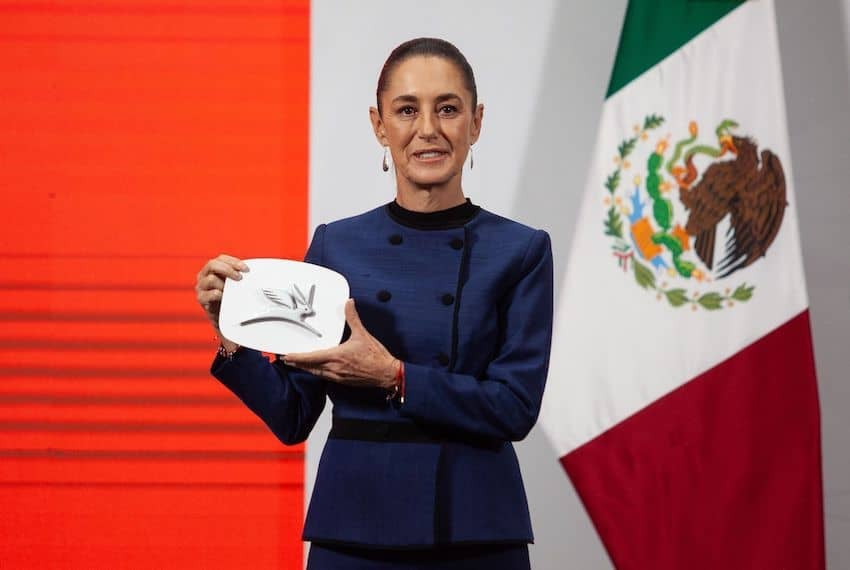
President Claudia Sheinbaum, who presented the vehicles just weeks after taking office in October 2024, has even expressed an optimistic desire to arrive at the World Cup opening ceremony in Mexico City in one.
“We are going to arrive in one or more Olinia vehicles so we can show them to the world,” she said last month while visiting the Tech Center in Puebla where they are being designed.
The Olinia — scheduled to hit showrooms in early 2027 — is described as a “mini-vehicle,” small and agile, with a focus on urban functionality and neighborhood mobility. It will feature enough power to climb hills, reach speeds of 50 kilometers an hour and possess the versatility to be recharged at any standard outlet.
The new Mexican EV comprises two primary designs: one for passengers (a personal mobility model and a neighborhood mobility model) and another for last-mile deliveries.
Expansión magazine reported that industry specialists see an opportunity for Olinia to meet a mobility need different from that currently focused on by Mexico’s traditional automotive industry.

Eric Ramírez, a Latin America regional director at Urban Science Applications (an automotive consultancy and technology firm headquartered in Detroit), believes the Olinia has a future in neighborhood-based mobility, replacing motorcycle taxis and the like.
“I think the niche where it will participate is a good idea,” he told Expansión. “It is ideal for short distances with very small capacities.”
Olinia’s main competition would seem to be low-cost Asian motorcycles and scooters, whose sales have surged in the past year. These vehicles are now ubiquitous in crowded commercial areas such as the Mexico City Historic Center.
As of Jan. 1, these types of vehicles must pay a 35% tariff, but the resulting markup will still make for stiff competition.
The price range for Olinia models has been announced as between 90,000 and 150,000 pesos (US $5,040 and US $8,400), which is more than triple what the Made in China vehicles cost (25,000 to 30,000 pesos).