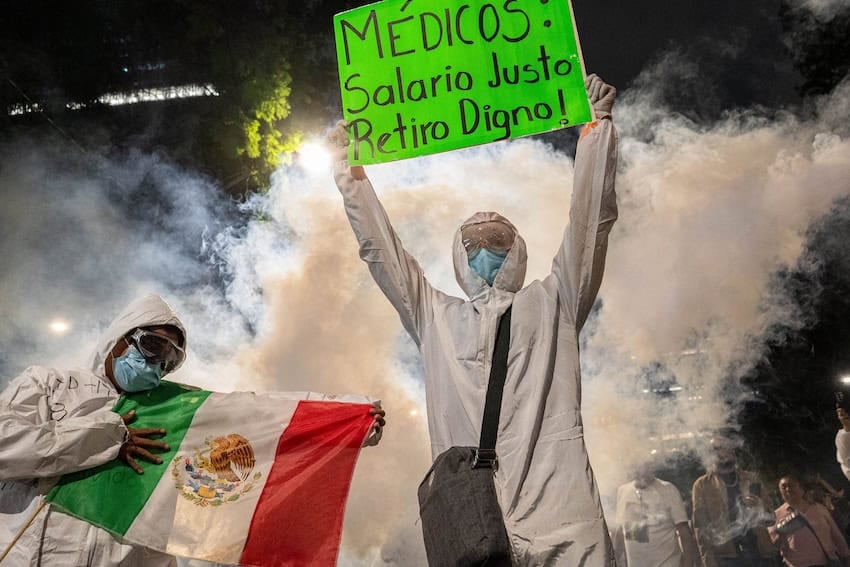
Thousands of Mexican Social Security Institute (IMSS) workers took to the streets of Mexico City and other cities across Mexico on Tuesday to demand higher pay, better work conditions, increased funding for healthcare and an end to shortages of medicines and medical supplies.
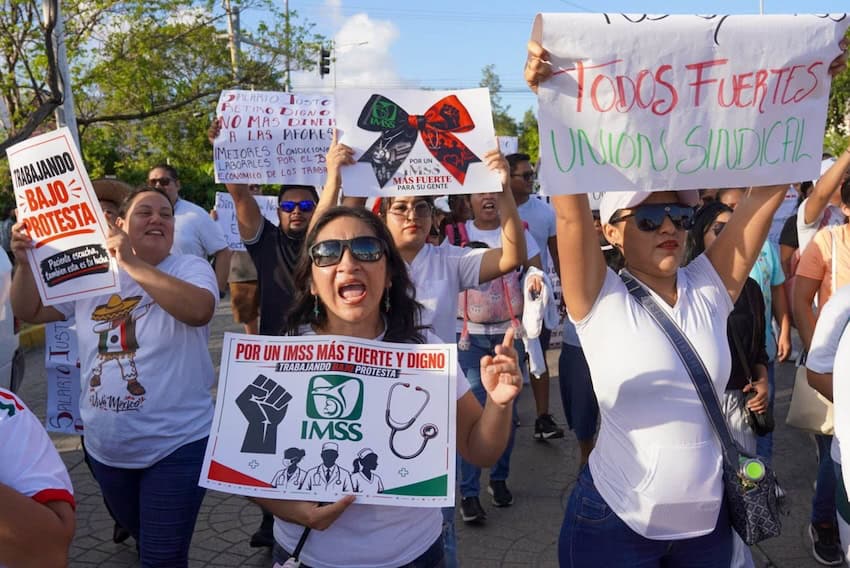
In the capital, around 7,000 workers, including doctors, nurses, orderlies, social workers and administrative staff joined a so-called megamarcha (mega-march), which set off from the IMSS-run Siglo XXI National Medical Center in the Doctores neighborhood at 4 p.m. and made its way to IMSS offices on Paseo de la Reforma, the tree-lined boulevard that runs into the historic center.
🔴“¡Presente!” Con un pase de lista, manifestantes mencionan a los estados donde trabajadores del IMSS se movilizan para exigir un aumento salarial, mejores condiciones laborales y el abasto de medicamentos e insumos médicos en las unidades de salud. https://t.co/hOiEVTO42z
— Azucena Uresti (@azucenau) October 14, 2026
“Don’t get sick because there are no supplies” and “Listen up people, this is your fight too” were among the slogans chanted by the protesting workers.
IMSS workers protested in virtually every state across Mexico on Tuesday, and additional demonstrations were held on Wednesday, including in Mexico City. Among the cities where protests were held on Tuesday were Monterrey, Guadalajara, Tijuana, León and Mérida. Some IMSS derechohabientes (beneficiaries) and other supporters of healthcare workers, including members of various unions, also participated in the protests.
IMSS is a major healthcare provider in Mexico, running hospitals and clinics across the country. Some 78 million people have healthcare coverage through IMSS, a figure that accounts for around 60% of Mexico’s total population. IMSS has more than 520,000 employees, around 80% of whom work in healthcare-related roles.

A 10% pay rise among workers’ demands
Thousands of IMSS workers have made it clear that they reject an offer of a 2.9% pay rise coupled with a 3.9% increase in benefits. Instead, they are demanding a 10% increase to their base pay.
IMSS workers reportedly turned out in large numbers to vote on the proposed pay rise on Wednesday. The newspaper Reforma reported that workers “fear the result might not reflect the will of the voters because the union is the judge” — i.e., members of the National Social Security Workers Union are overseeing the voting process.
At Tuesday’s protest in Mexico City, workers said they were formerly considered “heroes” because of their work during the COVID pandemic, but have now been “forgotten on the payroll.”
In addition to higher pay, IMSS workers have a range of other demands. They include:
- The adequate supply of medications and medical supplies in IMSS hospitals and clinics.
- The hiring of additional healthcare personnel in order to ease excessive workloads.
- The allocation of resources equivalent to 7% of GDP to healthcare. (Mexico’s public and private expenditure on healthcare was below 6% in 2024, according to the OECD.)
- Respect for their labor rights, including their right to speak out about problems in IMSS healthcare facilities.
- Modifications to the Social Security Law to guarantee the ongoing financial viability of IMSS.
- Changes to their pension system.
- Additional upgrades to IMSS healthcare infrastructure. (The government has been modernizing hospitals.)
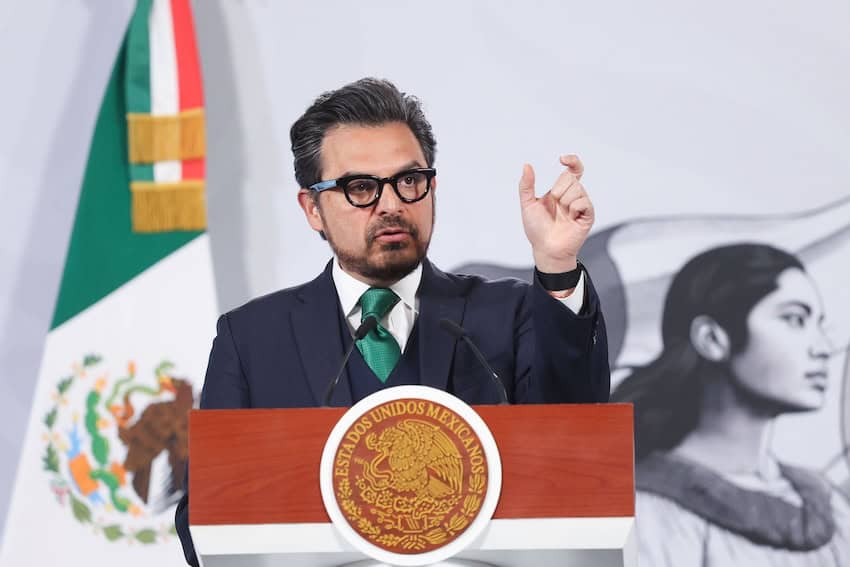
IMSS workers are also calling for the resignation or dismissal of Rafael Olivos Hernández, head of the National Social Security Workers Union. Workers have accused Olivos of pressuring them to accept the 2.9% pay rise on offer and violating union statutes. Some workers also called for the dismissal of IMSS chief Zoé Robledo.
Outside the IMSS offices on Paseo de la Reforma, disgruntled IMSS workers said that their fight for better pay and conditions is just getting started. They pledged to keep up the pressure with future protests if their demands aren’t met.
Vinicio Martínez, a spokesperson for protesting IMSS workers, told Reforma that protests could be “intensified” and that “activities that are a little bit more drastic” could be carried out “until our voice is heard.”
‘There are no syringes, [rubbing] alcohol or diapers. We’re short-staffed, too’
Workers who protested in Mexico City on Tuesday offered firsthand accounts of the conditions they face in IMSS healthcare facilities.
A nurse from the No. 30 General Hospital in the Mexico City borough of Iztacalco told the La Jornada newspaper that no one is called in to cover for staff who are on vacation or off sick.
“We don’t know why,” said the nurse, who asked to remain anonymous.
“We’ve had deficiencies for years and the quality of [medical] supplies has declined significantly,” she said.
The same woman rejected the proposed 2.9% pay increase, saying that it would only increase her fortnightly salary by 109 pesos (about US $6).
“That would be my raise if the union proposal is supported,” she said.
“I’m a single mother, I have a son at university and a daughter at primary school. It’s an insult to the work we do.”
José, a nursing student who works at the No. 32 General Hospital in the capital’s Coyoacán borough, told La Jornada that basic supplies are lacking.
“There are no syringes, [rubbing] alcohol or diapers. We’re short-staffed, too,” he said.
José also denounced the heavy workload medical personnel face, saying that it affects the quality of care they can provide.
América Barragán, a nurse from Jalisco who traveled to Mexico City to participate in Tuesday’s megamarcha, told Reforma that the public healthcare system lacks funds, medicines, medical supplies and personnel. She said that hospitals are overwhelmed by patients, who face long waits to receive specialized care.
“The demand to treat more patients in less time affects both working conditions and the quality and timeliness of medical services,” Barragán said.
She said that the problem won’t be resolved by demanding greater productivity from healthcare workers. Instead, more resources need to be allocated to healthcare, more workers need to be hired and hospital infrastructure needs to be upgraded, Barragán said.
She called on authorities to respond to IMSS workers’ demands with concrete solutions.
Sheinbaum: Workers’ ‘legitimate demands’ are being addressed
Asked about IMSS workers’ protest at her Wednesday morning press conference, President Claudia Sheinbaum initially responded by showing aerial footage of the Mexico City march.
“We took it from social media; it’s not filmed by the government or anything, but rather …by people who had drones,” she said.
“It’s important for everyone to reach their own conclusions,” Sheinbaum said before presenting footage that showed that the march stretched for quite a distance, but the crowd was relatively thin.
“That was the protest,” she said, adding that everyone could do “their own count of how many people participated.”
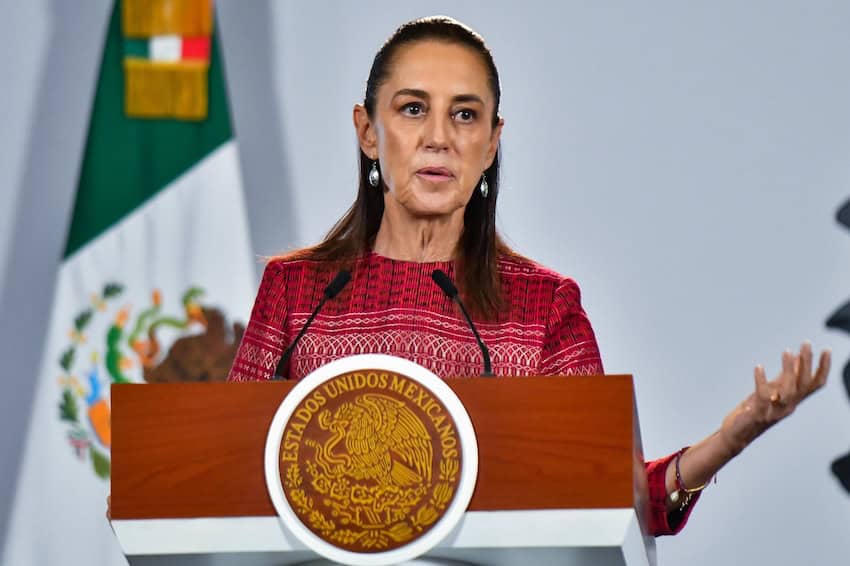
Sheinbaum went on to say that IMSS workers’ “legitimate demands” are being addressed. She conveyed the same message at her Tuesday morning press conference, during which she said resident doctors’ salaries would be increased and acknowledged that the government has work to do to improve the distribution of medications and medical supplies to public hospitals.
On Wednesday, Sheinbaum said that Robledo, the IMSS director, has been instructed to draw up an “action plan” to “immediately” address “all the legitimate demands of IMSS workers.”
“… When there is a legitimate demand, we’re listening,” she said.
Sheinbaum noted that IMSS workers would vote on the proposed pay rise on Wednesday.
“A union consultation is taking place today to see whether [the pay rise] offered by IMSS management is approved or not. It was already approved in Congress, but as there were people who didn’t agree an open consultation is taking place,” she said.
“I asked the Mexican Social Security Institute to ensure that it is totally free,” Sheinbaum said. “… We’re going to wait for the results.”
A day after she outlined a range of government achievements in the area of healthcare, Sheinbaum said that her government is working hard to improve Mexico’s public healthcare system.
“We’re doing better [but] there are still challenges and we have to solve them,” she said.
With reports from La Jornada, Sin Embargo, Reforma, El Financiero and El Economista