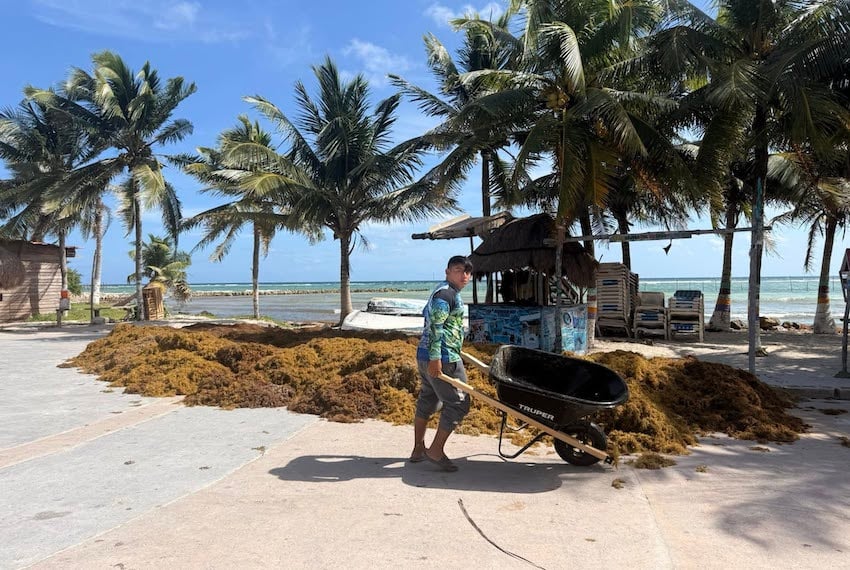
Sargassum, the yellowish seaweed that washes ashore on the coasts of the Mexican Caribbean every year, has arrived earlier than expected this year, according to local reports.
The premature arrival of the seaweed — which typically shows up between April and May — is already affecting several tourist beaches and has triggered environmental and economic alerts in the Mexican Caribbean. The hotel sector in this region spends some US $150 million each year to keep beaches free of macroalgae, in addition to government funds allocated to address the problem.
Esteban Jesús Amaro Mauricio, head of the Sargassum Monitoring Network in Quintana Roo, said that the first arrivals of sargassum were observed in Xcalac and Mahahual, in the southern part of the state. The algae were also present in Cozumel, Tulum, Puerto Morelos and Playa del Carmen.
Amaro noted that while only a handful of beaches have reported the arrival of the seaweed, experts anticipate this year to be “as intense” as 2025, when some 73,224 tonnes of sargassum were collected.
According to satellite images reported by the University of Florida, some seven million tonnes of sargassum are currently travelling from Africa to the Gulf of Mexico.
Amaro explained that the satellite images don’t show a uniform patch of macroalgae. Rather, due to the heavy cloud cover caused by a new cold front, “large patches” can be seen in the ocean.

The Gulf and Caribbean Oceanographic Institute of the Mexican Navy issued a bulletin on Jan. 10 (valid for 48 hours), revealing that the largest accumulation weighs 85 tonnes and is projected to primarily impact the beaches of Puerto Morelos and Playa del Carmen, representing the highest concentration expected during this period.
Sargassum, a yellowish seaweed that floats in the central Atlantic Ocean for much of the year, provides food, shelter and breeding grounds for many marine species. But once it reaches shore and rots, it releases a foul smell that poses health risks to beachgoers.
Mexico, particularly its beaches along the Mexican Caribbean, has struggled with persistent sargassum invasions that have hurt tourism. In 2025, Mexican authorities officially declared sargassum a national fishing resource in a move to expand its management beyond beach cleanup and allow equipped vessels to capture the seaweed before it reaches shores and decomposes.
With reports from Quadratín and La Jornada