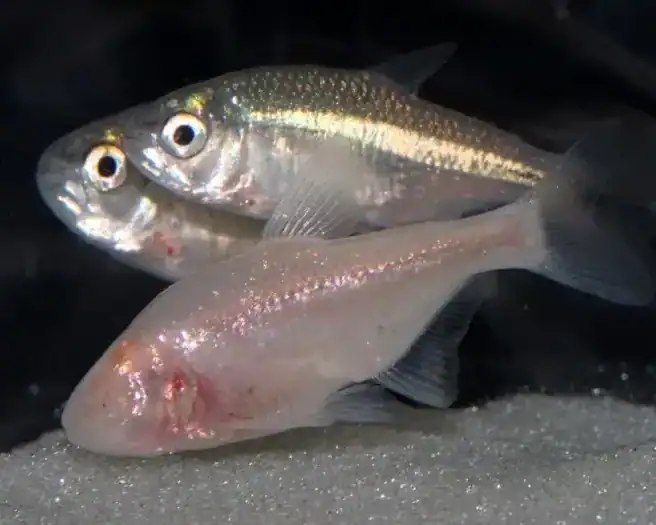
A new study of an underground lake in the mountains of Tamaulipas has documented an exceptionally rare cave ecosystem — one in which Mexican tetra fish with full vision live alongside close relatives that are completely blind.
The site, Caballo Moro, is located in a limestone cave system in the Sierra de Guatemala, just south of the El Cielo Biosphere Reserve in the northern Mexican state of Tamaulipas.
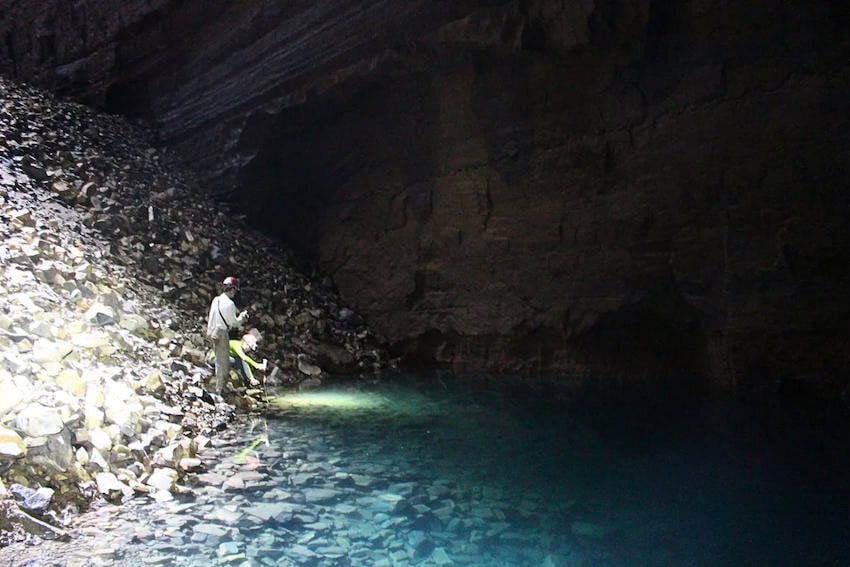
Thousands of years ago, part of the cave’s ceiling collapsed, creating a vertical shaft of light that strikes one stretch of an 80-meter-long pool while leaving the rest of the lake in perpetual darkness.
A study posted last month on the biology preprint server bioRxiv reported that this rare “karst window” has created two adjacent habitats: Mexican tetras (small freshwater fish) with fully functional eyes patrol the illuminated side, while eyeless cavefish dominate the shadows only meters away.
Researchers involved in the study said this side-by-side arrangement — with no physical barrier between the fish populations — has created a natural experiment for tracking how and why eyes disappear underground.
Earlier work identified about 35 cave populations of the Mexican tetra (Astyanax mexicanus) with reduced or absent eyes, but the precise genetic changes behind that shift remained unclear.
Though articles on bioRxiv are shared before peer review, in practice, about two-thirds of bioRxiv papers later get published in peer‑reviewed journals.

For this study, the team compared DNA from seeing fish with DNA from blind fish in Caballo Moro, whittling thousands of genetic differences down to 203 key mutations in 41 genes.
From there, one gene stood out: a lens gene called Cx50.
In follow-up lab work, they disabled Cx50 in normally sighted surface fish. This caused the sighted fish to quickly experience eye shrinkage and degeneration in their eyes — linking that mutation to loss of vision.
Genetic analyses indicated that the fully eyed fish in Caballo Moro descend from surface fish that invaded the cave roughly 3,300 to 4,300 generations ago and then hybridized with long-established blind cavefish.
The result is a mixed-ancestry population that still sorts into two distinct forms: fully eyed or fully eyeless, with only a small number of intermediates.
“At first glance one wouldn’t be able to tell the difference,” said co-author Nicolas Rohner, an evolutionary geneticist at the University of Münster in Germany. “However, physiologically and behaviorally they are more like cavefish. Which they genetically are.”
Rohner said the eyed fish remain aggressive and territorial in the bright zone, where vision helps them defend territory against blind neighbors.
Scientists say similar mutations in eye genes in other cavefish and underground mammals hint that some blind and eyeless fish in Mexico’s cenotes could have followed a comparable genetic path.
With reports from Discover Wildlife and NYU News