In this week’s MND Local for CDMX, Mexico City Mayor Clara Brugada touted her administration’s accomplishments and outlined future priorities during her second annual “state of the city” address. Meanwhile, new research highlights the capital’s ongoing sinking problem, and officials are pursuing efforts to reduce the city’s methane emissions.
Let’s get into it.
Mayor Brugada delivers 2nd ‘state of the city’ address
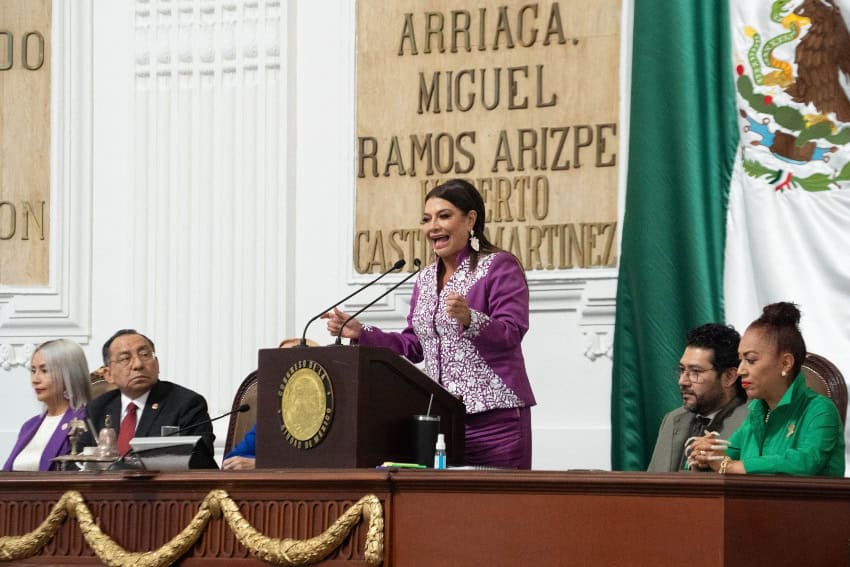
Earlier this month, Mexico City Mayor Clara Brugada delivered a “state of the city” address, touting her administration’s accomplishments across various sectors, including social services, security, infrastructure and healthcare. It was Brugada’s second such address since she assumed office on Oct. 7, 2024.
The theme of Brugada’s speech was “utopias,” which she said are the cornerstone of her administration’s policies.
“We want to build the city of Utopias, the city where all possible utopias fit: the utopia of well-being, democracy, social justice, fraternity and freedom,” Brugada, who belongs to the ruling Morena Party, said.
She touched on several future priorities and projects the administration intends to carry out, including criminal justice reform that centers on reintegration, establishing three new public universities outside Mexico City’s core, and constructing five new high schools that serve the city’s Indigenous population.
MND Local CDMX: Craft beer, gourmet foodies and ‘Fallout’ fans unite

Utopian visions
Meanwhile, she touted myriad accomplishments over the past two years, such as a 48 billion peso (US $2.6 billion) investment in the city’s metro system, resulting in 100 kilometers of electric bus routes. She also pointed to 1 million square meters of public space that have been reclaimed, 600 new public women’s spaces, a 1 billion peso (US $54 million) investment in agriculture, and an 85% increase in social programs, which now cover 2.6 million people across the capital, among other things.
“Let’s continue building all possible utopias,” Brugada said during her address, per La Gazzetta DF. “Let’s strive for more, for much more. With the memory of those who fought before and the hope of those who will come after. This is our city, this is our time, this is our history, and we are writing it together.”
While Brugada’s approval rating currently stands at 60%, according to the most recent polling from El Financiero, her tenure has not been without controversy.
During her speech, Brugada touted a significant reduction in crime over the past two years, including a 24% dip in “high-impact crimes” and four consecutive months with homicides at historic lows. However, her administration’s failure to hold anyone accountable for the assassinations of two of her deputies in 2025 continues to dog her legacy.
Mexico City is sinking … still
A new study published Oct. 12 in “Nature Cities” suggests that areas of Mexico City are sinking as much as 8.5 inches per year, while the citywide average sits somewhere around 0.3 inches per year.
The study, led by Shengli Tao and Xie Hu of Beijing’s Peking University, used high-resolution satellite data collected over nine years, from 2014 to 2023. Of the 465 cities across 107 countries that were surveyed, Mexico City recorded the fastest localized sinking.
The 8.5-inch figure hovers around a similar analysis published in May, which found that Mexico City is sinking by nearly 10 inches (about 25 centimeters) a year and has sunk by nearly 40 feet over the past century.
That study relied on NASA satellite data from NISAR, a joint U.S.-India satellite project. NISAR uses advanced radar imaging — effectively a microscope in space — to measure changes in Earth’s land, ice, sea level rise and groundwater.
It’s a different approach from Tao and Hu’s team, which used satellite interferometric synthetic aperture radar, which basically functions like a ruler that measures ground movement over time.
Mexico City details methane mitigation efforts
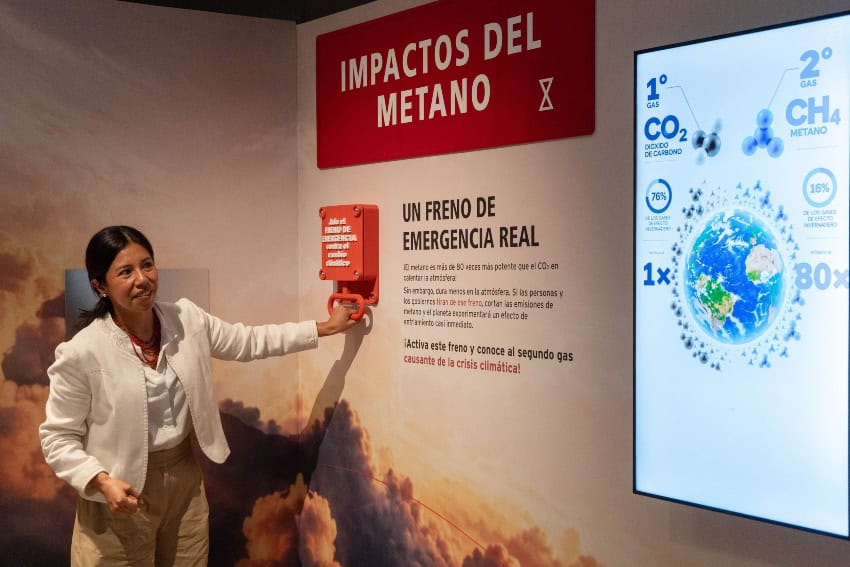
Meanwhile, Mexico City is attempting to tackle a significant driver of global warming — methane emissions.
Earlier this month, the city hosted Mexico Climate Week, which included a session dubbed “Accelerating Methane Action in Mexico City.” The event brought together domestic and international stakeholders representing government, academia, civil society and the private sector.
According to Ricardo Cepeda of the U.S.-based nonprofit C40 Cities, methane mitigation efforts are one of the best, most demonstrable ways to slow climate change in the near future.
“The objective is not to create more strategies, plans or projects,” Cepeda said. “The objective is to reduce methane emissions.”
Despite Cepeda warning governments off endless strategy meetings, Maritza Florez, who works with Mexico City’s Environment Ministry, did just that, detailing the capital’s methane mitigation strategy. It includes preventing food waste, expanding composting infrastructure and developing four additional treatment facilities for organic waste.
MND Local CDMX: From a new theater to a crackdown on counterfeit games
While much of the infrastructural onus lies with city leaders, residents are encouraged to develop composting and food waste prevention initiatives in their own communities.
“Methane mitigation is the brake for climate change,” said Mexico City Environment Ministry Secretary Julia Álvarez Icaza, adding that better waste management and separation systems are key to controlling the capital’s methane emissions.
“When waste is not mixed, it can be valued and utilized. When it is mixed, it becomes garbage,” Icaza said.
Drew Pittock serves as Mexico News Daily’s features director. He is based in Mexico City. Have an idea for a feature story or unique event in CDMX? Send an email to drew.pittock@mexiconewsdaily.com.