This week, we have an update on construction of the Guadalajara International Airport’s second entrance and how the buildout of bus rapid transit (Line 5) along the Chapala highway has affected the local environment.
Airport’s 2nd entrance road now expected to open by March 2027
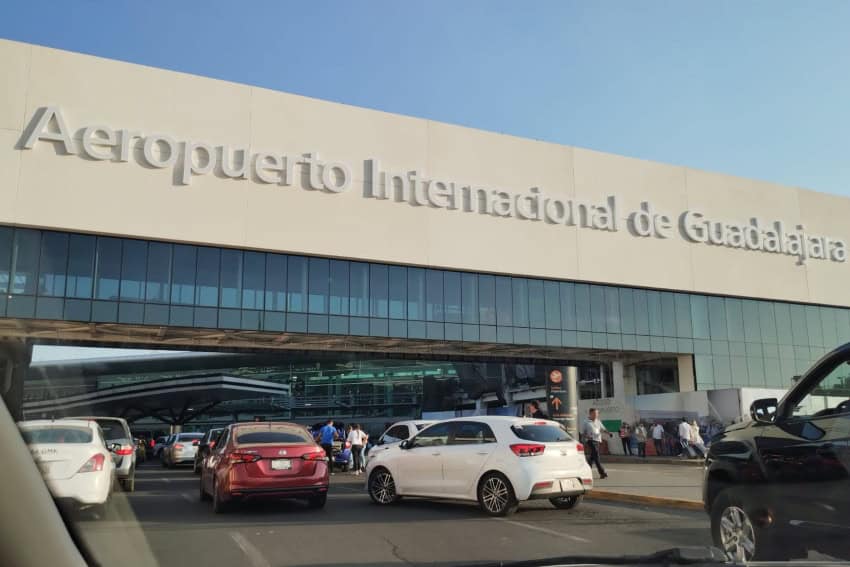
The project to add a second airport entrance kicked off in earnest 13 months ago. It aimed to ease chronic traffic bottlenecks along the Chapala highway, where airport travelers, daily commuters and commercial trucks all battle for scarce road space.
View this post on Instagram
In summer 2025, public officials promised the work would be finished in time for the FIFA World Cup earlier this summer, but that deadline came and went. Then work was suspended to prevent construction delays around the airport during the tournament.

Now that work has resumed, we have an updated timeline for completion. Earlier this month, Jalisco Gov. Pablo Lemus Navarro declared the airport’s new 6-kilometer entrance road should be ready for its debut by March 2027.
“The Guadalajara Airport will have a second entrance; it will no longer only be possible to enter via the Chapala Highway,” he told local newspaper El Informador. “This is good news for connectivity and mobility from the airport.”
The new road will connect Adolf Horn Avenue with the airport’s south side. For southbound drivers coming from areas like Tlajomulco, Tlaquepaque and Zapopan, the road will allow them to bypass the initial segment of the Chapala highway. It will also alleviate northbound traffic congestion on the Chapala highway by diverting drivers to Adolfo Horn.
Additional airport upgrades
In addition to a second airport access road, the project includes an internal interchange and new roads to connect to the airport’s future Terminal 2.
But that is not all. The final phase of work to modernize the Chapala highway also got started this month. This project involves new pedestrian bridges, public transport stations, storm drainage, sidewalks, streetlights, bike lanes and replacement trees (more on that below).
Here are all the major airport upgrades in Mexico in 2026 so far
These improvements are expected to take eight months to complete, with final delivery by May 2027.
Airport access improvements are being jointly funded by the Jalisco state government and airport operator Pacific Airport Group (GAP). Guadalajara International Airport is the third busiest in Mexico, with annual passenger traffic of nearly 18.8 million in 2025.
The high environmental cost of the city’s new Line 5 mass transit system
The extension of public transit to the Guadalajara airport was constructed in a rush ahead of the 2026 FIFA World Cup. This new link to Guadalajara’s mass transit system was dubbed Line 5, even though it’s not a light rail system like Lines 1 through 4.
The impetus behind the new Line 5 was not visionary public planning but a FIFA requirement for all host cities, which mandated that tournament visitors have a public transport option from the airport to the soccer stadium. Chronic traffic bottlenecks along the Chapala highway, the sole access point to Guadalajara airport, also threatened to embarrass public officials on the world stage, something they were desperate to avoid.
Line 5 was completed in time for June’s World Cup matches. While some lamented the lack of rail service on this congested route, the project was widely hailed as a success.
The part that’s received far less attention is the environmental cost of this new infrastructure. Below is a look at that scorecard.
View this post on Instagram
Constructing six new BRT stations over a 22.5-kilometer stretch of the Chapala highway involved the elimination of 1,541 trees along the route, according to the Ministry of Environment and Territorial Development.
All the trees cut were located in the El Salto and Tlajomulco municipalities, with authorization granted by local officials.
Tree cover loss and its effects
An environmental impact assessment completed ahead of Line 5’s construction identified 32 tree species (97% of which were deemed healthy), 133 bird species and six reptile species inhabiting the wooded areas in its path. The trees were removed anyway, with subsequent plans to add 2,846 new trees.
How has the sudden removal of so much tree cover impacted the urban area?
Dr. Lucila Méndez Morán of the Department of Applied Ecology at Centro Universitario de Ciencias Biológicas y Agropecuarias (CUCBA) explained that deforestation on the city’s south side tied to Line 5 has intensified the “urban heat island” effect already afflicting this part of the metropolitan area.
The loss of vegetation and shade not only elevates local temperatures but also reduces the area’s ability to absorb water during the rainy season, dampen noise and flush air pollutants. The state has said that while the short-term environmental impact of Line 5 is negative, the landscape should improve over the medium term.
Despite more trees being replanted than removed, it’s not a net benefit, ecologically speaking. The amount of oxygen generated by small tree saplings is a fraction of what’s generated by mature trees. Until those trees grow to maturity over the coming decade or more, their loss will be acutely felt.
Line 5 construction compounds legacy environmental issues
Massive tree loss in Tlajomulco and El Salto is especially painful due to a well-documented environmental crisis that predates the construction of Line 5.
Uncontrolled real estate expansion on the city’s south side in recent decades has already stripped much of the forest cover, raising local temperatures by 2 degrees to 3 degrees Celsius relative to other parts of the Guadalajara Metropolitan Area (GMA). Besides Tlajomulco and El Salto, this area also includes popular tourist destinations Tlaquepaque and Tonalá.
In addition, this zone suffers severe air pollution tied to chronic heavy traffic, under-regulated industrial emissions and thermal inversions in wintertime.
Going forward, this poses a risk of worse public health outcomes due to poor air quality and even hotter temperatures.
MND writer Dawn Stoner is reporting from Guadalajara.