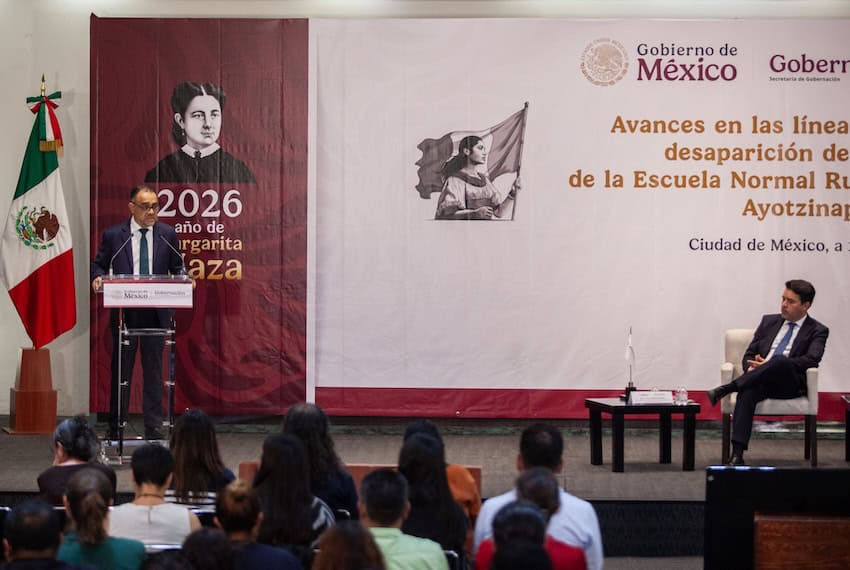
Twelve years and two days after 43 students disappeared in the southern state of Guerrero, federal officials outlined “four new lines of investigation” in the abduction and presumed homicide case that shocked Mexico and triggered massive protests during the presidency of Enrique Peña Nieto.
At a press conference on Monday, Deputy Interior Minister Arturo Medina and Mauricio Pazarán, the prosecutor heading up the investigation into the Ayotzinapa case, presented the new investigative leads, which are included in a new federal report.
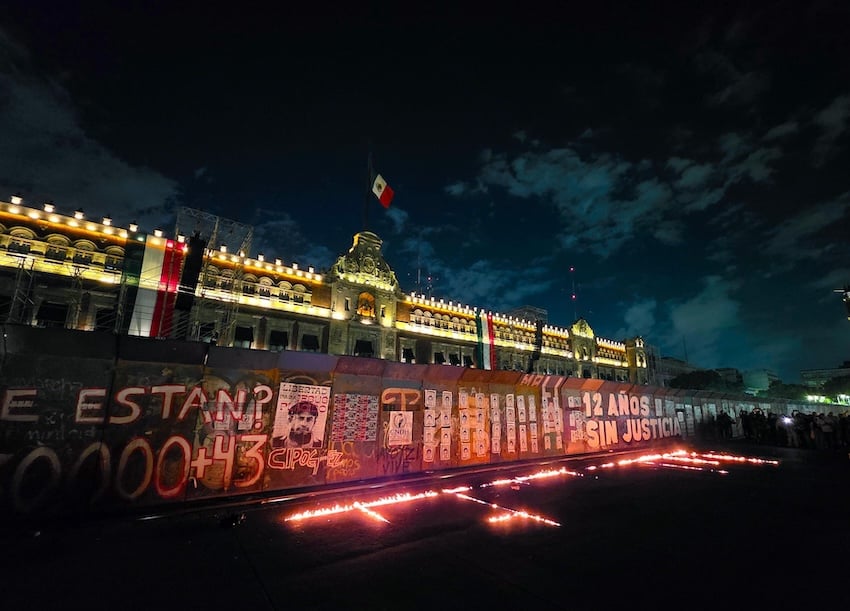
Before we look at each line of investigation presented on Monday, here is a summary of the Ayotzinapa case, one of Mexico’s most notorious criminal cases.
- On the night of Sept. 26, 2014, 43 male students from the Ayotzinapa Rural Teachers College were abducted after a bus on which they were traveling to a protest in Mexico City was stopped by municipal police in Iguala, Guerrero.
- The students were presumably murdered after their abduction, which was allegedly carried out by members of a Guerrero-based crime gang.
- The remains of just three of the students have been found and formally identified.
- A total of 168 people are subject to judicial proceedings in connection with the case. Among those people — 130 of whom are in prison — are soldiers, high-ranking members of the Mexican Army, police officers, members of the Guerreros Unidos crime gang and former officials, including Ángel Heladio Aguirre Rivero, governor of Guerrero at the time of the students’ abduction.
- No one has been convicted of involvement in the abduction and presumed murder of the students.
- The disappearance of the students triggered large protests in Mexico City and other cities across Mexico in late 2014. Countless additional protests have been held since then, including annual marches on the anniversary of the abduction of the 43 young men. “Fue el estado,” or “It was the state,” is a common chant at the protests, as is “¡Vivos se los llevaron, vivos los queremos!” (They were taken alive, we want them back alive!)
- Two mothers and six fathers of the 43 students have died in the 12 years since their sons disappeared.
- The Ayotzinapa case file runs to more than 5 million pages and is divided into more than 3,000 volumes. It is currently being digitized.
- In a 2023 report, the federal government cited three “possible reasons” behind the abduction of the students. Among those possible reasons was that the students were mistaken for rival gangsters by Guerreros Unidos members, and that “drugs, weapons or money” were on buses they had commandeered to travel to a protest in Mexico City.
- Jesús Murillo Karam, federal attorney general at the time of the students’ disappearance and a chief architect of the Ayotzinapa case’s so-called “historical truth,” was detained in 2022 on charges of forced disappearance, torture and obstruction of justice in connection with the case. He was released from prison in 2024 after a judge ruled he could await trial under house arrest. The 78-year-old former attorney general suffered a stroke in April.
Line of investigation No. 1 leads to the discovery of human remains at Iguala funeral parlors
In a statement released after Monday’s press conference, the Interior Ministry (SEGOB) said that the “four new lines of investigation” stem from a “reanalysis of documents and telephone records, using a methodology that incorporates technical and scientific elements.”
“… This approach made it possible to organize, correlate, and compare the data collected over 12 years with a new perspective, in order to identify clues that had not previously been noticed or thoroughly investigated,” the ministry said.
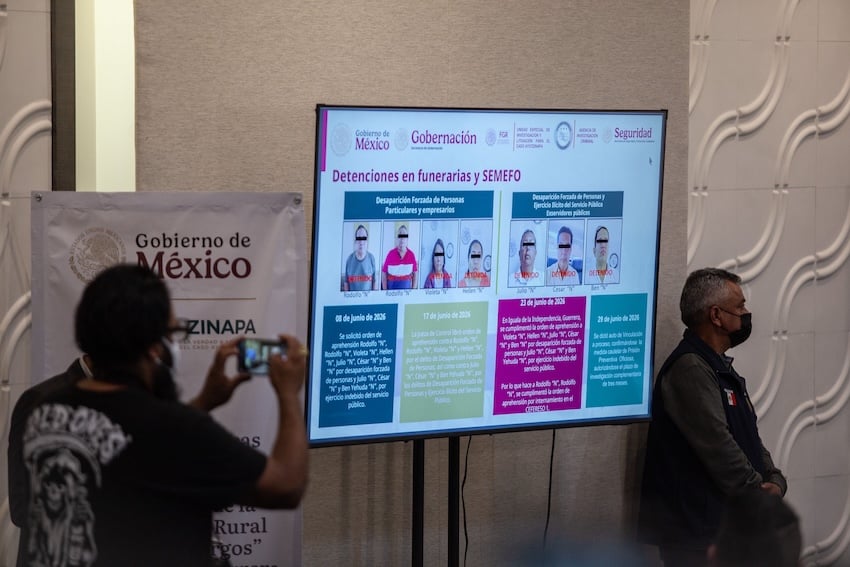
The first “new” line of investigation stems from the analysis of telephone communications and allowed authorities to identify 17 new suspects who are now under investigation. The analysis also allowed authorities to “reconstruct links” between members of the Guerreros Unidos crime gang — who allegedly kidnapped the students — municipal and state police, public servants and “people related to funeral parlors,” according to SEGOB.
“Among the findings, calls between members of that criminal organization and staff of funeral establishments and the health sector were detected. One of the people under investigation (Rodolfo Rueda) and his family were owners of funeral parlors, licensees of the [Guerrero government’s] Forensic Medical Service (SEMEFO) in Iguala and participated in the management of a cemetery,” SEGOB said.

“In August 2025, it was established that the owner of the funeral parlor used a telephone belonging to a student [from Ayotzinapa],” the ministry said.
SEGOB said that the discovery that the funeral parlor owner (Rueda) had used an Ayotzinapa student’s phone “motivated various actions” in October 2025, including searches at funeral parlors and SEMEFO facilities in Iguala, during which authorities found a “human femur, a firearm, documents and a crematorium oven without official registration.”
Between March and June 2026, authorities carried out additional searches at SEMEFO facilities attached to an Iguala funeral parlor owned by Rueda, locating hundreds of bone fragments, dental prostheses, “biological remains,” cartridges, bullet casings and documents, according to SEGOB.
The ministry said that the human remains and other items are “under expert analysis to determine their nature and possible match with missing people.”
Line of investigation No. 2 ‘strengthens the hypothesis’ that some students were taken to the Iguala municipal lockup on the night of their disappearance
The second line of investigation stems from an analysis of the phones of three of the Ayotzinapa students.
After the students’ disappearance, authorities established that those phones were used by a municipal official in Iguala, who was arrested in August on forced disappearance charges, a municipal police officer, who is under investigation, and people close to a former public servant in Iguala.
“The review of the third device strengthens the hypothesis that some students were taken to the municipal lockup [on Sept. 26, 2014] as the users [of the phone] after the disappearance were people close to an ex-public servant in Iguala who was assigned to … [the municipal lockup],” SEGOB said.
Authorities suspect that 17 students were taken to the municipal lockup in Iguala on the night of Sept. 26, 2014. In addition to information found on the telephone in question, the lockup “hypothesis” is based on statements made by municipal police officers, two alleged members of the Guerreros Unidos and an Ayotzinapa student.
Line of investigation No. 3 leads to identification of a new suspect who was a minor at the time of the students’ disappearance
The third line of investigation stems from a reanalysis of documents in the Ayotzinapa case file.
The reanalysis allowed authorities to “identify a person who participated in the events,” SEGOB said, adding that the previously unidentified suspect was aged 14 at the time.
“From the statement he gave on July 30, 2026, information was obtained that strengthens the accusations against members of the ‘Guerreros Unidos’ criminal organization,” the ministry said.
Line of investigation No. 4 leads to the arrest of former Guerrero governor
SEGOB said that the fourth line of investigation is related to the “concealment” of video footage captured by security cameras at the Superior Court of Justice in Iguala on the night of Sept. 26, 2014, and in the early hours of the following day.
Federal Attorney General Ernestina Godoy said in August that her office had evidence that former Guerrero Governor Ángel Aguirre ordered the concealment of said video footage, which apparently showed the bus on which the students were traveling at the time it was stopped by police in Iguala. The Federal Attorney General’s Office hasn’t managed to obtain the footage — which was likely destroyed — but is aiming to do so.
SEGOB said that authorities had been able to “reconstruct part of the decisions” high-ranking officials made in relation to the “concealment” of the video footage.
“This led to the arrest of the former presiding judge of the [Superior] Court [in Iguala], as well as the former inspector of the same judicial body, both of whom are currently subject to criminal processes,” the ministry said.
“Based on the statements made by these former public officials and in light of new evidence, the former governor of Guerrero [Ángel Aguirre] was arrested on August 6, 2026, for the crime of forced disappearance of the 43 students.”
Medina addresses allegations of army involvement
Interior Minister Medina, who heads up the government’s Ayotzinapa Truth Commission, said that the Ministry of National Defense, which has direct responsibility for the Mexican Army, provided investigators with all the information it had that is relevant to the Ayotzinapa case.
He said that 17 members of the Mexican Army have been arrested and are subject to ongoing judicial proceedings. Medina stressed that military personnel allegedly involved in the students’ disappearance are accused of acting independently rather than under the auspices of the Mexican Army. He said that the army, as a federal institution, is not accused of involvement in the abduction and presumed murder of the students.
The government’s ‘priority’ is to find the missing students
In its statement, SEGOB said that “for this government, the mothers and fathers of the 43 young men remain at the center of this process” — i.e., the investigation into the Ayotzinapa case and the pursuit of justice.
“The priority is to find them, shed light on what happened and bring to justice those who are responsible,” the Interior Ministry said.
“… The case is not closed and no person is above the law,” SEGOB said.
One suspect who has avoided arrest is Tomás Zerón, the former head of the now-defunct Criminal Investigation Agency (AIC).
As head of the AIC, Zerón — who now lives in Israel — was tasked with investigating the disappearance of the 43 students. Among the charges he faces in connection with the Ayotzinapa case are torture and tampering with evidence. The Mexican government has long sought Zerón’s extradition from Israel, but, to date, Israeli authorities have not arrested him.
With reports from La Jornada, CNN Español and Sin Embargo