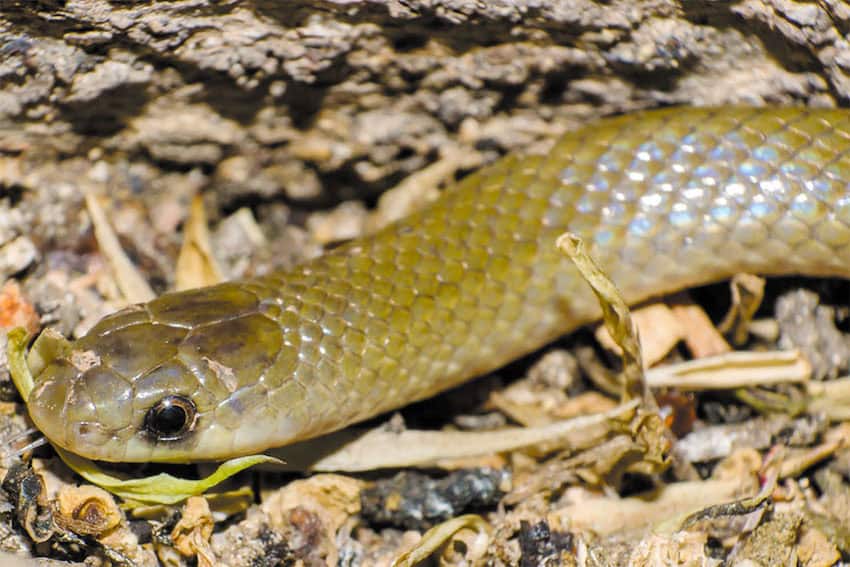
Often cited as the country with the most recorded snake species in the world, Mexico has now added a new, uniquely underground dweller to that list.
Researchers have identified Yakacoatl tlalli as a nonvenomous, subterranean snake from the Balsas River basin in the south-central part of the country that represents not only a new species but also a whole new genus endemic to Mexico.
The discovery further underscores Mexico’s standing as one of only 17 nations in the world categorized as “megadiverse” — countries that collectively hold a very large share of Earth’s total biodiversity and endemic species.
Within the last 10 months, two new crocodile species were discovered off the Yucatán Peninsula, a new species of firefly was found in Mexico City and a new gecko species was discovered in a biocultural region spanning the states of Puebla and Oaxaca. Overall, Mexico contains between 6.5% and 12% of all of the world’s known species.
In terms of snakes, Mexico is believed to contain somewhere between 430 and 440 known species — or roughly 11% of the world’s known snake species, according to one oft-cited database. Brazil is next on the list with 420.
Only three specimens of the new Yakacoatl tlalli are known.
Two were found dead — one had been preyed on by a family’s chicken, the other was found dehydrated nearby — and one was observed alive, photographed and released.

View this post on Instagram
The two dead snakes were both found in a lowland stretch of Puebla state — within the Balsas River basin that runs from Puebla in the east to Michoacán on the Pacific coast. The live snake was found in the same basin, though its exact locality was not reported.
With dry conditions, semi-arid vegetation and surrounding mountains, the basin has characteristics, researchers said, that promote endemism, in which a species is naturally found in only one specific geographic area and nowhere else on Earth.
The research was conducted by the National Autonomous University of Mexico (UNAM), the Meritorious Autonomous University of Puebla (BUAP), the University of Texas at Arlington and Argentina’s National Scientific and Technical Research Council.
Also playing a role was Mexico’s Ministry of the Environment and Natural Resources (Semarnat).
The snake belongs to the Sonorini tribe, a group of small, nonvenomous, mostly burrowing snakes concentrated in the dry lowlands of northern Mexico and the southern U.S.
Yakacoatl tlalli shows adaptations to subterranean life, including a head with reduced scales, a rearranged and fused skull and a shovel-shaped scale on the snout that helps it dig through compact soils.
In contrast to many fossorial snakes — those that dig and live primarily underground — it retains relatively large eyes.
Taxonomic work on the male reproductive organs revealed a shape and arrangement unlike those of any other known snake, confirming Yakacoatl tlalli as a new genus restricted to Mexico.
Limited dietary evidence — a scorpion tail was found in one specimen — points to subterranean arthropods and possibly soil invertebrates as prey, but researchers say there is still a lot to learn.
With reports from La Jornada, Mi Morelia and UNAM Global