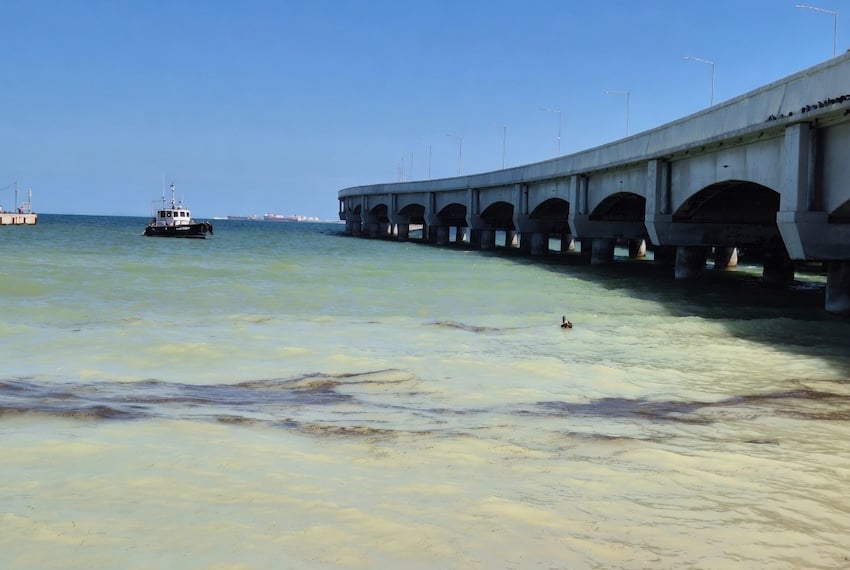
A new hydrocarbon leak off the coast of Progreso, Yucatán, was quickly contained and is unrelated to the massive Pemex oil spill in the Gulf of Mexico that fouled over 600 kilometers of shoreline in recent weeks, state and federal officials said Monday.
During a live broadcast, Yucatán Governor Joaquín Díaz Mena said authorities traced the latest slicks near the iconic arch pier in Puerto Progreso to “a leak … in a disused underwater pipeline.”
He said the problem was handled by the Mexican navy (Semar), Petróleos Mexicanos (Pemex) and local authorities.
“Specialized divers worked to contain the situation and permanently seal this leak,” he said. “The pipeline has been completely sealed, the area is now under control, and there is no risk to the population or port activities.”
Fishermen had reported diesel-like stains near the 6.5-kilometer pier, one of the world’s longest, over the past week — warning about environmental damage, threats to fishing and risks for swimmers.
Local media documented at least two main slicks, one roughly 300 meters from shore under the pier and another about 100 meters away. Preliminary checks indicate the damaged line once transferred hydrocarbons — a category of compounds that includes crude oil and refined fuels like diesel and gasoline — to the deep-water port and is ruptured in at least two sections.

Díaz Mena stressed that the Progreso leak “is not related” to the earlier Gulf spill that hit Veracruz, Tabasco, Campeche, Tamaulipas and Yucatán, and even sent tar and oil residue as far as Texas.
After weeks of denials, Pemex admits responsibility for Gulf Coast oil spill
That disaster began with a major leak in a subsea pipeline that was detected in early February but denied internally by Pemex, according to President Claudia Sheinbaum and Pemex director Víctor Rodríguez.
After weeks of public complaints and satellite-based investigations by environmental groups, Pemex acknowledged responsibility for the spill, and three high-ranking officials were removed from their posts as prosecutors review possible crimes.
In the wake of that spill, Sheinbaum has moved to tighten oversight in the region.
During her morning press conference Monday, she announced a decree to create a Gulf of Mexico Observatory “to monitor the situation permanently using satellite imagery,” strengthen emergency response and ensure that proper investigations are carried out.
The observatory will bring together the science ministry, the navy, Pemex and environmental regulators to track spills in real time and publish reports — part of a broader push to restore trust after the concealed Gulf leak.
With reports from La Jornada Maya, La Silla Rota, López-Dóriga Digital and Milenio