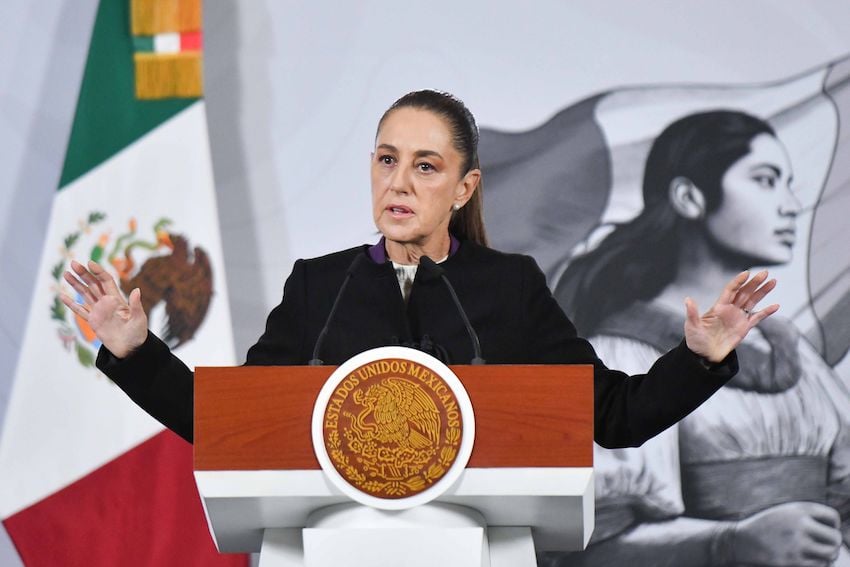
President Claudia Sheinbaum is frequently asked to comment on the remarks, actions and policies of her U.S. counterpart Donald Trump.
That was the case again at her Tuesday morning press conference, where she fielded a question on Trump’s decision to formally designate fentanyl as a weapon of mass destruction, or WMD.
BREAKING: President Trump just declared FENTANYL a WEAPON OF MASS DESTRUCTION.
This critical step unleashes every tool to combat the cartels & foreign networks responsible for flooding communities with this deadly substance—the leading cause of death among Americans aged 18-45. pic.twitter.com/C9YXC53kzK
— The White House (@WhiteHouse) December 15, 2025
Among other remarks, Sheinbaum offered her view on an unbecoming episode in the Mexico City Congress on Monday.
Sheinbaum responds to Trump’s designation of fentanyl as a WMD
Asked about Trump’s executive order designating “illicit fentanyl and its core precursor chemicals as Weapons of Mass Destruction,” Sheinbaum said that her government will analyze the document as well as its “scope” and “implications.”

Issued on Monday, the executive order states that “illicit fentanyl is closer to a chemical weapon than a narcotic” and directs “the heads of relevant executive departments and agencies … [to] take appropriate action to implement this order and eliminate the threat of illicit fentanyl and its core precursor chemicals to the United States.”
Sheinbaum told reporters that her government’s “vision about how to address drug use is different” from that of the Trump administration.
“Of course, crimes must be addressed — that’s why there’s an Attorney General’s Office and that’s why there are judges. But we also have to address the causes of drug use. If the causes are not addressed, … drugs will continue to be used,” she said, adding that she has put that view to Trump.
Classifying a drug as a “weapon of mass destruction” is not enough on its own to stop the use of a particular narcotic, Sheinbaum said.
“If the causes [of drug use] aren’t addressed, it will be one drug or another [that hooks young people],” she said.
“Young people have to be attended to, as we are doing here,” Sheinbaum said, referring to the provision of educational scholarships, employment opportunities and other government initiatives.
Given that much of the illicit fentanyl in the United States comes from Mexico, a reporter said that the U.S. government could use Trump’s WMD designation to “insist” on sending the U.S. military to Mexico to combat drug cartels, an offer the U.S. president has already made.
Sheinbaum reiterated that her government is opposed to any kind of foreign intervention in Mexico, but noted that it is willing to cooperate and collaborate with the U.S. on security matters.
The country’s sovereignty and territorial integrity “are not up for discussion under any circumstances,” she said.
Sheinbaum condemns fight in CDMX Congress
Sheinbaum described the fight that broke out between lawmakers in Mexico City’s Congress on Monday as “very bad.” (Click here to read MND’s story on the melee.)
She called on all lawmakers to abstain from acts of violence.
“You can be against a proposal, you can even take over a rostrum [in Congress] … but resorting to acts of violence is reprehensible,” Sheinbaum said.
Security minister speaks to his Canadian counterpart
Sheinbaum had little information to add when asked whether she could provide additional details about the call on Monday between Mexico’s Security Minister Omar García Harfuch and Canada’s Minister of Public Safety Gary Anandasangaree.
Today, Minister Anandasangaree had a productive call with Mexico’s Secretary of Security and Citizen Protection, Omar García Harfuch, on strengthening bilateral security and advancing shared priorities, including progress on the Canada-Mexico Action Plan. pic.twitter.com/FDHMoaK3X5
— Public Safety Canada (@Safety_Canada) December 15, 2025
“The minister already reported [on the call]. It’s part of the relationship we have with Canada,” she said.
García Harfuch wrote on social media that he had a “frank and productive” conversation with Anandasangaree aimed at “strengthening bilateral security between Mexico and Canada.”
“We’re advancing on shared priorities and on the Canada-Mexico Action Plan, with the conviction that international cooperation is fundamental for security and the well-being of our nations,” he wrote.
In January 2023, the governments of Mexico and Canada announced the creation of a joint “action plan” following a meeting between then-president Andrés Manuel López Obrador and then-prime minister Justin Trudeau in Mexico City.
One of the pillars of the plan is “peace and security.”
According to the Canadian Embassy in Mexico, “Canada and Mexico collaborate through security and safety institutions to share information and best practices on key issues such as police surveillance and crime prevention, border security, and migration.”
“The Royal Canadian Mounted Police receives Mexican police officers at the Canadian Police College to reinforce their capacities on a regular basis,” the Embassy states on its website.
“In addition to operational exchange, our governments meet formally each year to update and exchange information of mutual interest such as combating drugs and crime, cybersecurity and cybercrime, emergency management, border and prison security, and rehabilitation.”
By Mexico News Daily chief staff writer Peter Davies (peter.davies@mexiconewsdaily.com)