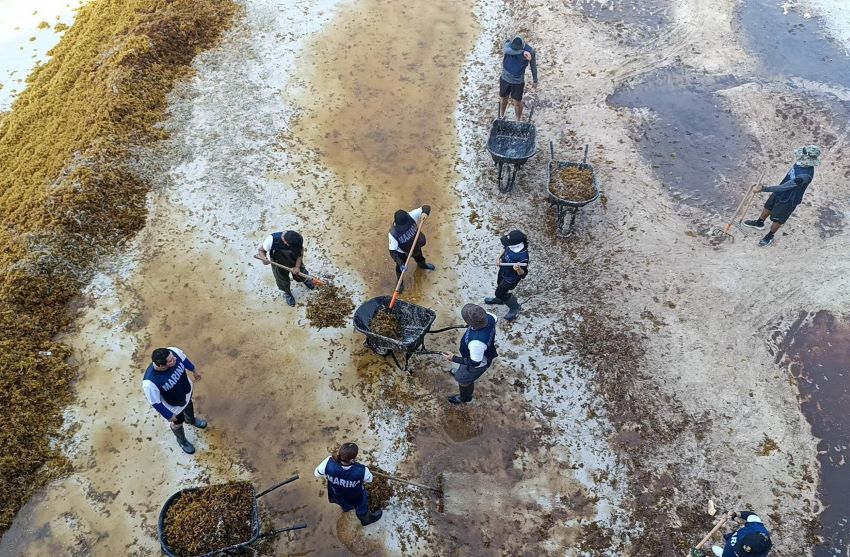
Sargassum has invaded Quintana Roo’s beaches with unprecedented intensity for much of the year, prompting daily herculean efforts by authorities and citizens to clear the noxious brown seaweed from normally pristine shores. And their task shows no sign of abating.
A stunning indication of the current crisis — as well as of the locals’ heroism — took place in Isla Mujeres. Between Sunday night and Monday morning, 140 tonnes of the algae came ashore. In other words, in some 12 hours, the island received an amount of sargassum equivalent to 10% of what it had received in the previous three and a half months.
¡Continuamos trabajando en la limpieza de playas y retiro de sargazo! 💪🏻
Agradezco al personal de todas las áreas del Ayuntamiento, quienes se sumaron a la gran labor que realizan nuestras guerreras y guerreros de #Zofemat, para mantener nuestras playas 🏝️limpias y ordenadas. pic.twitter.com/M1AmvLPG3T
— Atenea Gómez Ricalde (@soyateneadeisla) July 16, 2025
By 5 a.m. on Monday morning, response teams consisting of municipal workers, tourism service providers, Civil Protection personnel, Federal Maritime Terrestrial Zone (Zofemat) staff, firefighters, the Navy, taxi drivers and other civilians were working together to free the town’s coastline of sargassum.

After approximately four hours, the beach was clean.
Esteban Amaro, head of the Sargassum Monitoring Center, which issues red alerts, said that although there are no exact figures on the amount of sargassum arriving, the patches of algae are coming in bands, one after another, spanning from Punta Allen to Bahía Príncipe, in Tulum.
Amaro noted that the most critical areas are in the southern part of the state, particularly in Xcalak and Mahahual, where the algae enter the Mexican Caribbean, passing through Banco Chinchorro.
He added that the most critical recent sargassum cycles have lasted three to four years. The first massive grounding was in 2015, followed by one in 2018, another in 2022 and now this one in 2025, “which has been the most tremendous on record,” Amaro said.
Experts had predicted that July would be the peak sargassum period this year. Indeed, the situation has become so critical this month that nearly all beaches from the northern part of Tulum to the southern coast of Playa del Carmen, as well as the eastern part of Cozumel, are on red alert for the seaweed.
¡Redoblamos esfuerzos por unas playas limpias y un mar saludable! 🌊⚓
En el marco de la Estrategia de Atención al #Sargazo2025, la Secretaría de Marina continúa trabajando para proteger el litoral de #QuintanaRoo, desplegando:⚓ 1 Buque Sargacero Oceánico
⚓ 11 Buques… pic.twitter.com/hmVpYNzY3P— SEMAR México (@SEMAR_mx) July 13, 2025
On its official X account, the Navy said it has deployed in its sargassum control efforts an ocean vessel, 11 coastal vessels and 22 smaller support vessels, as well as 8,850 meters of containment barriers and 400 naval personnel along the beaches of Quintana Roo.
Dayana Pérez Medina, director of Zofemat, explained that these types of accumulations are not constant and do not affect all beaches, but when they occur, clean-up efforts are immediately activated, as the Isla Mujeres case confirms.
Sargassum is notorious for its negative effects on ecosystems, tourism and public health. It has indirect consequences for human health when it decomposes, releasing ammonia, methane and sulfuric acid. When it rots, it creates a sludge called “brown tide,” which reduces sunlight penetration and lowers oxygen levels in the water.
In early July, Governor Mara Lezama announced the creation of a new facility to monitor and manage sargassum along Mexico’s Caribbean coast, and eventually convert it to biofuel. Lezama expects the new project to promote new sustainable industries, create jobs and reduce the environmental impact of the sargassum.
With reports from La Jornada and Quintana Roo Quadrantín