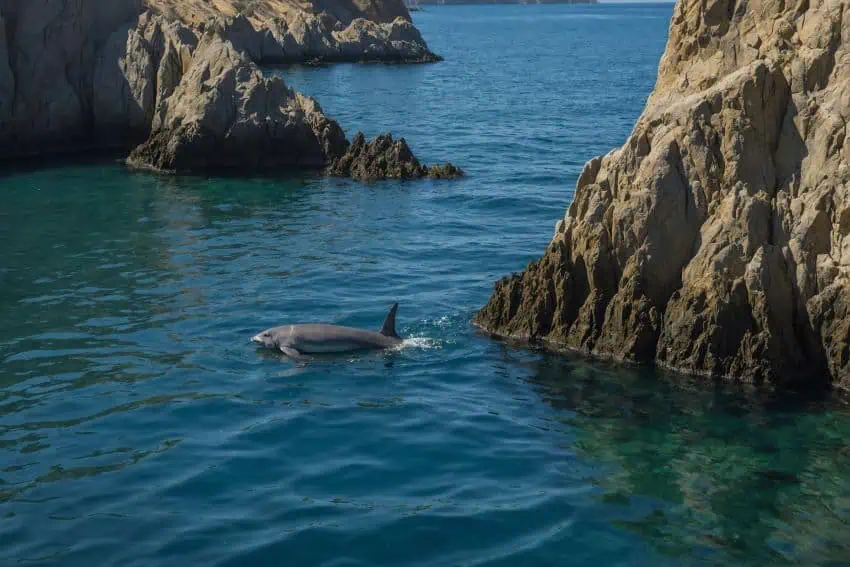
Recent monitoring in Mexico’s Gulf of California has detected the presence of vaquita on 41 occasions, suggesting that government efforts to protect the critically endangered porpoise may be working.
Starting in May, the regional Intragovernmental Group on Sustainability (GIS) has conducted acoustic monitoring in strategic points off the coast of San Felipe, Baja California, to better understand where the vaquita seeks natural refuge and assist future census missions.
Vaquitas are shy, small porpoises native to the Gulf of California. Their population has severely declined over the last two decades, largely due to a boom in the illegal fishing of totoaba.
In 2024, the annual vaquita census expedition co-led by the nongovernmental organization Sea Shepherd Conservation Society and Mexico’s Natural Protected Areas Commission (CONANP) returned only six to eight specimens, down from between eight and 13 in 2023.
However, sound monitoring operations carried out in the upper Gulf of California have logged 41 acoustic encounters with the vaquita, representing a step forward in conservation.
An acoustic encounter is like a ping that helps scientists map the location of mammals like the vaquita, which emit sounds at a higher frequency than is detectable by the human ear.
Shhh, vaquita are talking. Hydrophones record the vaquita and help scientists know where to visually observe them. Visit https://t.co/cGLTZfbeQv. pic.twitter.com/Z7UBgTz9GS
— Sea Shepherd US (@SeaShepherdSSCS) July 14, 2025

The number of acoustic encounters does not directly confirm that there are 41 vaquita in the upper Gulf of California — the same vaquita may trigger an acoustic encounter more than once — though the high number of encounters means the vaquita population is likely larger than recorded in 2024.
“We have new records, more records, and I think that is a sign of hope,” said the Environment Ministry’s Deputy Minister of Biodiversity and Restoration Marina Robles García on Wednesday, during the GIS’s second session of 2025.
“There is a juvenile that had not been seen for six or eight years, and that tells us that there may be other areas that are being used as refuge by the vaquita.”
Annual Sea Shepherd observation cruises will be carried out from Sept. 3 to 13 in the region to conduct a new population census.
Alejandro Olivera, the Mexican representative for the Center for Biological Diversity, does not expect the vaquita population to increase substantially in 2025, however.
Given the prior census figures and the fact that the vaquita’s gestation period is longer than a year, repopulation will be a gradual process, he said in an interview with the newspaper La Jornada.
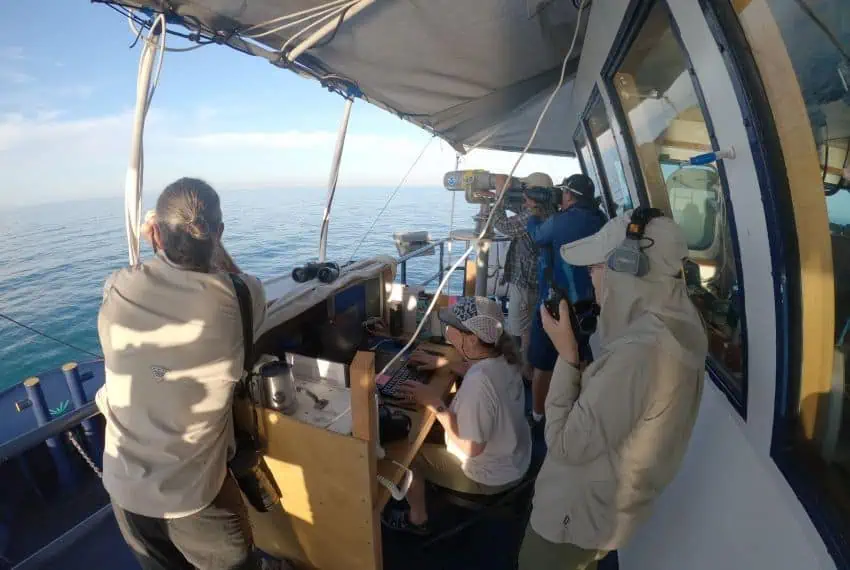
On Friday, the Environment Ministry (Semarnat) announced that it had strengthened its conservation efforts to include maritime patrols, ghost net removal, environmental education, sustainable production alternatives and scientific monitoring, in coordination with state and local actors.
While conservation efforts have improved in recent years, Olivera stressed the need to enhance efforts in line with the 2023 Action Plan.
The installation of geolocation systems on small vessels, the use of alternative fishing nets, coordination with Interpol to stop poaching and greater organization among the governments of Mexico, the United States and China to prevent the illegal trafficking of totoaba could enhance conservation work, according to Olivera.
With reports from La Jornada and Once Noticias