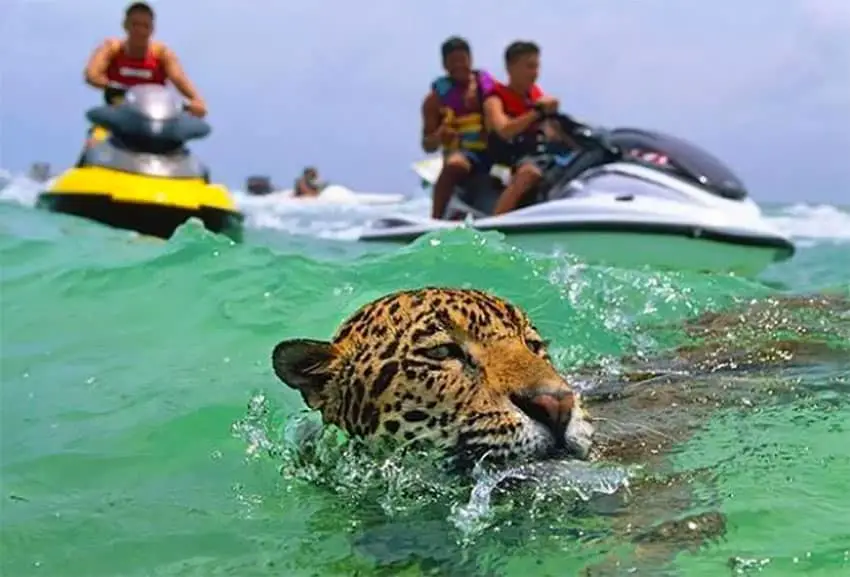
Wildlife photog decries selfies with jaguars as abuse

Wildlife photographer Steve Winter has denounced the abuse of tame jaguars with which tourists can dive and take selfies in Cancún, Quintana Roo.

The National Geographic photographer posted two of his own photos on his Instagram account that he says serve as evidence of the exploitation of the big cats in the Caribbean coast resort city.

One photo shows two jaguars sitting chained in a boat in Cancún, where tourists can accompany the felines as they swim in the Caribbean Sea.

“Wildlife exploitation practices like this are common around the world and it is important for us to be on the lookout for dodgy tourism operations that promote animal selfies!” Winter wrote in a caption beneath the photo.

“This must stop and it is our responsibility as tourists to not engage in taking pictures with animals. I always ask myself why we do this? It may be a seemingly cool thing to do (take a selfie with a tiger or a leopard or elephant) but there is so much pain, trauma and animal abuse that goes into keeping these animals human friendly. Big cats did not evolve to be ‘friends’ with people,” he said.

 

View this post on Instagram


@natgeo photo by @stevewinterphoto Two jaguars sit chained in a boat in Cancun, Mexico. Wildlife exploitation practices like this are common around the world and it is important for us to be on the lookout for dodgy tourism operations that promote animal selfies! This must stop and it is our responsibility as tourists to not engage in taking pictures with animals. I always ask myself why we do this? It may be a seemingly cool thing to do (take a selfie with a tiger or a leopard or elephant) but there is so much pain, trauma and animal abuse that goes into keeping these animals human friendly. Big cats did not evolve to be “friends” with people, to be cuddled and to be cuddled and touched. My new story with @sharon.guynup shows how captive tigers are being exploited across the USA and selfies with tigers are leading to more and more cubs being bred in facilities in places like Florida and Texas. Please be on the lookout for animal photo tourism operations in the USA and abroad (especially in South Africa) and know that there is a very high likelihood that the laces offering you big cat selfies are linked to dubious breeding operations and even commercial trophy hunting operations. Join hands with me in the fight against this malpractice! . . . . . #jaguar #animalselfie #stopanimalselfies #noanimalselfies #wildlifecruelty #animalcruelty #stopwildlifecrime

A post shared by Steve Winter (@stevewinterphoto) on

Winter warned people to be on the lookout for “animal photo tourism operations,” explaining that there is a “very high likelihood” that places offering “bit cat selfies” are linked to dubious breeding operations and even commercial trophy hunting operations.

A second photo taken in Cancún shows a jaguar in the sea with three men on personal watercraft in the background.

“Jet Ski drivers and their tourists get ready to dive with two tame jaguars in Cancún, Mexico,” Winter wrote in the caption.

“People need to know more about the trade and selfie industry with big cats. From Thailand to South Africa, big cats often represent the face of the wildlife trade. If you see your friends or family partaking in activities like in this picture or petting cubs let them know that such businesses are often linked to breeding programs, illegal trade in body parts and cubs,” he said.

The number of jaguars living in the wild in Mexico has increased to 4,800 from 4,000 in 2010 but the feline is still considered an endangered species. Ecology experts and conservationists have urged authorities to make a coordinated effort to protect the population, which is under threat from poaching, habitat loss and illnesses transmitted by domestic animals.

The National Jaguar Conservation Alliance warned in December that the black market in China is the biggest threat facing jaguars in Mexico and said late last month that there is evidence that the felines are being targeted for their genitals.

Experts have also warned that the construction of the Maya Train on the Yucatán Peninsula presents a risk to the long-term survival of the species.

Mexico News Daily 

Have something to say? Paid Subscribers get all access to make & read comments.
Manzanillo, Colima, México, 13 de marzo de 2026. La doctora Claudia Sheinbaum Pardo, presidenta Constitucional de los Estados Unidos Mexicanos en conferencia de prensa matutina, “Conferencia del Pueblo” desde Colima. La acompañan Indira Vizcaíno Silva, gobernadora Constitucional del Estado de Colima; Omar García Harfuch, secretario de Seguridad y Protección Ciudadana (SSPC); Raymundo Pedro Morales Ángeles, secretario de Marina (Semar); Bulmaro Juárez Pérez, divulgador de lenguas originarias, presentador de la sección “Suave Patria”; Ricardo Trevilla Trejo, secretario de la Defensa Nacional (Sedena); Jesús Antonio Esteva Medina, secretario de Infraestructura, Comunicaciones y Transportes; Bryant Alejandro García Ramírez, fiscal general del Estado de Colima; Fabián Ricardo Gómez Calcáneo; Rocío Bárcena Molina, subsecretaria de Desarrollo Democrático, Participación Social y Asuntos Religiosos de la Secretaría de Gobernación; Efraín Morales López, director general de la Comisión Nacional del Agua (Conagua); Marcela Figueroa Franco, secretaria ejecutiva del Sistema Nacional de Seguridad Pública (SESNSP) y Guillermo Briseño Lobera, comandante de la Guardia Nacional (GN). Foto: Saúl López / Presidencia

Mexico’s week in review: Congress deals Sheinbaum her first legislative defeat

0
The week of March 9 in Mexico was marked by standoffs between allies in Congress and adversaries at the airport. Here's what you missed.
A soldier displays seized handguns

The US and Mexico, growing together and growing apart: A perspective from our CEO

0
From a historic drop in homicides to opposite bets on electric vehicles, Mexico News Daily's CEO breaks down where the U.S. and Mexico are converging — and where they're not.
Veracruz Gov.

Veracruz governor blames private vessel for 200-kilometer Gulf Coast oil spill

1
The spill, which has spread to over 200 kilometers of Mexico's Gulf Coast beaches, has been traced to a private oil tanker off the coast of Tabasco.
BETA Version - Powered by Perplexity