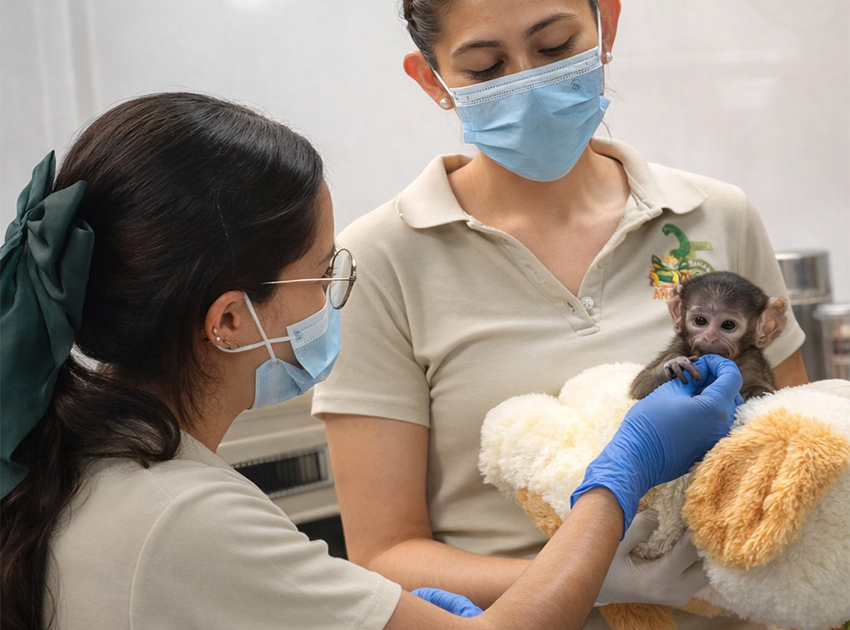
Rejected by his mother and now clinging to a stuffed dog for comfort, a tiny Mexican monkey at the Guadalajara Zoo has become Mexico’s latest internet star.
The story of frail, lovable Yuji — who weighed just 443 grams, slightly less than a pound, at birth on March 3 — lands in the middle of a global wave of sympathy for rejected zoo babies.
Nace el “Punch mexicano” en el Zoológico de Guadalajara 😍🐒
Se trata de Yuji, un monito de apenas 38 días que fue rechazado por su mamá y recibe cuidados y alimentación especial además de su propio peluche 🥹
Usuarios ya lo llaman de cariño “Poncho de Jesús” 🇲🇽♥️ pic.twitter.com/lLDsPNQ0H0
— NotiGDL (@NotiGDL) April 10, 2026

In Japan, Punch, a baby macaque whose mother rejected him shortly after birth, went viral this year after he was photographed clinging to a stuffed orangutan — an image recreated by a Mexico City baker in the form of a concha.
Now in Washington, D.C., there is a frenzy over Linh Mai, a 10-week-old bottle-fed Asian elephant calf at the National Zoo whose own mother refused to care for her.
Meanwhile, Yuji, a six weeks old patas monkey (Erythrocebus patas), is being hand-raised at the Guadalajara Zoo’s Integral Center of Animal Medicine and Wellbeing (CIMBA) after his mother, Kamaria, a first-time parent, failed to hold or nurse him properly in the hours after birth.
Weighing just 15.6 ounces at delivery, he was moved almost immediately into an incubator kept near 35 degrees Celsius to stabilize his temperature. A team of more than a dozen veterinarians and biologists are giving him 24/7 care, including four bottles a day of fortified formula. Yuju now weighs about 673 grams (23.7 ounces).
“His mother was a first-time mother and did not have the experience needed to care for him,” said Iván Reynoso, veterinarian and manager of the zoo’s primates department. “Therefore, we decided to provide assisted rearing by doctors, veterinarians and caretakers from the primates area here at CIMBA.”
Like Punch, Yuji now rarely lets go of his plush toy, a stuffed dog that functions as a surrogate mom.
“They cling, and at that age, all the security they have comes from their mother,” Reynoso said. “So, in the absence of his mother, what we do is substitute her with a stuffed toy … This is completely natural behavior for him.”
Staff rotate the stuffed dog with a bear and a monkey to keep the toys clean, but Yuji’s routine is the same: he naps and drinks from a bottle while clinging to the plush toy inside a crate with a small hammock and ropes to encourage climbing.
He has not yet had physical contact with other patas monkeys and no date has been set for his move into the exhibit with 12 adults and three other infants. The transition will depend on weaning him off milk and getting him onto fruits and vegetables.
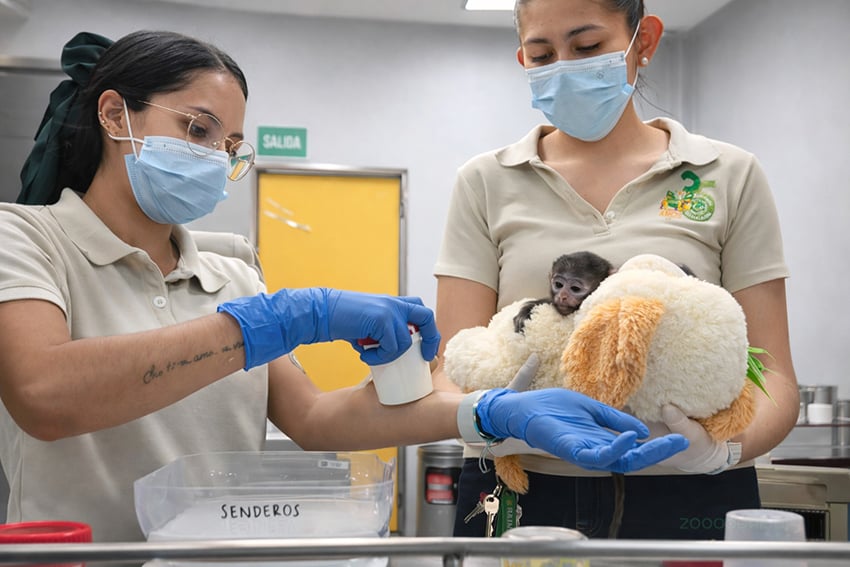
As he approaches six months, officials will slowly take away the plush toys in preparation for his move into the main habitat.
Social media users have dubbed him “Mexican Punch” and “Punch tapatío.”
As for his given name, veterinarian Sandra Arely Franco said she chose “Yuji” because it’s a character from the Japanese manga-anime series “Jujutsu Kaisen” known for having “unbreakable strength.”
As with Punch and the baby elephant in Washington, Yuji’s story has stirred debate.
Some animal-rights advocates argue that no incubator or plush toy can replace a natural habitat and social group, and that animals have the right to live and die where they belong.
Guadalajara Zoo officials counter that intervention was a matter of survival. They even tried to get other patas mothers to “adopt” him.
“If he was not fed and comforted, it could have had negative consequences for his life,” Reynoso said.
With reports from Associated Press, TV Azteca Laguna, Dexerto and Reuters