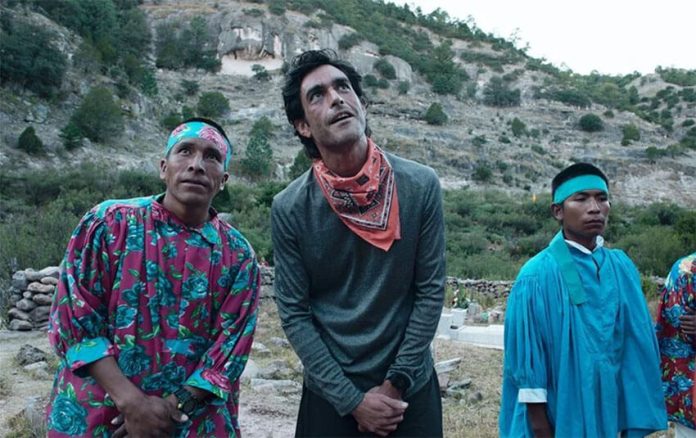
Rarámuri runners Martín Moreno and Enrique Moreno star alongside actor David Angulo in 37 kms. Rafael Montero
Two Rarámuri runners are part of the cast of a new Mexican movie about a man training to compete in the Mexico City marathon.
Martín Moreno and Enrique Moreno star alongside film and television actor David Angulo in 37 kms, a film directed by Rafael Montero that is currently in the final phase of postproduction.
The protagonist meets Martín and Enrique at the start of the film, asks them for help to achieve his goal of running in the Mexico City marathon and pledges to accompany them as they run along the highway from Chihuahua city to the state’s Sierra region.
“They laugh at him a little and tell him he won’t get anywhere with those shoes,” Montero told the newspaper El Universal.
Tomás J. Ramírez, a Rarámuri siríame (traditional leader) in a Sierra community where the movie was partially filmed, and Martín Makawe, a local teacher, also appear in the film. The director said that the Rarámuri men also contributed to the development of the plot in real time.
“They said, ‘Yes, we want to participate but in a direct way, suggesting things,’” Montero said. “Some [of them] had already done theater in the sierra. They already had certain experience, so it wasn’t complicated. In the end, they understood what making a movie is about.”
Montero said that the amateur actors speak in both Spanish and Rarámuri in the film, which is expected to premiere at festivals later this year. Spanish subtitles will accompany the Rarámuri dialogue, he said.
The filming of 37 kms was postponed twice due to the pandemic, but shooting finally happened between September and November last year.
The federal government and private investors helped cover the 30-million-peso (US $1.5 million) cost of making the film, which already has a distributor in the United States.
“The idea is that when you come out of the cinema, you’ll feel good,” said Mineko Mori, one of the producers.
“It’s the story of a man who, like all of us, isn’t perfect. He has several problems in his life, but he’s not a bad person. Through this journey, he connects with the best version of himself, and it’s always nice to see the transformation of a person,” she said.
The vaquita, a critically endangered species, only lives in the northern end of the Gulf of California.
The Mexican government’s erratic approach to saving the vaquita marina porpoise in Gulf of California has only furthered the critical threat illegal fishing poses for the species.
After years of collaboration with the Sea Shepherd Conservation Society to combat illegal fishing, the Mexican government announced the birth of two vaquitas in early April. Both the nongovernmental organization and the Mexican navy credit their thorough patrols of the area for the small sign of recovery.
Last fall, a group of experts convened by the organization the International Union for Conservation of Nature used a technique called expert elicitation to analyze the results of a survey of the vaquita’s Gulf of California habitat over 17 days in 2021 and estimated that only between seven and eight vaquitas remained, with at most two of them being calves.
So the news of the births came as a surprise, especially given that in July 2021, the Mexican government officially scrapped the zero-tolerance area (ZTA), where fishing had been previously banned inside the Vaquita Protection Refuge. While fishing with gillnets — long wall-like structures that are dragged along the ocean floor — remains banned, the government has replaced the zero-tolerance approach with a sliding scale of sanctions based on the number of fishing vessels in the area.
The Mexican government’s move was widely lampooned by experts.
Scientists with the first-ever caught vaquita marina porpoise calf in the Gulf of California in October 2017. Semarnat
Adding to the pressure on the vaquita marina, the Convention on International Trade in Endangered Species of Wild Fauna and Flora (CITES) approved the trade of farm-raised totoaba fish in March 2022. The swim bladders of the totoaba are prized as a delicacy in China and fetch high prices there, which has made it a mainstay target for illegal fishing in Mexico. While the vaquitas are not the target of illegal fishing, they are often bycatch. They become entangled in gillnets used to catch totoaba, shrimp and other fish.
Until March, international trade in the totoaba, which shares waters with the vaquita marina, had been illegal.
InSight Crime Analysis
While controlling illegal fishing in the vaquita habitat would have always been a challenge, Mexico’s meandering approach to enforcement has made the situation even more difficult.
There have been some attempts at prosecuting wildlife traffickers: in February 2021, the government increased penalties for totoaba trafficking and followed this with several arrests of alleged totoaba traffickers linked to organized criminal groups.
A source working for a conservation group in Baja California who wished to remain anonymous for security concerns said that this was the first successful intelligence-led operation to take down totoaba traffickers.
Totoaba in a fisher’s boat. White tissue under the knife is of a recently-extracted swim bladder. G.K. Silber
The Mexican navy, however, has few options to crack down on the number of vessels fishing inside the vaquita refuge. According to the conservation source, the government’s unofficial policy towards illegal fishing in the area remains non-confrontational. “The navy’s role is to ask fishermen to move their nets out of the ZTA without forcing them to do [so],” the source explained.
While there is some level of compliance, dozens of vessels are routinely spotted inside the refuge area.
Andrea Crosta of Earth League International (ELI) told the Mongabay environmental news site that while taking down larger criminal structures will help ensure the vaquitas’ survival, the problem ultimately lies in tackling demand. Chinese traders operating in Mexico are the most critical link in the supply chain, moving the swim bladder to East Asia, according to Crosta.
Reprinted from InSight Crime. Henry Shuldiner is a writer with InSight Crime, a foundation dedicated to the study of organized crime.
Aranza Ortega Jaimes in Vienna. Twitter @EmbaMexAua
A 15-year-old pianist from Iguala, Guerrero, won an international music competition in Vienna, Austria, this week.
Aranza Ortega Jaimes, a student of the National Conservatory of Music, won the 13-15 years piano division of the Grand Prize Virtuoso Vienna 2022, which also has categories for string and wind instruments as well as singing and chamber music.
She played Frédéric Chopin’s Scherzo No. 1 in B minor, Opus 20 in the competition, held Tuesday in the Musikverein concert hall in the Austrian capital.
Ortega, who has been playing piano since she was seven, told the newspaper Reforma that she was very happy to represent Mexico on the international stage.
“I’m very pleased that the name of my country was in the program, I got very excited. I’m also very happy because I felt a lot of support from my teachers,” she said.
Ortega noted that the National Institute of Fine Arts supported her financially so she could travel to Vienna.
“It was an experience that meant a lot to me and it gave me the impetus to keep wanting to play piano,” she said.
In a post on Twitter, Mexico’s Embassy in Austria congratulated the young musician on her victory in the event, which was open to musicians of all ages and nationalities.
“She had the opportunity to debut in one of the most important halls of Europe, Gläserner Saal at the Musikverein in Vienna,” the post added.
A rendering of the Riad Romeo, a proposed condo hotel in El Cuyo, Yucatán. Grupo Tsalach
Hundreds of residents of a small town on the northeastern coast of the state of Yucatán are fighting to stop the construction of a luxury condo hotel that has already been approved by the federal government.
The Environment Ministry (Semarnat) last year approved construction of the beachfront Riad Romeo hotel in El Cuyo, a fishing village on the Gulf of México near Yucatán’s border with Quintana Roo.
Local authorities have also signed off on the project. In the past, much smaller projects have been rejected based on their environmental impact, leading some residents to suspect that there were irregularities in the new hotel’s approval process.
Residents say the four-story building – which would consist of 40 apartments (already on sale on real estate websites) and amenities including a restaurant, rooftop swimming pool and car park beneath the first floor – threatens the natural environment and local wildlife, and would cause sewage, litter and light pollution problems.
They say the hotel would adversely affect the Ría Lagartos Biosphere Reserve, a UNESCO protected area with mangroves, small estuaries, coastal lagoons, marshes and savanna that are home to a variety of species, including endangered ones.
The road into the town of El Cuyo, which is located on a narrow peninsula and surrounded by Ría Lagartos National Park. Photo by Alfri Peraza
Residents assert that the planned construction poses risks to the reproduction of flamingos, crocodiles, fish and sea turtles that nest on the coastline of northeastern Yucatán. They have also warned of risks to migratory birds.
In addition, the new hotel – which would easily be the tallest building in El Cuyo – would place additional pressure on electricity, water and trash collection services, which are already stretched.
Local official Neydy Yolanda Puc Gil, elected town commissioner last September, and other El Cuyo residents opposed to the developments have denounced Semarnat’s failure to consult with locals before approving the Riad Romeo hotel and other tourism developments.
At a recent meeting with Paulina Navarrete, a representative of the hotel, residents made it clear that they do not want the new hotel.
They told Navarrete they didn’t want any new developments to be built in El Cuyo, according to a report by the newspaper El Diario de Yucatán. They also gave some blunt advice to the company, telling it to get out of town and not come back.
For its part, Riad Romeo has asserted that the construction will benefit the economy of the local community, such as providing jobs for El Cuyo residents. That claim was met with contempt at the recent meeting, according to a resident who spoke with Mexico News Daily. (The resident spoke on condition of anonymity to avoid retaliation from local authorities, some of whom support the project.)
[wpgmza id=”182″]
Meanwhile, a Change.org petition with the hashtag #SalvemosElCuyo (Let’s Save El Cuyo) had attracted support from about 21,000 people as of Thursday morning, a figure some 10 times larger than the town’s population.
“Only working together can we save El Cuyo! Let’s preserve the peace! Let’s preserve everything that makes El Cuyo so beautiful! No to massive construction! No to political leaders who insult the wishes of residents! No to turning El Cuyo into another [Isla] Holbox! No to the destruction of the environment!” the petition says.
José Jesús Rosado Castro, an El Cuyo homeowner, explained that he supports the petition because “the tranquility of the residents is worth more than the ambition of authorities and unscrupulous developers.”
The El Cuyo resident who spoke with Mexico News Daily said this week that construction is currently stopped amid the ongoing community opposition, but given that the project has the all the required permits – obtained in the proper way or otherwise – work is likely to resume at some point, unless people power ultimately prevails.
Protesters march with signs bearing the names of missing and murdered women in Nuevo León in 2022.
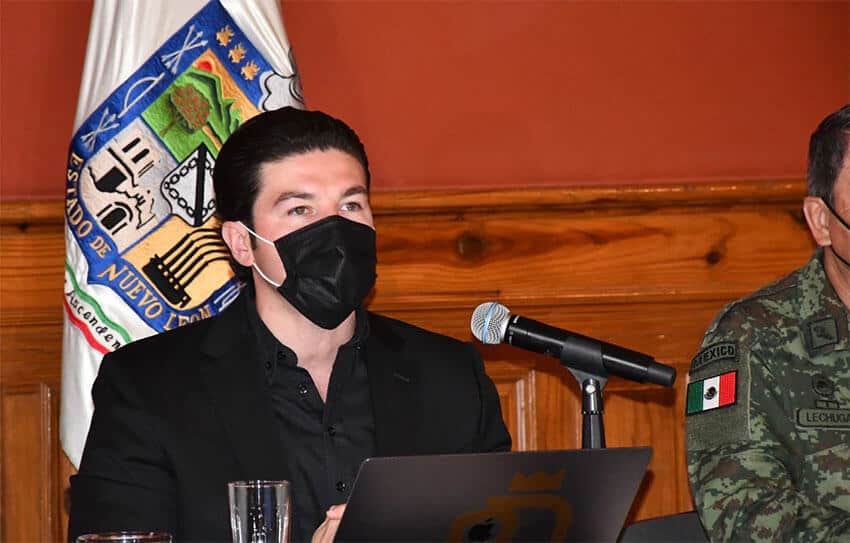
Following the disappearance of more than 20 women in Nuevo León during the past month, Governor Samuel García announced Thursday the implementation of a protocol to expedite searches for missing women and girls.
At a press conference after a security meeting with state and federal officials, García said the Código Alba (Code Dawn) protocol would apply in the northern border state.
The protocol demands “an immediate reaction” when a person is reported as missing, not just from authorities but also from gas stations, hotels and many other civil organizations, he said.
The governor said that “we all have to go and look” for people reported missing. García also said the protocol has proven to be 98% effective in other places where it has been implemented.
It was first used in Ciudad Juárez – formerly Mexico’s femicide capital – in 2003 before being applied across Chihuahua. Several other states have also implemented the protocol.
Nuevo León Governor Samuel García announced the new policy at a Thursday press conference.
According to the federal government, the objective of the Alba protocol – so named to emphasize the importance of searching for missing people from first light – is to carry out immediate searches for missing women and girls with the aim of protecting their lives.
It entails “a plan of attention and coordination between authorities of the three levels of government … [and] involves the media, civil society and public and private organizations throughout Mexico.”
García’s announcement came after the disappearance of 22 women in Nuevo León in the past month. One of those, María Fernanda Contreras, disappeared on April 3. Her body was found four days later in Apodaca, a municipality that is part of the Monterrey metropolitan area.
The impunity rates for crimes such as abduction and femicide are high, but a man accused of murdering Contreras was arrested Tuesday and remanded in preventative custody. He could be sentenced to 60 years in jail.
García also announced Thursday that new search centers, including a centralized state one, would be established and an additional 50 million pesos (US $2.5 million) would be allocated to combating the state’s enforced disappearance problem.
A range of authorities including the Nuevo León Attorney General’s Office, the State Search Commission and municipal governments will collaborate on missing persons cases, the governor said, explaining that their aim will be to locate abductees as soon as possible and apprehend the perpetrators.
He also said the Nuevo León government would collaborate with its counterparts in the neighboring states of Tamaulipas, Coahuila and San Luis Potosí.
In addition, García said government would seek to have people fielding 911 calls trained in issues related to gender violence and missing person cases.
“When there is a report by telephone, the first responder [should] be an expert person … who can act in the most important hour, the golden hour, which is the first hour after a report is made,” he said.
Tacos al pastor, brought to Mexico by immigrants from the Ottoman Empire, is a variation on schwarma.
Tacos al pastor, that most Mexican of foods, seen and served at the entrance to eateries from Merida to La Paz, Veracruz to Guanajuato, a food that has existed in the country since as far back as the first arrival of the sirio-libaneses (Syrian-Lebanese) community in the late 19th century.
Based on the shawarma spit-grilled meat found in Arab nations, tacos al pastor is now considered a quintessentially local dish. Likewise, kibis, wheat dough traditionally filled with ground meat — often sold on streets in the south by walking vendors — is derived from the Lebanese national dish, kibbeh, or kipe. Served with bitter oranges grown in the Yucatán Peninsula, and habanero chile, they are easily distinguishable for their potato-like shape and are popular with locals and tourists alike.
The amazing and unique Syrian-Lebanese heritage of Mexico, in fact, might completely pass you by if you did not know where to look for it.
“The Yucatán has always been a melting pot for people seeking a different way of life,” says Alejandro Azar Pérez, the Campeche Red Cross’ state delegate and the descendant of early 20th century Lebanese immigrants. “Even today,” he argues, “we see families arriving from all over the world to settle in the Yucatán, who are after the same change in lifestyle that my great-grandparents were searching for.”
The term sirio-libanes doesn’t mean Syrians with Lebanese heritage or vice-versa exactly, but it is the term Azar uses, as do other members of these two ethnic groups in Mexico. The reason for that has to do with the complicated history of where these Mexicans’ ancestors came from when they arrived here in the late 19th and 20th centuries to escape war, social turmoil and oppression.
Campeche’s Red Cross state delegate Alejandro Azar Pérez is the great-grandson of a Lebanese couple who migrated to Mexico in 1905.
The geographical region now spanning Syria and Lebanon has a long and richly textured history of being invaded, beginning with the Assyrians, Prussians, and Greeks, and continuing through the takeover by the Ottoman Empire in the 16th century. By the end of the nineteenth century, foreign domination and internal conflicts in the area were driving a huge exodus of Lebanese people out of their homeland in search of a better life. In the early 20th century, both Syria and Lebanon were one administrative entity under the Ottoman Empire, which then became independent states after World War I.
For many of these emigrants, the final destination was of little concern; their primary goal was finding better opportunities and a life away from poverty, exploitation and hunger.
Though most went in search of the American Dream, a sizable number traveled south to Uruguay, Argentina and Mexico in search of freedom. In 1878, the first Lebanese citizens to arrive in Mexico made land at the port of Tampico, in Veracruz.
In 1879, Santiago Sauma, the first Lebanese national to settle in the Yucatán arrived in Progreso. Most of the emigrants who traveled to Mexico began their journey alone, leaving wives, children and friends in Lebanon with the hope of forging ahead and establishing a secure living situation.
At the time, President Porfirio Díaz’s policies favored those looking to escape wretched situations in other countries. Hoping to increase Mexico’s economic prosperity and populate empty land, Díaz encouraged an active open-door immigration policy to attract individuals with skills and tenacity.
In 1905, one such ambitious individual — Alejandro Azar Azar — disembarked at the port of Progreso, Yucatán. Alongside his companion, Salima Farah Elias, he was hoping to try his luck at a better life on the peninsula, where he had heard there was an abundance of trade and commercial opportunities.
Though Syrians and Lebanese immigration has declined since the Porfiriato, Mexico still welcomes citizens of those nations today, often with the help of ethnic associations.
Even for those with little capital and no grasp of the Spanish language, it was said, life was more prosperous and much freer. The couple had few resources except for hope, good faith and a commitment to building a life for themselves.
Generations later, Azar Azar and Farah Elias’s family is spread across Mexico and has children, grandchildren and great-grandchildren almost too numerous to count.
Azar’s great-grandson, the aforementioned Alejandro Azar Pérez of Campeche’s Red Cross, recalls the tales he heard as a child, passed down by word of mouth, about his ancestry. As is often the case in the folk histories of diasporic cultures — groups who have moved outside of their place of origin to settle in other lands — the only ancestral history for many of the descendants of these immigrants is oral.
“Stories,” he says, “it was always stories. Stories told at every family event, and there were many. There still are many. Stories of how the first of our family came to be in Mexico. Where we came from. Who we are. What binds us together.”
Perhaps unsurprisingly given their shared past, the family has retained strong links despite the geographical distance. Like much of the Syrian-Lebanese community in Mexico, they helped construct a network that communicated between parts of the family across the country, as well as with their relatives across the ocean in Lebanon. It’s a network that is alive and well today and arguably still serves as modern Mexico’s most successful mercantile class, alongside the Galicians.
Because when you stop to look, or scratch beneath the surface, the Syrian-Lebanese community is everywhere and is now a de facto part of modern Mexico, inextricably so. It may be most felt publicly in quasi-Middle Eastern foods, but really there is no aspect of the country in the early 21st century that does not have the root and branch participation of this most unique and resilient of communities.
Shannon Collins is an environment correspondent at Ninth Wave Global, an environmental organization and think tank. She writes from Campeche.
One of the trucks set on fire by an organized crime group in Reynosa, Tamaulipas, near the Reynosa-Pharr, Texas, border crossing.
Members of an organized crime group set at least four trucks on fire on Wednesday to pressure truckers to end their blockade of the international crossing between Reynosa, Tamaulipas, and Pharr, Texas.
After being threatened by presumed members of the Gulf Cartel, the truckers terminated their protest, which began Monday in response to a more stringent vehicle inspection program implemented last week by the government of Texas. The new policy caused lengthy delays at the border and threatened billions of dollars in international trade.
The trucks set alight by gangsters were located near the Pharr-Reynosa International Bridge and in at least one other part of the Tamaulipas border city. One truck on Avenida Puente Pharr was set on fire at approximately 11:00 a.m. by four men who first doused the vehicle with gasoline, the newspaper El Universal reported.
Another truck was set on fire near Parque Colonial, about seven kilometers from the border crossing. The gangsters also set a vacant lot on fire, the newspaper Excélsior reported.
As Civil Protection personnel extinguished the blazes there was a gunfight between the presumed cartel members and the National Guard, El Universal said. No casualties were reported.
State police arrested three presumed members of the Gulf Cartel and seized two vehicles used by the criminal gang.
Edgar Zambrano Quintallan, Reynosa president of the National Chamber of Trucking, said that protesting truckers were advised to end their blockade due to safety concerns. “We explained to the drivers that the best thing was to move,” he said.
Blockades at border crossings began after truckers faced delays of up to 30 hours due to Texas’ stricter vehicle inspection program, introduced by Governor Greg Abbott to detect migrants and drugs and increase vehicle safety. It was suspended Wednesday at the border crossing between Colombia, Nuevo León, and Laredo, Texas, but remained in place at other border crossings between Mexico and the Lone Star state.
Abbott and Nuevo León Governor Samuel García signed a memorandum of understanding Wednesday that ensured the stricter program would be suspended at the Colombia-Laredo crossing.
It said the two states would cooperate to ensure that vehicles crossing the border meet safety standards and to reduce human trafficking and the smuggling of fentanyl and other drugs.
The memorandum also said the neighboring states would collaborate to stem the flow of migrants into Texas and that Nuevo León has begun and will continue enhanced border security enforcement measures.
In addition, it said the two states would work cooperatively to restore the border-crossing inspections process to allow crossings at a faster pace.
At a press conference with García, Abbott criticized U.S. President Biden for failing to secure the border with Mexico and said he was open to negotiating with the governors of other states that share a border with Texas.
“President Biden must assert the national security priority that comes with being the commander in chief of the United States,” the Texas governor said.
“Until then, Texas will use its own strategies to secure the border and continue to negotiate with Mexico to seek solutions.”
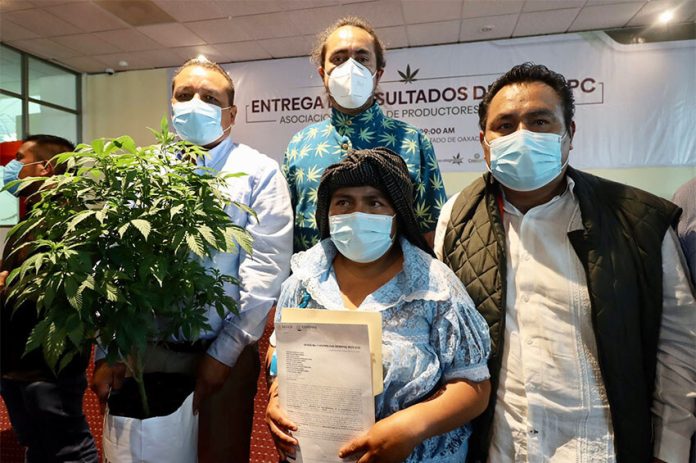
On Wednesday morning, 26 grow permits were presented to indigenous communities. Twitter @cesarmateos_oax
Federal permits allowing the cultivation of marijuana for medicinal purposes have been assigned to 26 indigenous communities in Oaxaca.
Issued by health regulator Cofepris, the permits also allow the communities to process the plant into different medicinal forms.
The Oaxaca Association of Indigenous Cannabis Producers (AIPCO) presented the permits at an event in Oaxaca city on Wednesday morning.
Among the recipients were the towns of Santa Cruz Papalutla, San Juan Chilateca, San Pablo Huixtepec, San Dionisio Ocotepec, San Nicolás Yaxe, El Tepehuaje and Coatecas Altas.
The use of marijuana for medicinal purposes has been legal in Mexico since 2017. The Supreme Court has directed Congress to legalize marijuana for recreational purposes, but it has repeatedly missed deadlines to do so.
Horacio Sosa Villavicencio, a Morena party state representative in Oaxaca, shared the news about the permits and video from the event on his TikTok account.
AIPCO president Roberto Carlos Cruz Gómez described the issuing of the permits as an historical event. They were issued after an arduous process that lasted for years, he said.
Cruz said that the 26 communities will grow plants that have a high cannabidiol, or CBD content. Unlike tetrahydrocannabinol, or THC, CBD is not psychoactive. Among a wide range of CBD products are oils and gummies.
Cruz said that cannabis derivatives could be made available via the Oaxaca Health Ministry if a production and commercialization bill becomes a state law.
Daniel Ramírez López of agri-food consultancy firm COAGRO said that the issuing of permits to the Oaxaca communities will allow the cannabis industry to begin to develop in Mexico.
Cannabis has always been vilified in Mexico, he said before noting that the marijuana industry is very lucrative in U.S. states where use of the plant is legal.
Once recreational use is approved, Mexico will become the world’s largest legal marijuana market. One person already cashing in on the CBD and marijuana paraphernalia market is former president Vicente Fox, who is a part owner of a chain of cannabis stores.
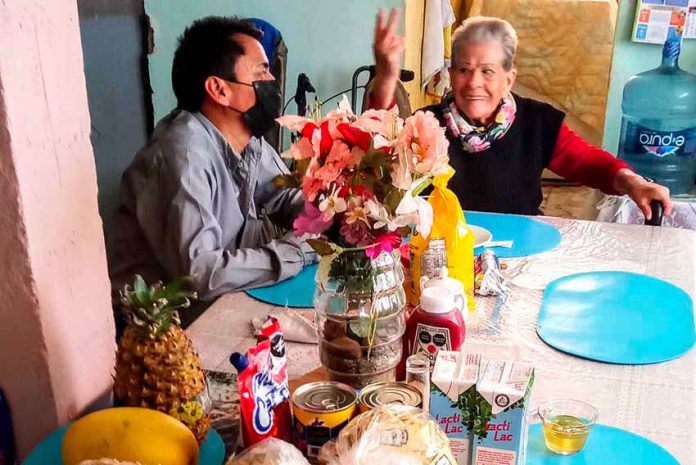
Puebla Food Bank staffer Rodrigo Bravo Morales confers with client Margarita Aguilar about her hearing problems after a making a food delivery to her home. Photos by David Kirby unless otherwise noted
Margarita Aguilar Bonilla sat alone in her modest home in Lomas de San Miguel, a largely working-class district on the eastern edge of Puebla city, when two staffers from the Puebla Food Bank appeared at her door, bearing smiles, hugs and enough food for the elderly woman and her disabled son to last a week.
The delivery was spread out over the kitchen table and onto surrounding chairs: items ranging from a large bag of red, yellow and green bell peppers, a ripe pineapple, fresh apples, carrots and chayotes to fruit juice, milk, rice and beans, pasta, bread and even pastries and cupcakes.
“This is so important to us; it’s a huge help,” Aguilar said. “And it’s a blessing because it also delivers the people who deliver the food. The attention they give to elderly people — they take care of us.”
The bounty will not only save Aguilar and her son, it will save the food itself.
All of it was “rescued” from local companies, farms, restaurants and greenhouses. Without the Puebla Food Bank, most of it would have been tossed into a landfill.
The Puebla Food Bank’s constantly busy receiving, weighing and dispatching food. An upcoming expansion will allow it to process more food and also give classes to recipients about food self-sufficiency.
The twin plagues of food waste and starvation are of epidemic proportions in Mexico, where a staggering amount of nutritious, fresh food is thrown away each day even as millions of people go to bed hungry.
Enter the National Network of Food Banks, with 54 chapters throughout Mexico. These nonprofits, including the large, active one in Puebla, act as a bridge between food waste and feeding people in dire need.
“Every day, 50,000 tonnes of food are lost in Mexico; nearly 40% of the food produced is thrown away,” said Puebla Food Bank Director José Miguel Rojas Vértiz Bermúdez. “But even worse, on that same day, 50 million people endure hunger and malnutrition.”
Each year, some 8,000 Mexicans die of hunger, nearly one every hour.
And there’s more. The annual pollution and wasted resources from producing, processing and transporting all that food, which will never be eaten, takes a huge toll.
“It equals the amount of vehicle pollution created in Guadalajara, Monterrey and Mexico City combined,” Rojas said.
Producing the throwaway surplus also consumes 40 billion liters of water annually, “or enough to provide Mexicans potable water for nearly two and a half years,” he said.
COVID-19 has made these two problems worse, as people lost jobs and other resources. According to the National Network of Food Banks, the number of Mexicans suffering from hunger increased by 9% since the pandemic, as did the total amount of wasted food.
A recent visit to the Puebla Food Bank revealed a massive, clean, modern facility bustling with staff and volunteers who were receiving, sorting and dispatching food — not only dry and canned goods but also fresh produce that might not be ready for prime time but was still eminently edible, including slightly bruised tomatoes and carrots that were small, broken, or looked like the face of Lyndon Johnson.
The loading dock was beeping with forklifts, busy receiving, weighing and then dispatching food.
“The difference between what we take in and what we deliver in kilos is minimal,” said Procurement Coordinator Guadalupe Carmona Calva. “We try to be as efficient and transparent as possible. We get it out almost as quickly as we receive it,” she said, explaining that the shelf life was so limited.
Food rejects appropriate for animals are carefully excised from human deliveries and dispatched to the Africam safari park just outside Puebla. “Those animals need to eat too, and this way, nothing is wasted,” Carmona said.
Some of the people they serve, Puebla Food Bank staffer Rodrigo Bravo said, “live in one-room homes without furniture and sleep on cardboard on the floor.” UN
Unspoiled food is delivered to people in the states of Puebla and neighboring Tlaxcala via climate-controlled trucks that transport them to dozens of distribution centers throughout the region or to some 120 institutions, including hospitals and orphanages.
The food bank sends 14,000 hot meals a month to eight comedores (dining rooms), runs a cafeteria for its own volunteers and staff and operates the “Ruta de Caridad” (Route of Charity), which offers food, companionship and other services to people who cannot leave their homes.
All told, that’s 1,400 tonnes of rescued food a month distributed to 150,000 people via 45,000 deliveries in 250 communities.
Alexandra Ladrón de Guevara, director of institutional outreach, is pleased with the bank’s progress but given that 1.5 million people in the State of Puebla still face food insecurity, she admits that there is a long way to go.
Still, support for the project comes from an impressive list of places — from the state and city governments (although the foundation is strictly nonpolitical); from foundations; from large companies based in Puebla, including Volkswagen and Audi; from universities and students; and from individual donors. “There are many ways to help,” she said. “Some people donate 300 pesos a month to sponsor a family, and some literally drop off rice and beans at the bank.”
Back in Lomas de San Miguel, Food Bank Route of Charity Coordinator Rodrigo Bravo Morales was chatting with Aguilar. She is frail and facing almost complete hearing loss, while her adult son has debilitating rheumatoid arthritis. Neither can work, and they depend on the weekly deliveries for survival.
Bravo is trying to find a better hearing aid for Aguilar, who worked for nine years on a noisy auto-parts assembly line before being forced to retire. Her paperwork fell through some corporate cracks, and she never collected a pension.
He has managed to procure a new toilet and bathroom sink for her home. “We have an alliance with Walmart, which donates household appliances,” he said. “They are slightly damaged, maybe a dent, but still perfectly good. So, we don’t just rescue food. We let nothing go to waste for people who need it.”
The largely homebound food bank clients on the Route of Charity receive more than just physical sustenance.
“We visit each of them once a week to check on their well-being and to see if they need anything, and we arrange for a doctor through our alliance with the (nonprofit) Dr. Simi Foundation to visit them twice a month,” Bravo said.
For some of the food bank’s clients, those who bring the weekly food deliveries are the only visitors they see. “We have become like family,” he said, adding that he sometimes arrives with flowers and a guitar to serenade Señora Aguilar.
“I always try to make them a little coffee or dessert,” Aguilar said. “They are out there running around all the time, and they deserve it.”
Each month, the Puebla Food Bank rescues 1,400 tonnes of food that would otherwise be thrown away from sites ranging from companies and farms to restaurants and greenhouses. Puebla Food Bank
While Aguilar’s situation is difficult, other food bank clients have even greater challenges.
“Some people have nothing at all,” Bravo said. “They live in one-room homes without furniture and sleep on cardboard on the floor. We try to get them clothing, beds, sofas, stoves and fridges, all donated.”
In poorer communities, health problems complicate hunger exponentially. One family nearby is an older woman with an adult daughter with severe epilepsy and constant seizures.
“About two years ago, she had a seizure and fell onto a hot barbeque, burning about half of her body,” Bravo said. “The mother had to quit work to care for her daughter and then she herself fell and broke her ankle. It’s a very difficult situation. We managed to get her a wheelchair.”
Many client families have members with intellectual disabilities, paralysis, brain disease, or illnesses such as autoimmune disorders or severe GI problems.
“In many, but not all cases, they are going to need our help forever,” Carmona said. “Other clients who lost their jobs or had pay cuts will eventually be able to buy their own food again.”
And that, she said, is the overriding goal.
The food bank is currently building a large extension onto its facility, using donated sheetrock from a United States-based company. It will not only expand their capabilities for food storage, processing and delivery, it will also have dedicated spaces for training clients in food self-sufficiency and economic independence.
“Our goal is that [one day] the Food Bank will no longer exist,” Carmona said, “because people are no longer hungry.”
If you are interested in supporting the Puebla Food Bank with a donation, you can reach them via their Spanish-language website. If you don’t understand Spanish, you can make a donation online at the website Global Giving.
A three-month-old baby jaguar was seized at Mérida airport, the environmental protection agency Profepa said on Monday.
The male cub was discovered during a National Guard operation to combat the illegal trafficking of animals.
The feline was found thanks to the detection of a microchip that it was wearing, aided by the discovery of irregularities in documents that were presented.
Profepa wrote on Twitter to confirm the seizure and said the jaguar would be handed over to a Wildlife Management Unit (UMA).
Jaguars are listed as near threatened on the International Union for Conservation of Nature (IUCN) Red List as the population has probably declined by 20–25% since the 1990s. In Mexico, the jaguar is primarily threatened by poaching. Its habitat, in the north, the Gulf of Mexico and the Yucatán Peninsula, is threatened by changes in land use, construction of roads and the construction of tourism infrastructure.
Bengal tigers have also become a challenge for authorities.
Three Bengal tigers under the responsibility of federal and state authorities died of starvation in a cage in Guerrero in February. In March, a Bengal tiger was captured in a house in Chimalhuacán, México state, and a cub was rescued in Celaya, Guanajuato. A large white tiger was killed by authorities in Querétaro later that month and a tiger has been on the loose in Guanajuato, killing livestock, since December.
Meanwhile, tropical birds have also been appearing outside of their habitat.
A pelican whose wings had been hurt was seized by authorities in the center of the borough of Tláhuac in Mexico City. Officials said it would be taken to a reserve belonging to the National Autonomous University (UNAM) for observation, to be freed later by Profepa.