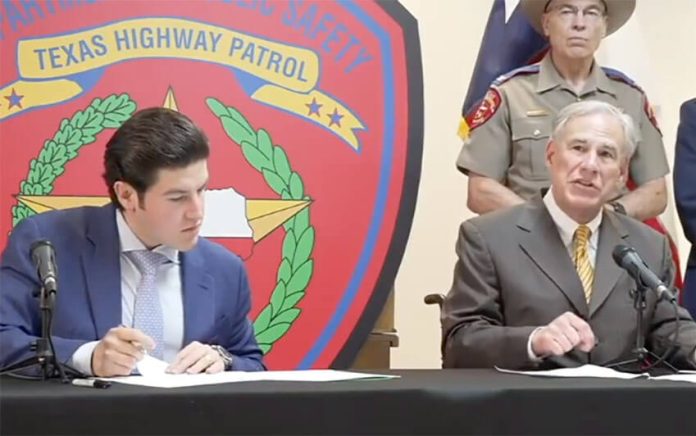
Governors García, left, and Abbott at Wednesday's meeting over vehicle inspections.
Texas Governor Greg Abbott backed down on extra inspections for vehicles from one part of Mexico on Wednesday as a domestic U.S. clash over immigration policy created delays threatening billions of dollars in international trade.
The additional checks introduced by Abbott last week — which he said were meant to reduce crime and increase vehicle safety — added hours to usual crossing times and led to long backlogs at important ports of entry along Texas’ nearly 2,000-kilometer border with Mexico.
Truck drivers south of the border had blockaded some of the entry points in protest over the onerous measures, adding to the chaos and further imperiling supply chains already under strain.
At a news conference with Samuel García, governor of Nuevo León, on Wednesday, Abbott said Texas would return to the previous practice of random inspections at the shared ports of entry. García said he had agreed that the portion of the border would be continuously patrolled by state police.
“The bridge from Nuevo León and Texas will return to normal effectively immediately, right now,” Abbott said.
However, the move will only ease congestion at one crossing for now.
Most of Texas’ southern border is shared with Coahuila, Tamaulipas and Chihuahua states. Abbott said he had been contacted by those governors and would hold talks starting as soon as Thursday, signaling his intent to resolve the trade dispute in piecemeal deals at the state level.
“I look forward to working with all of them toward achieving results similar to what we are achieving today with Governor García,” he said, adding that in the meantime the additional checks would be in place.
Abbott, who is up for reelection in November, introduced the additional checks amid a domestic battle with the Democratic Biden administration over federal immigration policy. The border check measures, however, drew the ire of local Republican business leaders.
Mexico, which is the United States’ biggest trading partner, also protested that the more than US $440 billion in annual trade flows that crossed through Texas entry points were at risk.
Jen Psaki, White House press secretary, said on Wednesday that Abbott’s measures were unnecessary, hurt jobs and raised prices.
As the leaders were speaking, trucks were still facing long delays in crossing the border. Blockades at two important crossings in Ciudad Juárez had been lifted on Wednesday, local media reported.
Industries from carmakers to agriculture have been affected by the delays. Daniel Gudiño, chief executive of Mexican lime exporter SiCar Farms, said his company had citrus stuck at crossings that was at risk of spoiling.
“If this is prolonged it’ll break the supply chain and inventories,” he said. “The consumer at the end of the day will always be the most affected because the prices will stay high or rise again.”
Copyright The Financial Times Limited 2022. All rights reserved.
Electric vehicles need lithium for their batteries.
President López Obrador has a plan B to nationalize lithium in case his proposed electricity reform doesn’t pass Congress: send lawmakers a different nationalization bill.
The president’s electricity bill, which would change the constitution to guarantee the state-owned Federal Electricity Commission 54% of the market and ensure that no new lithium concessions are granted to private companies, faces a vote in the lower house of Congress this Sunday.
It requires support from two-thirds of lawmakers to pass, but the ruling Morena party and its allies don’t have a supermajority in either the Chamber of Deputies or the Senate.
Morena has attempted to persuade Institutional Revolutionary Party (PRI) deputies to break ranks with their party, whose official stand is in opposition to the bill. But the government needs another 57 votes to get that supermajority.
It came one closer on Wednesday when a PRI legislator from Chiapas announced he would vote in favor, but getting another 56 seems an unlikely prospect.
Meanwhile, López Obrador said Wednesday that future exploration of lithium – a key component of lithium-ion batteries used in electronic devices and for green energy storage – will be nationalized via a reform to the mining law if his electricity bill isn’t approved.
“If there isn’t two thirds [support] on Sunday, because the lobbyists, the influence peddlers and foreign interests dominate – if there is treason by the lawmakers, we already have the mining law reform initiative, [which] I just signed this morning,” he told reporters at his regular news conference.
López Obrador said the bill, which would ensure that lithium is designated as “property of the nation,” only needs support from a simple majority of lawmakers to become law. If the electricity bill doesn’t pass the lower house this Sunday, the proposed mining law reform will immediately be submitted to Congress, he said.
“They’re not going to put us up against the wall. Lithium, which both foreign corporations and governments lust after, will belong to Mexico,” López Obrador declared.
Firms with active lithium mining permits, such as China’s Ganfeng Lithium, will not be affected by the nationalization plans, the government has said while pledging not to issue any new concessions.
AMLO announced in February that a new state company will be created to exploit lithium deposits for which no permits have been issued.
Mexico has large potential reserves in Sonora and smaller potential deposits in states such as Baja California, San Luis Potosí and Zacatecas. However, most of Mexico’s potential reserves are in clay deposits that are technically difficult and expensive to mine, leading to doubts about the state’s capacity to exploit them.
Such concerns haven’t diminished Lopez Obrador’s enthusiasm for nationalizing what he describes as a “strategic mineral.”
“There couldn’t be electric cars without lithium … and it turns out that we have lithium, which is like having oil … or gold in earlier times,” he said Wednesday.
“Lithium is white gold and … [foreign companies and governments] covet it, that’s why they’re against the constitution being changed. … They’re very opportunist, … they don’t even have an ideology, they have interests, their god is money,” López Obrador said.
He issued a new call for opposition lawmakers to go against their parties and support the electricity reform, advising them to rebel and ignore the foreign lobbyists. He said last week he had information that some opposition lawmakers would support the bill, which he refused to alter despite intense pressure from the United States.
Legislators should tell the lobbyists they have a responsibility to defend the people and the nation and let them know that they “won’t fold even with their filthy money,” AMLO said before changing his tone and wishing everyone a peaceful Holy Week with their families.
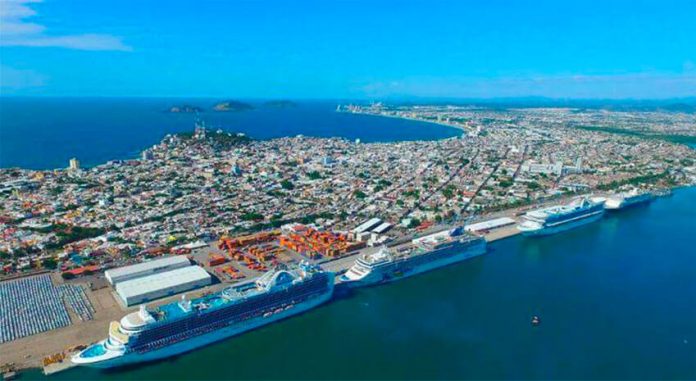
Cruise ships berthed at the port of Mazatlán. government of sinaloa
Three cruise ships arrived in Mazatlán, Sinaloa, Wednesday with more than 15,000 people on board, helping to recover the city’s tourism industry over the Easter break.
Almost eight months since cruise tourism was reactivated in Mexico, the largest of the arrivals is at close to 100% capacity.
The Carnival Panorama arrived from Puerto Vallarta, Jalisco, at 9 a.m. carrying 4,616 of the possible 4,716 passengers and 1,304 of a maximum 1,450 crew. The ship will head to Cabo San Lucas, Baja California Sur, at 6 p.m.
The near-full ship is a positive sign for the industry: when cruise tourism returned in August, the Carnival Panorama was only operating at around 60% capacity.
Another ship, Discovery Princess, arrived in Mazatlán at around 7:30 a.m. from Cabo San Lucas carrying 3,264 passengers and 1,334 crew. It will continue its journey towards Puerto Vallarta at 6 p.m.
Norwegian Bliss is sailing the reserve route with 3,195 passengers and 1,588 crew. It arrived from Puerto Vallarta in the morning and will set sail for Cabo San Lucas at 6 p.m.
The general director of port administration, Mariel Aquileo Ancona Infazón, said that the number of cruise tourists had doubled since August. “It started with 1,500 [passengers] and now the majority have more than 3,000. It’s been remarkable,” he said.
Aquileo added that almost triple the number of cruise ships are likely to arrive to Mazatlán in 2022 compared to last year. He expects the first four months of the year to bring 65 ships, a rate which is likely to dip slightly to finish the year with 145 arrivals. In 2021, 52 cruise ships visited Mazatlán.
In May arrivals are likely to decrease until October when the high season begins.
The arrivals will provide a welcome bump in commercial activity in the city known as the Pearl of the Pacific, after its normally thriving tourist industry was heavily affected by travel restrictions introduced in March 2020 due to the COVID-19 pandemic.
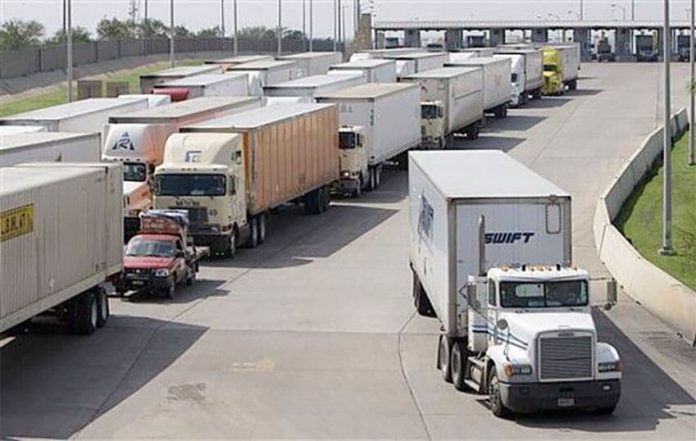
Longer crossing times are affecting supply chains that were already under pressure.
The governor of Texas is facing growing calls to abandon a vehicle inspection program that has led to blockades and long queues at Mexico border crossings, threatening billions of dollars in trade at a time when supply chains are already under strain.
Mexican truck drivers have blockaded border crossings since Monday in protest against the additional security checks, which were announced by Governor Greg Abbott in a two-paragraph letter last week. Crossing times for commercial freight have slowed to 10, 20 or even 30 hours in some cases, Mexican industry bodies said.
The dispute has imperiled billions of dollars’ worth of goods moving between the countries. In total, more than US $440 billion in trade flows through Texas-Mexico border crossings each year, according to the Texas Center for Border Economic and Enterprise Development at the Texas A&M International University.
The commercial disruption comes amid a broader dispute over immigration between Abbott, a Republican, and the Democratic Biden administration.
Abbott said the additional inspections were aimed at stopping migrant smuggling and drug trafficking across the border, as well as increasing vehicle safety. He also framed the measures as a response to U.S. President Joe Biden’s decision to end pandemic-related migrant expulsions.
“This is going to dramatically slow traffic from Mexico into Texas. It is a byproduct of cartels crossing the border,” Abbott said in a news conference last week.
Texas’s Department of Public Safety said that within five days of Abbott’s order, it had inspected 3,443 commercial vehicles and put 807 of them out of service for safety violations.
Trade traffic at four critical ports of entry has been reduced to about one-third of the typical level, costing both countries income and competitiveness, Mexico’s foreign ministry said on Tuesday, adding that it rejected the inspection program.
U.S. Customs and Border Protection on Tuesday called Texas’ new measures “unnecessary” and said protests in Mexico had stopped all commercial traffic at the Pharr International Bridge. Northbound cargo traffic was also interrupted at Ysleta and New Mexico’s Santa Teresa crossing, it said.
The increased safety inspections piled further disruption on supply chains in industries from agriculture to automobiles that were already under stress because of the pandemic.
“The execution of this order has wreaked havoc up and down our supply chain,” the Texas International Produce Association said in a letter this week. “This is destroying our business and the reputation of Texas.”
Several Mexican industry groups said the checks had caused hours-long delays in crossing in some cases, with drivers often having to wait without food, water or bathrooms.
Mexico’s National Freight Transport Chamber on Tuesday called on Abbott to end the inspections to avoid a “collapse in international cross-border trade,” estimating that the delays at the Pharr bridge were costing $8 million a day.
Mexico’s National Agricultural Council said drivers would previously take about four hours to go through all the necessary border checks in Texas. Since the new measures came into effect, that has risen to as much as 30 hours.
The measures were designed to focus the federal government’s attention on immigration issues, said Raymond Robertson, director of the Mosbacher Institute for Trade, Economics and Public Policy at Texas A&M University. Even many conservatives in the state’s business community were pushing back against them, he added.
“There’s already been a lot of conservative people who are life-long Republicans who are really uncomfortable with what’s going on and I think they’re going to put pressure on the governor,” he said.
Copyright The Financial Times Limited 2022. All rights reserved.
In Chiapas, two women died in transit to vote in the referendum. They only went to vote because they feared their federal benefits were at stake, residents said. Twitter
Two women in Chiapas died on their way to vote in President López Obrador’s recall vote on Sunday, and citizens from their town accuse municipal authorities of pressuring people to travel to polling stations to vote in the president’s favor.
Citizens from Nueva Victoria, in the San Fernando municipality, said municipal worker Iván López Aquino arrived in town at 7 a.m. on Sunday to warn residents to vote to ensure they maintain their social program payments from pensions and from the Sembrando Vida (Sowing Life) tree-planting program.
“A lot of people were afraid because they depend on the support,” one local man said.
The citizens said the municipal government brought a pickup truck to take some local people to vote and that López kept a list of those who went. On the way to San Fernando, two hours down a dirt road from Nueva Victoria, the vehicle transporting 35 people fell some 100 meters into a ravine, killing the two women and injuring 13 other people, including a one-year-old baby who went into a coma.
One local woman, Odilia Girón López, said that some of the injured people weren’t provided with medicine or medical attention.
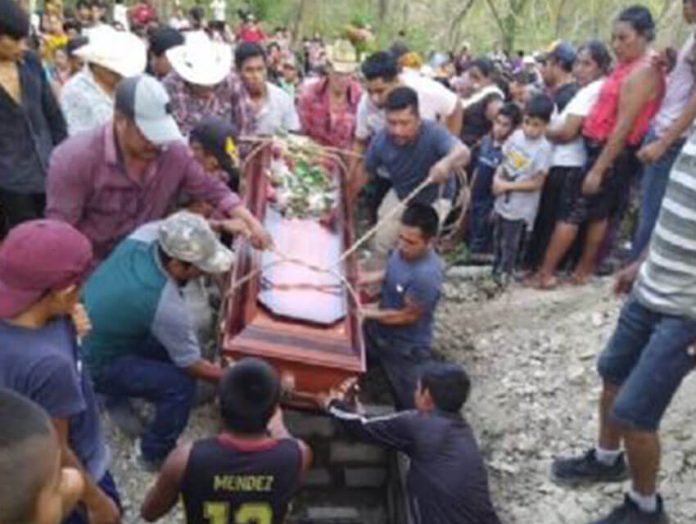
Hundreds of residents attended the funeral of Petrona Vázquez González and Lesbia Hernández Pérez, who died in the vehicle accident. Twitter
Angry people from the community took a San Fernando municipal official hostage, demanding to see San Fernando Mayor Antonio Castillejos. The mayor is a member of the Ecologist Green Party (PVEM), an ally of the Morena party. He is also being investigated by the Chiapas state auditor’s office for the suspected embezzlement of 17 million pesos in municipal funds, the newspaper Diario de Chiapas reported in February.
“If it was all right for them to come for people at 7 a.m., it’s also fine for him to come and show his face,” a local man said.
Relatives of the women were angered further by Castillejos’ attempts at compensation. They were given 15 chickens, three kilograms of rice and a few kilograms of corn dough, they said.
A total of 7,455 votes were cast in the seven polling stations in San Fernando on Sunday, and 95% of those were in favor of López Obrador remaining president. The seven stations had an average turnout of 29.7%, higher than the national average of 17.8%.
Meanwhile, another pickup truck crashed on the way to voting booths in Chiapas on Sunday. Three people from the town of Cruz de Piedra died on the way to Siltepec, but there have been no claims that they were pressured to vote by authorities.
The president called the democratic exercise a “complete success” after more than 90% voted in his favor, despite turnout falling far below the 40% needed to make the result legally binding.
López Obrador said he was considering a proposal to lower the minimum threshold required in such votes to 20%.
The Felipe Ángeles International Airport (AIFA) is an austere facility in the boondocks whereas the previous government’s canceled airport project would have been a “state-of-the-art” hub, according to an Australia-based aviation analysis and research company.
Centre for Aviation (CAPA) said in a report that the canceled US $13-billion Texcoco airport project would have replaced the busiest airport in Latin America – the saturated Mexico City International Airport – with a “new, single-site and state-of-the-art facility.”
The airport would have been open by now except it was “abruptly abandoned, partly completed and at huge cost, by the incoming president in 2018,” CAPA said, referring to Andrés Manuel López Obrador’s decision to cancel the project following a legally questionable referendum held a month before he took office.
López Obrador repeatedly claimed that the previous government’s project was plagued by corruption, too expensive and being built on land that was sinking, but CAPA posited that he held a spurious referendum on the airport and then canceled it for political reasons.
In its report, entitled Mexico City’s new airport opens – ‘mission accomplished,’ or is it?, the research firm noted that the replacement is “a converted military base out in the boondocks beyond city limits, where the military remains.”
The airport, which opened March 21, was built by the army on the Santa Lucía Air Force base, located about 50 kilometers north of downtown Mexico City in México state. The site of the canceled airport is about half that distance northeast of the historic center.
CAPA acknowledged that the AIFA – part of a three-pronged plan to meet air travel needs in the greater Mexico City area – at least opened on time, but observed that it has few air services and scant interest from international airlines.
“One of the issues facing the airport as it attempts to attract new airlines is its distance from downtown, the central business district and the southern suburbs,” the report said.
CAPA raised concerns about the lack of transport connections to the AIFA given that a new highway connection and rail link have not yet been completed.
Centre for Aviation said that it is probable that the AIFA will be compared to the Montréal–Mirabel International Airport, located 40 kilometers northwest of the Canadian city.
That airport, it said, failed to attract sufficient passenger flights due to its location and for that reason became a cargo-only airport in 2004.
CAPA said the AIFA will be able to handle 20 million passengers annually in its first phase of operations and 40 million per year in its second phase, although only 2,000 passengers per day, or fewer than 1 million per year, are currently using it due to the low number of flights.
“In 2052 it is expected to serve approximately 90 million passengers a year,” the company added, citing a figure that would be well above the record 50.3 million passengers who used the Mexico City International Airport (AICM) in 2019.
CAPA acknowledged that the success or otherwise of the new airport will contribute to the overall perception of the performance of AMLO, who has unsurprisingly championed the AIFA – one of his pet projects.
“Halfway through the president’s six-year term of office, the success or failure of the Felipe Ángeles International Airport may well turn out to be President [López] Obrador’s ultimate legacy,” CAPA said.
The federal government also intends to upgrade the AICM and the Toluca airport in order to increase their capacity and meet what was growing demand for air travel before the coronavirus pandemic began.
Passengers check in at Felipe Ángeles International Airport.
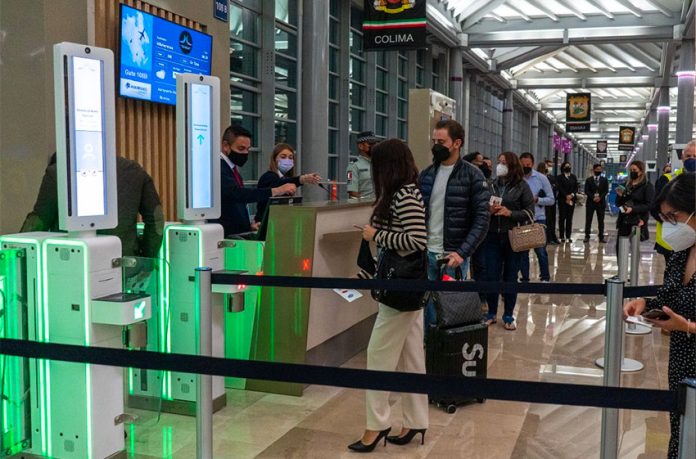
With relatively few passengers and most stores still closed three weeks after the fanfare of its opening, the Felipe Ángeles International Airport (AIFA) has not yet overcome its slow start.
Located on an Air Force base about 50 kilometers north of downtown Mexico City in México state, the army-built AIFA opened on March 21.
Three Mexican airlines – Aeroméxico, Volaris and VivaAerobús – and one international carrier, Venezuela’s Conviasa, are using the airport, but the AIFA has handled an average of just 12 flights per day since opening and only about 2,000 passengers have used the facility on a daily basis.
By comparison, an average of more than 136,000 passengers travel through the Mexico City International Airport (AICM) every day.
A Reuters journalist visited the AIFA on a recent Friday afternoon and reported that the facility was devoid of travelers.
Fourteen departures and arrivals, including military flights, were confirmed for that day – compared to almost 900 at the AICM – but only one flight, a delayed Aeroméxico service from Mérida, was showing on the display system in the afternoon.
Reuters reported that check-in booths were empty and “not a single suitcase was in sight.”
The news agency also said that only a few businesses were open, including a Starbucks cafe, a Krispy Kreme stall and a gift shop. Most storefronts displayed “coming soon” signs.
While there didn’t appear to be any travelers present, the airport was not bereft of people. Airport tourists strolled around, waiting to see the delayed flight from Mérida touch down.
Despite the low number of passengers, the airport estimates that 2.4 million passengers will pass through the facility this year before that number is doubled in 2023. Passenger numbers would have to increase significantly for those targets to be met.
To reach 2.4 million passengers in 2022, an average of 8,392 people – more than quadruple the current average – would have to use the airport during the 286 days between the opening date of March 21 and December 31.
“Once we get to mid-year, I really hope there’ll be more flights,” an airport employee told Reuters, although there doesn’t appear to be any certainty that will occur.
Attracting foreign carriers to the airport apparently remains a major challenge, even though the AIFA has lower usage rates compared to the AICM and the government has offered incentives to airlines, according to an airport employee. As it stands, the AIFA only has one operational commercial runway, although a second one is planned.
Victor Manuel Peña Chávez, aeronautical engineering professor at the National Polytechnic Institute, noted that not even the AICM has the capacity to have two planes landing or taking off simultaneously.
One barrier to attracting more airlines and passengers to the new airport is its location. Concerns have been raised about the travel time needed to get there from central Mexico City, and a new highway connection and rail link to the airport have not yet been completed.
That said, getting to the AIFA will be easier than getting to the AICM for many residents of densely-populated México state.
President López Obrador – who decided to build the AIFA after canceling the previous government’s larger airport project in Texcoco, México state – unsurprisingly retains faith in the new airport, the first of his major infrastructure projects to begin operations.
He has hailed it as “one of the best airports in the world” and declared on the day of its inauguration that it was 100% complete.
But Reuters reported that the AIFA is still under construction. “Chain-link fences covered with green tarps lined the entrance to the airport, and dust painted the sky a reddish hue as construction crews continued excavation,” the news agency said.
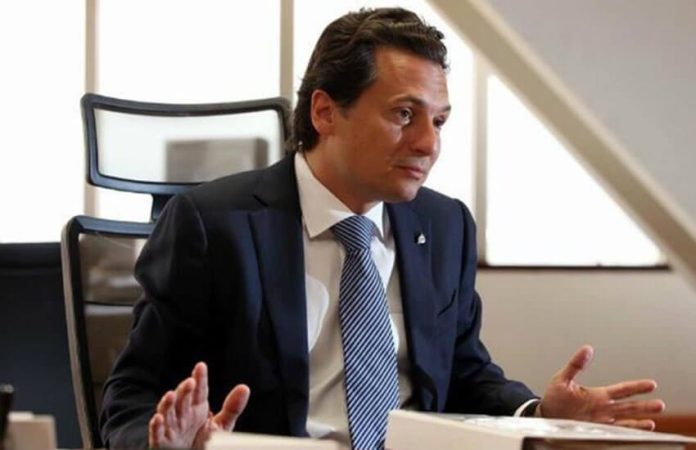
As CEO, Lozoya allegedly took bribes from private companies to award at least one contract and buy a property for Pemex at an inflated price. File photo
Former Pemex CEO Emilio Lozoya remains in jail on corruption charges after failing to reach a compensation agreement with the state oil company.
The newspaper Reforma reported Monday that Lozoya — accused of corruption in cases involving Brazilian construction company Odebrecht and steelmaker Altos Hornos de México (AHMSA) during the 2012–2018 government of Enrique Peña Nieto — had reached an agreement with Pemex that would allow him to leave jail in exchange for payments of over US $10 million.
However, at a court hearing on Monday on the AHMSA case, a lawyer for Pemex said the conditions needed for the agreement were not in place. The state oil company argued that Lozoya’s compensation offer of more than $3 million for the corrupt purchase of a dilapidated fertilizer plant from AHMSA in 2015 was insufficient given the financial damage he caused. Lozoya is accused of accepting more than $3 million in kickbacks from AHMSA to effect the purchase.
A second hearing scheduled for Tuesday — at which Lozoya’s offer to compensate for his involvement in the Odebrecht case with a payment of over $7 million was to be considered — was postponed on Pemex’s request. No new date was set.
As a result of Pemex’s rejection of the compensation offer in the AHMSA case and the postponement of the second hearing, Lozoya didn’t have the opportunity to formally conclude the agreement that would have resulted in a suspension of the charges against him and his release from the Reclusorio Norte prison in Mexico City.
Lozoya, left, has admitted to authorities that he took bribes but claims he did so at the behest of former president Enrique Peña Nieto, center. File photo
The former official — accused of receiving multimillion-dollar payments from both Odebrecht and AHMSA in exchange for awarding a lucrative refinery contract to the former and buying the rundown fertilizer plant from the latter — was extradited to Mexico from Spain in July 2020 and has been in jail since November.
He initially avoided jail for over a year due to poor health and a “protected witness” cooperation agreement he struck with the federal Attorney General’s Office (FGR). His freedom came to an end in October shortly after he was seen dining at a high-end Mexico City restaurant, which put a spotlight on the alleged preferential treatment he was receiving.
If Lozoya and Pemex are unable to reach a compensation agreement in which the former effectively buys his way out of jail, the ex-Pemex chief will face trial on charges of bribery, money laundering and criminal association. A conviction could see him sentenced to almost four decades behind bars.
The former Pemex CEO has implicated a who’s who of Mexico’s political elite in the corruption of which he is accused, including former presidents Peña Nieto, Carlos Salinas and Felipe Calderón, ex-cabinet minister Luis Videgaray and 2018 presidential candidate Ricardo Anaya.
Based on Lozoya’s claims, the FGR accused Peña Nieto of being the author of a bribery scheme that allegedly used Odebrecht money to buy lawmakers’ support for the former government’s structural reforms, in particular the energy reform which opened up the sector to foreign and private companies after an almost 80-year state monopoly.
President López Obrador pledged there would be “no protection for anyone” involved in the Odebrecht corruption case but said Monday that he supported a compensation agreement as long as Lozoya paid fair compensation for his crimes.
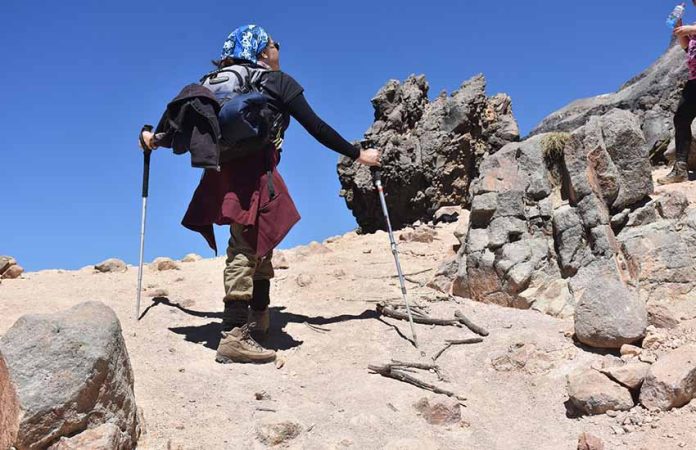
Guides reccomend being prepared for Iztaccíhuatl's steep, at times rocky, terrain with a host of other supplies. Photos by Joseph Sorrentino except where credited
Iztaccíhuatl — Náhuatl for “the White Woman” but affectionately known as the Sleeping Woman, is a dormant volcano and, at 5,264 meters (17,270 feet), Mexico’s third highest peak. Living as I do in Chipilo, Puebla, it’s impossible to escape her. I see her and Popocatépetl, the active volcano, from the front of my home and on drives to Cholula or Puebla.
It was, and still is, more than a dormant volcano for many of Mexico’s indigenous people. Both Iztaccíhuatl and Popocatépetl are revered as gods and sources of water.
I’m not accustomed to climbing anything much larger than a modestly sized hill, but Martha Cabrera, my girlfriend, who’s significantly more adventurous than me, was itching to climb Iztaccíhuatl.
When Ari Castro Galicia, a good friend of mine, happened to mention he frequently takes people up the volcano, it seemed like it was time to try.
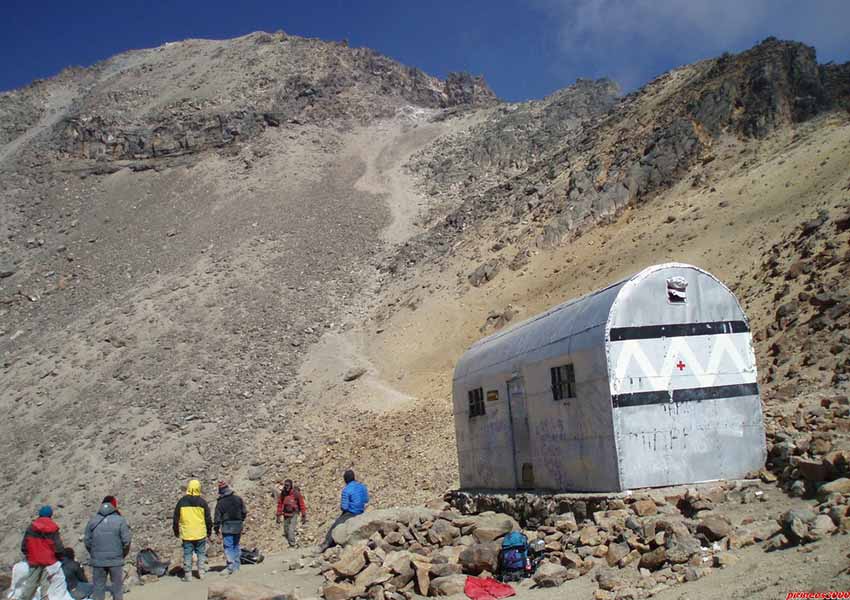
Castro was an army mountaineering instructor, and since he retired two years ago he has guided people up Iztaccíhuatl and other mountains. We were only going to hike to a place called El Refugio (the refuge), which is about 4,700 meters tall, but it still promised to be challenging.
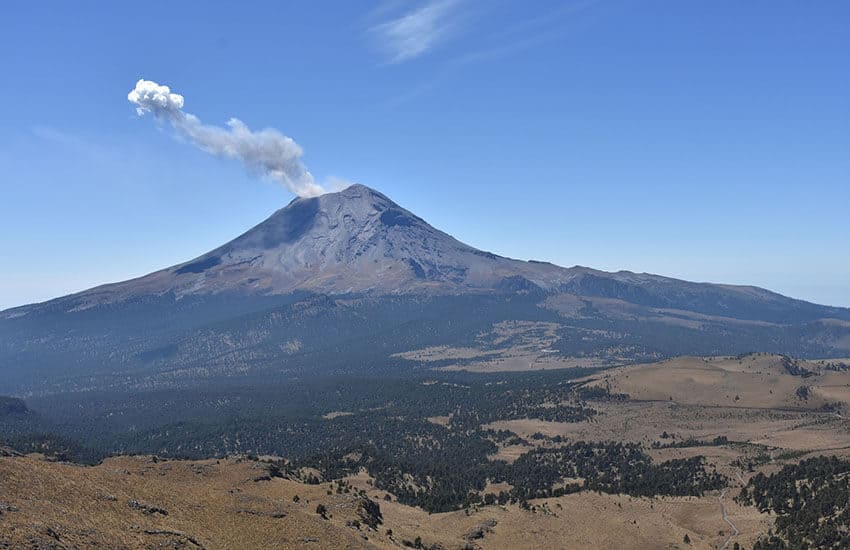
You’ll get a great view of Iztaccíhuatl’s twin volcano Popocatépetl even if you don’t make it too far up the mountain..
“How far one can go depends on the experience of the person and the conditions,” said Castro. “One needs to be in good shape.”
One also needs to be properly prepared.
“A person needs two liters of water, minimum,” Castro detailed, “[with] high-calorie food like nuts and chocolate, gloves, mountain boots, a helmet and walking sticks.” He also told us to wear warm clothing and to bring sunglasses, sunscreen and sandwiches.
As he listed what we needed, it started to sound more than a little challenging.
Martha and I drove to Iztaccíhuatl-Popocatépetl National Park, which is about 40 miles almost directly west of Puebla city. A few miles past San Nicolás de los Ranchos, a small pueblo on the Paso de Córtes highway, the pavement ends and the road is bumpy, hard-packed dirt for several miles.
Six of us gathered at the parking lot of the welcome center at 9 a.m., where we registered and paid 50 pesos.
The hike begins at La Joya, located at 4,000 meters above sea level. Before continuing, Castro said a short prayer. “I only ask permission from the mountain to climb and entrust myself to God,” he told me.
Shortly after leaving a short, flat stretch, you encounter a fairly steep part. Despite a weekly exercise regimen of three high-intensity workouts on a stationary bike and three days of swinging Russian kettlebells, I found myself huffing pretty hard.
Alejandro Guzmán Machado, Castro’s friend and a second guide, reminded everyone, “This is not a race. There is no rush.”
The hike to El Primer Portillo, where we had our first short break, took 50 minutes. It was cold enough that we could see our breath.
Soon after we started hiking again, smoke was pouring out of Popocatépetl. “Is Popo angry or welcoming us?” I asked.
“He is welcoming us,” Guzmán said.
Guzmán and Matú continuing on through El Arenal to El Refugio.
When, after 50 minutes, we reached the next rest stop at El Segundo Portillo, I was feeling the effects of the altitude and the climb, blissfully unaware that up ahead were even more challenging sections.
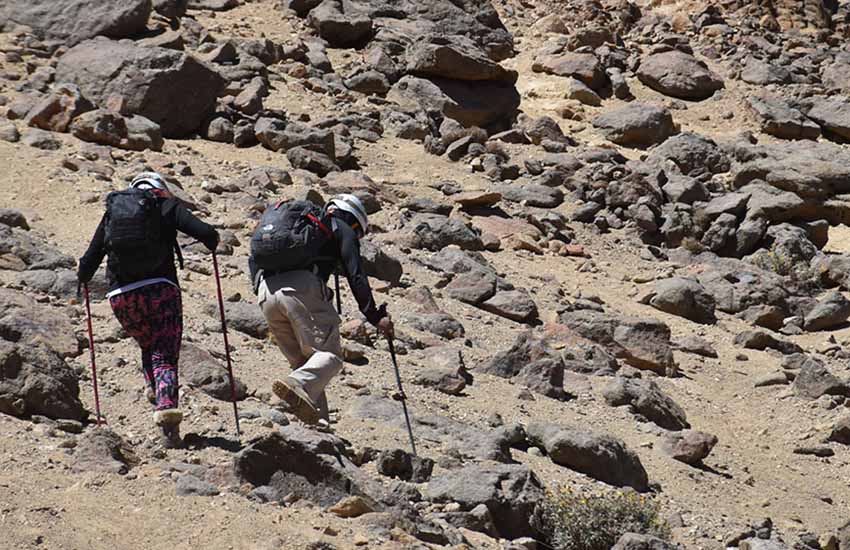
There’s a field with large boulders that one must carefully clamber over, and it was here that I fully realized the wisdom of wearing a helmet and using walking sticks. After that, the path narrows. On the left is a very steep drop. I wouldn’t say it was an overly dangerous stretch, but I found myself leaning as far to the right as possible.
Then came my favorite section: El Arenal, the sandbank: a long, fairly steep stretch of soft sand where you sink to your ankles with each step. To traverse it means firmly planting your walking sticks in the sand and then pulling yourself along with your arms. Perversely, Paul Simon’s song Slip Sliding Away got stuck in my mind.
At that point, we had hiked for 3 1/2 hours and we still weren’t through El Arenal. That’s when I looked up and saw Martha sitting and signaling, “Ya. No más” or “Enough. No more.”
I slogged up and sat down beside her. When she said she didn’t want to continue, I gave a silent prayer of thanks because being a chivalrous man, I knew I couldn’t very well leave her; but I was spent.
Guzmán said El Refugio, our destination, was “muy poquito más,” — very little left to go. But I’ve been on enough hikes and pilgrimages in Mexico to know that muy poquito más can mean anything from a few minutes to a couple of hours, so I asked Castro how much longer.
“About 30 minutes,” he said.
I threw in the towel.
Guzmán and his niece, Diana Laura Matú Guzmán, continued on while the rest of us ate our lunch.
I asked Castro how far we’d hiked, fully expecting it to be a few miles. “About two and a half kilometers [1 1/2 miles],” he said.
Stunned, it was then that I understood how tough a hike it really was. “Well, I’m going to write that we went 10 kilometers,” I told him.
Getting back down was a lot faster — under three hours — and I actually found myself having fun as I slid down El Arenal, although the strong, cold wind that had kicked up kept the fun to a minimum. When we got back to the trailhead, Guzmán placed his hand on a boulder to pray. “I thank God we returned,” he explained.
The El Refugio base — not a view the writer managed to see. File photo
Despite congratulations and handshakes all around, I was a little disappointed that I hadn’t made it to El Refugio. I felt a little better when Castro said that only about 20% of the people he’s taken up Iztaccíhuatl make it there.
Matú, Guzmán’s niece, made it on her first attempt; she may have had some extra incentive.
“When I was five years old, my uncle promised me that when I was 15, he would take me up The Sleeping Woman,” she explained. “Time passed, and we lost contact because of his work. Last year, I saw him again and reminded him of the promise. I’m 23 now, and 18 years later, he kept his promise.”
“I loved it,” she said. “It was hard, but I want to go again.”
She may have to wait until next year since climbing season runs from October through late April.
Castro and Guzmán have both climbed Iztaccíhuatl dozens of times and will continue to do so. “The mountain has an inexplicable attraction that makes you return again and again and again,” Castro said.
I don’t know if a guide is a requirement, but I’m convinced it’s necessary. In addition to knowing the way and keeping people motivated, Castro and Guzmán carry everything needed to attend to any type of problem.
If you’re interested, you can email Castro at insercion_360@hotmail.com.
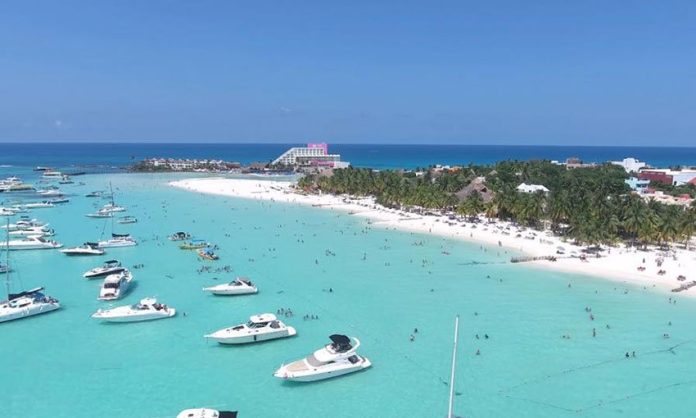
At the north end of Isla Mujeres sits Playa Norte, a protected Caribbean beach with white sand and clear turquoise water. (File photo)
A beach in Mexico has been voted one of the world’s best in the Tripadvisor Travelers’ Choice Best of the Best awards 2022.
Playa Norte on Isla Mujeres, Quintana Roo, was voted the 19th best beach in the world and No. 1 in Mexico. The overall international winner was another Caribbean beach, Grace Bay Beach on the Turks and Caicos Islands.
Mexico’s second-best beach was Playa La Entrega in Huatulco, Oaxaca, followed by Playa Nuevo Vallarta in Nayarit and Playa El Chileno in Cabo San Lucas, Baja California Sur.
In fifth place is a beach near Isla Mujeres: Playa Delfines in Cancún, Quintana Roo. The sixth best beach, according to voters, was Playa Balandra in La Paz, Baja California Sur.
Seventh and eighth places went to beaches that, like Playa Norte, benefit from warm Caribbean waters: Playa El Cielo on Cozumel island and Playa Paraiso in Tulum, both in Quintana Roo.
The ninth most popular beach in Mexico was Playa El Médano in Cabo San Lucas and No. 10 was Playa La Ropa in Zihuatanejo, Guerrero.
Meanwhile, Tripadvisor also released the winners of other international categories, like the world’s best destinations, best restaurants and best hotels.
Hacienda Beach Club and Residences in Cabo San Lucas was voted the 10th best hotel in the world and voters ranked Gran Hotel Ciudad de Mexico, Mexico City, the 20th best place to stay in the world.
One Mexican restaurant made the list of the world’s best eateries: Restaurante Benazuza in Cancún was voted the fourth best international restaurant.
In terms of destinations, Quintana Roo flew the tricolor flag with two entries. Tulum was voted the fourth best destination in the world and Playa del Carmen was honored with 14th place.
The Travelers’ Choice Best of the Best awards are Tripadvisor’s most prestigious accolades. The awards filter entries by taking into account the quantity and quality of traveler reviews and ratings.
Entrants must have been listed on Tripadvisor for at least 12 months and have received a minimum number of reviews within the evaluation period and achieved a minimum star rating.