Home Blog Page 1023

Maya Train protesters tie themselves to machinery to stop work

0
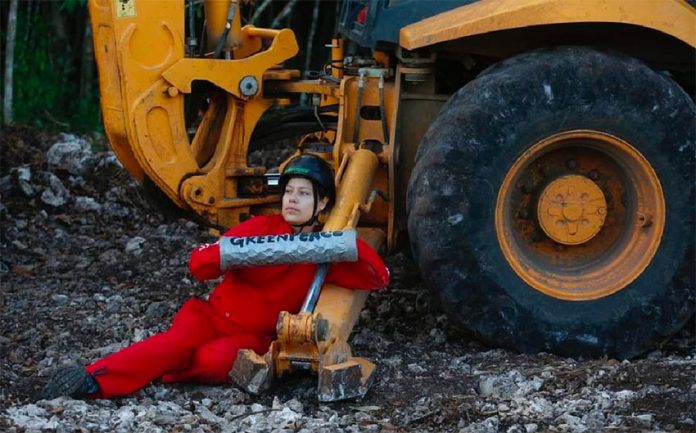
A train protester is tethered to a backhoe Monday in Quintana Roo.

Activists from Greenpeace tied themselves to heavy machinery on Monday to impede work on a Quintana Roo section of the Maya Train railroad.

Eight protesters from the environmental organization began their protest in the municipality of Solidaridad at 7:00 a.m. and intended to remain tethered to the machinery all day, the newspaper Milenio reported.

The federal government recently modified the route for section 5 of the railroad, moving the Cancún-Tulum stretch inland after the business community in Playa del Carmen complained about its construction through the center of the coastal resort city.

Jungle has already been cleared for the construction of tracks along the modified route, triggering protests both at the site of the deforestation and online.

The Greenpeace protesters said that section 5 was rerouted to run through jungle before environmental studies were completed.

They also said that the damage to flora, fauna and subterranean rivers in Quintana Roo will be irreversible, and urged people to sign a Greenpeace petition against the “devastation of the Mayan jungle.”

Aleira Lara, campaigns director for Greenpeace México, called on President López Obrador to immediately suspend construction of section 5 of his US $8 billion signature infrastructure project, which is slated for completion in 2023 and will run through Tabasco, Campeche, Yucatán, Quintana Roo and Chiapas.

“As it is planned, this route will fragment, deforest, strip of animals [and] contaminate … the jungle, the rivers and the communities,” she said.

The likelihood of López Obrador agreeing to suspend section 5 of the railroad is extremely low. He has rejected claims that the Maya Train project will cause extensive environmental damage and described its opponents as “pseudo-environmentalists.”

“In 1,500 kilometers of the train, only 100 hectares [of vegetation] will be affected, mainly weeds. However, at the same time 200,000 hectares are being reforested; three large natural parks (18,000 hectares) will be created and on the edge of the tracks, rows of flowering trees will be planted,” López Obrador wrote in a Facebook post earlier this month.

On Monday, he celebrated that the ambitious rail project no longer faces any legal impediment after a Mérida-based federal court last week lifted a suspension of environmental permits for sections 1,2 and 3 that was first issued in March 2021.

The court ruled in favor of maintaining the suspension of the permits in February, but acknowledged that doing so was a mistake because it previously revoked the same suspension in December.

López Obrador told reporters at his regular news conference that there is now “no legal problem” for sections 1, 2 and 3, which will connect Palenque, Chiapas, to Izamal, Yucatán, or any other sections. “There was an injunction but it has already been ruled against,” he said.

AMLO reaffirmed that construction of section 5 won’t cause major environmental damage.

“A new route was chosen, … the entire right-of-way is already in place. Reaching Tulum there are cenotes [natural sinkholes] but the project has taken into account viaducts to go through there. They won’t be touched, the subterranean rivers and cenotes won’t be affected at all,” he said.

López Obrador said that most of the land along which the modified route will run is owned by hotels and has already been altered. “It’s not jungle, it’s grasslands,” he said.

With reports from Milenio and Reforma 

Help sought to remedy pollution in Hidalgo’s Tecocomulco lake

0
Tecocomulco lake
Residents say they've removed tonnes of lilies from the lake but their efforts have not been enough.

Communities living by a polluted lake in Hidalgo that sustains hundreds of families are calling for the government to take action to rescue it.

Tecocomulco lake is under threat due to the accumulation of mud, water lilies and another reed known as tule.

The lake sits in a 56,000 hectare basin between the communities of Tecocomulco and Tepeapulco, about 65 kilometers southeast of Pachuca. It is a large aquatic ecosystem with a variety of animal and plant species. It is also where migratory birds from the northern Mexico, the United States and Canada make their nests, along with two species of amphibians in danger of extinction.

A local fisherman, Juan López, said the problem emerged from a smaller lake some 15 kilometers away. “The problem we have at the moment is the lilies … It’s a reed that was carried here, it is not native to the lake. It was in the dam of the Puerco lake which burst and that brought it here,” he said in an interview with the newspaper Milenio.

Juan López added that families were depending on authorities to act. “We have not been able to control it. We are asking the authorities to support us because we have already taken out many tonnes of lilies and it reproduces a lot … If this problem continues, it will end [the lake] and we have many families around it that depend on it … We also have two or three fishermen’s cooperatives. Their families and our families would lack the sustenance to survive” if the lake were not rescued, he said.

A community spokesman from San Miguel Allende, José Trinidad, reiterated the necessity for government assistance. “”We are requesting the support of the authorities, because we have been waiting here for some time with promises that have been made to us yet nothing has been done for this lake. It really is a very important lake as for its surroundings and for its most distant municipalities,” he said.

Another local person, José Antonio Vargas, said he felt cheated by the authorities. “They promise and promise. They have been promising us for many years and when they come to ask for our votes we give them [our votes], and they never come back,” he said.

With reports from Milenio

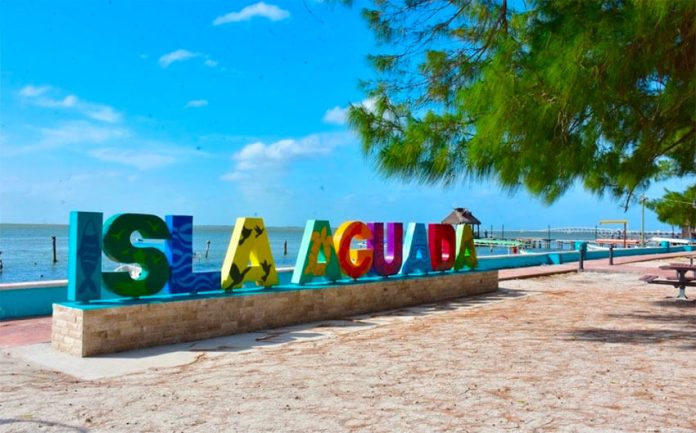
Pirates a threat to Campeche Magical Town of Isla Aguada

0
isla aguada

Modern-day pirates are threatening the lives and livelihoods of the fishermen and tourism operators of Isla Aguada, a recently-designated magical town that is part of an archipelago of islands on the Gulf of Mexico in Campeche.

Armed with weapons including guns, pirates approach fishing and tourism boats in the Gulf of Mexico and the Laguna de Términos tidal lagoon and steal their motors.

Data shows that some 500 outboard motors have been stolen in Campeche over the past eight years. The impunity rate is 100%, Milenio reported.

Joaquín Echavarría, an Isla Aguada lanchero (boatman), told the newspaper that up to five armed pirates violently attack fishing and tourism boats.

“Furthermore, they’re hooded, you don’t know who’s attacking you. … When they’ve removed your motor, they leave you adrift,” he said.

“It’s a tragedy. Do you know how much a motor is worth? A motor … costs 200,000 or 300,000 pesos [about US $10,000-$15,000],” Echavarría said, adding that people have made sacrifices to save up for motors only to have them stolen in the blink of an eye.

“[My boat] is the means of support of my family, I earn my living with it, to be able to eat,” he said.

Santiago Puch, another boat owner, told Milenio that a lanchero working for him was attacked and almost killed by criminals who posed as tourists. During the 2021 Easter holiday period, he explained, the supposed tourists paid to go on an afternoon boat tour of Laguna de Términos.

When night fell and his employee and the phony tourists hadn’t returned Puch grew worried and called the latter.

“When they answered they told me they’d just killed my lanchero, that they’d left him dead on the Cayo Arena island,” he said.

He went to search for his employee and found him unconscious, but still alive. While his lanchero survived the terrifying ordeal, Puch never recovered his boat, or its valuable motor.

He has since canceled sunrise and sunset tours of Laguna de Términos due to the risk of attacks under the cover of darkness.

Lázaro Aguilar, a fisherman turned tourism boat lanchero, said that early morning and dusk are the best times to observe birdlife on the Isla de los Pájaros (Island of the Birds) as well as marine animals such as bottlenose dolphins, but he doesn’t go out at that time due to the risk of motor theft.

“We prefer not to run the risk, … for our safety and that of the people who use our services,” he said.

Echavarría called for greater surveillance of the Gulf of Mexico and the Laguna de Términos. Only one navy boat is currently based at Isla Aguada.

“As the town has now become a Magical Town, I would ask that there be a little more security for everyone, both for the fishermen that go out on the Gulf of Mexico and the group of lancheros who work in tourism,” Echavarría said, adding that authorities need faster boats to be able to apprehend the modern-day pirates.

With reports from Milenio

Mexican actor celebrates Oscar win by the film CODA

0
Eugenio Derbez (second from left) poses with fellow CODA cast members after winning the Oscar.

A Mexican actor triumphed at Sunday night’s Academy Awards when the film CODA took best picture.

Eugenio Derbez played the character Bernardo Villalobos, a music teacher to a high school student with a talent for singing unknown to her deaf family. CODA, an abbreviation of Child of Deaf Adults, was directed and produced by Sian Heder.

Derbez explained that moments before the award was announced, he held hands with his co-stars, including deaf actors Troy Kotsur and Marlee Matlin. He said the triumph sent a positive political message.

“It’s the most emotional moment of my career … Right now there’s so much talk about inclusion and diversity. It’s the perfect film [to win right now] and I think the fact that they’ve given the award to a low-budget film without the name of a Hollywood star speaks volumes about inclusion,” he said.

CODA — Official Trailer | Apple TV
CODA is the story of a talented young singer from a deaf family.

Derbez added that he never expected CODA to take the prize.

“It was a surprise because two weeks ago we were not the favorites. The Power of the Dog was the movie that was thought most likely to win and suddenly two weeks ago our movie started to move up and we started to have a great chance. But we didn’t expect to win,” he said.

CODA triumphed over other strong contenders like Steven Spielberg’s West Side Story and Denis Villeneuve’s Dune.

However, Derbez added that he wasn’t satisfied by the award and would return to directing for a shot at future glory.

“Now I’m going for my own award … I’m looking forward to directing again … whenever I act in a film I’m left wanting to give more. I think the only way to do things exactly how I want to is to direct myself, so that’s my next step, directing here in the U.S.,” he said.

Meanwhile, Mexican director Guillermo del Toro was left empty handed after his film Nightmare Alley failed to pick up any awards, despite nominations for best picture, best cinematography, best costume design and best production design.

Del Toro’s 2006 film Pan’s Labyrinth won three Academy Awards and his 2017 work The Shape of Water won four, including best director and best picture.

With reports from El Universal and tikitakas

Mexicans returning home for Easter victims of extortion once again

0
An INM agent speaks with migrants near the Mexico-US border.

National Immigration Institute (INM) agents demanded US $400 each from 50 Mexicans who entered the country by bus from the United States last week, according to the president of a Chicago-based migrants association.

Rogelio Ávila said agents in Nuevo Laredo, Tamaulipas, extorted or attempted to extort migrants traveling to Guadalajara from Minnesota.

“The bus left Minnesota for Guadalajara with day laborers – farmworkers who were traveling legally through a Mexican program,” he said, referring to a government program that is supposed to provide protection to U.S.-based migrants returning home before holiday periods such as Christmas, or in this case Easter.

According to audio recordings Ávila shared with the newspaper Reforma, some of the migrants told the INM agents that they weren’t carrying such a large quantity of cash. They were subsequently subjected to body searches, with the immigration officials even removing the migrants’ shoes in search of greenbacks.

Ávila said the massive extortion undertaking occurred at 10:30 p.m. last Wednesday at an immigration checkpoint at kilometer 26 on the Nuevo Laredo-Monterrey highway.

Rogelio Ávila, the president of a migrants' advocacy association, said he filed a complaint through the government's Denuncia Paisano application, but the INM had no record of any formal complaint filed, they said.
Rogelio Ávila, the president of a migrants’ advocacy association, said he filed a complaint through the government’s Denuncia Paisano application, but the INM was not aware of any formal complaint, the agency said.

“We’re aware that those assholes [the INM agents] are there for money. That’s OK, but not so much,” one of the migrants told Ávila in a voice message. He said the agents concealed their identity, presumably to avoid complaints being made against them.

Extortion payments of $400 are eight times higher than the $50 bribes that INM agents and security force members more commonly ask for. Non-payment could result in being held up by authorities for hours or worse.

Ávila said he filed a complaint with the INM but it was ignored. However, the INM told Reforma that it had opened an investigation into the alleged extortion.

In a written statement, the INM told the newspaper that it wasn’t aware of any formal complaint against the agents stationed at the Nuevo Laredo-Monterrey highway checkpoint.

“However, the INM reaffirms its commitment to attend to any improper action that is reported,” the institute said.

Ávila asserted that he did file a complaint with the INM as well as the National Guard and via the Denuncia Paisano cell phone app, an initiative of the Ministry of Public Administration, the federal government’s internal corruption watchdog.

The INM called on migrants returning home for the Easter vacation period or at any other time to report any improper conduct by Mexican authorities.

There were reports that Mexicans who returned home for the 2021-22 Christmas and New Year holiday season were forced to pay bribes to customs officers, immigration agents, police, members of organized crime gangs and others.

Some Mexicans traveling home from the United States for Easter holidays via Nuevo Laredo last year were pressured to pay tips to police deployed to protect them.

More migrants are expected to enter the country via the northern border in the coming weeks in order to spend the April 10-16 Holy Week period with their Mexico-based families.

With reports from Reforma 

US trade diplomat expresses ‘serious concerns’ on Mexico energy policies

0
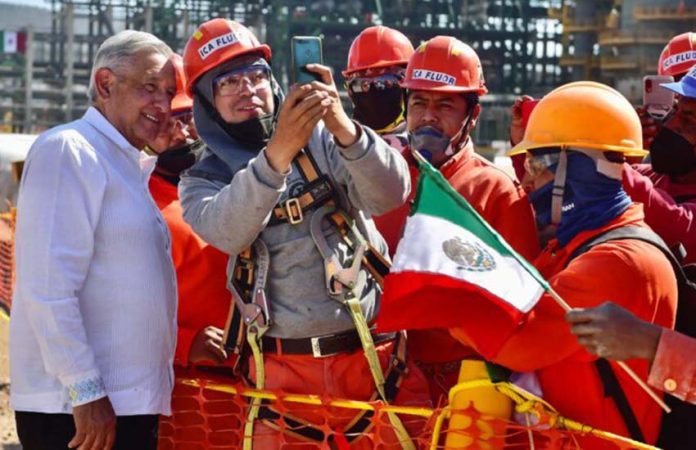
AMLO at coking plant under construction in Tula, Hidalgo
AMLO says his energy policies don't shut out private companies, but US Trade Representative Katherine Tai heard a different story at a meeting on Friday. Presidencia

United States Trade Representative Katherine Tai has joined a long list of U.S. officials who have raised concerns about Mexico’s energy policies.

Tai on Friday said that her office had “serious concerns with the deteriorating trajectory of Mexico’s energy policies,” according to a readout of a virtual roundtable discussion she convened.

Two United States lawmakers as well as representatives of environmental NGOs, business associations and U.S. companies were convened by Tai to discuss what her office called “the troubling developments” in Mexico’s energy sector and their implications for the U.S.-Mexico-Canada Agreement (USMCA).

Tai raised concerns about “a series of ongoing actions the Mexican government has taken to increase state control over, and limit competition in, the energy sector.”

She said the USTR is “actively assessing these developments,” among which are the government’s closure of privately owned fuel storage terminals and delays in issuing the energy sector permits private companies require to operate without encumbrance in Mexico.

US Trade Representative Katherine Tai
US Trade Representative Katherine Tai at an event last week in Baltimore. Katherine Tai Twitter

The government is also pursuing an electricity reform that would guarantee 54% of the market to the state-owned Federal Electricity Commission (CFE). A vote on the constitutional bill in the lower house of Congress is expected in April.

According to the USTR readout, the roundtable discussion participants told Tai that developments including “chronic” permit delays and abrupt closures of numerous fuel terminals near the U.S. border are weakening investor confidence in Mexico.

They are being made at the expense of the environment, restrict U.S. fuel exports, and damage efforts to enhance North American competitiveness.

Environmental NGOs said the Mexican government’s energy sector policies “cripple the expansion of renewable energy development in Mexico and hinder efforts to achieve environment and climate goals for communities throughout North America.”

The readout said that Tai also noted that Mexico’s energy policies damage the environment, U.S. business and investor interests in multiple sectors, and hamper joint efforts to mitigate climate change.

United States Energy Secretary Jennifer Granholm, climate envoy John Kerry, Ambassador Ken Salazar, Texas Governor Greg Abbott and lawmakers with the Democratic and Republican parties are among the other U.S. officials who have raised concerns about Mexico’s energy sector policies and plans.

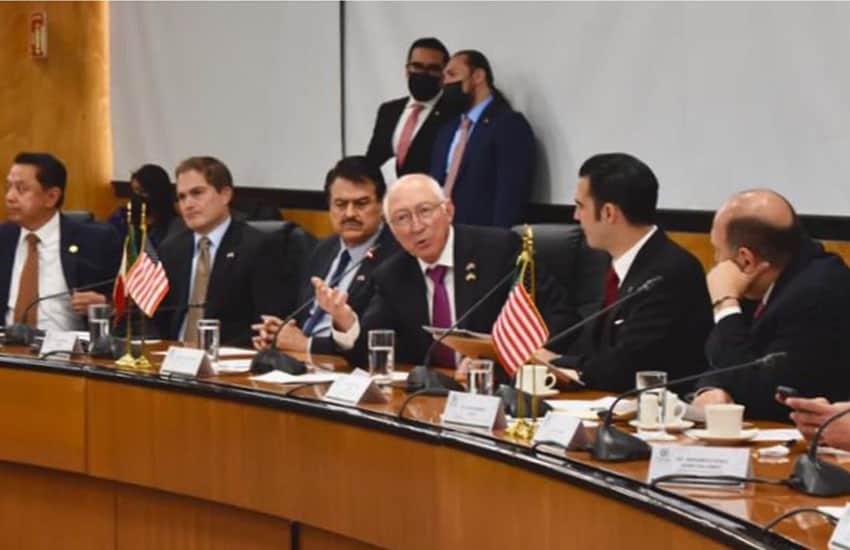
Ken Salazar in lower house of congress Mexico
“If there is no confidence, there won’t be investment,” US ambassador Ken Salazar told a Mexico-US friendship group in the lower house of Congress on Thursday. Ken Salazar twitter

Salazar said last Thursday that Mexico must respect private energy companies’ existing contracts, even if the proposed electricity reform becomes law.

“My hope is that we have a [law] that will support the economic relationship between the United States and Mexico and respect the contracts … that [were signed] under the laws that existed,” he told members of the lower house of Congress’ Mexico-United States friendship group.

“… If there is no confidence there won’t be investment,” the ambassador added.

“We need investment [in Mexico], we need investment in the southeast, we need investment in Coahuila, in the places where there is so much solar energy,” Salzazar said.

He said that energy sector investment in a state such as Oaxaca – where there are already numerous wind farms – will spur economic development and create jobs, and thus act as a deterrent to migration.

“Why do people from Oaxaca go to the United States? It’s not because they want to go, because Oaxaca is a place of the heart. Who wants to leave their country and go to another place?” Salazar asked.

Energía Eólica del Sur, Isthmus of Tehuantepec, Oaxaca
The Energía Eólica del Sur wind farm in the Isthmus of Tehuantepec, Oaxaca, is one of many foreign-owned energy facilities in Mexico.

But the ambassador’s wish for all existing energy sector contracts to be respected won’t come true if President López Obrador gets his way.

The president, who has long argued that foreign and private companies were allowed to enter Mexico’s energy sector on terms that were unfair to the state, asserted Friday that the proposed electricity reform – which requires support from two-thirds of lawmakers to become law – will be passed without modifications, and “one-sided” contracts private companies signed before he took office will be canceled.

He also said that the federal government won’t pay any compensation to companies whose contracts are revoked. However, private companies will have the opportunity to negotiate new contracts under the terms of the electricity reform, López Obrador said.

He acknowledged that two-thirds congressional support is required in order for the constitutional bill to become law, but the ruling Morena party and its allies don’t have a supermajority in either house of Congress, meaning that at least some opposition lawmakers will have to back it to ensure it’s approved.

“In these [upcoming] days we will find out if the legislators represent the people … or … companies and vested interest groups,” Lóez Obrador said. “… Hopefully they’ll think about the people, about the nation, not just in partisan interests.”

López Obrador also said that foreign and private companies shouldn’t be concerned because there will be plenty of room for them to participate in the electricity market after the proposed reform becomes law.

“The bill establishes that they are guaranteed 46% of the market and the Federal [Electricity] Commission, which is a public company, would be tasked with 54% of generation. How much is 46%? It’s all [the power] that Argentina uses. That would be allocated to the private sector, to private companies, but we need to have the majority, the … [CFE] should have more presence,” he said.

The president rejected claims that the government’s proposed reform would violate the USMCA. “None of that, we’re combatting corruption,” he said.

Under the terms of the trade pact, individual companies as well as countries could seek arbitration or take other legal action if they believe Mexico is in violation of the USMCA, which superseded NAFTA when it took effect in 2020.

With reports from Reforma 

Cost of living is No. 1 attraction for expats living in Mexico: survey

0
San Miguel de Allende, Guanajuato is one of many areas with an established expat population.
San Miguel de Allende, Guanajuato is one of many areas with an established expat population. Consejo de Turismo SMA

The low cost of living is the primary reason that expats live in Mexico and security is only a concern for a small minority, according to a survey by the online magazine Expats In Mexico.

The magazine’s Expats In Mexico 2022 Survey reveals that nearly one-quarter of respondents named the cost of living as their top motive, while only 17% said personal security is an issue for them, despite homicides exceeding 30,000 for a fourth consecutive year in 2021.

A much larger concern for those surveyed is their Spanish skills: nearly 39% said they were worried about learning and using Spanish.

Other popular motives for being based in the country were a Mexican lifestyle, chosen by 21% of respondents, and the warm climate, which was the main draw for 16% of participants.

The modest incomes of respondents may explain why cost of living was their uppermost concern. The survey shows that about 64% live on a monthly budget of 40,000 pesos (almost US $2,000) or less.

The founder of Expats In Mexico, Robert Nelson, said that nearly 80% of respondents were retirees, many of whom sold their homes before moving to Mexico.

Nelson added that high global inflation made the country an even more attractive option for expats.

“Mexico has long been known as a low-cost haven for American and Canadian retirees … It continues to rank among the least expensive countries to live. With most of the world caught in an inflationary spiral, cost of living is upper-most in the minds of many expats who live here, as well as aspiring expats from other countries who may be planning or considering a move to Mexico,” he said.

Mexico has the 16th cheapest cost of living in the world. Meanwhile, the U.S. is the 21st most expensive country and Canada is the 31st most costly nation to live in, according to the statistics site World Population Review.

The survey was completed by 364 expats living in Mexico, 77% of whom are full-time residents. Detailed survey results can be found at the Expats In Mexico website.

Mexico News Daily

20 killed in attack at Michoacán cockfight

0
Soldiers and members of the National Guard responded to the incident.

Twenty people were killed and four were injured in a massacre at a clandestine cockfight in Michoacán on Sunday night.

The bodies of 16 men and three women were found with bullet wounds in Las Tinajas, Zinapécuaro municipality, and an injured person died on the way to hospital.

Las Tinajas is 70 kilometers east of the state capital Morelia near the state border with Guanajuato.

The state Attorney General’s Office was informed of the attack at around 10:30 p.m. and personnel from the Investigation and Crime Scene Unit (USPEC) attended the scene where more than 100 bullet casings were found and 15 vehicles were seized.

Gunfire is audible on videos on social media recorded near the site of the attack.

The Michoacán Security Ministry wrote on social media to say that USPEC agents, soldiers and National Guardsmen were carrying out patrols in Zinapécuaro to search for the attackers.

It is the second large massacre in the state in a month. On February 27, 17 people were shot dead outside of a wake they were attending in the town of San José de Gracia.

The victims of that attack are presumed to be members of Cárteles Unidos, which is engaged in a turf war with the Jalisco New Generation Cartel (CJNG).

The turf war was previously concentrated in Aguililla, the birthplace of the CJNG’s leader, and neighboring municipalities until February when the army largely retook control. However, the mayor of Aguililla, Arturo Valencia Caballero, was assassinated in the town on March 10.

More than half of total homicides recorded in the first two months of the year occurred in six states, a list which included Michoacán and Guanajuato.

The government recently announced that last month was the least violent February of the past five years, with total homicides down 14% from February 2021.

With reports from Milenio, Infobae and TV Azteca

National Museum show tackles issues of indigenous creativity and identity

0
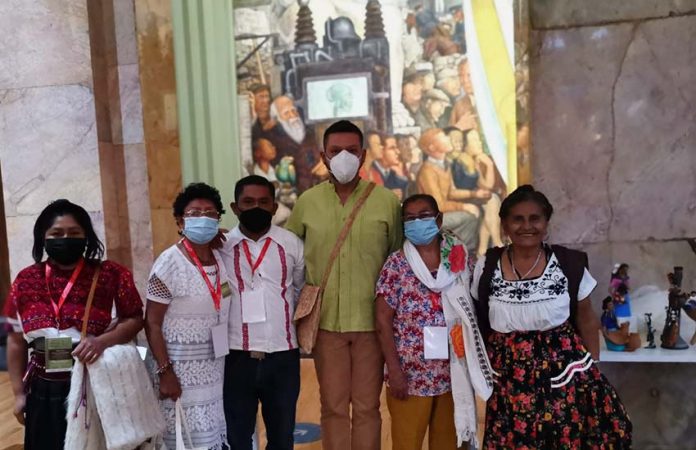
Mexico National Museum indigenous art roundtable
Co-curator Octavio Murillo, center. He's also the lead archivist at the National Institute of Indigenous Peoples. Octavio Murillo

Folk art and handcrafts, called artesanía in Mexico, are essential parts of this country’s identity. But the question of how to present them can be controversial.

First there is distinguishing them from fine art,  a problem worldwide because there is significant overlap between the two concepts, especially for decorative items that are inspired by the local culture (hence the name “folk art” for many pieces).

In Mexico, nationality and ethnicity are important factors in the authenticity of artesanía — that’s not the case for fine art. Foreign artists can and have had successful careers in Mexico, but no matter how authentically a foreigner or outsider might make a piece of artesanía, it generally won’t be accepted as “Mexican” neither by other artisans nor by collectors.

Add to this issues of identity and politics for artesanía created by any of Mexico’s 68 federally-recognized indigenous peoples.

This year, the Mexico City Palace of Fine Arts opened an exhibit on creative expression by Mexico’s indigenous communities called Arte de los pueblos de México, Disrupciones indígenas (The art of Mexico’s peoples, indigenous disruptions). The venue and timing are important.

Indigenous cross 19th century
19th-century cross showing indigenous influence in its decoration from the Museo del Pueblo de Guanajuato’s collection.

Why? To start, the building is the most prestigious art venue in Mexico. Also, the event comes 100 years after Mexican muralists such as Robert Montenegro and Dr. Atl promoted artesanía as an integral part of Mexican identity — then a radical idea.

Before then, all artesania was considered to have no cultural or economic value and to be a sign of Mexico’s backwardness.

The Arte de los pueblos exhibit traces the evolution of thought about indigenous peoples and their creative works with a timeline starting just before the Mexican Revolution, then through the promotion of Mexican identity afterward, then to indigenous movements that came later and finally to modern academic thinking about indigenous art.

With almost 500 works on loan from 59 different public and private collections, the exhibit’s selections run the gamut from tools and textiles to the “classic” expressions of the visual arts, such as painting and sculpting.

However, instead of stating that all creative works by indigenous hands are equal to that of those nonindigenous, the exhibit has as its premise that using “European” or “Western” artistic or aesthetic concepts to judge indigenous creations is, at the very least, inappropriate.

The exhibition tosses out any dividing line between “artist” and “artisan.” One reason is that there are indigenous cultures that don’t even have words for the “European” concepts of art and aesthetics, says Juan Rafael Coronel Rivera, the exhibit’s principal curator.

Tajeew by Mixe artist Octavio Aguilar
“Tajëëw” is by Mixe artist Octavio Aguilar of Oaxaca. Tajëëw was one of two Mixe twin god-brothers, the snake god.

So we should instead try to look at the pieces in this exhibit from a different perspective — one that emphasizes such works as “truly” belonging to a culture.

According to Coronel, work that fits this definition is created “inside the culture,” where the objects have cultural value to the community, not just as something to sell.  He goes on to say that “… those of mixed heritage [mestizo] do not belong to any specific culture.”

However, given all this, the exhibit’s choice of venue is curious.

Mexico City has the National Museum of Folk Cultures. There is also a prominent Museum of Folk Art only blocks away from the Fine Arts Palace.

The most obvious reason to have it at this location is that the building is quite famous and will attract more visitors. However, the choice of site does seem to reinforce the post-Revolution idea of equating folk art with “real” art to give it the respect it deserves.

Still, that is not really a bad thing. The exhibit has some fine writing at the entrance to each of the halls by Octavio Murillo of the National Institute of Indigenous Peoples that explains the academic concepts, but the notion that “indigenous folk art is art” is what gets people in the door.

I have to admit that I am not comfortable with the idea of lumping all indigenous cultures together like this. Some indigenous groups may not see “art” and “aesthetics” the way we do in the western world, but there have been indigenous cultures that definitely have had “art” in that sense. Just one look at the murals and sculptures produced by the Olmec, Mayan and Mexica attest to that.

Nahua masks and ceremonial items
Masks and other ceremonial items from various Nahua communities in central Mexico.

But I doubt that sort of thinking just disappeared in 1521.

For centuries, and right up until today, indigenous communities have often had to put their efforts into surviving, so creativity is applied to the making of practical items such as clothing and pottery. With the rise of tourism, it’s also been applied to the making of decorative items for sale. In the end, the equivalence between “fine” and “folk” art, especially in indigenous cultures, remains, but its justification has changed.

This exhibition would have us use only concepts from the indigenous cultures themselves in order to judge the works. But I see two problems with this.

First, it assumes that indigenous people are so very different from the rest of humankind, making their ideas of “art” and “aesthetics” too alien or strange for those who speak Spanish or English. That returns indigenous cultures to the “inscrutable” category, one that relegated distinct, complex cultures to little more than novelties. It also lumps too many cultures with very different languages and histories into some kind of homogenized whole.

To be fair, there are problems with any ideological basis for an exhibition that looks to promote indigenous creative expression as part of Mexico while simultaneously trying to conserve each culture’s uniqueness. There is probably no perfect way to do this.

Leigh Thelmadatter arrived in Mexico 18 years ago and fell in love with the land and the culture in particular its handcrafts and art. She is the author of Mexican Cartonería: Paper, Paste and Fiesta (Schiffer 2019). Her culture column appears regularly on Mexico News Daily.

Hold the beef!

0
Portobello burger
If we didn't say anything, could tell this fat, juicy burger has a portobello inside?

If you’ve always thought of plant-based burgers as a meat substitute, you’ll never be happy; nothing can replace a well-made beef hamburger. Instead, think of them as a dish all their own, made and eaten just because they actually taste good. And while you can buy all kinds of frozen meat-free burgers, making your own — especially using the black bean recipe below — is really the way to go.

The trickiest thing is texture: meatless burgers tend to be mushy, and even if the flavor is good, a mouth full of mush isn’t. How to get rid of excess moisture but still retain juiciness is one of our challenges. Meatless patties are made of already-cooked ingredients and starch; they don’t have the long, sticky proteins of raw meat that meld together as they cook. That’s why, for instance, black bean burgers don’t shrink when cooked and often develop a crispy outside crust while remaining mushy inside — not what we want. Eggs help a little, but it’s still not the same. Another tip for firmer texture is to add the breadcrumbs at the last minute, just before cooking — don’t let them sit in the mixture and get soggy.

The real key is to roast the drained, rinsed canned black beans in the oven, partially dehydrating them, before adding to your burger mixture. This gets rid of the mushiness and intensifies the flavor and is well worth the extra effort. Crumbled cotija or feta cheese, plus chipotles in adobo sauce, add moisture and zesty tang.

I’ve included two other recipes for meatless burgers: one a basic portobello mushroom version, the other a more complex beet and rice burger. For me, it’s the black bean burgers that’ve become part of my repertoire; I make a full batch and freeze them.

In the United States, brands like Impossible Burger and Beyond Meat make plant-based burgers that taste incredible and cook up with the texture, flavor and juiciness of real beef — almost “bleeding” when put on the grill. Burger King even introduced Impossible burgers in 2019 and now serves its own version of the vegetarian patty, named the Impossible Whopper. In Mexico, the fast-food giant began serving the plant-based “Whopper Vegetal” a year later, citing a growing demand. (Are they available in your city? Not here in Mazatlán.)

Black bean burger
This black bean burger, loaded with chipotle mayo, cotija cheese and topped with fixings is great on its own terms.

Best-Ever Black Bean Burgers

  • 2 (15-oz.) cans black beans, rinsed and drained
  • 4 Tbsp. vegetable oil, divided
  • 1 cup finely chopped onion
  • 1 cup finely chopped fresh poblano pepper
  • 3 cloves garlic, minced
  • 1 chipotle chile in adobo sauce, finely chopped, plus 1 tsp. sauce
  • ¾ cup roasted cashews
  • ½ cup finely crumbled feta or cotija cheese
  • ¾ cup panko breadcrumbs
  • 1 egg
  • 2 Tbsp. mayonnaise
  • Salt and pepper
  • Cheese, buns, condiments, toppings as desired

Spread beans in single layer on a foil-lined rimmed baking sheet. Bake in preheated 350 F (175 C) oven until beans are mostly split open and outer skins start to get crunchy, about 20 minutes. Remove from oven; cool slightly.

While beans roast, heat 2 Tbsp. oil in skillet over medium-high heat. Add onion and poblano; cook, stirring, until softened, about 5 minutes. Stir in garlic. Add chipotle chile and sauce and cook, stirring, about 30 seconds. Transfer to large bowl. Pulse cashews in food processor into pieces no larger than 1/3 inch. Add to bowl with onion mixture.

Transfer slightly cooled beans to food processor; add cheese. Pulse until beans are roughly chopped (largest pieces should be about a third of a full bean in size). Transfer to bowl with onion mixture. Add breadcrumbs, egg and mayonnaise; season with salt and pepper. Using your hands, mix gently but thoroughly.

In skillet: Form bean mixture into 6–8 patties. Heat 1 Tbsp. oil in nonstick or cast-iron skillet over medium heat until shimmering. Add patties and cook, swirling pan occasionally, until well browned and crisp on first side, about 5 minutes. Carefully flip and cook until second side is browned, about 5 minutes longer, adding cheese if desired.

Beet burger
For a color change-up, try these burgers made with beets!

On grill: Form bean mixture into patties; brush top sides with oil. On clean, oiled grilling grate, place burgers oiled side down. Cook without moving until first side is well browned, 3–5 minutes. Brush burger tops with oil; carefully flip and continue cooking until second side is browned, 3–5 minutes longer, topping with cheese if desired.

Rice, Goat Cheese & Beet Burgers

  • 2 cups cooked brown or white rice
  • 1 cup minced/grated roasted beets
  • ¼ cup chopped fresh herbs (cilantro, parsley, basil, dill)
  • 1 (15-oz.) can white beans, drained and rinsed
  • 1 Tbsp. fresh lemon juice
  • 1 egg
  • 2 oz. goat cheese, crumbled
  • Salt and pepper
  • 2 Tbsp. olive/canola oil, as needed

Combine rice, beets and herbs in large bowl. In food processor, purée beans, lemon juice and egg. Add to bowl with rice mixture; stir in goat cheese, salt and pepper. Mix well. With moist hands, form 6 patties. Working in batches, heat 1 Tbsp. oil in nonstick or cast-iron skillet; brown patties on one side for 2 minutes. Gently flip and cook other side. Serve immediately, with or without buns.

Portobello Cheeseburgers

  • 1 Tbsp. red wine vinegar
  • Salt and pepper
  • 1 clove garlic, minced
  • 3 Tbsp. olive oil
  • 4 large portobello mushrooms, stems removed
  • 6 oz. baby spinach
  • Cheddar or Gruyere cheese
  • Buns, condiments

Whisk vinegar, salt, pepper, garlic and olive oil. In a wide, shallow bowl, toss marinade with mushrooms, covering all sides. Let sit 10–15 minutes. Place mushrooms on baking sheet, rounded side up. (Don’t rinse the bowl — you’ll use the remaining marinade to dress the spinach.)

Blanch spinach 20 seconds; drain and squeeze dry. Chop coarsely; toss in bowl with marinade. Set aside.

Prepare a medium-hot grill, heat heavy skillet over medium-high heat. Season mushrooms with salt and pepper. Place on hot grill or pan, rounded side down. Cook 6–8 minutes, depending on thickness, until lightly browned and moist. Flip and cook 6 minutes more.

Flip once more to reheat top, then flip back over and place cheese on top. Continue cooking until cheese melts. To serve, place mound of spinach on bottom half of bun, then mushrooms, rounded side up, on top of spinach. Top with condiments and serve.

Janet Blaser is the author of the best-selling book, Why We Left: An Anthology of American Women Expatsfeatured on CNBC and MarketWatch. She has lived in Mexico since 2006. You can find her on Facebook.