Home Blog Page 1022

Supreme Court orders release of attorney general’s niece

0
children of Alejandra Cuevas Morán
The children of Alejandra Cuevas, whom the Supreme Court ordered released from prison on Monday.

The Supreme Court (SCJN) on Monday ordered the immediate release of the stepdaughter of the federal attorney general’s brother, who was imprisoned for over 500 days on charges of “homicide by omission” for allegedly failing to provide adequate medical care to her stepfather.

The court also dropped the case against Alejandra Cuevas’ nonagenarian mother, Laura Morán, who was also accused of contributing to the death of Federico Gertz Manero, her husband of over 50 years who died in 2015 at the age of 82.

Cuevas, who’s in her late 60s, was immediately released from the Santa Martha Acatitla women’s prison in Mexico City where she spent 528 days after being jailed in October 2020 by a Mexico City court.

The absolution of Cuevas and Morán – the latter avoided imprisonment due to her age – is a “severe blow” for Attorney General Alejandro Gertz Manero, the newspaper Reforma reported, because “for seven years, he used all the resources at his disposal to pursue them for the death of his brother.”

Telephone conversation recordings leaked earlier this month indicated that Gertz sought to interfere in the work of the SCJN to keep Cuevas in jail.
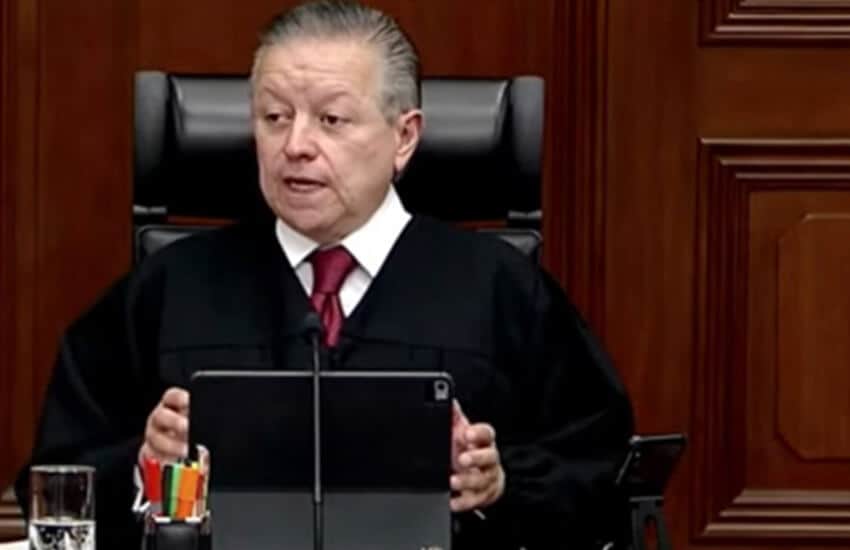
Supreme Court justice Arturo Saldivar
Supreme Court Chief Justice Arturo Zaldivar during deliberations on Monday.

She and Morán denied any wrongdoing, and their appeals eventually reached the nation’s highest court. In its ruling, the Supreme Court said the Mexico City Attorney General’s Office (FGJ) accused Cuevas of being a garante accesoria (accessory guarantor) to Federico Gertz Manero’s death — but that legal term doesn’t exist in the capital’s criminal code.

José Luis González Alcántar contended that Cuevas’ treatment by authorities was unjustified and violated her right to personal freedom. He said she would be eligible for compensation in accordance with the General Victims Law.

The FGJ said it respected the SCJN’s decision to release Cuevas and absolve Morán and asserted that it had acted autonomously in the case.

“[The FGJ] does not obey personal interests, doesn’t fabricate culprits or crimes and doesn’t create agreements on the margin of the law,” it said.

This isn’t the first time Gertz has been accused of abusing his authority. In 2021, he was criticized for using the Attorney General’s Office to attempt to arrest 31 members of the Scientific and Technological Advisory Forum (CCCyT), who were all formerly employed by the National Council of Science and Technology (Conacyt). Gertz accused the members of embezzlement of public funds, carrying out operations with resources of illicit origin, engaging in organized crime and making illicit use of their positions.

However, the FGR’s three attempts to obtain warrants for the forum members’ arrest were rejected by the courts and widely seen as without merit and part of a federal government campaign to discredit and silence academics critical of Conacyt’s management. The federal government has cut funding for science and other academic endeavors. President López Obrador has generally charged that corruption was allowed to flourish in academia during previous administrations.

Alejandra Cuevas Moran and her children
Alejandra Cuevas, right, with her children, who fought for her release. File photo

Speaking to reporters outside the Santa Martha Acatitla jail Monday, Cuevas asserted that the attorney general falsely accused her of the crime of “homicide by omission” and charged that his aim was to have her spend the rest of her life behind bars.

“I am certain that without [the media] Attorney General Alejandro Gertz Manero would have buried me in jail forever for a crime that he fabricated, causing irreparable damage to my family and to my life.”

She said her life changed 528 days ago, noting that she heard an “endless number” of cases of injustice while living with other incarcerated women.

“… Since I entered, I realized that all women are invisible. Together with you, we will achieve their freedom,” she said.

“If you allow me, I’ll get into the car because I want to hug my mother — I haven’t seen her for 528 days — and my children, to whom I pay great tribute because what they have done for me is unprecedented.”

With reports from Reforma 

AMLO renews attack on journalist with previously debunked tweet

0
The president displays a tweet
The president displays a tweet that had previously been debunked.

President López Obrador was accused of “lying again” after he presented a tweet Monday that was supposedly written by journalist Carlos Loret de Mola.

The president referred to the tweet to promote his government’s fiscal prudence, which he said was evidenced by the valuation of the peso against the U.S. dollar.

López Obrador mockingly called Loret an economist before reading a tweet he’d allegedly written in 2018, which predicted the devaluation of the peso. “Take note. Today, June 17, 2018, the dollar is at 22 pesos. In December when López Obrador enters the presidency, it will be at 25 and most likely by 2021, it will be at 35. I’m already buying my dollars,” AMLO read from a large screen.

“He didn’t buy dollars, he bought apartments,” the president added, alluding to a report by news site Contralínea which detailed the large property portfolio of Loret’s family.

The president added that due to his government’s policy the peso was “one of the most stable currencies in the world.” One dollar was worth 19.96 pesos at the time of writing.

Loret quickly called out the president, accusing him of dishonesty.

“He’s lying again. This supposed tweet of mine is false. It has been debunked a hundred times. But he cited it today in the morning news conference to slander me because he hasn’t been able to explain how his son became a millionaire,” Loret wrote.

The spat between the two intensified in January after Loret collaborated in an investigation into the president’s son, José Ramón López Beltrán, which alleged that there was an element of corruption in his U.S. property arrangements. The report was published by media company Latinus and Mexicans Against Corruption and Impunity (MCCI).

However, Loret had already pointed out that the tweet was false. “This tweet that is circulating on social media is false. Some creative person used my photo and verification to share a message that I didn’t write,” he wrote at the time.

Associated Press reported in May that it found no record of the tweet on Loret’s social media accounts, even after consulting the internet archive system WayBack Machine.

Since the report into López Beltrán’s living arrangements was published, the president has directed a barrage of criticism at Loret, including near daily demands for him reveal his wealth and salary. In February, the president exposed what he claimed to be Loret’s hefty salary.

More than 60,000 Twitter users joined a virtual protest in support of Loret earlier in February and U.S. Senator Ted Cruz accused López Obrador of intimidating Loret, which led to a statement by U.S. Secretary of State Antony Blinken calling for better protection of journalists.

With reports from El Universal

Cousteau’s Ocean Futures Society adds its voice to Maya Train alert

0
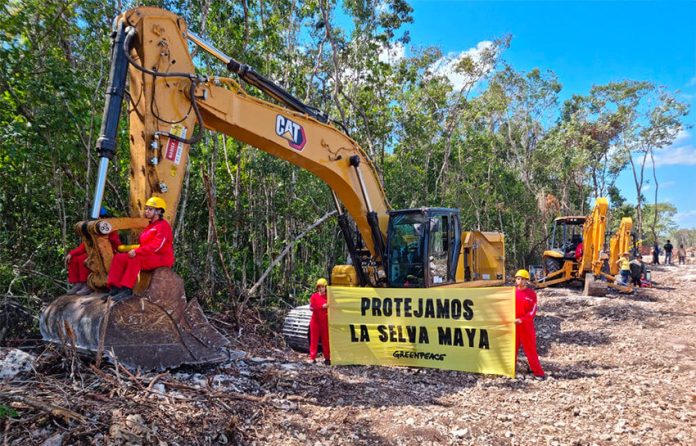
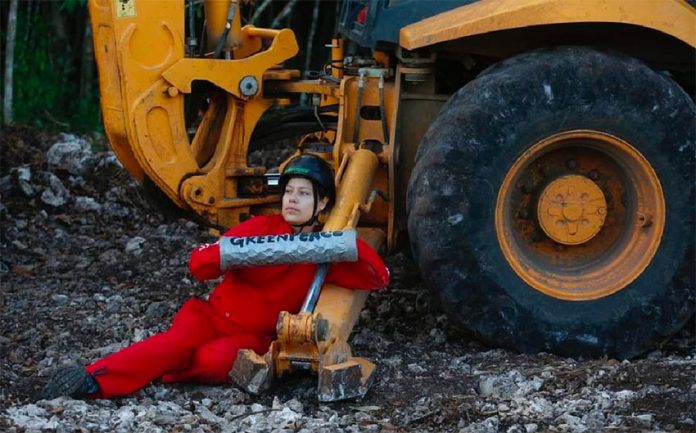
Greenpeace protesters at the train's construction site
Greenpeace protesters at the train's construction site on Monday.

An organization founded by French ocean explorer Jean-Michel Cousteau has added its voice to the condemnation of the construction of the Maya Train railroad section between Cancún and Tulum in Quintana Roo.

In an open letter, Cousteau’s Ocean Futures Society (OFS) said it fully supports the “honest petitions” made by organized groups in Mexico against section 5 of the US $8 billion rail project, whose route was recently modified by the federal government.

The letter, signed by OFS general director for Latin America Rubén D. Arvizu, noted that a group of citizens, including artists, musicians and environmental advocates, last week delivered a video message directed to President López Obrador.

“In this message they list the problems that the construction of the Mayan Train has caused and continues to cause in the Yucatán Peninsula and invite him to accompany them on a tour of Route 5, where the construction of the project is deforesting and seriously endangering the source of vital water, in a territory that lacks surface rivers,” it said.

“It is important to highlight that during the tour, the experts will provide … [the] president with the technical information that justifies the reason why the construction of the Mayan Train is not viable in the way it is being executed, due to the fact that the works have been carried out without the necessary environmental impact study.”

The OFS advised López Obrador that he can “rest assured” that its position “takes into account the conservation and integrity of the ecosystems” and asserted that “we can guarantee that we are not paid by anyone to make this public statement.”

The letter said the Cousteau group has been involved in exploration, filming and research in Mexico for more than four decades and has contributed to numerous ecological studies in the country.

“We extend a cordial greeting to all those who have raised their voices in defense of Mother Nature and we hope that harmony and reason will win this battle. We must not forget that no one owns a country and that each generation must strive to leave it in a better state than it received it,” the OFS concluded.

In addition to the #SelvameDelTren social media campaign to which the letter alluded, the decision to reroute section 5 of the railroad has triggered protests at the site of deforestation near Playa del Carmen, including one on Monday in which Greenpeace activists tied themselves to heavy machinery, and led to the creation of online petitions calling for an end to construction work that threatens the Mayan jungle and the Yucatán Peninsula’s subterranean water network.

Mexico News Daily 

6 children die in Oaxaca house fire

0
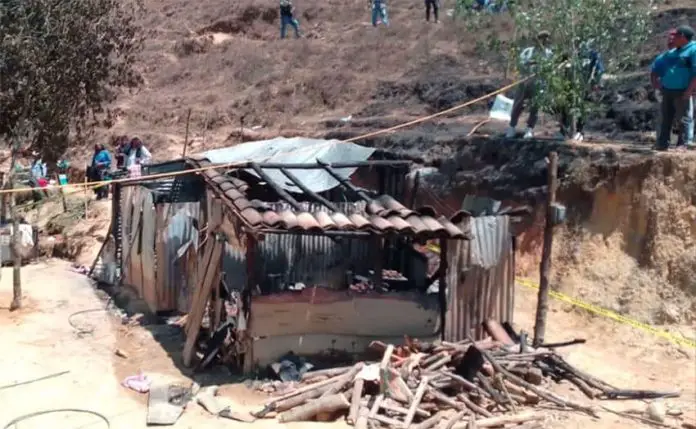
Scene of the house fire Monday in Oaxaca.

A house fire in the Mixtec region of Oaxaca killed six children including a six-month-old baby girl while they were sleeping on Monday morning and burned their house to the ground.

Made of wood, laminate and tiles, the house was located in Santiago Tilapa, a village of 828 people in Coicoyán de las Flores, one of the poorest municipalities in the country.

According to initial reports, the fire was accidental.

The children’s mother lit a fire in the kitchen at around 5 a.m., as was her morning routine, and left the house to grind corn in the communal mill while the six children were still sleeping. When she returned, the fire had consumed the entire house and reduced it to ashes.

The children were all under 12 years old.

The state Attorney General’s Office (FGEO) confirmed on Twitter that personnel from the state investigation agency were investigating.

Poverty is ubiquitous in the area: the most recent report by the National Council for the Evaluation of Social Development Policy (Coneval) from 2020 details that Coicoyán de las Flores is one of the five poorest municipalities in the country, and 99% of the municipality’s population lives in poverty.

With reports from El Universal and El País

Airplane crashes into Morelos supermarket killing 3

0
Wreckage of the plane inside a Bodega Aurrera store.

A light aircraft crashed into a supermarket in Morelos on Monday killing two men and one woman and injuring at least five more.

The twin-engine King Air aircraft demolished a wall and scattered the signage of a Bodega Aurrera store at around 1 p.m. in Temixco, on the outskirts of Cuernavaca near Cuernavaca International Airport.

The head of Civil Protection for Cuernavaca, Enrique Clement Gallardo, confirmed that the three victims had been flying in the airplane. The pilot and co-pilot were among them.

One passenger who was traveling in the plane survived and was taken to hospital. The news site MSN reported that the other four injured people were customers and workers at the supermarket.

Gallardo said the plane was embedded directly in the structure of the store.

The airplane took off from Puebla International Airport at 10 a.m. destined for Acapulco, Guerrero. It was on its way back to Puebla when the pilot requested a runway to land at the Cuernavaca airport, but crashed two kilometers from the runway, MSN reported.

A Temixco official concluded that the plane had run low on fuel. “The problem was a lack of fuel because spillage was not observed at the scene of the accident,” he said.

The plane is an air taxi operated by EagleMed, a U.S. air medical transport service.

With reports from Milenio, Reporte Indigo and MSN

Navy marines created Ayotzinapa crime scene according to drone video

0
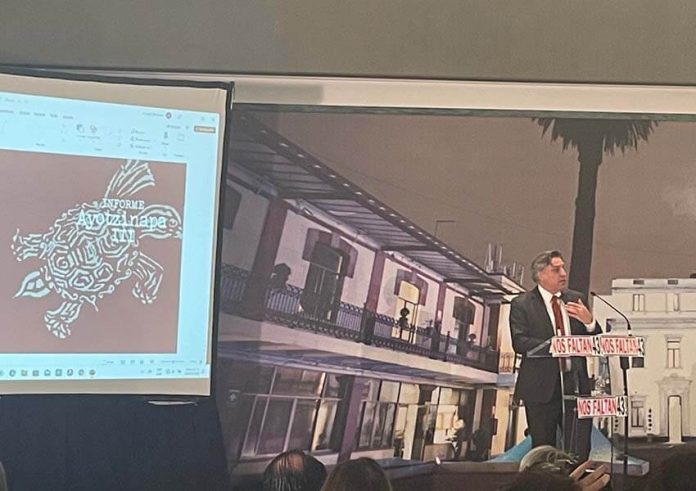
GIEI member Francisco Cox
GIEI member Francisco Cox speaks at the independent commission's third report on the Ayotzinapa case on Monday. Photos from GIEI Twitter

Startling video footage indicates that the armed forces may have planted evidence to show that the bodies of 43 students who disappeared in Guerrero in 2014 were burned in a garbage dump.

Independent experts tasked with investigating the disappearance of students from the Ayotzinapa teachers’ college have concluded that navy personnel transported packages possibly containing human remains to the dump in Cocula — about 20 kilometers from where the students were kidnapped in Iguala — and lit a fire there a month after the students’ abduction and presumed murder.

The previous federal government alleged that the students’ bodies were incinerated by a criminal group at the Cocula dump on the night of September 26, 2014.

In a report released Monday, the Interdisciplinary Group of Independent Experts (GIEI) also revealed that the army and navy were tracking the students in the lead-up to and during their abduction in Iguala. It said that there are 50 unpublished videos that are relevant to the Ayotzinapa case.

In one video filmed by a navy drone on October 27, 2014, a group of 12 people that the GIEI believes are navy marines are seen at the Cocula dump.

According to the GIEI, the marines removed packages from two navy vehicles, and three of those packages were deposited at the top of the dump. Marines then descended to the bottom and lit a bonfire.

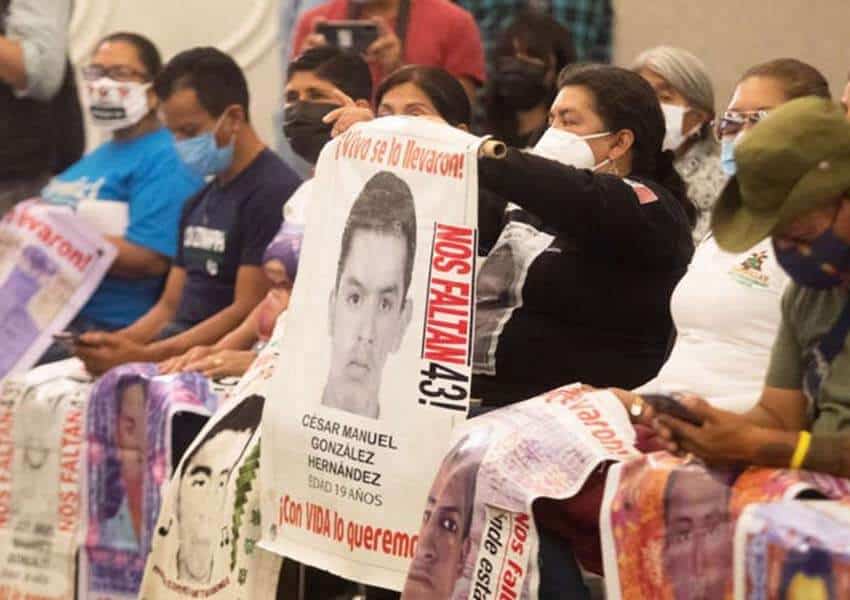
Families of the 43 missing students at GIEI's report.
Families of the 43 missing students attended the GIEI’s report of its findings.

Subsequent drone footage shows that the packages removed from the vehicles and seen at the top of the dump are no longer there.

At a press conference on Monday, GIEI members said that the contents of the packages are unknown and advised against speculation. The navy handed the video over to the GIEI on the orders of President López Obrador, El Universal reported. The navy didn’t respond to the newspaper’s request for comment.

The independent experts also said that former attorney general Jesús Murillo Karam — a key architect of the previous government’s “historical truth” vis-à-vis the Ayotzinapa case — and other officials were at the Cocula dump on October 27, 2014.

According to the official, supposedly unimpeachable, “historical truth,” the students, traveling on a bus they had commandeered to go to a protest in Mexico City, were intercepted by corrupt municipal police who handed them over to members of the Guerreros Unidos crime gang, who subsequently killed them, burned their bodies in the Cocula dump and disposed of their remains in a nearby river.

The GIEI members noted that Murillo and Tomás Zerón, former head of the now-defunct Criminal Investigation Agency, announced on October 27, 2014, that four members of the Guerreros Unidos who were allegedly involved in the disappearance of the students had been arrested.

Citing information from an official file on the case, the experts said the detainees hadn’t been turned over to the federal Attorney General’s Office (then known as the PGR) or made formal statements when Murillo and Zerón announced their arrest.

“Therefore, they were reporting on events that hadn’t yet occurred, at least [according to] the file,” the GIEI said.

Ángela Buitrago, a GIEI member, asserted that the PGR’s investigation was a complete simulation designed to hide what really happened. Its version of events — that the students were promptly killed and incinerated after their abduction — stopped a genuine search from going ahead and thus hindered the possibility of them being found, she said.

Buitrago also denounced a range of irregularities in the investigation that resulted in the creation of the “historical truth,” including arbitrary arrests, manipulation of evidence and crime scenes, alteration of official records and confessions obtained via torture.

The GIEI acknowledged that President López Obrador and Deputy Interior Minister Alejandro Encinas support a thorough investigation into what happened to the students – of whom the remains of just three have been found and formally identified –  but denounced an ongoing resistance to cooperation from officials with the Ministry of National Defense (Sedena) and the Attorney General’s Office, now known as the FGR.

A document released in late 2021 by the FGR containing testimony from soldiers – who have long been suspected of involvement in the case – was so heavily redacted that it was illegible.

“There is information that has been hidden from us as experts,” said GIEI member Claudia Paz. “… It prevents the full clarification of the events,” she said.

Tercer Informe del Grupo Interdisciplinario de Expertas y Expertos Independientes (GIEI)
The GIEI presented their findings on Monday.


The GIEI also reported that the Ayotzinapa students were under real-time surveillance by the army and navy in the time leading up to and during their abduction. Via the surveillance, the military presumably obtained information that could have been used to locate and rescue the students after they were kidnapped.

“Security authorities had two intelligence processes underway, one to follow the actions of organized crime in the area and the other to track the students,” the GIEI said in its report, which was based on official, declassified documents.

The students were tracked because the Ayotzinapa teachers college has links to left-wing social movements and is considered a breeding ground for subversion, the group said.

The revelation that the military was surveilling the students contradicts the military’s claims that it had no information about what happened to them. Military officials kept it secret that the students were being watched, the GIEI said.

Neither the army nor the navy responded to Reuters’ request for comment about their apparent surveillance.

Addressing the claim that marines manipulated evidence, López Obrador said Tuesday that he had ordered an investigation.

“About that video, … it was shown to me and the instruction was given for the navy chiefs that participated in that operation be investigated,” he told reporters at his regular news conference, noting that navy officials have already provided statements on the Ayotzinapa case to the FGR.

The president reaffirmed the commitment his government made to the parents of the students to conduct a thorough investigation into the case. López Obrador asserted that his administration is fulfilling that commitment, even though mystery still surrounds the case 7 1/2 years after the students’ disappearance and almost 3 1/2 years after he took office and created a super commission to conduct a new investigation.

“The investigation is open; making known what happened to the young men is a commitment we have. This commission of experts, [the GIEI], … showed me the information they had … and it will continue with the investigation – they will continue collaborating for another year,” he said, apparently indicating that the government won’t announce its definitive version of events any time soon.

With reports from El Universal, Reuters and Milenio

Indigenous artisan Juana Gómez’s mission: preserving her people’s history

0
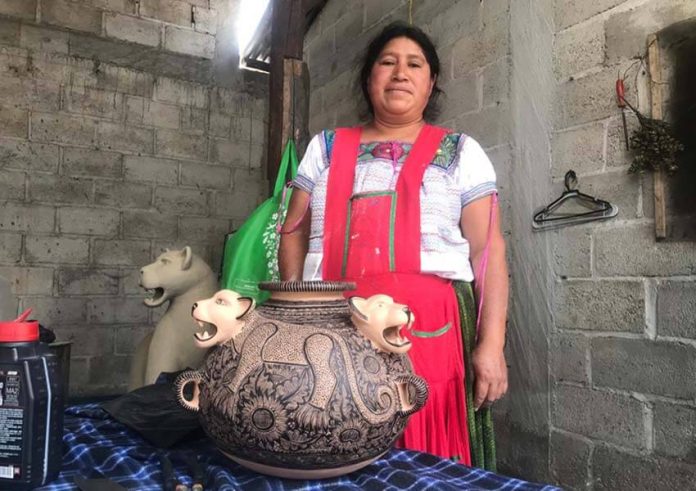
artisan Juana Gomez Ramirez
Juana Gómez learned her craft from her mother and grandmother, who used to sell their creations on the side of the road in Chiapas. Photos by Underhemp Balloo

In the Tzeltal indigenous community of Amatenango del Valle, half an hour outside of San Cristobal de las Casas, Chiapas, colorful splashes of traditional pottery mark the town out as unique and cement its position as a Pueblo Magico.

In a town renowned for the quality of its craftsmanship, one of its most notable artisans is 40-year-old Juana Gómez Ramírez, a celebrated maker of ceramic jaguars.

The jaguar, a sacred animal for the Tzeltal and other ancient indigenous cultures, has been an object of worship among Mayan peoples for millennia. It symbolizes the power and ferocity of the deities. Gómez fixes this essence of the jaguar in clay, honing her community’s unwritten history into tangible form.

Her story begins with her mother, Feliciana Ramírez, and her mother before her, who both sold their wares on the side of the road in the same pueblo in which Juana and her family still reside. Now Gómez, alongside a loose cooperative of artisans and family, makes life-sized jaguars that are painstakingly crafted over the course of weeks — sometimes even months — and then hand painted in minute detail.

“I have never actually seen a jaguar, but I am a dreamer,” she said, standing next to one of the creations in her workshop. “I was inspired by the pictures in the textbooks we used as children in school, and I made my first statue at the age of 12.”

by artisan Juana Gomez Ramirez
One of Goméz’s jaguars in progress.

Since then, Gómez and her family, to whom she has handed her knowledge of the craft, have existed at the spaces between international fame and the relative isolation of an unknown Chiapas indigenous community. On the one hand, her jaguars have made their way to exhibitions and auctions in the United States, Belgium, England, Spain and Australia. In 2013, she was recognized as a Grand Master of Popular Art. Often, there is a two-year waiting list for her commissioned works due to the time it takes to create the jaguars and the sheer number of people seeking her artwork.

But on the other hand, despite her international reach, her jaguars are fundamentally Tzeltal: they are made of the community, by the community. The statues are all unique and are often transposed from the mental images of her team of nearly 30 equally idiosyncratic people.

They dig their clay from the earth around the pueblo, part of a long tradition of searching out raw material locally to be used for sculpting practical items. The clay is dried and stored at the family home, and the dyes used for painting the jaguars are all derived from plants found in the area.

Gómez elects not to use intermediaries to sell her works, and barring the exceptions mentioned above, she chooses not to exhibit her works in galleries.

“It is much easier to keep the soul of the work this way,” she said. “The craftspeople are not paid a fair price for the pieces when they are sold through other parties, and economic success through external means often leads to a loss of sociocultural memory. So external input makes it very easy for the artist to lose their sense of their heritage — as well as the importance of the history of the community — without even really realizing.”

So, instead, Gómez invites the public to her workshop, where they learn about her work and bask in the warm demeanor and hospitality of one of Mexico’s most renowned artisans. Perhaps, if a visitor is lucky, they will be invited to partake of a cup of the ceremonial fermented corn drink, pox (pronounced “posh”).

Pot by artisan Juana Gomez Ramirez
A completed piece.

Pox is used as a welcoming beverage across much of Chiapas, a state otherwise known for frequent roadblocks and a tendency towards militant isolation. Chiapas is Mexico’s southernmost state and exists in a state of seclusion, partially because of its topography and geographical location — characterized by steep mountains and cavernous valleys.

Whereas in Yucatán and Oaxaca you may find broad swathes of land that belong to relatively unilinear groups of indigenous people, in Chiapas there are a number of disparate communities that are idiosyncratic in their appearances, beliefs and languages.

Historically, their massive disenfranchisement by the Mexican government, as well as their fractured nature, has meant that the indigenous peoples of Chiapas have also not always had the wherewithal to stand up for themselves. They have often found themselves at the mercy of foreign land grabbing and the encroachment of modern customs, customs threaten to wipe out their ancient historical traditions.

The most resilient of these communities, and individuals such as Gómez, have had to find other means of keeping the wolves at the door, often representing themselves through art that’s disseminated nationally and internationally, as a way of recognizing the innate talent and cultural tradition of a place. By sharing her story and the story of the women who came before her, Gómez amplifies the history of her people.

Her jaguars are not activism per se; the international popularity of her creations, and the ensuing opportunity for showcasing the artisans of Amatenango del Valle, allows Gómez and her family to support a paradigm shift that decenters the colonizing voice that’s threatened their people’s independence for centuries.

Shannon Collins is an environment correspondent at Ninth Wave Global, an environmental organization and think tank. She writes from Campeche.

President’s Boeing Dreamliner will be offered for wedding, 15th-birthday charters

0
The presidential plane, a Boeing Dreamliner, is still up for sale.

The presidential airplane, on sale for more than three years, will be offered for weddings and 15th-birthday party charters after the government failed to find a buyer, President López Obrador announced on Monday.

The Boeing 787 Dreamliner will be managed by the Defense Ministry’s company, Olmeca-Maya-Mexica, which operates Felipe Ángeles International Airport (AIFA). The airplane will also be exhibited at the AIFA for public viewing.

“The plane is going to be handed over to the Olmeca-Maya-Mexica company … so they can rent it and prevent it from remaining grounded. The rentals can generate some income to pay for the plane’s expenses and maintenance,” the president said at his regular morning press conference.

Comparable charter aircraft are available for US $30,950 per hour, according to airplane rental site Paramount Business Jets.

The president specified that the airplane would be available for charter “if anyone wants it. If they’re going to get married and … want to take their family and friends,” before adding 15th-birthday parties and work events to the list of worthy celebrations.

However, López Obrador said that the jet shouldn’t be used for long distance flights, suggesting Cancún, Quintana Roo, to Los Cabos, Baja California Sur, as one possible route and confirmed the airplane was still available for a buyer who meets the valuation.

As has become customary in discussion of the presidential jet, the president advertised its luxurious features and lamented the wastefulness of his predecessors. The plane was bought by former president Felipe Calderón for US $218 million and used by his successor, and has been on the market for three years.

But in order to make the charter offer sound more appealing, the president compared it to space travel. “It’s an experience. There are people paying to go to space and they pay a lot, so they are going to have the plane available too,” he added.

The Boeing Dreamliner has experienced something of an identity crisis since the administration began in 2018. It was set to be the prize in a raffle before the government realized it wouldn’t be an entirely practical prize for most Mexicans and was later offered to the Mexican Olympic Committee (COM) to transport athletes for the Tokyo Olympics in July, only to be turned down by the head of COM as it was ill-suited to the task.

With reports from Milenio

Maya Train protesters tie themselves to machinery to stop work

0
A train protester is tethered to a backhoe Monday in Quintana Roo.

Activists from Greenpeace tied themselves to heavy machinery on Monday to impede work on a Quintana Roo section of the Maya Train railroad.

Eight protesters from the environmental organization began their protest in the municipality of Solidaridad at 7:00 a.m. and intended to remain tethered to the machinery all day, the newspaper Milenio reported.

The federal government recently modified the route for section 5 of the railroad, moving the Cancún-Tulum stretch inland after the business community in Playa del Carmen complained about its construction through the center of the coastal resort city.

Jungle has already been cleared for the construction of tracks along the modified route, triggering protests both at the site of the deforestation and online.

The Greenpeace protesters said that section 5 was rerouted to run through jungle before environmental studies were completed.

They also said that the damage to flora, fauna and subterranean rivers in Quintana Roo will be irreversible, and urged people to sign a Greenpeace petition against the “devastation of the Mayan jungle.”

Aleira Lara, campaigns director for Greenpeace México, called on President López Obrador to immediately suspend construction of section 5 of his US $8 billion signature infrastructure project, which is slated for completion in 2023 and will run through Tabasco, Campeche, Yucatán, Quintana Roo and Chiapas.

“As it is planned, this route will fragment, deforest, strip of animals [and] contaminate … the jungle, the rivers and the communities,” she said.

The likelihood of López Obrador agreeing to suspend section 5 of the railroad is extremely low. He has rejected claims that the Maya Train project will cause extensive environmental damage and described its opponents as “pseudo-environmentalists.”

“In 1,500 kilometers of the train, only 100 hectares [of vegetation] will be affected, mainly weeds. However, at the same time 200,000 hectares are being reforested; three large natural parks (18,000 hectares) will be created and on the edge of the tracks, rows of flowering trees will be planted,” López Obrador wrote in a Facebook post earlier this month.

On Monday, he celebrated that the ambitious rail project no longer faces any legal impediment after a Mérida-based federal court last week lifted a suspension of environmental permits for sections 1,2 and 3 that was first issued in March 2021.

The court ruled in favor of maintaining the suspension of the permits in February, but acknowledged that doing so was a mistake because it previously revoked the same suspension in December.

López Obrador told reporters at his regular news conference that there is now “no legal problem” for sections 1, 2 and 3, which will connect Palenque, Chiapas, to Izamal, Yucatán, or any other sections. “There was an injunction but it has already been ruled against,” he said.

AMLO reaffirmed that construction of section 5 won’t cause major environmental damage.

“A new route was chosen, … the entire right-of-way is already in place. Reaching Tulum there are cenotes [natural sinkholes] but the project has taken into account viaducts to go through there. They won’t be touched, the subterranean rivers and cenotes won’t be affected at all,” he said.

López Obrador said that most of the land along which the modified route will run is owned by hotels and has already been altered. “It’s not jungle, it’s grasslands,” he said.

With reports from Milenio and Reforma 

Help sought to remedy pollution in Hidalgo’s Tecocomulco lake

0
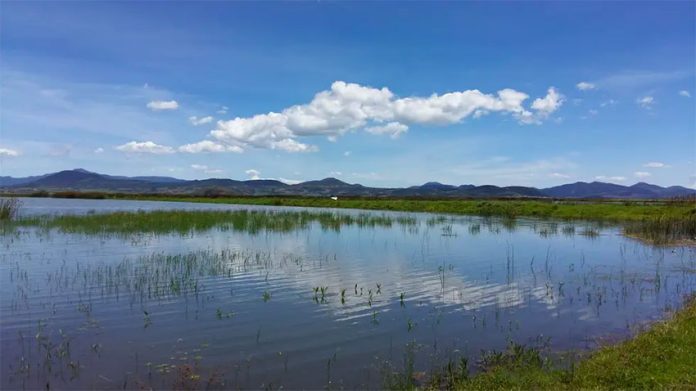
Tecocomulco lake
Residents say they've removed tonnes of lilies from the lake but their efforts have not been enough.

Communities living by a polluted lake in Hidalgo that sustains hundreds of families are calling for the government to take action to rescue it.

Tecocomulco lake is under threat due to the accumulation of mud, water lilies and another reed known as tule.

The lake sits in a 56,000 hectare basin between the communities of Tecocomulco and Tepeapulco, about 65 kilometers southeast of Pachuca. It is a large aquatic ecosystem with a variety of animal and plant species. It is also where migratory birds from the northern Mexico, the United States and Canada make their nests, along with two species of amphibians in danger of extinction.

A local fisherman, Juan López, said the problem emerged from a smaller lake some 15 kilometers away. “The problem we have at the moment is the lilies … It’s a reed that was carried here, it is not native to the lake. It was in the dam of the Puerco lake which burst and that brought it here,” he said in an interview with the newspaper Milenio.

Juan López added that families were depending on authorities to act. “We have not been able to control it. We are asking the authorities to support us because we have already taken out many tonnes of lilies and it reproduces a lot … If this problem continues, it will end [the lake] and we have many families around it that depend on it … We also have two or three fishermen’s cooperatives. Their families and our families would lack the sustenance to survive” if the lake were not rescued, he said.

A community spokesman from San Miguel Allende, José Trinidad, reiterated the necessity for government assistance. “”We are requesting the support of the authorities, because we have been waiting here for some time with promises that have been made to us yet nothing has been done for this lake. It really is a very important lake as for its surroundings and for its most distant municipalities,” he said.

Another local person, José Antonio Vargas, said he felt cheated by the authorities. “They promise and promise. They have been promising us for many years and when they come to ask for our votes we give them [our votes], and they never come back,” he said.

With reports from Milenio