The event is ready to go if the mayor gives the word.
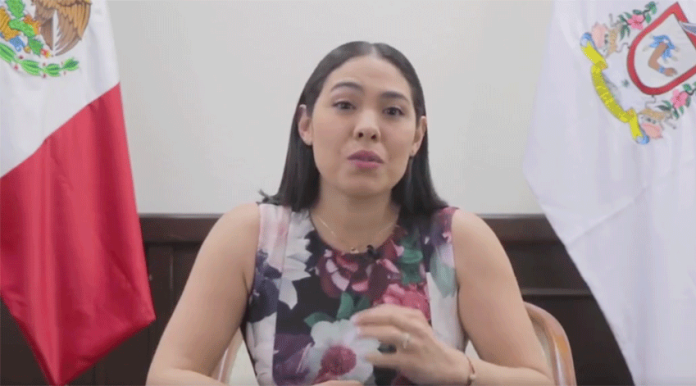
Mazatlán’s annual carnival is likely to go ahead even if Sinaloa remains yellow on the coronavirus stoplight map, the mayor said this week.
Luis Guillermo Benítez Torres said that if the stoplight remains yellow, the final decision will be in his hands. “We are going to wait for the result of the stoplight because remember that being in yellow, it is no longer the power of any committee, it is the [power of the] municipal council,” he said.
However, Benítez insisted that he would follow the guidance of the governor: “I will respect what Governor Rubén Rocha Moya thinks. If in a given case he thinks it prudent, we will stop it.”
The news site Debate reported that Rocha supported the event going ahead if the stoplight remained yellow, but that Health Minister Héctor Melesio Cuén was against it.
Benítez said the stoplight color would be confirmed on Friday and that the signs were positive, given that the pandemic was declining. “I am sure that things will be on the right track … the pandemic is continuing to decline. While it’s true that there was a small fluctuation, it continues to fall,” he said.
The economic hit of canceling the event would be severe, Benítez added. “It would be quite bad for Mazatlán … for the local businesses. Imagine the hotel owners, who already received their deposits, giving back money in these times we are living in … [if it’s] yellow it’s very probable that it will go ahead.”
The planning of the event is already 90% complete and more than 70% of hotel rooms are taken, according to the news site.
Carnival is the biggest event of the year in Mazatlán and is reported to be the third largest in the world after Rio de Janeiro and New Orleans. It was first held in 1898 and is set to run from February 24-March 1.
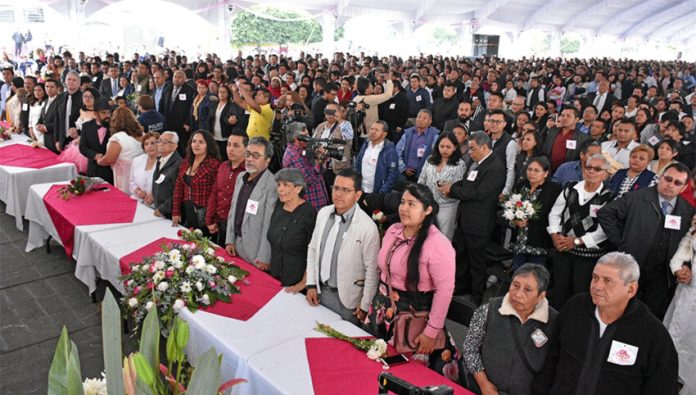
A previous edition of a collective wedding in Nezahualcóyotl.
Six hundred and sixty-one couples married en masse at a Valentine’s Day ceremony in México state on Monday.
The service in Nezahualcóyotl, 20 kilometers east of the center of Mexico City, revived an annual tradition made redundant by the COVID-19 pandemic. However, among the wedding dresses, rings and flowers, the newlyweds-in-waiting still had to wear face masks and use antibacterial gel.
The event was still relatively small: the maximum number of couples in other years was 1,200, while in 2021 a virtual service was held online.
The couples were married at no charge and professional makeup was provided by local beauty schools. The municipal government also raffled gifts and trips among the newlyweds.
Jonhatan García finally tied the knot with his partner of 10 years, with whom he has a child. He said the timing was right: “We would have liked to get married before, but it [the pandemic] was worse then,” he said.
José Luis Ibarra married María Edith Peña after the couple met in a shopping mall two years ago. “Really happy. Really proud to have a partner like her and hopefully it will be for life,” he said.
“We already treated each other like a couple. There was always good chemistry, good communication and above all, a lot of love,” Edith said.
Meanwhile, Dolores Bojórquez married a professional wrestler called Flama Roja (Red Flame), the newspaper Infobae reported. She said the public service had enabled them to say their vows. “We wouldn’t have been able to marry due to the economy … we took advantage of these weddings,” she said.
Bojórquez added she was grateful to have the opportunity to marry, despite the pandemic. “We wouldn’t have ever expected to marry in face masks but we have to be thankful that we are here and that we could marry,” she said.
However, the mood in Mexico was less festive than normal. Only 17% of people planned to celebrate Valentine’s Day and 57.5% were set on staying home, according to a survey by the insurance website HelloSafe México. The survey of 985 Mexicans was compiled from January 21-February 1.
Governor Vizcaíno announced new security measures on Sunday.
Many Colima city residents are staying home after dark due to a surge in violence last week as two criminal groups face off in the capital and nearby areas of the small Pacific coast state.
The Jalisco New Generation Cartel (CJNG) and the the Independent Cartel of Colima are fighting each other after the latter organization, also known as Los Mezcales, switched its allegiance to the Sinaloa Cartel.
At least 22 people have been murdered since the start of last week, according to a report published Tuesday by El Universal.
The newspaper reported that an unofficial, self-imposed curfew is in place in Colima city, home to approximately 150,000 people.
Most businesses are closing early and/or allowing employees to go home before their usual knocking-off time, while few bars and restaurants remain open after 9:00 p.m.
A waiter at a restaurant in the center of Colima told El Universal on Saturday that the greatest risk was the possibility of getting caught in the crossfire of a gunfight between the feuding criminal groups.
“But nothing has happened here yet,” he said before noting that violent incidents had occurred “four or five blocks away.”
The waiter said that the restaurant’s receipts decreased significantly between Monday and Friday. “Today has been a little bit better but normally at this time [3:00 p.m.] half the tables are taken,” he said.
However, the restaurant was only about one-quarter full, El Universal reported, noting that other establishments located around Jardín Libertad, a pretty square in the city’s downtown, were similarly empty.
A battle-scarred state police officer who spoke with the newspaper said that the current wave of violence wasn’t comparable to what he has seen in Mexico’s north, where he used to work, but warned that the situation could deteriorate.
Last week’s spate of armed attacks “is not even a quarter of what I saw in the north, but this is how it starts,” he said.
Hoping to stop a repeat of last week’s violence, or any deterioration of the security situation, are Colima and federal authorities, who are collaborating on a special operation.
Governor Indira Vizcaíno, who has been the subject of threats by both the CJNG and Los Mezcales, announced Tuesday that more than 600 additional soldiers, marines and National Guard troops were deployed to Colima over the weekend, increasing the total number of federal security elements in the state to over 3,600.
“… The central objective is to protect the safety of all working families in Colima,” she wrote in a Twitter post featuring a slickly-produced video about the joint state and federal security operation.
She said shortly after she was sworn in that the state became the country’s homicide capital during her predecessor’s term, but noted that murders were down in 2021 compared to the previous year.
Indeed, Colima was Mexico’s most violent state on a per capita basis for five consecutive years between 2016 and 2020, before losing that unenviable title to Zacatecas last year.
The state ranked as the third most violent in 2021 with 65.8 homicides per 100,000 people, according to data compiled by the crime monitoring website elcri.men. For total homicides it ranked 20th out of the 32 states with 518, according to federal data presented last month.
Ternium is one of the foreign companies that has announced increased investment in Mexico this year. (Ternium)
Latin American’s leading steelmaker is set to make a billion-dollar investment to enlarge its plant in Nuevo León, President López Obrador announced at his morning news conference on Tuesday.
Ternium will expand its factory in the Ternium Industrial Center in Pesquería, 50 kilometers east of Monterrey.
“Yesterday Paolo Rocca was here, an investor who works in steel, his company is called … Ternium. They came to tell me that they’re going to expand their plant in Nuevo León and that they’re going to invest a billion dollars … they manufacture pipe and work in the automotive industry …” the president said.
He added that the investment plan was evidence of Mexico’s bright economic future. “In their research and market analysis … they saw a promising economic and commercial future for Mexico, they came to inform me of that … this means jobs, it means well-being.”
The president also said signs were good for the Mexican economy, despite a technical recession and high inflation. “We are also verifying the data on foreign investment which will soon be released … in January there was record job creation, and see how we are doing in February … the economy is growing,” he said.
In 2017, Ternium invested around 1.1 billion pesos (US $58.2 million in 2017) to install a hot rolling plant at its site in Pesquería.
The almost one kilometer hot roller produced its first million tonnes of laminated steel in January. It can produce 4.4 tonnes of laminated steel per year, the newspaper El Financiero reported.
In 2019, the electroplating and painting lines at the Ternium Industrial Center went into production. The company had already invested US $2.52 billion prior to the president’s announcement.
Ternium has plants in Mexico, Brazil, Argentina, Colombia, the United States and Central America. It belongs to the Argentinian conglomerate Techint.
Governor Carlos Joaquín said that representatives of U.S. and Canadian security agencies would exchange intelligence and discuss strategies with Mexico.
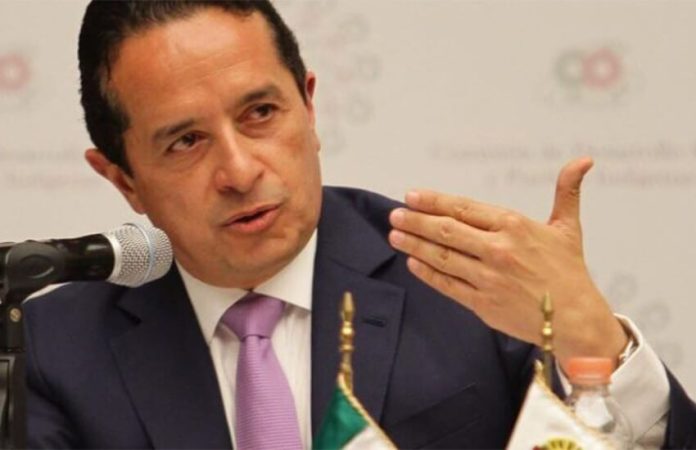
Mexican, United States and Canadian officials will attend a security summit in Quintana Roo this Friday, Governor Carlos Joaquín announced.
Joaquín said in late January that personnel from the Federal Bureau of Investigation, the Drug Enforcement Administration and the Royal Canadian Mounted Police would travel to the Caribbean coast state this month to meet with local authorities.
Asked about the meeting on Monday, the governor confirmed it would take place in Cancún this Friday. Federal and Quintana Roo security officials will meet with representatives of the U.S. and Canadian security agencies to exchange intelligence, review international crime trends and discuss anti-crime strategies.
A similar meeting attended by military personnel from Mexico, France, Canada and Belize took place in Chetumal in early February.
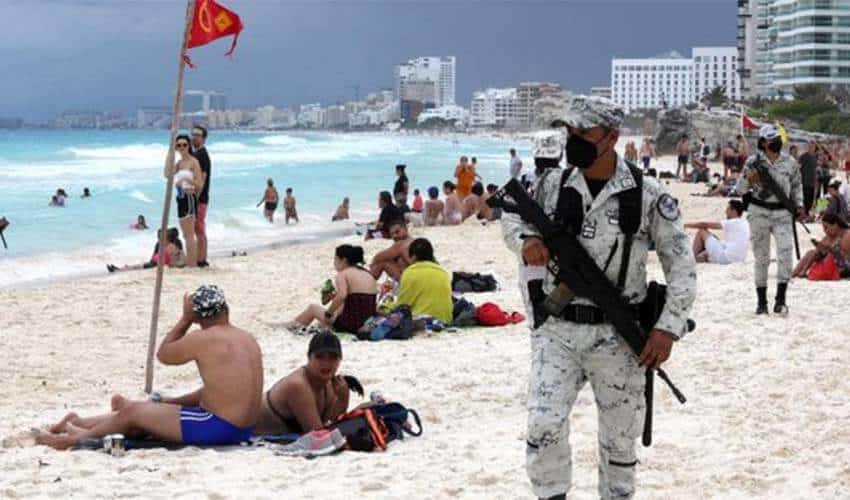
Mexico’s most powerful cartels, including the Jalisco New Generation Cartel, the Sinaloa Cartel and the Gulf Cartel, as well as smaller local gangs, operate in the state, which for decades has been used as an intermediate destination for cocaine headed to the United States from South America.
Criminal groups from at least eight foreign countries, including China, Russia and Colombia, also operate in Quintana Roo, according to a recent report by the newspaper Milenio. The state – a major tourism destination for domestic and foreign tourists – recorded just over 650 homicides last year, making it the country’s 18th most violent federal entity.
“In light of recent security incidents and criminal activity in popular tourist destinations, including Cancún, Playa del Carmen, and Tulum, U.S. citizens are reminded to exercise increased caution when traveling to the state of Quintana Roo. Criminal activity and violence may occur throughout the state, including areas frequented by U.S. citizen visitors,” the alert issued by the U.S. Consulate General in Mérida, Yucatán, read.
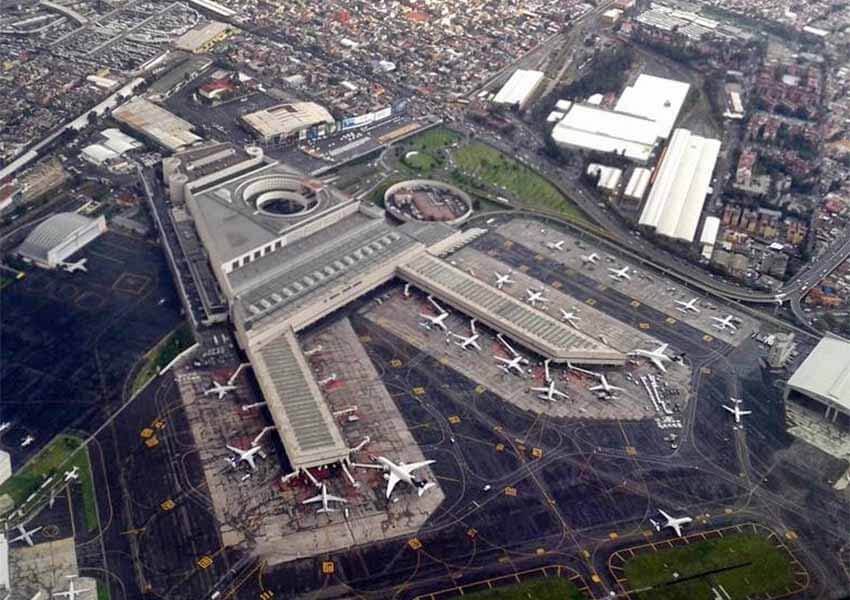
In the first 31 days of the year, 3.25 million people flew through Mexico City's airport, up from just over 2 million in January 2021. AICM
Passenger numbers were up 56% at Mexico City International Airport (AICM) in January in annual terms.
Just over 2 million people traveled through the airport in the first 31 days of 2021, compared to the 3.25 million that flew over the same period this year.
The spike is partly due to an increase in international travelers: last month, almost half were from outside Mexico, whereas fewer than a third were in January 2021. The overall low passenger numbers at the beginning of 2021 trended upward throughout the year, peaking at 4.1 million in December.
However, the number of January 2022 flyers was still relatively few compared to the same month in 2020, before any COVID-19 restrictions on travel were introduced.
The spike in passenger numbers still didn’t beat January 2020’s pre-pandemic figure of 4.2 million. Edgor TovarVmzp85/Creative Commons
That month saw 4.2 million passengers pass through Mexico City’s airport, 29.6% more than in January 2022.
By April 2020, passenger numbers had plummeted as restrictions were introduced: only 295,654 people traveled from AICM that month.
The air hub may see another hit to its traffic soon: the Felipe Ángeles International Airport (AIFA), located about 50 kilometers north of downtown Mexico City in México state, is slated to open in late March.
Tourism largely recovered in Mexico in 2021. Quintana Roo, home to Cancún, Playa del Carmen and Tulum, played host to 84% of the tourists it had welcomed in 2019.
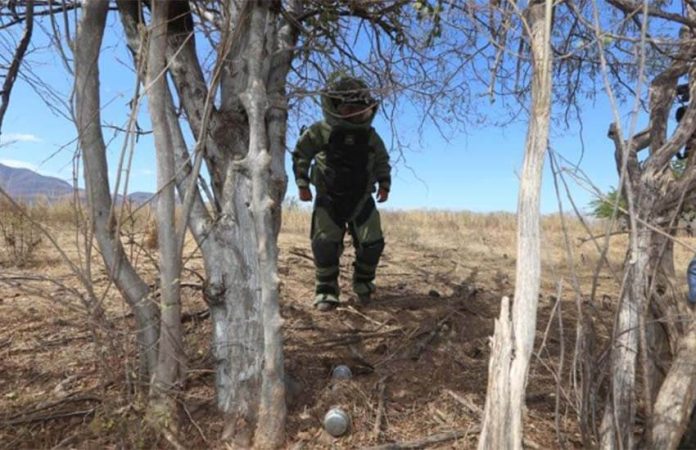
A soldier seeks out land mines in Michoacán's Tierra Caliente region. Sedena
The army has deployed a bomb squad to clear land mines in two Michoacán municipalities after an elderly farmer was killed in an explosion on Saturday.
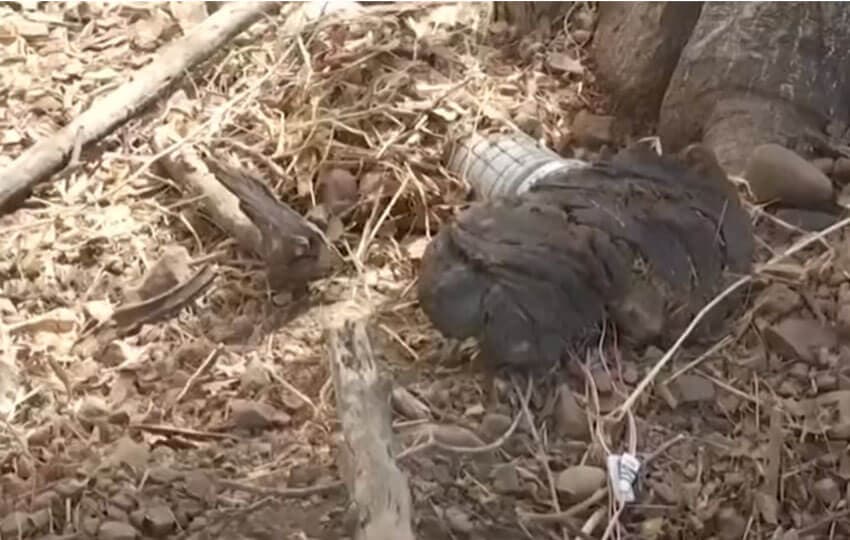
The Jalisco New Generation Cartel (CJNG) is believed responsible for laying mines, or improvised explosive devices (IEDs), in at least 10 communities in the notoriously violent Tierra Caliente municipalities of Tepalcatepec and Aguililla.
Soldiers are painstakingly searching for mines hidden under dirt or camouflaged among weeds. When one is detected, a bomb squad member wearing a heavy-duty protective suit is called in to deactivate or safely detonate it.
Among the communities where IEDs have been detected or are known to be present are Naranjo de Chila – the birthplace of CJNG leader Nemesio “El Mencho” Oseguera Cervantes, El Bejuco, El Cansangüe and El Aguaje, where 78-year-old Cristóbal N. was killed Saturday afternoon.
Don Cristóbal and his 45-year-old son were on their way to their farm in a pickup truck when a mine they drove over exploded.
Naranjo de Chila is just one of at least 10 communities in the Tepalcatepec and Aguililla municipalities with explosives.
The former was killed instantly while the latter was seriously injured and taken to hospital before being discharged by his family because they were unhappy with the treatment he was receiving.
According to Don Cristóbal’s son-in-law, the deadly IED was located five minutes from the farm, which his father-in-law hadn’t visited for two years due to violence in the area.
“He was hoping to grow limes again,” José told the newspaper Milenio.
The CJNG fled Aguililla, the municipality where El Aguaje is located, last week after the army retook control of the municipality last Tuesday.
The explosion on Saturday came two weeks after an IED damaged an armored army vehicle and injured 10 soldiers when it exploded in El Cansangüe, Tepalcatepec.
Aguililla residents told Milenio that one has to step carefully in the municipality, where the CJNG has been engaged in a turf war with a rival criminal group known as the Cárteles Unidos.
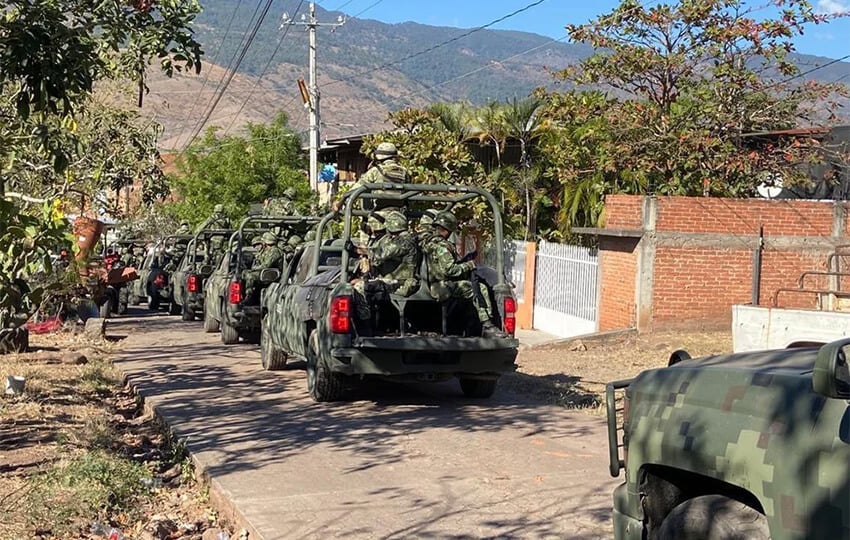
The military has a large presence in places like Aguililla, and some residents say they want it to stay that way. SEDENA
“There are mines all over the place,” one El Aguaje woman said, adding that people are afraid of working on their land.
Indigenous activists used axes, sledgehammers and rope Monday to topple statues in Morelia, Michoacán, that were part of a depiction of their ancestors being exploited by Spaniards during colonial times.
Purépecha members of the Supreme Indigenous Council of Michoacán brought down statues of Fray Antonio de San Miguel, a former bishop of Michoacán, and a Spanish town planner known as Alarife.
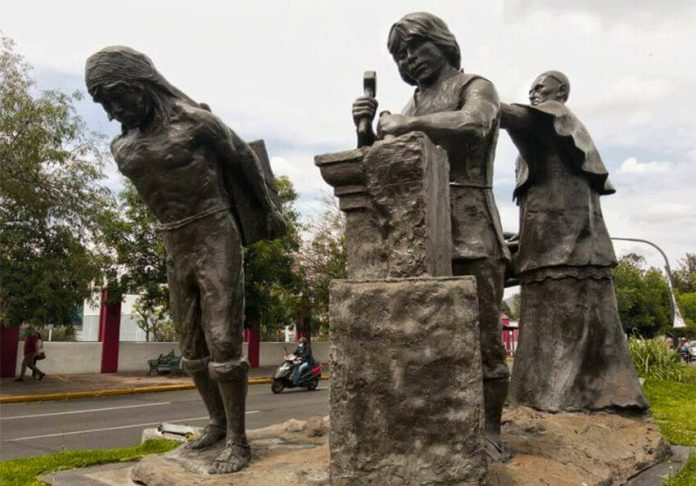
The group of four statues – called “The Builders” – showed two Purépecha men being forced to work. Fray Antonio, who supervised construction of an aqueduct in Morelia in the 1780s, was depicted ordering one near-naked man to cut stone while the other indigenous man carried a heavy stone on his back.
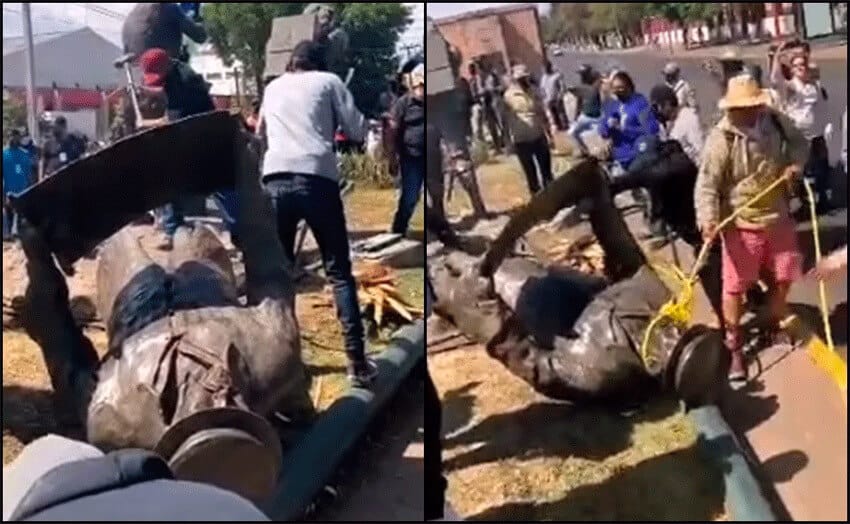
Videos posted to social media showed a large group of people pulling a rope placed around the neck of the statue of the priest. They succeeded in toppling the likeness of the 18th century bishop after various attempts, the newspaper El Universal reported.
The head was subsequently removed and taken away, while the body was abandoned at the site where it previously stood on Avenida Acueducto, a major thoroughfare in the Michoacán capital.
At least 24 people who contributed to the toppling of the statues were arrested and will presumably face vandalism charges.
The Purépecha people have been opposed to the statues since they were erected in 1995, and the Supreme Indigenous Council had been asking local authorities to remove “The Builders” for months, arguing that the monument promoted racism and discrimination.
The council noted in a statement that “2022 marks 500 years since the conquest and invasion of Michoacán” by the Spanish.
“During the invasion of what is today Michoacán, the Spanish enslaved thousands of indigenous people. Five hundred years after the invasion of Michoacán, the indigenous people continue to resist and fight as our grandfathers did,” it said.
Morelia’s cultural heritage authority defended the monument in a statement issued in 2020.
“You just have to read the simple and clear plaque on the monument to feel pride in our city, the birthplace of great thinkers,” the statement said. The authority denied that Morelia was built with slave labor.
Protesters pull down the statues on Monday.
Ramón Sánchez Reyna, a historian and professor at the Michoacán University of Saint Nicholas of Hidalgo, opined that the destruction of “The Builders” – the work of sculptor José Luis Padilla Retana – amounts to a loss of tangible heritage in Morelia.
He told the news website Contramuro that social memory is not erased with such actions, and asserted that the activists should seek alternative ways to build support for their cause.
“… As a sculptural piece it has value. I respect and recognize the work of … Padilla Retana,” Sánchez said.
He noted that a statue of Antonio de Mendoza, the first viceroy of New Spain, was previously knocked down in Morelia, but it was recast and reinstalled.
The historian acknowledged that the toppling of statues of historical figures in Morelia is part of a trend that has been seen in Europe and the United States.
The director of the National Institute of Anthropology and History said last October that the relocation of the Columbus effigy was an attempt to protect it.
“This was based, not on any ideological judgement of the character [of Columbus]. … If it had been left in place, it would have been the target of threats and protests,” Diego Prieto said.
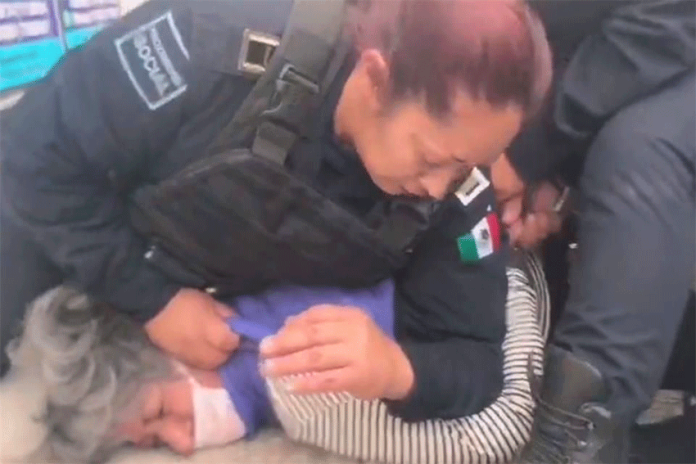
An officer holds the woman down while others put her in cuffs.
Municipal police officers in Hidalgo have been suspended after a video showed them violently arresting a 62-year-old woman for failing to produce a business license.
The officers in Pachuca were verifying store licenses when an elderly couple who own an alternative therapies store failed to present one. Both were arrested, the newspaper Reforma reported.
In the video, one female officer is seen pinning the elderly woman down on a street curb, beside a municipal police pickup truck, while two other female officers handcuff her. One of the officers’ hands is on the woman’s neck, pressing her head into the concrete.
“Let me go please, you’re hurting me,” the woman pleaded while pinned to the pavement.
“Do you need three people to arrest one?” another woman shouted to the police.
Pachuca Mayor Sergio Baños said the officers were clearly at fault. “[The video] shows an intervention of the municipal police in Punta Azul with evident excess in the use of force. I have arranged an immediate investigation to establish responsibilities,” he said.
Baños added that the officers involved had been suspended.
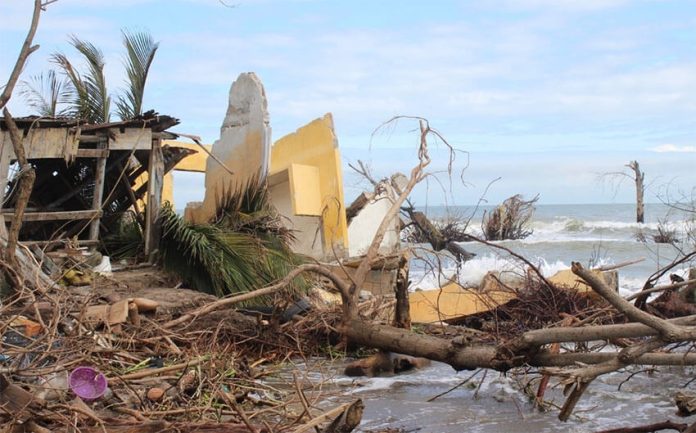
The village of El Bosque has lost more than a third of its homes to the sea.
A coastal village in Tabasco is disappearing due to erosion.
El Bosque, 95 kilometers north of Villahermosa, lost 29 homes in January and a primary school cafeteria which served 45 pupils. Now only 45 homes remain standing.
The locals first reported the erosion about eight years ago, when five meters of beach was swallowed. The waves rose again in February, 2021.
An El Bosque municipal delegate, Antonio Merlín Coto, said he was concerned that the village could cease to exist due to the turbulent conditions. “We’re afraid that the whole community will disappear soon due to the cold fronts.”
He added that the waves from the two most recent cold fronts — at the end of January and beginning of February — were so large that they swept away an entire street with street lighting.
Merlín lost his home a week ago, but is still staying in El Bosque with relatives. “Nobody wants to leave the place where they have lived since 1981,” he said.
Others that have lost their homes have built temporary housing. However, Merlín thinks the force of nature will be impossible to resist. On Monday, “another [cold front] will hit us, and we believe that the other houses that are still on the shore, will be swallowed by the sea,” he said.
Guadalupe Cobos is a mother of four that has lived in El Bosque for 34 years. She said authorities were too slow to act. “We’ve been insisting that we need a sea wall, but no one pays any attention to us.”
She speculated at the cause of the turbulent conditions. “I think it’s because of climate change and because of the Pemex platforms, because they are very close to us,” she said.
When the first house was destroyed in February, 2021, Rosa Cardoza Carrillo was left with no choice but to relocate to the municipal capital Centla. Cardoza used to sell seafood, but now sells tamales given Centla’s greater distance from the sea.
“The sea has been sweeping everything away. It took our houses. I lost mine a year ago… it was the first,” she said.
So far, no authority has conducted a study into the causes of the phenomenon, but the state government has said the damage will be examined by experts.
People left homeless have written to authorities, but the division between the 300 villagers complicates matters: some want to be relocated while others want to stay, largely due to their economic dependence on fishing.
However, Merlín isn’t sure their resolve will continue. The cold fronts end in May “but then the hurricane season comes and that ends in November. Do you think the community is going to stand it?”