Home Blog Page 1081

Omicron becoming the dominant strain of the coronavirus in Mexico

0
covid

Omicron is becoming the dominant strain of the coronavirus in Mexico, Deputy Health Minister Hugo López-Gatell acknowledged Tuesday as the fourth wave of infections continues to grow.

Mexico recorded 11,052 new cases on Monday, plus another 33,626 new cases today, lifting the accumulated tally to over 4.17 million and breaking a record for new cases diagnosed in one day that was set only this past Saturday.

There were 162 deaths recorded today, health officials said.

Daily case numbers declined significantly on Sunday and Monday after a new record of more than 30,000 was registered Saturday, but reported infections on those two days are invariably lower due to a drop-off in testing and/or the recording and reporting of test results on weekends.

Estimated active cases currently number 184,660. With today’s recorded deaths, the official COVID-19 death toll rose to 300,574.
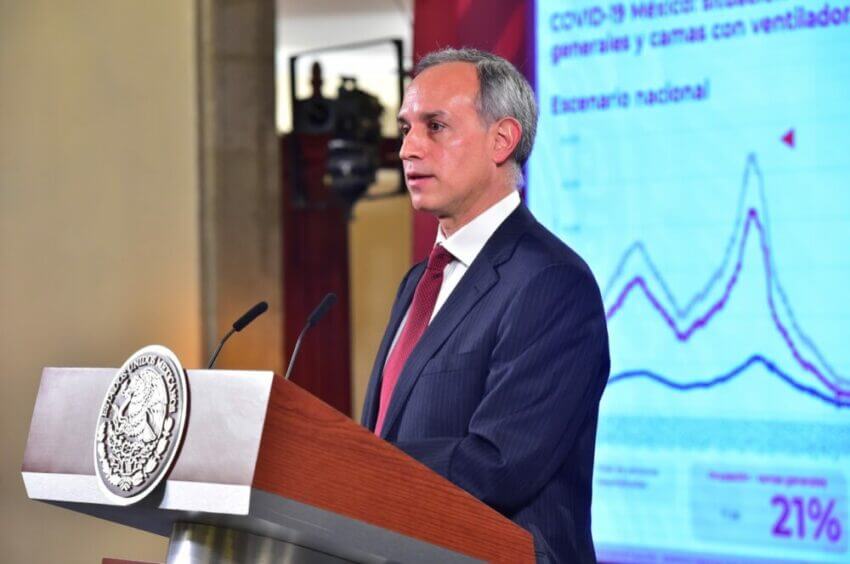
Hugo Lopez Gatell
Deputy Health Minister Hugo López-Gatell said Tuesday morning that due to a shortage of COVID-19 tests in Mexico, people shouldn’t get tested unless it’s essential.

Speaking at the federal government’s morning press conference on Tuesday, López-Gatell said that the highly contagious omicron variant is in the process of becoming the dominant strain in Mexico, as has occurred in other parts of the world.

The coronavirus point man, a John Hopkins University-trained epidemiologist, said that the variant is less likely to affect people’s lungs than previous strains such as delta. The symptoms omicron causes are “more similar” to those of the common cold, he said.

López-Gatell also said that vaccination against COVID-19 protects against pulmonary damage, adding that evidence suggests that illness caused by omicron is shorter than that caused by previous variants.

“The unfortunate infection” of President López Obrador, who announced Monday that he had tested positive but only has mild symptoms, “shows us what happens with the omicron variant,” the deputy minister said.

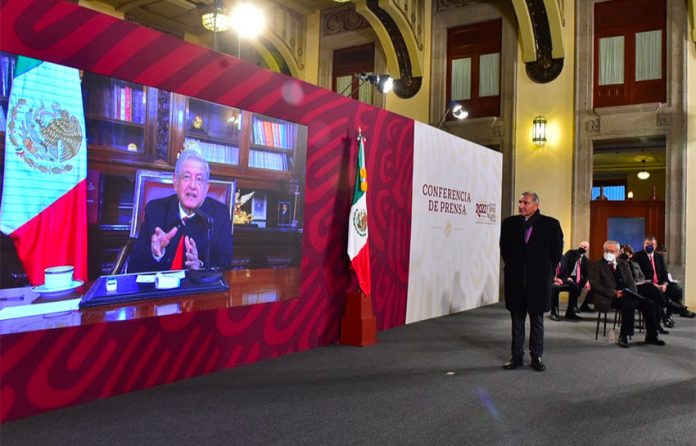
López Obrador appeared at his regular news conference via video link and declared he was feeling “quite well,” despite having a “burning” sensation in his throat and “a little bit of body pain.” He took his own temperature and measured his oxygen levels as he was beamed into the National Palace, and both were normal.

“… Let’s not be scared. Fortunately, this is a variant that doesn’t have the level of danger of the delta variant,” López Obrador said.

López-Gatell noted that COVID wards are only about one-fifth full despite the recent surge in case numbers. He also said that the Health Ministry is looking at the possibility of reducing the isolation period for affected people from two weeks to five days, as is the current advice in the United States.

As has occurred in other countries, the recent surge in case numbers has had a negative impact on various sectors of the economy as workers and their close contacts isolate. One of the affected industries is aviation, with hundreds of flights canceled in recent days.

Meanwhile, demand for COVID-19 testing remains very high. But unlike authorities in many other countries, the Mexican government is not encouraging people to get tested.

López-Gatell said that there is a shortage of tests both in Mexico and globally and for that reason people should abstain from getting tested unless they have “essential” medical reasons to do so.

“If everyone who has a cough and a sore throat rushes out for a COVID test, what will happen is that they will become anxious because they’ll be in a line, at a public or private laboratory, waiting to have a COVID test,” he said, adding that they will make accessing a test more difficult for people who really do need to find out whether they are infected or not.

In that category are people with chronic illnesses and the elderly, the coronavirus czar said.

“If a person has a chronic disease or is very old … he or she has greater probability of [COVID] complications,” he said.

Instead of running out to get tested, most people with coronavirus-like symptoms should stay at home, isolate and monitor their oxygen levels with an oximeter, López-Gatell said.

“I had a common cold myself last week and that’s why I didn’t come [to the press conference],” he said.

Mexico City authorities have also said that getting tested is not “exceedingly necessary,” but people continue to flock to testing centers in the capital. A young man who tested positive in the borough of Benito Juárez on Monday told the newspaper Milenio that he didn’t feel very sick but nevertheless wanted to find out whether he had contracted COVID-19.

“… It’s more about preventing [the spread of the virus],” said Francisco Javier, a México state man who works at a pizza restaurant in Benito Juárez.

He said he suspected he had contracted the virus because he is around a lot of people at work and those people likely gathered with family and friends over the Christmas period.

“At first I didn’t suspect [I had COVID] because I still had my sense of smell and taste, but since my throat closed up a little and my nose started to run I had my doubts,” he said.

According to federal government figures, some 184,000 other Mexicans are also currently infected – most likely by the omicron strain – but as official numbers for cases – and deaths – are considered significant undercounts due to a low testing rate, the real number of virus-carrying citizens is undoubtedly much higher.

With reports from Milenio and Reforma 

New Pinocchio film gives jump start to Jalisco animation studio

0
Gepetto and Pinocchio figures Centro Internacional de Animación
Figures of the fictional marionette-turned boy Pinocchio and his creator Geppetto from the new stop-motion animation film Pinocchio. CIA

A new stop-motion animated movie based on the 1883 Italian novel The Adventures of Pinocchio will have a famous “Made in Mexico” stamp on it.

The upcoming Netflix film Pinocchio was partially produced at the Centro Internacional de Animación (CIA), or International Animation Center, in Guadalajara, Jalisco. Founded by Pinocchio director and Guadalajara native Guillermo del Toro, the CIA is Latin America’s first stop motion production studio.

CIA director Angélica Lares told the news agency EFE that del Toro personally decided that part of his new movie would be made in Guadalajara. “He’s attentive to what we do. We’re constantly talking about what’s coming up,” she added.

Lares said that the CIA had an “unbeatable” beginning, given that it had the opportunity to work on Pinocchio shortly after it opened.

She said that the studio will seek to collaborate on more international projects, noting that it is especially well suited to the production of stop-motion films.

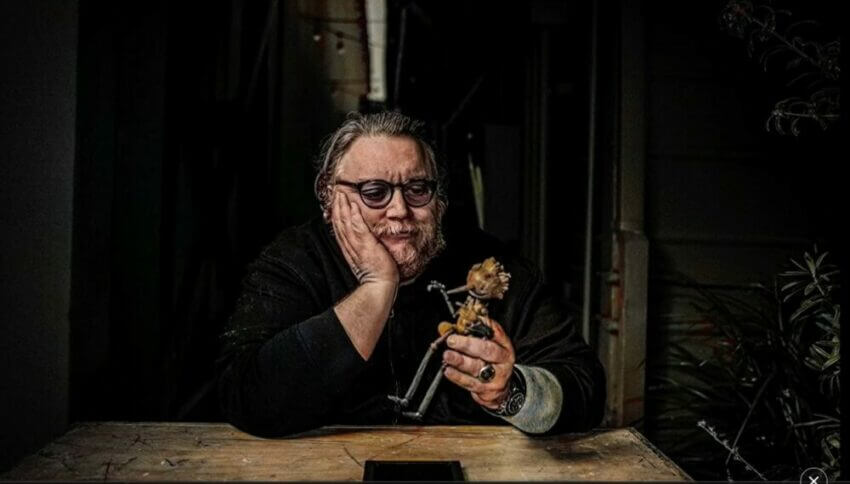
Guillermo del Toro
Filmmaker Guillermo del Toro. CIA

“We have … the spaces, equipment and staff [required for animation projects] and that’s a good thing because productions generally have to put together a studio from zero,” Lares said.

Rita Basulto, a renowned Mexican animator who worked on Pinocchio, told EFE that the CIA’s work on the film showed what the studio is capable of. “Making scenes for this feature film shows that work of a very high level can be done here,” she said

Featuring the voices of actors such as Ewan McGregor, Christoph Waltz and Cate Blanchett, Pinocchio is scheduled for release in the last quarter of 2022.

The CIA is now working on Mexican animator León Fernández’s short film Ramas Torcidas but given the large size of its facilities, it has plenty of room to take on additional projects.

“We’re interested in bringing international productions but also creating [Mexican] intellectual property” and contributing to the development of new local talent, Lares said.

With reports from EFE 

This traveling wine and gourmand fair’s next stop: Teotihuacán

0
Intervinos festival
A previous edition of the Intervinos wine and gourmand festival in Mexico City in 2021.

Two years ago, Intervinos, an itinerant wine and gourmand festival that has traveled all over Mexico since its inception, began to bring together food, wine, Mexican-made spirits and local crafts, visiting different states throughout the year, the most recent event taking place in Querétaro on December 10–12.

Already the event has taken place seven times in several states, spotlighting wines from every region in Mexico, as well as a few from Spain and France.

Wine lovers will soon have their chance to attend the traveling festival’s next incarnation on January 28–30, 2022, when it takes place in San Juan Teotihuacán, México state, near the famed ruins.

Other future Intervinos events are planned for Tlaxcala city on March 18–20, in Valle de Bravo on April 29–May 1, and Cuernavaca, Morelos, June 17–19, with more dates to come during the year.

At the Teotihuacán event, organizers are planning shows among the site’s archaeological ruins, an open-air cinema, kids games, photo opportunities, auctions and, of course, a selection of wines from all over Mexico. There will be five tastings a day.

Other activities scheduled include hot-air balloon rides at dawn, ATV tours, temezcales (indigenous sweat lodge experiences) and a luxurious spa on site, all while you bask in the shadow of the pyramids dedicated to the sun and moon.

Rooms will be available at the nearby Hotel Villas, and a romantic dinner package is available with a special menu.

Intervinos is a great excuse to travel throughout the country in 2022, celebrating Mexican unique wine regions and what they have to offer. For more details on its upcoming events, visit the traveling festival’s website.

Sommelier Diana Serratos writes from Mexico City.

French clothing line under fire for ‘mocking’ Zapotec woman in Oaxaca

0
Sézane employees filming in Oaxaca
The Sézane team in the market at Teotitlán del Valle, Oaxacam filming an elderly indigenous Zapotec woman. Twitter

A French fashion label attacked the dignity of indigenous communities by filming a Zapotec woman dancing in its new clothing line, the National Institute of Indigenous Peoples (INPI) charged.

Sézane, a clothing line founded in Paris in 2013, dressed women in their clothes in the market at Teotitlán del Valle, in the Central Valleys region of Oaxaca, on January 8. 

In a video uploaded to social media, a publicity team can be seen photographing an elderly indigenous woman against a professional backdrop. One representative encourages the woman to stand up and sway from side to side to a recording of the 1968 Mary Hopkin song, Those Were the Days playing in the background. Several spectators watch the moment, and laughter can be heard in the background of the video.

INPI said in a statement that the behavior of the Sézane representatives “undermines the dignity of [indigenous] peoples and communities and reinforces racist stereotypes about indigenous culture and traditions,” before adding that legal action was being considered. “There will be dialogue with the authorities of Teotitlán and the aggrieved people to undertake a legal action, in accordance with the law.” 

The agency demanded companies “cease exploiting indigenous and Afro-Mexican peoples and communities as cultural capital since they are not objects of clothing but citizens under public law who possess a vast cultural heritage and traditional knowledge.”

The video that circulated on social media of the incident.


It cited Article 2 of the United Nations Declaration on the Rights of Indigenous Peoples: “Indigenous peoples and individuals are free and equal to all other peoples and individuals and have the right to be free from any kind of discrimination, in the exercise of their rights, in particular that based on their indigenous origin or identity.”

A new piece of legislation in Mexico, Article 21 of the Federal Law on the Protection of the Cultural Heritage of Indigenous and Afro-Mexican Peoples and Communities, is set to become law pending presidential approval and aims to protect the “dignity and cultural integrity of indigenous and Afro-Mexican peoples.” 

Sézane has stores in New York, Madrid, London and France and focuses on vintage styles. 

The fashion industry has consistently come under fire in Mexico for the alleged exploitation of indigenous culture and designs. The federal Culture Ministry announced in May, 2021 that it had sent letters to Anthropologie as well as Zara and Patowl for the “improper cultural appropriation” of designs from Oaxaca.

The federal government and other authorities have previously accused several other international brands of plagiarizing indigenous Mexican designs. Among them are ZimmermanIsabel MarantCarolina Herrera, Mango and Pippa Holt.

With reports from El Universal 

Citigroup to pull out of retail banking in Mexico

0
banamex
Citi will retreat from consumer and small and medium-sized business banking, which it mostly does via Banamex. Nara_money / Shutterstock.com

Citigroup will exit its Mexican retail banking business after nearly a century of operating in the country, in the latest sign of the lender’s shrinking global ambitions under chief executive Jane Fraser.

The group said it would retreat from consumer and small and medium-sized business banking, which it mostly does via its Banamex subsidiary. The move is part of Fraser’s “strategic refresh” of Citi, a sprawling international lender that is trying to close the profitability gap with its larger U.S. peers.

Citi said it could exit the businesses by selling them or spinning them off into a new public company. It will keep its investment bank and private bank in Mexico, along with its unit that caters to institutional clients in the country.

“Mexico is a priority market for Citi — that will not change,” Fraser said in a statement.

The bank, which has operated in the country since 1929, plans to redirect capital from the Mexico consumer business into areas where the lender has “core strengths and competitive advantages,” she added.

Investors have pressed Citi to sell its Mexican consumer unit for years but executives had until now contended that it was a strategically important market despite lacklustre returns.

The business accounted for roughly US $3.5 billion of revenue in the first three quarters of last year, or roughly 15% of overall consumer banking revenue. It generated about 11% of consumer banking profit.

The move follows Citigroup’s decision in April to retreat from most of its consumer businesses in Asia, Europe the Middle East and Africa. At the time, it identified 13 markets from which it wanted to pull back.

It has since reduced its presence in less than half of those markets, a process that has resulted in more than $2 billion of writedowns.

© 2022 The Financial Times Ltd. All rights reserved. Please do not copy and paste FT articles and redistribute by email or post to the web.

Women-only taxi service seeks to grow in Querétaro

0
Querétaro's women's taxi service.
QroNosotras drivers with their pink outfits and two of their eight taxis.

A women-only taxi service operating in Querétaro city is meeting barriers in its path to success. 

QroNosotras launched in 2019 and released an app in October 2021. Despite its unique selling point — offering women safer journeys — it only has eight vehicles, and is having difficulty attracting investors and more drivers. 

The name refers to Querétaro and uses the feminine form for we to indicate who the service is for. Drivers, whose uniforms and vehicles are pink, are exclusively women who provide transport for other women and children under 15.   

Co-founder Virginia Campos said the idea first came about in 2015 due to the better experience women drivers had when serving customers of the same sex. “As operators of yellow taxis at the time, we realized the needs of women, both operators and users … we saw that it is a good opportunity and a good source of employment …” 

The company has reached agreements with six vehicle agencies that enable interested drivers to acquire vehicles. However, Campos said that sexism was preventing the business from expanding its driver base. “There are many women interested, but unfortunately in two out of 10 cases they don’t join because their husbands don’t allow it.”

Another co-founder, Angélica Reyes Servín, agreed that sexism was hindering their progress. “We are still lagging behind in the sense that the patriarchal system is imposing its sexism, but we are not going to stop … The advantage here is that women are becoming more and more empowered,” she said. 

Reyes added that QroNosotras is part of a cultural shift to make society safer for women. “We are contributing to security, which we really do need … we are looking for those spaces that are free of violence for us,” she said.

QroNosotras is looking for investors to help grow the project, both male and female.  

With reports from El Universal 

Retailers, transport services report extortion on rise in Acapulco

0
Acapulco Golden Zone
Underneath Acapulco's tourism glamour are ever-rising extortion, kidnapping and homicides, business owners say.

A plan to reduce extortion and homicide in Acapulco, Guerrero, is proving ineffective and working continues to be a dangerous activity, local business owners say. 

Refuerzo 2021 (Reinforcement 2021) was announced on November 8, shortly after Morena party Mayor Abelina López took office. The plan coordinates federal, state and municipal security forces to enable more patrols and establish road checkpoints in high-crime areas.  

But attacks on the workers most exposed to extortion have multiplied: eight transport workers were killed, and three service workers were murdered on the beach in López’s first 100 days as mayor, the newspaper Reforma reported.

From January through November, there were 1,260 homicides in Guerrero, of which 418 occurred in Acapulco, according to data from the National Public Security System (SENSP)The most violent state in the country, Guanajuato, saw 3,239 homicides over the same period. 

The head of the Acapulco federation of chambers of commerce, Alejandro Martínez Sidney, said the program’s failure was self-evident. “This operation has not provided any results, and the proof is that the violence is unstoppable because the murders, extortion and collection of rental fees continue.” 

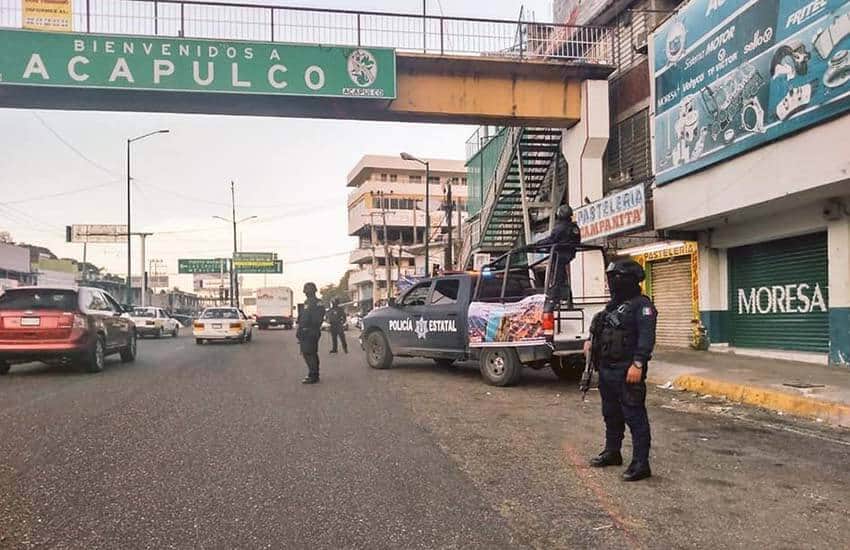
Guerrero state police in Acapulco
Guerrero state police reinforcements on Acapulco’s streets in late December. Guerrero state police

He added that at least 28 business people in Acapulco were being extorted by phone and that there was a spike in demands due to the commercial success of the holiday season. “This occurs at the end of the [festive] season. A great effort was made [by business owners] to have a successful season, and these criminals, taking advantage of the situation, have attacked our sector,” he said. 

The leader of a taxi drivers’ collective in Acapulco, who remained anonymous, said a change in tactics was needed. “We are asking that the strategy to confront organized crime is applied with intelligence and that checkpoints in the streets are not installed. Wherever they are put, there are lookouts who warn their bosses,” he said

Meanwhile, another business owner in Acapulco was killed on Sunday morning. Roberto Morales Silva, 48, the owner of a chain of 14 pharmacies, was found dead on the Acapulco-Coyuca de Benítez highway after being kidnapped the previous day.

It is likely that he was a target of extortionists.

With reports from Reforma and El Universal

A year after Metro fire, dominoes help monitor location of system’s trains

0
Mexico City Metro
For Lines 1–6, Metro control center employees without a functioning telemetry system rely on track monitors and calls from drivers to know where trains are located. CDMX Metro

Mexico City Metro employees are using dominoes to “imagine” the location of trains a year after a fire in the subway system’s downtown substation put train monitoring and communications systems out of action.

The operation and supervision of Lines 1, 2, 3, 4, 5 and 6 of the Metro system is “literally a board game,” the newspaper Milenio reported after visiting the subway system’s No. 2 Central Control Post (PCC2).

Metro employees known as regulators move dominoes on a paper map to simulate the movement of trains along those lines, the newspaper said. Train drivers notify regulators of their location via the WhatsApp messaging service.

One regulator conceded that “we can’t see the location of the trains in real time” before adding that train drivers “frequently call us to tell us where they are.”

“That’s when you put the domino in its place,” the employee said, adding that regulators use their imagination to determine the exact location of a train.

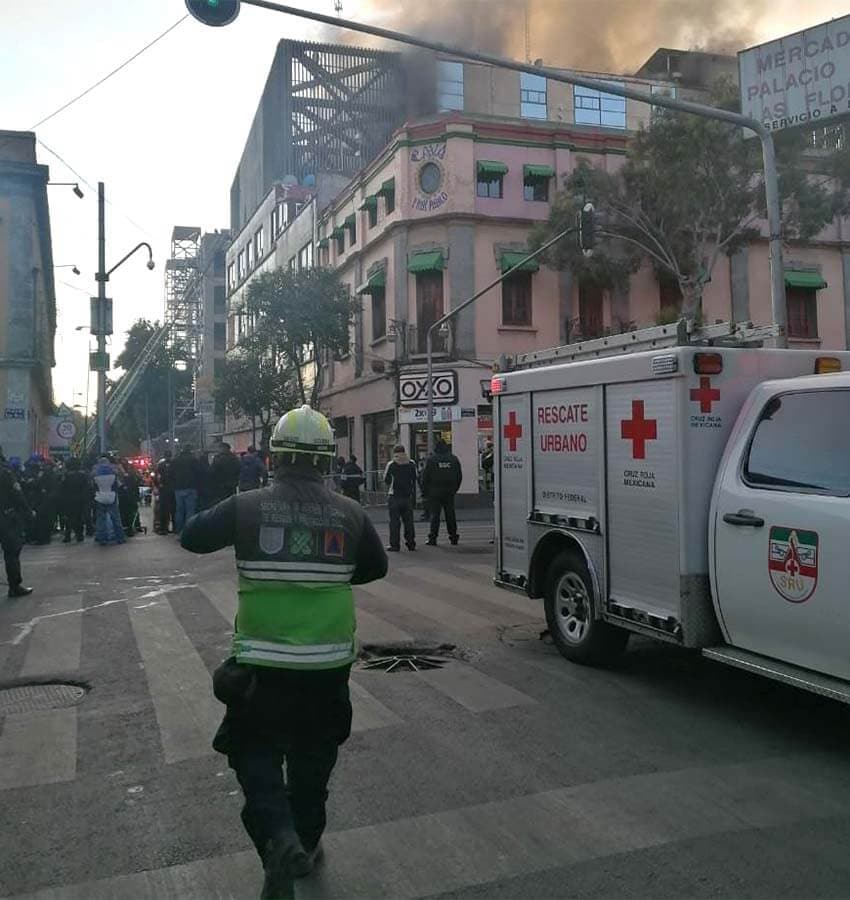
2019 fire at CDMX Metro system management station
Emergency crews responding to the fire at the Metro’s PCC 1 control center on January 9, 2021. Twitter

Before they started using dominoes, the Metro workers used items such as erasers and pencils to depict trains, Milenio said.

“They later progressed to a domino system. Due to the loss of the internal Metro communications system, Tetra, they [train drivers and regulators] had to use the WhatsApp application to communicate … [despite] the risk that there are spaces in the Metro that don’t have [cell phone] service,” the newspaper said.

The introduction of dominoes is not the only “improvement” that has been made to the rudimentary train monitoring system.

Regulators previously used paper boards with hand-drawn representations of the Metro system, but they now use maps downloaded from the internet, which show the different lines in different colors as well as the location and names of stations.

The latter are “a little clearer,” said the employee who spoke with Milenio. Asked whether it was safe to operate the Metro with such a monitoring system — which was only recently enhanced by the installation of monitors that transmit footage from the subway’s lines — the regulator responded:

“… With dominoes or erasers, we continue [to work] blindly, imagining where the train is moving forward. … We assume that [the trains] are [at a certain location], but we don’t have the visualization. They [the drivers] tell you they’re between stations, but you don’t know where. … It’s not precise at all, but you imagine [where the train is], put the domino down and assume that it’s there.”

CDMX Line 12 Metro collapse
The Metro workers union says members work with rudimentary equipment while trying to avoid another incident like the collapse of an overpass on Line 12 last May. Government of Mexico

Due to the lack of precision, the number of trains running on Lines 1, 2 and 3 is now lower than it was before the substation fire on January 9, 2021, the employee said.

“Lines 4, 5 and 6 are operating normally; they’re relatively small lines. But the circulation [of trains] on the large lines … is 30% lower,” the regulator said.

The employee also said that the PCC2 is short-staffed due to coronavirus infections among its personnel.

“There are currently nine colleagues with COVID, and we’re working double shifts. There are times at which we don’t have support on the large lines … [and just] one supervisor controls the … [monitoring system]. … When a problem arises, communication [with drivers] takes a lot of time, … you have to call each one to notify them of the problem, and that’s very complicated for just one person who is controlling everything,” the regulator said.

The Metro workers union acknowledged in a statement that its members are working with rudimentary equipment while trying to avoid “another serious incident” on the subway system. Twenty-six people were killed last May after two carriages of the train in which they were traveling plunged toward a busy road due to the collapse of an overpass on Line 12.

The Metro workers union said that the lack of sophisticated monitoring and communications systems is “putting [drivers’] instincts to the test,” forcing them to rely on “the experience they have acquired in their years of service.”

It also said that the administration of the Metro system by former chief Florencia Serranía was “disastrous.”

She was replaced by last June Guillermo Calderón Aguilera, a veteran transport official but the primitive monitoring system survived the change of leadership.

The newspaper Reforma reported last May that a domino system was in place because the subway’s digital telemetry system hadn’t been repaired. The “Monopoly” system, as one Metro employee described it, was ridiculed by Reforma readers, with one calling it a “true embarrassment” and another describing it as criminal.

“Only in Mexico!” wrote one person. “Great Mexican technology,” another said ironically.

With reports from Milenio and Reforma 

Migrant mules cross the desert into US with 30 kilos of drugs on their backs

0
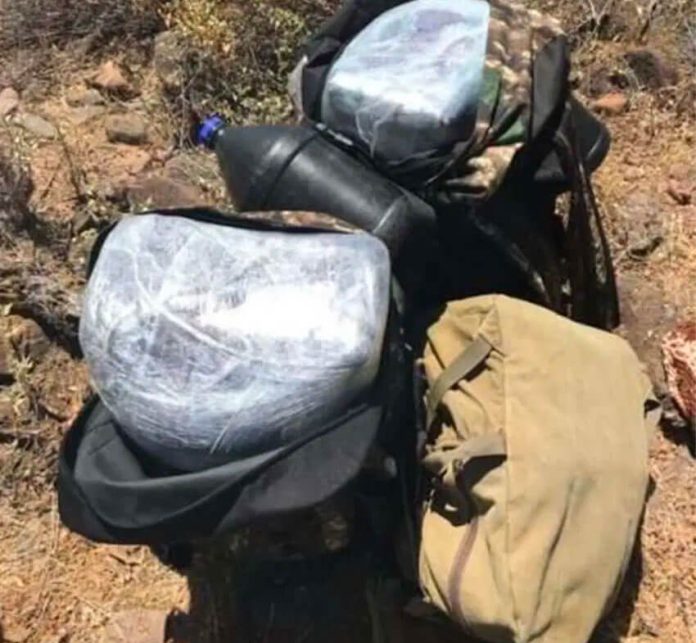
drugs in backpacks
Mexican authorities say that drug seizures have increased in recent months. (US CBP)

Migrants desperate to reach the United States are crossing the Sonoran desert free with the help of traffickers. But there’s one catch: they have to carry 30 kilograms of drugs on their backs into U.S. territory. 

Every day, migrants from Mexico, Central America and many of the world’s most impoverished countries cross the so-called ruta de la muerte (route of death). Temperatures hit 50 C in the day and dip below 0 in the early morning. 

Some of those migrants — forced into an agreement by necessity — heighten the risk of an already dangerous trip by transporting illegal substances worth a small fortune. Halfway through their trek, they might see dead bodies and skeletal remains of people who previously attempted the passage. 

At least 2,000 migrants have disappeared in the desert since 2019, according to the search organizations Madres Buscadoras de Sonora (Searching Mothers of Sonora) and the Arizona search and rescue group SOS. They have rescued some 200 people in the desert area, comprising 222,000 square kilometers across Arizona, Baja California and Sonora. 

Before attempting the journey, migrants have to buy camouflage clothing that makes them almost invisible to the U.S. Border Patrol agents and paint their water bottles black to prevent them from reflecting light. They also wear garlic on their feet to prevent snakes from biting them, the newspaper El Universal reported.

Migrants at Yuma border wall
Lucky migrants who made it through the desert at the US border wall in Yuma, Arizona. SOS Búsqueda y Rescate

The leader of Madres Buscadores, Ceci Flores, explained why so many languish in the desert. “These people disappear. Some die of thirst or fatigue or have heart attacks. There are different factors, and we can’t always know what caused their death,” she said.

Flores noted that most reports of disappearances are for people who came from Guatemala, Honduras and El Salvador.

Josué, a 24-year-old migrant from Honduras, said he had little choice but to leave his country. “I come from Honduras. You get out of there because of crime: you can’t live, there is a lot of poverty, work is scarce and what you earn is very little. There is no improvement,” he said. 

He added that risk-taking was the only way to reach the U.S. “It’s worth the risk because … the one who doesn’t take the risk doesn’t win.”

With reports from El Universal 

López Obrador tests positive for COVID for second time, goes into isolation

0
The president speaks to Tuesday morning's press conference via a video link.

President López Obrador has tested positive for COVID-19 for the second time in less than a year.

He announced Monday evening that he was infected, adding that he would remain in isolation even though he was only experiencing mild symptoms.

“I’ll only carry out office work and communicate virtually until I get through [my illness],” López Obrador wrote on social media.

“Meanwhile, Interior Minister Adán Augusto López Hernández will represent me at the [morning] press conferences and at other ceremonies,” he wrote.

The 68-year-old, who has received three shots of the AstraZeneca vaccine, said Monday morning that he had woken up “hoarse” but expressed doubt that he had COVID.

López Obrador also tested positive for COVID-19 in late January 2021. The president, who takes medication for high blood pressure and suffered a heart attack in 2013, was treated with the antiviral medication Remdesivir.

Interior Minister López presided over AMLO’s regular news conference on Tuesday morning despite being in close contact with the president on Monday. He was one of several officials who met with López Obrador at the National Palace on Monday, the newspaper Milenio reported.

The president met last week with Economy Minister Tatiana Clouthier, who announced Friday that she had tested positive for COVID. Environment Minister María Luisa Albores announced Monday that she had tested positive as well.

On Tuesday, cabinet ministers awaiting their turn at the podium sported face masks, a rare sight, while many of the government personnel who staff the daily press conferences appeared wearing masks for the first time. Unlike other government and public facilities, COVID protocols such as taking temperatures and offering hand gel have been largely ignored at the president’s daily mañaneras.

Meanwhile, political friends and foes of the president took to social media to wish him well after he announced that he had contracted COVID.

“I send you a caring hug from a distance. I hope that you get better soon because we’re standing before a great transformation, a great future, a strengthened and extraordinary Mexican nation that you lead,” wrote Senator Olga Sánchez, the former interior minister who took charge of the president’s press conferences when he was sick early last year.

“I sincerely wish you well,” wrote former president Felipe Calderón, an outspoken critic of the president.

Among the other political figures to send their best wishes to AMLO were Mexico City Mayor Claudia Sheinbaum, Morena party Senate leader Ricardo Monreal, Deputy Health Minister Hugo López-Gatell, former president Vicente Fox and 2018 presidential candidate Ricardo Anaya.

López Obrador’s illness comes as Mexico endures an omicron-fueled fourth wave of coronavirus infections. There are currently more than 157,000 active cases across the country, according to Health Ministry estimates.

With reports from Milenio