Home Blog Page 1109

Mexico and US aid agencies to cooperate in Central America development programs

0
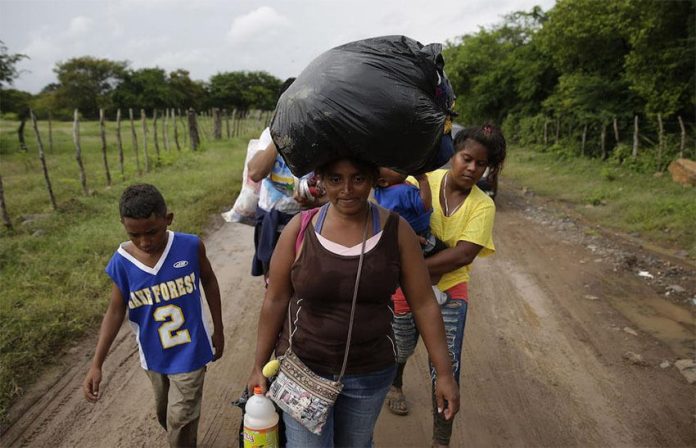
A group of Honduran migrants on the border of Honduras and El Salvador heading north in 2018.

The Mexican and United States governments have announced a new framework for development cooperation in Guatemala, Honduras and El Salvador.

Called Sembrando Oportunidades (Sowing Opportunities), the framework aims to address the root causes of irregular migration from northern Central America, said a joint statement issued by the Mexican Ministry of Foreign Affairs, the U.S. Department of State, the Mexican Agency for International Cooperation and Development (Amexcid) and the United States Agency for International Development (USAID).

Amexcid and USAID will coordinate the two countries’ development resources and expertise to help citizens of northern Central America build prosperous futures in their home communities, the statement said.

“Our complementary efforts are set to begin in Honduras, where USAID and Amexcid plan to provide youth with skills and experience that can lead to long-term employment, reducing the risk of irregular migration. Under this initiative, we aim to reach more than 500,000 at-risk youth in Honduras. Both the United States and Mexico have committed resources to this effort and both agencies have begun to coordinate,” it said.

How much money each nation has committed to Sembrando Oportunidades was not announced. In September, Mexico asked the United States to provide US $108.4 million a month to fund the implementation of two employment programs in Central America. Earlier that month, the United States agreed to collaborate on the expansion of Mexico’s Sembrando Vida (Sowing Life) tree-planting employment program and Jóvenes Construyendo el Futuro (Youths Building the Future) apprenticeship scheme.
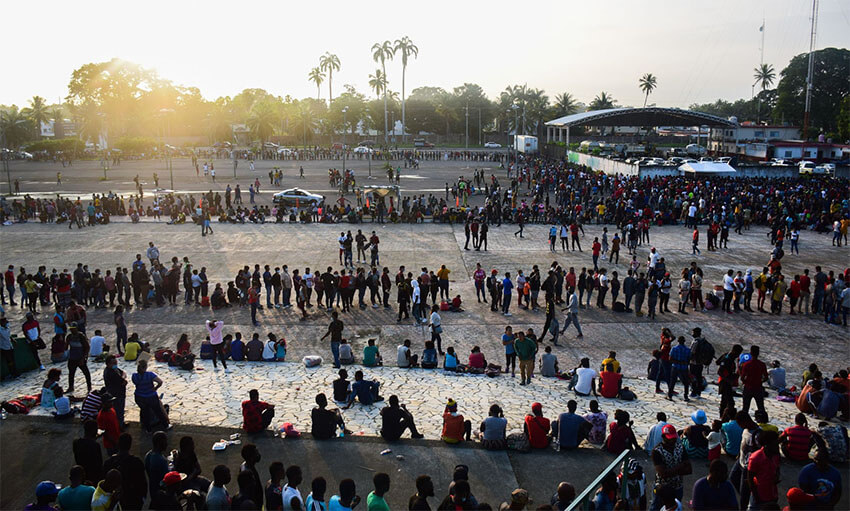
Long lines of migrants wait to make an appointment with the Mexican refugee agency Comar, in Tapachula, Chiapas.
Long lines of migrants wait to make an appointment with the Mexican refugee agency COMAR, in Tapachula, Chiapas.

Foreign Minister Marcelo Ebrard said after last month’s North American Leaders’ Summit that the U.S. would invest in a program that would probably be called Sembrando Oportunidades.

The joint statement said the framework “will grow to include additional agriculture and youth workforce development activities, pending availability of funds.”

“USAID plans to complement Amexcid’s Jóvenes Construyendo el Futuro program by linking scholarship opportunities as an option for youth graduating from Amexcid assistance in El Salvador through the USAID-funded program with the International Organization for Migration,” it said.

“… Amexcid intends to continue to assist small farmers through their Sembrando Vida agriculture and reforestation program, while USAID intends to continue to help farmers reach new and higher value market opportunities,” the statement added.

“USAID plans to pilot and rigorously evaluate programmatic approaches to conditional cash transfers in the region, sharing its findings with Amexcid.”

In addition, USAID intends to strengthen the institutional partnership with Amexcid under Sembrando Oportunidades, “sharing materials and best practices, establishing a coordinated research and learning agenda that will include rigorous analysis to inform root cause programs, and developing guidelines for branding joint initiatives.”

“… Under the Sembrando Oportunidades framework, the United States and Mexico plan to work together in El Salvador, Guatemala, and Honduras to promote good governance, an improved business enabling environment, and enhanced investment by national governments in their neglected communities,” the statement said.

The two governments said the framework expands on the shared vision for enhanced development cooperation to address the root causes of migration discussed by President López Obrador and President Biden during the North American Leaders’ Summit.

“The government of Mexico is implementing its largest development programs in its history in Central America, and President Biden has also made a historic commitment to the region under the U.S. strategy for addressing the root causes of migration in Central America,” the statement said.

The formal announcement of the framework comes as large numbers of migrants from Central American and Caribbean nations continue to enter Mexico via its southern border and travel through the country en route to the United States.

Mexico News Daily 
AMLOFest: 250,000 attend anniversary rally in Mexico City zócalo

0
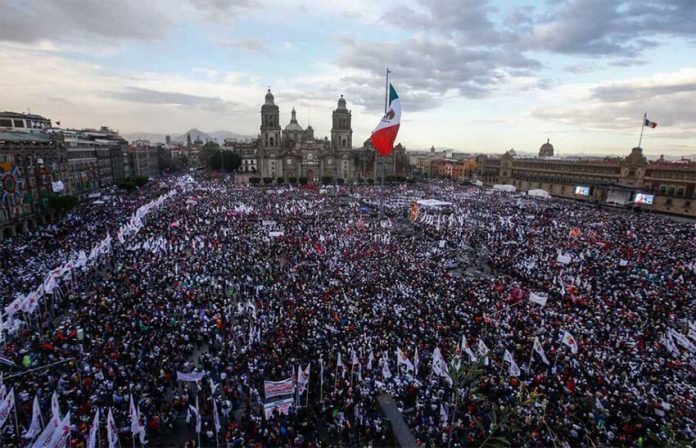
The rally drew 250,000 people from around the country, the Mexico City government said.
Hundreds of buses brought people from around the country.

A quarter of a million people flocked to Mexico City’s central square on Wednesday to attend President López Obrador’s rally to mark the third anniversary of the commencement of his six-year term.

The size of the crowd, made up of supporters from numerous states, matched that of December 1, 2018, when López Obrador appeared in the same square – the zócalo – wearing his presidential sash just hours after being sworn in.

It was the first time since early 2020 that the president had convened a mass rally, the long break due to the pandemic, which has officially claimed close to 300,000 lives in Mexico. Most attendees wore face masks but social distancing was impossible in the tightly-packed square.

Hundreds of buses transported supporters to downtown Mexico City for the latest AMLOFest, with residents of Tabasco, Chiapas, Guanajuato, Sinaloa, San Luis Potosí, Veracruz, Oaxaca and Nayarit among the 250,000-strong crowd.

The Mexico City government, which provided the official attendance figure, said there were no adverse incidents at the event.

Morena, the ruling party founded by López Obrador just four years before his comprehensive victory at the 2018 presidential election, used a tried-and-tested tactic to get large numbers of people to the zócalo: it provided free transportation to the event and sweetened the deal by handing out t-shirts, hats and packed lunches.

The once omnipotent Institutional Revolutionary Party frequently used the same tactic, giving rise to a colloquial term to refer to people herded to political events – acarreados, literally those who are transported or  — perhaps more accurately — hauled.

One México state woman told the newspaper Reforma she was invited to the event by a local official and had to go because that person makes sure that water tankers arrive in her neighborhood in the densely populated municipality of Ecatepec.

She received details about the location and time for a bus departure to Mexico City’s historic center via a WhatsApp message.

“They gave us a t-shirt and lunch,” said another Ecatepec resident.

Other people were shepherded to the event by leaders of labor unions or similar organizations to which they belong. For example, some 400 Mexico City street vendors affiliated with a group led by Claudia Franco descended on the zócalo to hear López Obrador speak.

Busloads of supporters from around the country arrived in the downtown area on Wednesday.


“… We came to thank the president for the support he gives us,” Franco said.

The crowd also included government employees given permission to leave their desks early – presumably as long as they agreed to attend the AMLOFest, but many other Mexicans made their way to the zócalo of their own accord, lured by the opportunity to see the president in person and appreciate his well-honed oratorical skills.

Musicians entertained the masses before López Obrador, hand in hand in with his wife Beatriz Gutiérrez Müller, took to a stage set up in front of the National Palace shortly after 5:00 p.m.

With members of his cabinet and Mexico City Mayor Claudia Sheinbaum seated behind him, AMLO delivered a “greatest hits” address of the kind he has given several times before, enumerating government achievements since he took office three years ago.

Among those he highlighted were the revocation of the “poorly named education reform,” job creation through the construction of public infrastructure projects, the delivery of COVID-19 vaccines to all adults, a 95% reduction in fuel theft, the creation of the National Guard, the delivery of welfare and social programs and the generation of 1.4 trillion pesos (US $66 billion) in savings over three years due to “republican austerity” and the government’s anti-corruption initiatives.

The president, who retains a high approval rating despite the severity of the coronavirus crisis, near record homicide rates and economic uncertainty, also looked to the future. He confirmed he would subject himself to a “revocation of mandate” vote next year, announcing he would test support for “our transformation policy” in April.

President López Obrador and his wife Beatriz Gutiérrez Müller wave to the crowd outside the National Palace.

“The people – who are sovereign, who command – will be asked if they want me to continue as president or resign,” López Obrador said.

He also asserted that his controversial electricity reform bill will allow “the balance lost” due to “neoliberal energy policy” to be recovered.

The bill seeks to guarantee more than half the electricity market to the state-owned Federal Electricity Commission, reversing policy that López Obrador said “sought to ruin the national electricity industry and leave the market in the hands of private, mainly foreign, companies.”

The president confirmed that the military will support efforts to distribute medications to Mexico’s most remote public health facilities, an idea he floated last week.

“As we did with the [COVID-19] vaccines, in January a general distribution plan for medications, supported by the armed forces, will begin,” he said.

Concluding his 75-minute address, López Obrador asserted that his government will continue to show faith in the people of Mexico and continue to “make history” in the second half of his term.

“… In these three years we’ve shown that we’re a great, free and sovereign nation respected … by the rest of the world,” he said.

“[We’re a country] that is striving for peace and one that is heading toward being a fair, egalitarian, democratic and fraternal republic, and this has been a project of everyone, of a ‘we’ that is today represented by you: free and responsible women and men, principal protagonists of the fourth transformation of Mexico.”

With reports from Reforma and Milenio

Santa Claus has helpers in 2 Mexican towns

0
Feria de la Esfera , Michaocan
The Feria de la Esfera (Ornament Fair) in Tlalpujahua, Michaocán, is ongoing until December 19.

If you buy blown-glass Christmas tree ornaments made in Mexico, it’s almost guaranteed that they were made in one of two towns you probably never heard of:  Tlalpujahua, Michoacán, or Chignahuapan, Puebla.

The story of these towns begins in the 1950s when economics forced many out of the high mountains of the Michoacán-México state border. Joaquin Muñoz Orta found himself an immigrant in Chicago, working in a factory making artificial Christmas trees and glass ornaments. He returned to Mexico in the 1960s to make both in Mexico City, but the ornaments sold much better.

In the early 1970s, he decided to move their manufacture to his hometown of Tlalpujahua, the start of his company Adornos Navideños. At the factory’s height, it was making about 100 million ornaments a year, but competition from Asia put a squeeze on mass production in Mexico. The factory closed in 2012, but not before it spurred a major cottage industry.

Ornaments remain extremely important in Tlalpujahua, employing about 70% of the families in one way or another. However, there have been changes, mostly in the direction of tourism. Tlalpujahua is a natural “Christmas town,” a weekend drive from Mexico City, San Miguel Allende and Guadalajara into rugged pine-forested mountains and cold not unlike many parts of the United States and Europe at the same time of year.

The family behind Adornos Navideños founded La Casa de Santa Claus. It produces about a million ornaments a year, but its focus is now retail in Tlalpujahua. The municipality sponsors an annual Feria de la Esfera (Ornament Fair) which is ongoing until December 19th to attract shoppers to its over 100 manufacturers that set up stalls all over town.

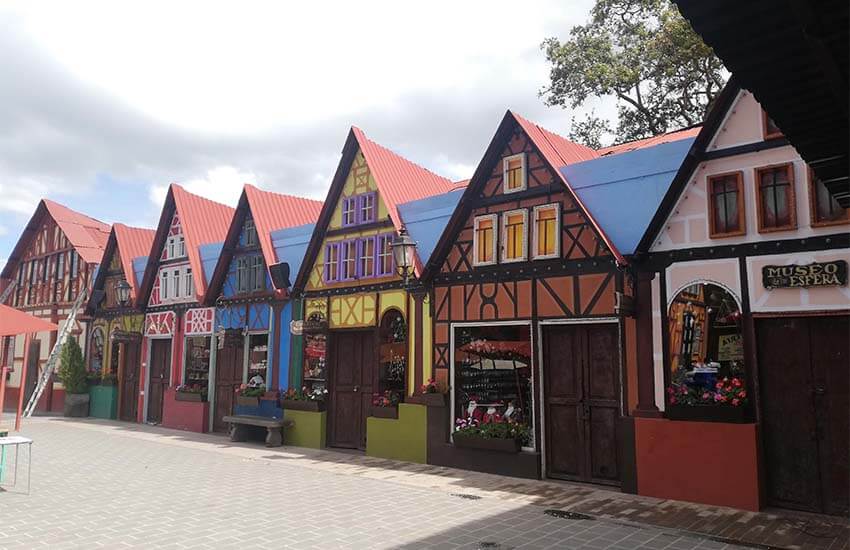
Santa Claus Village in Tlalpujahua
Casa de Santa Claus built the Villa de Santa Claus to draw in more tourists to Tlalpujahua. Svetlana/Wikimedia Commons

Mexico’s other Christmas town is Chignahuapan, Puebla, whose story begins when Tlalpujahua native Rafael Méndez Núñez set up shop here in the 1970s. Many of the products here are similar to those made in Tlalpujahua, and Chignahuapan has kept much of its wholesale business, mostly because it is easier to ship to Mexico City.

Tourism is important, although the atmosphere is different from that of Tlalpujahua.

It is an easy day trip from Mexico City and Puebla, and it has a wonderful parish church with a facade painted in bright colors. Its continued focus on wholesale is the reason why its annual fair starts and ends earlier (October–November). But don’t worry, if you go there now, you will find plenty of stores and stalls for your shopping pleasure, along with locally made apple cider and pulque.

Most of the blown-glass ornaments sold in both towns will be familiar to many of us from North America, focusing on traditional Christmas colors and with sparkly designs of stars, flowers, Santa Claus and more. Continued export explains some of this, but the main reason is that the Mexican market demands it. Christmas trees are a relatively new addition to the culture, and many Mexicans still look to recreate what they have seen in the media.

The vast majority of producers maintain the techniques of small workshops and factories. including blowing and hand-painting, which is usually done by women.

However, there are signs of innovation, especially in the decoration of the basic sphere. Wild colors and new images appear, mostly because of influences from popular culture. It is easy to find ornaments with logos from Mexican and U.S. sports teams, famous players, superheroes, Japanese cartoon characters and more. (I would not ask if they have permission to reproduce these images, however.)

ornament store in Chignahuapan
One of the many ornament stores in Chignahuapan, Puebla. Alejandro Linares Garcia

There has been the development of blown glass in new shapes such as flower petals and hot-air balloons, along with apples and other fruit. Transparent spheres with items inside are also popular, and you can even have one with your own photo inside made while you wait.

Both towns have developed other Christmas decorations, including interesting takes on wreaths, nativity scenes and “trees” made from pine cones and other local forest products. But for the most part, it has not led to the development of collectible ornaments in (Mexican) folkloric designs similar to what can be seen in North America and Europe.

With the end of the mass production export market, federal and state governments have stepped in to promote the two towns and their products. It is important to keep the industry from dying completely as it is about the only major economic activity in either. Ornaments from both places have appeared on Christmas trees at the Vatican, and both are designated as Pueblos Mágicos — in large part but not exclusively because of their history with Christmas.

While both Tlalpujahua and Chignahuapan are the closest to Christmas towns in our sense of the term, there are also other places worth a mention with a strong connection to the holiday.

The first is Acolman, México state. Just north of the Mexico City metropolitan area, it is the birthplace of the Mexican piñata, developed at the monastery here. It holds an annual Piñata Fair, this year happening December 16—20.

Live and cut Christmas trees are now cultivated in many of Mexico’s high-altitude and colder climes, particularly in México state, Nuevo León, Michoacán and Veracruz. These farms welcome visitors during the season.

Tlalpujahua
Shopping for ornaments in Tlalpujahua. Alejandro Linares Garcia

The best known is the Bosque de los Árboles de Navidad, or Christmas Tree Forest, wedged between Mexico City and the Popocatepetl Volcano in Amecameca, México state.

In case you didn’t know, the poinsettia is native to Mexico and called in Spanish the “Nochebuena” (which is also the word for “Christmas Eve”).

Morelos is a principal producer of the plant, and Cuernavaca holds an annual Expo Nochebuena from now until December 24.

Leigh Thelmadatter arrived in Mexico 18 years ago and fell in love with the land and the culture in particular its handcrafts and art. She is the author of Mexican Cartonería: Paper, Paste and Fiesta (Schiffer 2019). Her culture column appears regularly on Mexico News Daily.

Minimum wage to jump 22%, business group says

0
coins

The National Minimum Wage Commission (Conasami) agreed to bump the minimum wage by 22% next yar, the Business Coordinating Council (CCE) said. 

Low wage earners will earn a daily rate of 172.87 pesos (US $8.11) in most of Mexico in 2022, up from the current rate of 141.70 pesos ($6.65).

The minimum wage is higher on the U.S. border, where the 43 municipalities in the Northern Border Free Zone will enjoy a daily rate of 260.34 pesos. The 25-kilometer stretch is given special treatment in economic matters: it was created by President López Obrador in 2018 to improve the local economy and dissuade would-be migrants from crossing the border. 

Conasami itself has not yet announced the increases. 

The CCE said in a statement that the hike would improve workers’ lots relative to an established economic standard for family well-being. “The increase will reflect in a real improvement in the purchasing power of workers. With this, the minimum wage of the Northern Border Free Zone will cover 112% of the family welfare standard, and the minimum wage for the rest of the country will cover 74% [of the standard].”

It added that social issues were important to the private sector: “it is a priority for the private sector to provide solutions to the challenges facing our country, in the face of the economic reactivation after the COVID-19 pandemic, which has affected the finances of Mexican families so much.” 

The Mexican minimum wage is one of the lowest in the Americas. In the United States, the lowest legal pay is $7.25 per hour, more than the current daily rate in Mexico.

President López Obrador has complained that the minimum wages of Guatemala, Honduras and El Salvador are higher than that of Mexico, which was raised 15% from 123.2 pesos at the start of this year.

An anti-poverty organization said earlier in November that the minimum wage should be increased by 30% in 2022.

However, many workers will be feel relieved by the 22% hike amid soaring prices: the first half of November recorded inflation over 7%, the highest rate in 20 years.

Mexico News Daily

Territorial dispute delays new Oaxaca highway

0
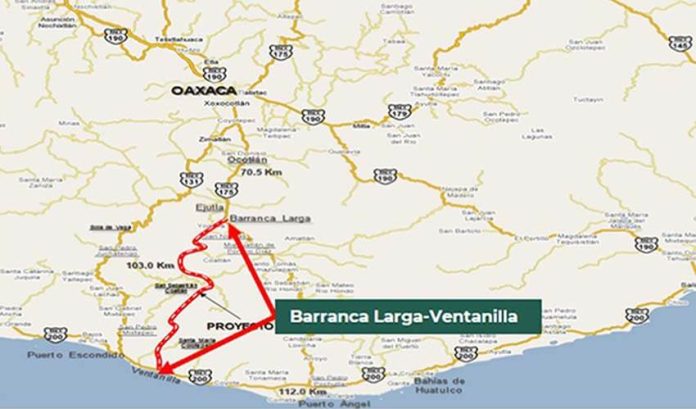
plans for Barranca Larga Ventanilla highway, Oaxaca
The Barranca Larga-Ventanilla highway has been planned for some 20 years.

The construction of a highway connecting Oaxaca city to the beach resort of Puerto Escondido has hit a snag due to a land dispute between rival towns in the Oaxaca Sierra.

Inhabitants of the bordering municipalities of Villa Sola de Vega and San Vicente Coatlán, both about 95 kilometers south of Oaxaca city, have a longstanding dispute over 20,000 hectares of land, which is holding up the construction of 13 kilometers of the Barranca Larga-Ventanilla highway, which authorities plan to open in August next year.    

A court ruling in 2003 awarded the territory to Sola de Vega, but people in San Vicente Coatlán have not given up their claim to the area. The conflict has frequently turned violent, as it did most recently in April, when seven people were killed in a confrontation between communities in the two municipalities.

According to the newspaper Reforma, the conflict has taken more than 50 lives over about 60 years. Residents of both municipalities have at different times in 2021 blocked various federal highway construction projects in an attempt to get the state and federal governments’ attention regarding the conflict.  

Agrarian conflicts of this kind are common in the largely rural state. On Sunday, in another part of the state, part of a road to an isolated village in the Isthmus of Tehuantepec — which had been paved via a federal public works program — was destroyed by rival villagers due to a conflict over land, cutting off another eight rural communities.

Villa Sola de Vega, Oaxaca
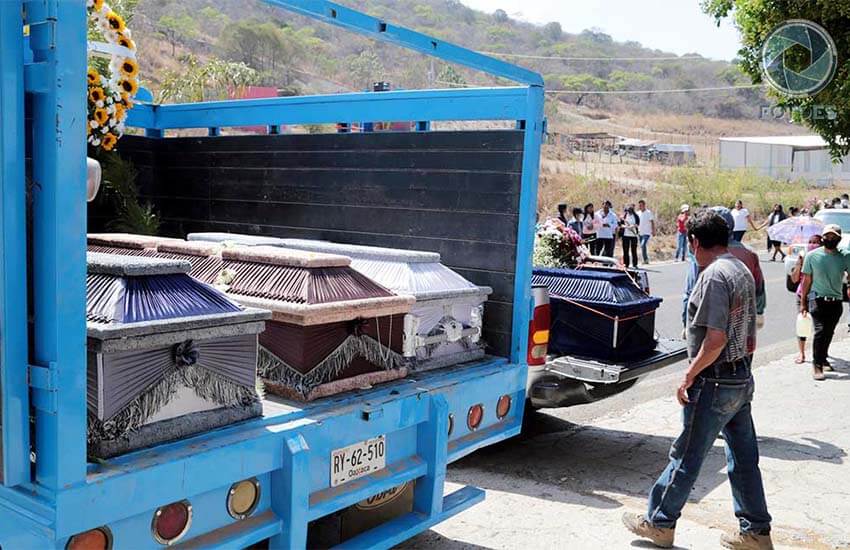
A funeral procession in Sola de Vega in April after armed conflict erupted between residents in rival municipalities.

President López Obrador addressed the dispute during his morning news conference in Oaxaca city on Monday. The inhabitants of San Vicente “don’t want the work to conclude,” he said. In June, he visited the municipality on a tour of infrastructure projects in the area and promised to help resolve the conflict in exchange for residents lifting a blockade on another construction project — the Oaxaca-Isthmus highway, Reforma reported at the time.   

“I have already met with them. They acted well and we reached an agreement to find a solution, but the problem is not the road but an agrarian issue, a conflict about the limits of Sola de Vega and San Vicente Coatlán, which comes from a long time ago,” López Obrador said. 

He asserted that, depending on their goodwill and good faith, the stretch would be finished in December, and the highway inaugurated in August 2022. 

The 20-year-old project has seen presidents come and go: Vicente Fox, Felipe Calderón and Enrique Peña Nieto all failed to fulfill their promises to complete it.

Sola de Vega’s inhabitants share their neighbors’ tendency to take matters into their own hands. In January, residents put a rope around the neck of their mayor, Esaú Núñez, and threatened to hang him, arguing that he was corrupt and did nothing for the community. 

With reports from Proceso 

Palliative care hospice for children with cancer is first in Mexico

0
An event organized by the foundation for children with cancer.
An event organized by the Antes de Partir foundation for children with cancer.

The first palliative care hospice in Mexico for children with cancer has opened in Mexico City.

Casa Colibrí, or Hummingbird House, was officially inaugurated by the British Ambassador to Mexico, Jon Benjamin, and Mariana Hernández, the founder of the Antes de Partir (Before Departing) foundation.

Located in Gustavo A. Madero in the northeast of the city, the hospice has ​​eight rooms decorated with different themes, a palliative care clinic, a playroom, kitchen, dining room and terrace.

Childhood cancer is a serious health problem in Mexico: it is the first cause of death by illness for children from 5-14, and kills more than 2,000 children a year, according to figures from the National Center for the Health of Children and Adolescents (Censia).

More than 20,000 children live with a terminal illness, of whom 80% do not have access to drugs for palliative care or psychological care for the final stages of their lives, the foundation said.

As a result, “16,000 minors die annually with great physical pain, symptoms associated with terminal illness and psychological suffering.” It added that only a few public health institutions in Mexico provide similar services.

Hernández said every day should be valued for a child in care. “Before Departing has a philosophy of life that invites you, whether you are a healthy person or with a disease, to live day by day in the best way. We are aware that sooner or later we will no longer be here, but until that moment arrives, we have the commitment to laugh, and to enjoy life to the fullest and it is precisely what we try to convey to both patients and their families,” she said. 

Antes de Partir says it has helped 330 children and more than 2,300 parents through courses, workshops and conferences. It offers services in medical and psychological care, funerals, and helps families with food and transportation. 

The foundation’s sponsors include the Gonzalo Río Arronte Foundation, Qualitas Insurance, IENOVA Foundation, Home Depot and Prevex Insurance. 

Mexico News Daily

Opponents of projects in Oaxaca’s Isthmus will fight AMLO’s fast-tracking decree

0
A 2019 protest against projects in the Isthmus.

Two environmental activists in the Isthmus of Tehuantepec region of Oaxaca have denounced the presidential decree that fast-tracks government infrastructure projects and protects them from scrutiny and legal challenges.

Published in the government’s official gazette last week, the decree shields from scrutiny the construction of infrastructure projects in a wide range of sectors by declaring them pertinent to national security.

Two environmental group leaders who spoke with the newspaper El Universal asserted they won’t stand by and allow the decree to violate their rights.

The government is building a trade corridor across the Isthmus of Tehuantepec, a project that includes construction of a new highway and gas pipeline, modernization of the existing railroad and upgrades to the ports in Salina Cruz, Oaxaca, and Coatzacoalcos, Veracruz.

The project faces considerable opposition from environmental and indigenous rights groups.

Miguel Ángel García Aguirre, regional coordinator of the National Committee for the Defense and Conservation of Los Chimalapas Forest, said the decree uses similar language to that used by “repressive” former president Gustavo Díaz Ordaz, who was in office when the armed forces carried out the Tlatelolco massacre of students in Mexico City.

He warned that individual rights could be threatened by the decree, which allows the federal government to avoid having its projects halted by injunctions and other legal instruments.

García said the decree – which he described as “terrible and dangerous” – will be met with “very strong indigenous resistance” in the Isthmus region because it opens the door to possible human rights violations, including repression, against people protesting infrastructure projects.

Betina Cruz Velázquez, a representative for the People’s Assembly for the Defense of Land and Territory in the Isthmus, said the decree will remove the obligation for environmental impact assessments to be carried out before infrastructure projects break ground. The removal of that requirement –  due to the fast-tracking aspect of the decree – is in violation of the constitution and international agreements to which Mexico is party, she charged.

The decree tramples on indigenous people’s rights, Cruz said, adding that the group she represents is preparing to take legal action against it. The goal, she said, is to block “authoritarian policies” that threaten people’s freedoms.

The government intends to invest more than 10 billion pesos (US $465 million) in the trade corridor next year, and activists fear that the use of that money won’t be transparent as a result of the presidential decree. Several consultation processes on projects in the Isthmus haven’t been completed, and there are concerns that the government will go ahead with work before they are finished.

“We think [the decree] is grave for the indigenous communities,” said Irma Pineda Santiago, Mexico’s representative to the United Nations Permanent Forum on Indigenous Issues.

“There is a risk that free, prior and informed consultations will be omitted, which would violate human and environmental rights, and the right to consultation,” she said.

With reports from El Universal 

US officials say Mexico is once again providing visas to drug enforcement agents

0
dea
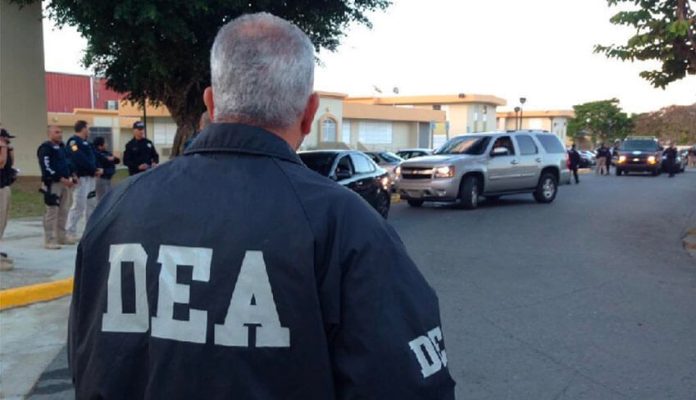
DEA agents are working in Mexico again, US officials said.

The federal government is once again issuing visas that allow United States Drug Enforcement Administration (DEA) agents to work in Mexico, a U.S. official said Tuesday.

Broadcaster CNN reported almost two months ago that Mexico had not processed visa applications for 24 DEA agents this year.

Anonymous White House officials told CNN that the 24 agents had been waiting for more than six months for their visas to be issued.

The process normally took just a month, but Mexico enacted a law in January that restricts and regulates the activities of foreign agents in Mexico. The long waits for visas appeared to be related to the promulgation of that legislation.

Todd Robinson, assistant secretary of state for the Bureau of International Narcotics and Law Enforcement Affairs, told a hearing of the United States Senate Committee on Foreign Relations that the Mexican government “just agreed to more visas for DEA agents in Mexico.”

He also said that U.S. authorities are working “very closely” with the Mexican government on security issues.

“They have agreed with us on an accord that lists a number of things we’re going to do, including greater cooperation on intel exchange,” Robinson said.

“… One of the aspects that we miss, that is not as public, is the great work we do … with state and local governments in Mexico. They clamor for greater opportunities to cooperate and collaborate with us on security issues, on equipment, on training, so we are trying to keep up with the demand,” he added.

“The last thing I would say is we have some work to do at home on this issue as well. If we can’t get a handle on the demand side for these drugs—” Robinson said before being cut off by a senator.

His revelation that Mexico was issuing new visas for DEA agents came after the agency’s chief, Anne Milgram, requested in October the reactivation of joint anti-narcotics operations and greater sharing of intelligence.

Matthew Donahue, deputy chief of operations for the DEA, said in May that joint efforts to combat drug cartels in Mexico had broken down due to a collapse in trust and cooperation between law enforcement forces and the militaries in the two countries.

“They themselves are too afraid to even engage with us because of repercussions from their own government if they get caught working with the DEA,” he said.

The breakdown in bilateral security relations could be traced back to the United States’ arrest of former defense minister Salvador Cienfuegos in October 2020 on drug trafficking and money laundering charges. The arrest of the ex-army chief — whom the United States subsequently returned to Mexico under pressure from Mexican authorities — occurred without the U.S. first notifying Mexico, a slight that led the federal government to express “profound discontent” to its counterpart north of the border.

Security relations have improved considerably since then. The two countries have sought to reset their relationship after U.S. President Joe Biden took office in January, and they announced a new agreement encompassing security after top officials held bilateral talks in Mexico City on October 8.

In the “bicentennial framework for security, public health, and safe communities,” the two countries pledged to work together to combat the trafficking of drugs and weapons.

The leaders of Mexico, the United States and Canada subsequently acknowledged that more needs to be done to combat drug trafficking and gunrunning.

“To address these issues, and protect our communities from harms emerging from the global illegal drug environment and firearms trafficking facing North America, we need a collective, coordinated approach,” President López Obrador, President Biden and Prime Minister Trudeau said in a joint statement after the North American Leaders Summit in Washington D.C. last month.

“We commit to continue addressing these issues via venues like the North American Drug Dialogue in 2022 and beyond,” they said.

With reports from Reforma 

Highline walker breaks records crossing 800-meter-high Chiapas canyon

0
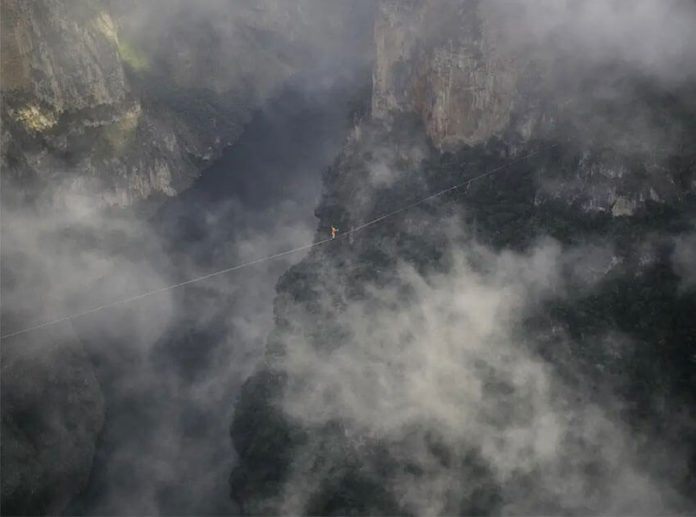
Highline walker Alexander Schulz high above the Sumidero Canyon on Tuesday.

A German highline walker broke two world records on Tuesday with an aerial crossing of the Sumidero Canyon in Chiapas while blindfolded. 

Alexander Schulz, 30, began the tense 800-meter high crossing on the north side of the canyon near the community of El Triunfo at 8:00 a.m., slowly walking the 1,720-meter-long band in 4,080 steps.

When he arrived at the Los Chiapa viewpoint on the other side an hour and a quarter later, Governor Rutilio Escandón Cadenas was there to receive him. 

Schulz is the sport’s standout figure and already held a long list of world records before his latest feat, which was organized by the state Tourism Ministry. He has broken records without a harness but he wore one for the Chiapas event.

After achieving the feat, Schulz admitted to some nerves. “The past two weeks have been a roller coaster ride of emotions. Sleepless nights of stress, excitement, fears and doubts, throwbacks and again sleepless nights … But today in the morning we completed a project that we had planned … for over two years,” he wrote on his Instagram page.

On Facebook he wrote that the canyon crossing was the climax of his career.

The Bavarian daredevil isn’t an easy man to frighten. In December 2016, he broke highline records in urban surroundings in Mexico City, crossing between the Reforma Tower and the BBVA Bancomer Tower over Reforma Avenue at a height of 230 meters.

In April 2020, he crossed an active volcano on the south sea island of Tanna, Vanuatu.

Highline is a sport that tests the balance of its brave practitioners. Amateurs suspend a band between two anchor points, usually trees, and tighten it before jumping on and trying to walk across. 

With reports from Milenio and TV Azteca

Sinaloa Cartel’s internal dispute extends into Sonora, Baja California

0
Los Chapitos
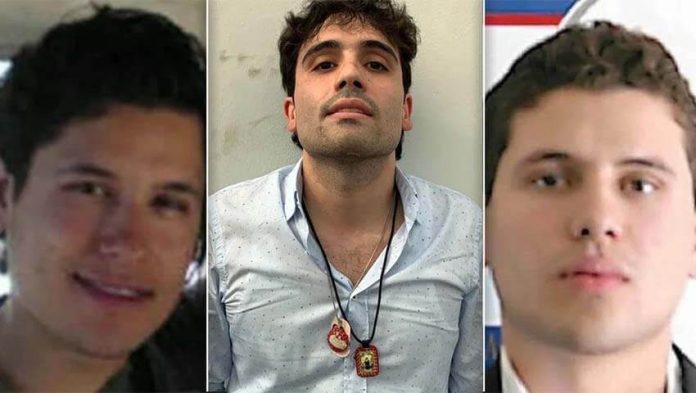
Los Chapitos, a Sinaloa Cartel cell, is run by sons of the cartel's ex-leader, Joaquín 'El Chapo' Guzmán.

A dispute between competing cells of the Sinaloa Cartel has spread beyond the borders of the criminal organization’s home state, according to federal officials.

Unnamed officials cited by the newspaper Milenio said a dispute between Los Rusos and Los Chapitos has extended into states such as Sonora and Baja California.

Los Rusos, led by Jesús Alexander Sánchez Félix, is affiliated with the Sinaloa Cartel’s top leader, Ismael “El Mayo” Zambada.

Los Chapitos is headed by the sons of former Sinaloa Cartel leader Joaquín “El Chapo” Guzmán, who was sentenced to life imprisonment in the United States in July 2019.

Iván Archivaldo Guzmán Salazar, known as El Chapito, and his brother Alfredo are notorious for acts of violence they have ordered or perpetrated. Ovidio Guzmán, El Ratón (The Mouse), is the least violent brother and maintains a low profile, Milenio said.

Sinaloa Cartel weapons found in Baja California
Weapons found at a crime scene in Baja California that authorities said belonged to Sinaloa Cartel members. Baja California Attorney General’s Office

The federal officials told the newspaper that Sánchez Félix, known as El Ruso (The Russian), led the “rescue” of Ovidio Guzmán when he was arrested in Culiacán in October 2019, triggering a vicious cartel response.

But Los Rusos and Los Chapitos are no longer on good terms. According to Milenio, the power Sánchez Félix wields within the cartel – he is considered El Mayo’s chief operator – angered Los Chapitos and caused a rupture between the two cells. Los Chapitos want a bigger share of the cartel’s criminal activities for themselves.

The federal officials told Milenio there is evidence that Zambada ordered Los Rusos to leave Sinaloa to avoid a turf war in that state, but they are now fighting Los Chapitos in Sonora and Baja California. The officials said Los Rusos have taken charge of the Sinaloa Cartel’s main criminal activities in the two border states, whereas people affiliated with El Chapo and Los Chapitos were formerly in control.

Meanwhile, Los Chapitos have started to lose the sympathy of Sinaloa residents due to acts of violence they have committed against cartel members and ordinary people, the federal sources said. Such violence didn’t occur when El Chapo was in charge, although the crime group did clash with rivals and government security forces, the officials told Milenio.

Murders of cartel members in Sinaloa in recent months were the result of a purge carried out by Los Chapitos, they also said.

The same cell has also recently clashed with an organization led by Fausto Isidro Meza, a one-time leader of the Beltrán-Leyva Organization known as El Chapo Isidro. Milenio said gunfights have occurred in the northern Sinaloa municipalities of Guasave and Sinaloa de Leyva.

In addition, Los Chapitos have clashed with another criminal group in Badiraguato, Sinaloa, the municipality where El Chapo was born. That dispute is over drug trafficking routes into Chihuahua, Milenio said.

With reports from Milenio